Loading...
Otto von Bismarck vs Yuan Shikai
Otto von Bismarck leads by 5.8 pts · 2 figures compared
…
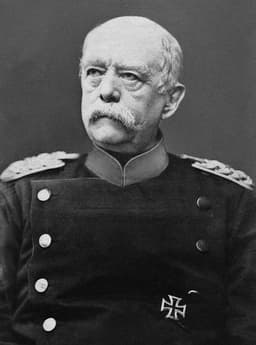
Otto von Bismarck
Politician · Modern
65.8Total
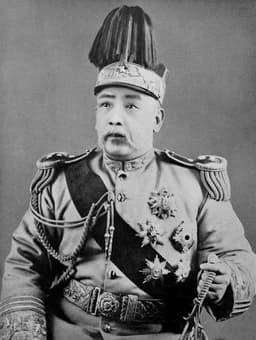
Yuan Shikai
Politician · Modern
60.0Total
Basic Information
Born
1815
1859
Died
1898
1916
Era
Modern
Modern
Nationality
Germany
China
Occupation
Politician
Politician
Civilization
Western
Eastern
Score Comparison
Military (10%)
55.0
45.0
Political (20%)
85.0
72.0
Influence (20%)
82.0
57.2
Legacy (20%)
40.0
54.0
Leadership (15%)
80.0
72.0
Strategy (15%)
50.0
61.2
TOTAL
65.8
60.0
Otto von Bismarck — Complete Timeline
1870 AD
Franco-Prussian WarWar
Bismarck provoked France into declaring war by editing the Ems Dispatch to appear insulting. The resulting conflict saw Prussia and its allies decisively defeat France, leading to the fall of Napoleon III, the capture of Paris, and the annexation of Alsace-Lorraine.
WarProvocationAnnexation
Impact: globaldestructive
1871 AD
Unification of Germany ProclaimedPolitical Action
Following the Franco-Prussian War, Bismarck orchestrated the proclamation of the German Empire in the Hall of Mirrors at Versailles. King Wilhelm I of Prussia was declared German Emperor, uniting the German states under Prussian leadership and establishing the Second Reich.
UnificationGerman EmpireNationalism
Impact: globalconstructive
1878 AD
Enactment of the Anti-Socialist LawsPolitical Action◆ Major
After two assassination attempts on Kaiser Wilhelm I, Bismarck pushed through laws banning socialist organizations, publications, and meetings. The laws remained in force until 1890, suppressing the Social Democratic Party while Bismarck simultaneously introduced welfare reforms to undercut its appeal.
RepressionSocialismWelfare State
Impact: nationaldestructive
Congress of BerlinPolitical Action◆ Major
Bismarck hosted the Congress of Berlin to revise the Treaty of San Stefano and resolve the Eastern Crisis. He acted as 'honest broker,' reducing Russian gains, granting independence to Romania, Serbia, and Montenegro, and placing Bosnia-Herzegovina under Austro-Hungarian administration.
DiplomacyBalkansBalance of Power
Impact: global
1883 AD
Establishment of the Welfare StateReform◆ Major
Bismarck introduced the Health Insurance Bill (1883), Accident Insurance Bill (1884), and Old Age and Disability Insurance Bill (1889). These laws created the first modern welfare state, providing workers with social security and aiming to reduce support for socialist movements.
Social ReformWelfareInsurance
Impact: globalprogressive
1890 AD
Dismissal as ChancellorPolitical Action◆ Major
Emperor Wilhelm II forced Bismarck to resign due to policy disagreements, particularly over anti-socialist laws and foreign policy. Bismarck's departure marked the end of an era, leading to a more aggressive German foreign policy and the eventual unraveling of his alliance system.
ResignationWilhelm IIPolicy Shift
Impact: global
Yuan Shikai — Complete Timeline
1901 AD
Command of the Beiyang ArmyReform◆ Major
Yuan Shikai took command of the Beiyang Army, the most modern military force in late Qing China. He expanded and trained the army, which became the basis for his political power and later dominated Chinese politics.
Military reformBeiyang Army
Impact: national
1912 AD
Appointed First President of the Republic of ChinaPolitical Action
Yuan Shikai became the first president of the Republic of China after negotiating the abdication of the Qing emperor. He used his control of the Beiyang Army to pressure the revolutionary government into accepting his leadership.
PresidencyRepublic of China
Impact: national
1915 AD
Declaration of the Empire of ChinaPolitical Action◆ Major
Yuan Shikai declared himself emperor of the Empire of China, attempting to restore the monarchy. This move sparked widespread opposition from provincial leaders and foreign powers, leading to the collapse of his regime.
Monarchy restorationPolitical crisis
Impact: nationaldestructive
Signing of the Twenty-One DemandsPolitical Action◆ Major
Yuan Shikai accepted most of Japan's Twenty-One Demands, which expanded Japanese influence in China. The agreement granted Japan economic rights in Manchuria and Shandong, and was seen as a national humiliation.
DiplomacyJapanese imperialism
Impact: globaltragic
1916 AD
Death and Collapse of the Beiyang GovernmentPolitical Action◆ Major
Yuan Shikai died of uremia, leaving no clear successor. His death led to the fragmentation of the Beiyang Army into warlord factions, plunging China into a period of civil war and political instability.
Warlord eraPolitical fragmentation
Impact: nationaltragic
Expert Analysis
Otto von Bismarck vs Yuan Shikai
# The Iron Chancellor and the Would-Be Emperor
On a spring morning in 1871, Otto von Bismarck stood in the Hall of Mirrors at Versailles, watching as German princes proclaimed Wilhelm I Emperor of a unified Germany. Forty-four years later, on a winter day in 1915, Yuan Shikai sat in the Forbidden City, preparing to declare himself emperor of a new Chinese dynasty. One succeeded beyond measure; the other failed catastrophically. Both men wielded immense power, commanded modern armies, and dreamed of forging nations from chaos. Why did Bismarck’s “blood and iron” build a lasting empire, while Yuan’s careful calculations crumbled into warlord anarchy?
Origins
Bismarck was born in 1815 into the Prussian Junker aristocracy, a class defined by land, tradition, and military service. His father was a country squire; his mother came from a bourgeois intellectual family. Young Otto studied law at Göttingen and Berlin, but he was no scholar—he drank, dueled, and earned a reputation as a wild, brilliant man. The revolutions of 1848, which swept across Europe and threatened monarchy itself, shaped his lifelong contempt for liberalism and democracy. He saw order as the highest virtue, and the Prussian king as its divinely appointed guardian.
Yuan Shikai, born in 1859, came from a very different world. His family were minor officials in Henan Province, part of the Confucian scholar-bureaucrat class that had governed China for two millennia. But the world of his ancestors was dying. The Opium Wars, the Taiping Rebellion, and the relentless pressure of Western imperialism had shattered China’s ancient certainties. Yuan failed the civil service examinations—the traditional path to power—and instead bought a minor military post. He was a pragmatist in an age that demanded nothing less.
Rise to Power
Bismarck’s ascent was swift and improbable. In 1862, King Wilhelm I of Prussia appointed him Minister President to resolve a constitutional crisis over military reform. The parliament refused funds; Bismarck simply collected taxes without their consent. “The great questions of the day,” he told the Prussian Diet, “will not be decided by speeches and majority resolutions—but by blood and iron.” He then engineered three wars—against Denmark (1864), Austria (1866), and France (1870)—each carefully limited, each brilliantly won. By 1871, he had unified Germany under Prussian leadership and become its first Chancellor.
Yuan’s path was slower but no less dramatic. In 1882, he went to Korea as a Chinese military advisor, suppressing a coup and earning a reputation for ruthless competence. The Boxer Rebellion of 1900 nearly destroyed him—he refused to obey the Empress Dowager’s order to attack foreign legations, correctly judging that the rebellion was doomed. By 1901, he commanded the Beiyang Army, the most modern military force in China. When the Qing dynasty collapsed in 1912, Yuan was the only man who could hold the country together. He negotiated the emperor’s abdication and became the first president of the Republic of China.
Leadership and Governance
Bismarck governed through a system of brilliant manipulation. He played political parties against each other, co-opted his enemies, and crushed those who could not be co-opted. His constitution gave the Chancellor immense power while preserving the monarchy’s authority. He made Germany the dominant power in Europe through the alliance system he crafted at the Congress of Berlin in 1878, acting as “honest broker” between the great powers. Domestically, he was a paradox: a conservative who created the modern welfare state. The Health Insurance Bill of 1883, the Accident Insurance Bill of 1884, and the Old Age and Disability Insurance of 1889 were designed to steal support from the socialists he simultaneously banned with the Anti-Socialist Laws of 1878. He gave workers security to keep them loyal to the state.
Yuan’s governance was more straightforward and more fragile. As president, he ruled by decree, relying on the Beiyang Army and a network of loyal officials. He crushed the Second Revolution of 1913, a rebellion by provincial governors who opposed his authoritarianism. But he lacked Bismarck’s institutional creativity. Instead of building a lasting system, he tried to restore the monarchy—with himself as emperor. In 1915, he declared the Empire of China. The response was immediate and devastating: widespread rebellion, foreign condemnation, and the collapse of his authority.
Triumph and Tragedy
Bismarck’s greatest triumph was the unification of Germany itself. The Franco-Prussian War, which he provoked by editing the Ems Dispatch to appear insulting to France, was a masterpiece of diplomatic provocation. The German victory was swift, the peace terms harsh—France lost Alsace-Lorraine and paid a huge indemnity. But Bismarck’s tragedy came from his success. After his dismissal by Kaiser Wilhelm II in 1890, the young emperor dismantled Bismarck’s careful alliance system, and within a generation, Europe plunged into the First World War. The Iron Chancellor had built a machine that no one else could control.
Yuan’s tragedy was more personal and more complete. His greatest achievement—the peaceful abdication of the Qing emperor and the establishment of the Republic—was undone by his own ambition. The Twenty-One Demands he accepted from Japan in 1915, granting Tokyo extensive economic and political control over China, destroyed his nationalist credentials. When he died of uremia in 1916, the Beiyang Army fragmented into warlord factions. China descended into a decade of chaos.
Character and Destiny
Bismarck was a man of immense will and calculation. He once said, “A statesman cannot create anything himself. He must wait and listen until he hears the steps of God sounding through events—then leap up and grasp the hem of His garment.” He believed in timing, in patience, in knowing when to strike and when to wait. His personality was domineering, his temper legendary, but he knew his limits. He never tried to become king or emperor; he was content to be the power behind the throne.
Yuan Shikai was equally ambitious but less wise. He saw power as something to be accumulated, not channeled. He modernized China’s army but not its politics. He crushed his enemies but built no lasting institutions. His attempt to become emperor revealed a fundamental misunderstanding of his era—the Chinese Revolution of 1911 had destroyed the Mandate of Heaven, and no amount of military force could restore it. Bismarck understood that legitimacy comes from results; Yuan believed it came from titles.
Legacy
Bismarck’s legacy is written across Europe. The German welfare state he created still exists. The nation he unified became the continent’s dominant power. But his methods—war, manipulation, authoritarianism—left a dangerous precedent. “The statesman’s task is to hear the steps of God,” he said, but the steps he heard led eventually to the trenches of the Somme.
Yuan Shikai’s legacy is more ambiguous. In China, he is remembered as a traitor who sold out the nation to Japan and tried to restore the monarchy. But historians recognize his role in modernizing China’s military and in achieving the peaceful transition from empire to republic. His failure taught later Chinese leaders—Sun Yat-sen, Chiang Kai-shek, Mao Zedong—that power must be rooted in institutions, not personalities.
Conclusion
In the end, the difference between Bismarck and Yuan Shikai is the difference between building a house and building a sandcastle. Both men had power, ambition, and skill. But Bismarck understood that power must be institutionalized—embedded in laws, alliances, and social programs—while Yuan believed that power was personal, something to be worn like a crown. One created a nation that lasted; the other created a vacuum that warlords filled. The Iron Chancellor’s Germany survived his dismissal; the Would-Be Emperor’s China collapsed at his death. History judges not by intentions but by what endures.
Rankings
🥇
Otto von BismarckLeader
Mil: 55.0Pol: 85.0Inf: 82.0
65.8
🥈
Yuan Shikai
Mil: 45.0Pol: 72.0Inf: 57.2
60.0
+5.8 behind
How This Comparison Works
Algorithm
Each figure is scored on 6 dimensions (0—100 scale) based on structured historical data: Military (10%), Political (20%), Influence (20%), Legacy (20%), Leadership (15%), Strategy (15%). The weighted total produces the final ranking.
Data Sources
Scores are computed from structured sub-indicators in the database. Scale factors adjust for era (Ancient ×0.85, Modern ×1.0) and civilization size (Eastern ×1.05, Other ×0.80) to account for differences in population and military scale.
Maximum 3 Figures
Comparisons are limited to 2—3 figures to ensure readability and statistical meaningfulness.
Error Margins
±5 points per dimension — Sub-scores are derived from historical records with inherent uncertainty. Two figures within 5 points on a dimension should be considered roughly equivalent in that area.
Total Score Accuracy
±3 points overall — The weighted combination of 6 dimensions produces a total score with approximately ±3 points of uncertainty. Differences of less than 3 points are not statistically significant— the figures are effectively tied.
Known Limitations
- Historical records are incomplete and uneven across civilizations
- Figures from oral-tradition societies may be underrepresented
- Occupation labels can misclassify multi-role figures
- Scores measure capability and impact, not moral character
- Quantitative scoring is a comparison tool, not absolute truth
Capability Radar
Military (10%) — Battles & Warfare
Battles
60
45
Win Rate
70
55
Expansion
80
50
Political (20%) — Governance & Reform
Reform
90
55
Diplomacy
95
70
Economy
80
50
Influence (20%) — Cultural & Global Reach
Cultural
65
40
Global
75
35
Legacy (20%) — Historical Impact
Historical
85
65
Longevity
70
40
Leadership (15%) — Power & Stability
Tenure
85
60
Stability
70
30
Strategy (15%) — Tactics & Innovation
Strategy
85
65
Tactics
55
60
Reform
75
80
Similar Comparisons
Comments & Discussion
铁血判官6/16/2026
俾斯麦统一德国靠的是战略耐心和外交算计,而袁世凯称帝是彻头彻尾的妄自尊大。别拿“强人政治”混淆视听——俾斯麦至少尊重权力制衡和法律框架,袁连国会都当摆设。一个把普鲁士变成了帝国,一个把民国变成了笑话。历史判断很简单:成功不是偶然,失败也不是冤枉。
StatisticalRealist6/16/2026
Nostalgia for Bismarck misses the point: his Reich barely survived 50 years and collapsed into the worst war Europe had ever seen. At least Yuan’s failure was immediate and contained. The Iron Chancellor’s “lasting empire” was a brittle patchwork of Prussian domination, secret treaties, and military brinkmanship that shattered in 1914. If success means building something that lasts, neither man succeeded. One just took longer to fail.
史书老饕6/16/2026
说俾斯麦比袁世凯“更高明”的人,恐怕只读过西方史。袁在甲午战争后一手训练新军、推动近代化改革,手腕和眼光绝不逊色。他输的不是能力,是时代的潮向——1915年的中国已经不可能接受皇帝了。俾斯麦遇到的德意志,是各邦国对统一的渴望;袁世凯面对的,是刚刚革命过的四亿人。位置不同,结局自然不同。
UselessContrarian6/16/2026
Everyone romanticizes Bismarck’s “realism,” but what he called realpolitik was just aggressive opportunism dressed up in conservative clothes. Yuan at least understood power had to be negotiated with local elites—something Bismarck’s monocle-and-saber crowd could never grasp. The German Empire was built on Prussian bullying; Yuan tried to build on silver and patronage. Both were doomed to fail their nations, just in different ways and different centuries.
PercentileProf6/16/2026
Bismarck was a genius of statecraft who built a durable German Empire through precise diplomatic timing and constitutional craftsmanship. Yuan was a dynastic pretender who mistook military coercion for political legitimacy. The difference isn’t tactics—it’s that Bismarck understood public opinion and nationalism, while Yuan tried to resurrect imperial monarchy by buying generals. One gave Germany stability for decades; the other left China in warlord chaos within months. Blood and iron only work