Loading...
Nguyen Cao Ky vs Sitiveni Rabuka
Sitiveni Rabuka leads by 2.7 pts · 2 figures compared
…
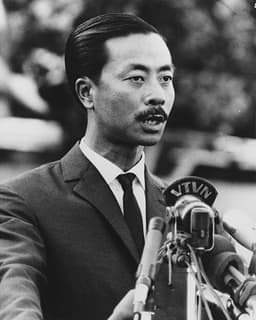
Nguyen Cao Ky
General · Modern
49.0Total
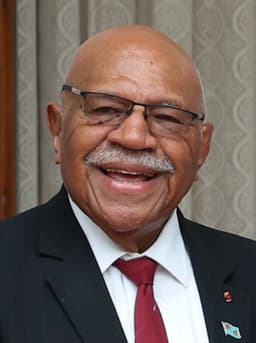
Sitiveni Rabuka
General · Modern
51.7Total
Basic Information
Born
1930
1948
Died
—
—
Era
Modern
Modern
Nationality
Vietnam
Fiji
Occupation
General
General
Civilization
Eastern
Other
Score Comparison
Military (10%)
45.0
10.2
Political (20%)
39.4
60.0
Influence (20%)
50.2
53.3
Legacy (20%)
40.0
46.7
Leadership (15%)
67.0
85.0
Strategy (15%)
60.0
39.6
TOTAL
49.0
51.7
Nguyen Cao Ky — Complete Timeline
1963 AD
Commander of South Vietnamese Air ForcePolitical Action◆ Major
Nguyen Cao Ky was appointed commander of the Republic of Vietnam Air Force. He led the air force during the Buddhist crisis and participated in the coup that overthrew President Ngo Dinh Diem.
Air ForceCoupDiem
Impact: national
1965 AD
Appointed Prime MinisterPolitical Action◆ Major
Nguyen Cao Ky became Prime Minister of South Vietnam, leading a military junta. His government intensified the war against the Viet Cong and North Vietnam, with strong US support.
Prime MinisterMilitary juntaVietnam War
Impact: national
1967 AD
Conflict with President ThieuPolitical Action
Nguyen Cao Ky ran for president but lost to Nguyen Van Thieu, becoming vice president. The two leaders had a tense relationship, with Ky later accusing Thieu of corruption and mismanagement of the war.
ElectionThieuRivalry
Impact: nationaldestructive
1975 AD
Exile after fall of SaigonPolitical Action◆ Major
Nguyen Cao Ky fled South Vietnam as Saigon fell to North Vietnamese forces. He settled in the United States, where he became a critic of the communist government and later returned to Vietnam for visits.
ExileFall of SaigonVietnam War
Impact: nationaltragic
Sitiveni Rabuka — Complete Timeline
1987 AD
1987 Fijian Coup d'étatPolitical Action
Rabuka, as a colonel in the Fijian military, led a coup overthrowing the elected government of Timoci Bavadra. The coup was motivated by ethnic Fijian opposition to Indo-Fijian political influence. Rabuka declared Fiji a republic.
CoupMilitary InterventionEthnic Tension
Impact: nationaldestructive
1992 AD
1992 Election as Prime MinisterPolitical Action◆ Major
Rabuka transitioned from military leader to civilian politician, winning the 1992 general election as leader of the Fijian Political Party. He became Prime Minister, serving until 1999.
ElectionCivilian GovernmentPolitical Transition
Impact: national
1997 AD
1997 Constitution ReformReform◆ Major
Rabuka's government oversaw the adoption of a new constitution that removed ethnic-based voting and provided for a multi-ethnic government. The constitution aimed to reduce ethnic tensions and promote national unity.
ConstitutionReformEthnic Reconciliation
Impact: nationalconstructive
1999 AD
1999 General Election DefeatPolitical Action◆ Major
Rabuka's government was defeated in the general election by the Labour Party led by Mahendra Chaudhry. Rabuka stepped down as Prime Minister, marking the end of his first period in power.
Election DefeatGovernment ChangeChaudhry
Impact: national
2022 AD
2022 Return as Prime MinisterPolitical Action◆ Major
Rabuka led the People's Alliance to victory in the 2022 general election, forming a coalition government. He became Prime Minister again, 23 years after his previous tenure, promising democratic reforms.
ElectionReturn to PowerCoalition Government
Impact: national
Expert Analysis
Sitiveni Rabuka vs Nguyen Cao Ky
### The General Who Became the Prime Minister: Two Paths from the Barracks
The scene could not have been more different. In Saigon, 1965, a 34-year-old air force commander in a tailored black flight suit, a pearl-handled revolver holstered at his hip, stood before the world’s press. Nguyen Cao Ky was the new prime minister of South Vietnam, a man who seemed to have stepped out of a propaganda poster for the war itself. Across the Pacific, in Suva, Fiji, twenty-two years later, a tall, soft-spoken colonel named Sitiveni Rabuka, dressed in the crisp uniform of a soldier, announced on national radio that he had overthrown his country's elected government. He was 39. Both men were generals who seized political power in times of national crisis. Yet their stories diverged so sharply that they illuminate a profound truth about history: the same starting point—a military uniform and a coup—can lead to radically different destinations, determined not by fate, but by character, context, and the will to change.
### Origins: The Making of a Warrior and a Coup Maker
Nguyen Cao Ky was born in 1930 in Son Tay, a province north of Hanoi, into a landowning family. The French colonial system shaped his early life, and he chose a military career, training at the French-run Da Lat Military Academy. He was, by all accounts, a dashing figure—a pilot who loved speed, risk, and the unmistakable glamour of a fighter ace. The Vietnam War, in its early stages, was a conflict of ideologies, but for Ky, it was a personal crusade. He saw himself as a modern warrior battling communism, and his air force, with its American-supplied planes, was the most potent symbol of South Vietnamese sovereignty.
Sitiveni Rabuka, born in 1948, came from a very different world. He was the son of a Fijian Methodist minister from the village of Nakobo on Vanua Levu. His upbringing was humble, steeped in the communal values of indigenous Fijian culture and the strict discipline of his faith. He joined the Royal Fiji Military Forces and rose through the ranks, serving with distinction in United Nations peacekeeping missions in Lebanon and the Sinai. For Rabuka, the military was a profession, not a calling for glory. The crisis that pushed him into politics was not a global ideological war, but a local, ethnic one: the 1987 election of a coalition government led by Timoci Bavadra, an ethnic Indian Fijian, which indigenous Fijian nationalists saw as a threat to their land and power.
### Rise to Power: The Coup and the Vote
Ky’s rise was swift and violent. In 1963, he was appointed commander of the South Vietnamese Air Force after a coup that overthrew President Ngo Dinh Diem. He became a kingmaker, a man whose planes could decide the fate of governments. In 1965, amidst political chaos and military setbacks against the Viet Cong, a junta of generals asked him to become prime minister. He accepted. His power rested on the barrel of a gun and the patronage of Washington. He was a warlord in a suit, governing by decree, his authority fragile and constantly challenged.
Rabuka’s rise was a single, decisive act. On May 14, 1987, he led a bloodless coup, marching ten soldiers into parliament and arresting the prime minister. He was not a politician seeking power, but a colonel acting to protect what he saw as the indigenous Fijian birthright. He then did something extraordinary: he handed power back to the Governor-General, who appointed an interim civilian government. Rabuka staged a second coup later that year when negotiations faltered, but he did not cling to military rule. Instead, he resigned his commission, formed a political party, and in 1992, won the general election. He had transformed himself from a coup leader into a prime minister by the will of the people.
### Leadership & Governance: The Dictator and the Democrat
As prime minister, Ky governed with a heavy hand. He intensified the war against the North, relied on American support, and suppressed dissent. His regime was marked by corruption, instability, and a constant struggle for power among rival generals. He was a man of action, not of policy, and his “leadership” was often a euphemism for brute force. His political score of 60.2 reflects this: he ruled, but he did not govern.
Rabuka’s governance was a study in evolution. His first term (1992-1999) was marked by tension. He had come to power on a platform of indigenous supremacy, but he soon realized that Fiji could not be a prosperous nation if it excluded its Indo-Fijian population. This was his turning point. In a remarkable act of political wisdom, he pushed through the 1997 Constitution, which removed ethnic-based voting and created a multi-racial democracy. He was a man who learned from his mistakes. He lost the 1999 election peacefully, accepted defeat, and returned to private life. Then, in 2022, at the age of 74, he returned as prime minister, leading a coalition government. His political score of 72.0 is a testament to a man who grew into a statesman.
### Triumph & Tragedy: The Fall and the Return
Ky’s greatest moment was also his most tragic. In 1967, he ran for president but lost to his rival, Nguyen Van Thieu. He became vice president, a powerless figure in a government he had once led. The war ground on, and in 1975, as Saigon fell, Ky fled in a helicopter, leaving his country behind. He lived the rest of his life in exile in the United States, a bitter and controversial figure. His legacy is a score of 56.0—a reminder of a leader who failed his nation.
Rabuka’s triumph was his transformation. His 1997 Constitution was a masterpiece of compromise, and it held. He was defeated in 1999, but his legacy was secure. Then, in 2022, he returned, a grandfatherly figure who had once been a coup leader, now a champion of democracy. His legacy is a score of 61.2, but it is a legacy of redemption. He is remembered not for the coup, but for the peace he built.
### Character & Destiny: The Man Who Couldn’t Change and the Man Who Did
The difference between Ky and Rabuka is ultimately a difference of character. Ky was a man of the past, trapped by his own image. He was the “black knight” of the Vietnam War, a figure of bravado and defiance, but he could not adapt. He could not see that the war was unwinnable, that his country was being destroyed, and that his own power was a mirage. He was a tragic figure, a man of action who lacked the wisdom to know when to stop.
Rabuka, by contrast, was a man who could change. He admitted his mistake. He once said, “I am a product of my upbringing, but I am not a prisoner of it.” He had the courage to embrace multiculturalism, to apologize to the Indo-Fijian community, and to walk the long road from colonel to democrat. His leadership score of 77.4, higher than Ky’s 76.3, reflects not his skill in battle, but his skill in governing himself.
### Legacy: The Coup That Failed and the Coup That Succeeded
Nguyen Cao Ky is a footnote in the history of the Vietnam War, a symbol of a failed regime. In Vietnam, he is largely forgotten; in the West, he is remembered as a colorful but tragic figure. His legacy is a warning about the limits of military power.
Sitiveni Rabuka is a living legend in Fiji. He is the man who broke the cycle of coups. His 1987 coup was the first, but it was also the last for many years. He proved that a coup leader could become a democrat, that a nation could heal. His legacy is a lesson in redemption.
### Conclusion: The Two Paths
These two generals, born decades apart on opposite sides of the world, faced the same choice: cling to power or transform it. Ky chose the former and was destroyed. Rabuka chose the latter and was reborn. Their stories remind us that history is not a script written by fate, but a series of choices made by flawed men. The greatest weapon a leader can wield is not a gun, but the courage to change. And the most difficult coup to lead is the one against oneself.
Rankings
🥇
Sitiveni RabukaLeader
Mil: 10.2Pol: 60.0Inf: 53.3
51.7
🥈
Nguyen Cao Ky
Mil: 45.0Pol: 39.4Inf: 50.2
49.0
+2.7 behind
How This Comparison Works
Algorithm
Each figure is scored on 6 dimensions (0—100 scale) based on structured historical data: Military (10%), Political (20%), Influence (20%), Legacy (20%), Leadership (15%), Strategy (15%). The weighted total produces the final ranking.
Data Sources
Scores are computed from structured sub-indicators in the database. Scale factors adjust for era (Ancient ×0.85, Modern ×1.0) and civilization size (Eastern ×1.05, Other ×0.80) to account for differences in population and military scale.
Maximum 3 Figures
Comparisons are limited to 2—3 figures to ensure readability and statistical meaningfulness.
Error Margins
±5 points per dimension — Sub-scores are derived from historical records with inherent uncertainty. Two figures within 5 points on a dimension should be considered roughly equivalent in that area.
Total Score Accuracy
±3 points overall — The weighted combination of 6 dimensions produces a total score with approximately ±3 points of uncertainty. Differences of less than 3 points are not statistically significant— the figures are effectively tied.
Known Limitations
- Historical records are incomplete and uneven across civilizations
- Figures from oral-tradition societies may be underrepresented
- Occupation labels can misclassify multi-role figures
- Scores measure capability and impact, not moral character
- Quantitative scoring is a comparison tool, not absolute truth
Capability Radar
Military (10%) — Battles & Warfare
Battles
30
5
Win Rate
35
5
Expansion
10
5
Political (20%) — Governance & Reform
Reform
20
50
Diplomacy
25
45
Economy
15
40
Influence (20%) — Cultural & Global Reach
Cultural
15
30
Global
15
20
Legacy (20%) — Historical Impact
Historical
20
40
Longevity
10
30
Leadership (15%) — Power & Stability
Tenure
40
55
Stability
10
35
Strategy (15%) — Tactics & Innovation
Strategy
30
10
Tactics
40
10
Reform
25
5
Similar Comparisons
Comments & Discussion
Historian7996/16/2026
Rabuka's story proves that coup leaders can evolve, unlike Ky who remained a caricature of military bravado. Rabuka led Fiji's 1987 coup to protect indigenous rights, but later became a democratically elected PM in 1999 and again in 2022—a redemption arc that's rare. Ky, by contrast, never shed his flashy image; his pearl-handled revolver and black flight suit were symbols of a brittle regime propped up by US power. Ky's failure to adapt cost him, while Rabuka's willingness to embrace democracy