Loading...
Muhammadu Buhari vs Nguyen Cao Ky
Muhammadu Buhari leads by 2.5 pts · 2 figures compared
…
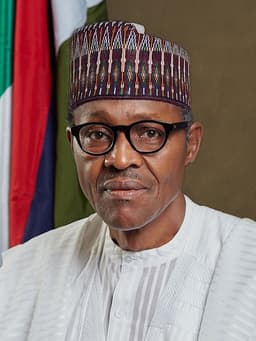
Muhammadu Buhari
General · Modern
51.5Total
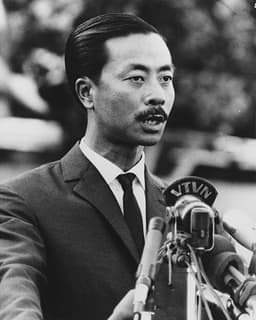
Nguyen Cao Ky
General · Modern
49.0Total
Basic Information
Born
1942
1930
Died
—
—
Era
Modern
Modern
Nationality
Nigeria
Vietnam
Occupation
General
General
Civilization
Other
Eastern
Score Comparison
Military (10%)
22.6
45.0
Political (20%)
68.0
39.4
Influence (20%)
53.3
50.2
Legacy (20%)
43.3
40.0
Leadership (15%)
72.0
67.0
Strategy (15%)
41.0
60.0
TOTAL
51.5
49.0
Muhammadu Buhari — Complete Timeline
1983 AD
1983 Nigerian coup d'étatPolitical Action
Major General Muhammadu Buhari led a military coup that overthrew the civilian government of President Shehu Shagari. Buhari cited corruption and economic mismanagement as justifications, and he became the head of state.
CoupMilitary RuleCorruption
Impact: nationaldestructive
1984 AD
War Against Indiscipline (WAI)Reform◆ Major
Buhari launched the War Against Indiscipline, a campaign to enforce discipline and order in Nigerian society. It included harsh penalties for minor offenses, such as queue-jumping, and was criticized for human rights abuses.
DisciplineSocial PolicyHuman Rights
Impact: nationaldestructive
1985 AD
Overthrow by Ibrahim BabangidaPolitical Action◆ Major
Buhari was overthrown in a palace coup led by his Chief of Army Staff, Ibrahim Babangida. Babangida cited Buhari's authoritarian style and failure to address the economy as reasons for the coup.
CoupOverthrowBabangida
Impact: national
2015 AD
Anti-corruption campaignReform◆ Major
Buhari launched a high-profile anti-corruption campaign, targeting government officials and recovering stolen assets. The campaign was praised internationally but criticized for being selective and politically motivated.
Anti-CorruptionReformGovernance
Impact: nationalconstructive
Election as President of NigeriaPolitical Action
Buhari won the 2015 Nigerian presidential election, defeating incumbent Goodluck Jonathan. This was the first time an opposition candidate had defeated a sitting president in Nigeria's history, marking a democratic milestone.
ElectionDemocracyOpposition Victory
Impact: nationalprogressive
Nguyen Cao Ky — Complete Timeline
1963 AD
Commander of South Vietnamese Air ForcePolitical Action◆ Major
Nguyen Cao Ky was appointed commander of the Republic of Vietnam Air Force. He led the air force during the Buddhist crisis and participated in the coup that overthrew President Ngo Dinh Diem.
Air ForceCoupDiem
Impact: national
1965 AD
Appointed Prime MinisterPolitical Action◆ Major
Nguyen Cao Ky became Prime Minister of South Vietnam, leading a military junta. His government intensified the war against the Viet Cong and North Vietnam, with strong US support.
Prime MinisterMilitary juntaVietnam War
Impact: national
1967 AD
Conflict with President ThieuPolitical Action
Nguyen Cao Ky ran for president but lost to Nguyen Van Thieu, becoming vice president. The two leaders had a tense relationship, with Ky later accusing Thieu of corruption and mismanagement of the war.
ElectionThieuRivalry
Impact: nationaldestructive
1975 AD
Exile after fall of SaigonPolitical Action◆ Major
Nguyen Cao Ky fled South Vietnam as Saigon fell to North Vietnamese forces. He settled in the United States, where he became a critic of the communist government and later returned to Vietnam for visits.
ExileFall of SaigonVietnam War
Impact: nationaltragic
Expert Analysis
Muhammadu Buhari vs Nguyen Cao Ky
The General’s Two Lives
On a September morning in 1967, a young man in a rakish flying suit and a purple scarf stepped onto a stage in Saigon, his pearl-handled revolver visible at his hip. Nguyen Cao Ky was running for president. Half a world away, in a dusty barrack in northern Nigeria, another general was sharpening his own ambitions, watching a civilian government crumble under the weight of corruption. Both men believed the sword could purify the state. One would lose his country, then reinvent himself as a critic of his own past. The other would lose power, wait three decades, and win it back at the ballot box. Their parallel journeys ask a haunting question: what makes a general’s rule end in exile, and what makes it end in redemption?
Origins
Nguyen Cao Ky was born in 1930 in Son Tay, a small town west of Hanoi, into a well-off landowning family. French colonial education shaped him, and he absorbed the crisp, efficient manners of the officer class. His Vietnam was a land of war and division, where loyalty shifted like monsoon winds. He trained as a pilot, a profession that demanded precision and nerve—qualities he displayed in abundance. By 1963, at age thirty-three, he was commander of the Republic of Vietnam Air Force, a position he owed to his daring and his willingness to fly missions against the Viet Cong.
Muhammadu Buhari, born in 1942 in Daura, northern Nigeria, came from a different soil. His father was a farmer, his family Fulani, a pastoral people with a deep sense of honor and hierarchy. He joined the Nigerian Army at eighteen and trained in Britain, India, and the United States. His Nigeria was a young nation, fragile and rich, already fractured by ethnic rivalry and military coups. Buhari was a quiet, stern man, known for his integrity in an institution that often lacked it. By 1983, he was a major general, commanding a division and watching his country bleed from civilian mismanagement.
The difference in their origins was not just geography. Ky grew up in a world of French colonial order and American money; Buhari in a world of British colonial discipline and post-independence chaos. Ky learned to fly high and fast; Buhari learned to march slow and steady.
Rise to Power
Ky’s rise was a coup d’état in miniature. In 1963, he led the air force’s support for a plot against President Ngo Dinh Diem—a murderous, chaotic affair that left Diem dead. Ky emerged as a key figure in the revolving-door military juntas that followed. By 1965, he was prime minister, at thirty-five, the youngest leader in South Vietnam’s history. His power rested on planes and pilots, not on any popular mandate. He ruled from a command post, his voice crackling over the radio as he ordered bombing runs against the Viet Cong.
Buhari’s rise was quieter, but no less decisive. On December 31, 1983, he led a coup that overthrew President Shehu Shagari, a civilian whose government had collapsed under the weight of oil-boom corruption. Buhari’s justification was simple: the politicians had failed, and the army must clean up. He became head of state, promising discipline, order, and a war against the rot. Unlike Ky, he did not fly into power; he marched.
The key difference lay in the nature of their nations. South Vietnam was a client state, dependent on American support. Ky’s rise was a product of Cold War patronage. Nigeria was an independent country, rich in oil and resentment. Buhari’s rise was a product of internal decay. Ky could not survive without Washington’s nod; Buhari answered only to his own generals.
Leadership & Governance
As prime minister, Ky governed with a flamboyant, authoritarian hand. He banned political parties, censored the press, and executed prisoners without trial. He also intensified the war, ordering massive bombing campaigns that killed thousands of civilians. Yet he was not a pure tyrant. He pursued land reform, built schools, and tried to stabilize a shattered economy. His military score of 61.8 and political score of 60.2 reflect a man who was competent but brutal, effective but isolated. His leadership score of 76.3 suggests he could command loyalty from his inner circle, but his strategy score of 65.0 reveals a man who could not win the war he fought.
Buhari’s governance was equally harsh, but differently targeted. In 1984, he launched the War Against Indiscipline (WAI), a campaign that punished lateness, littering, and queue-jumping with public humiliation and prison sentences. He also jailed journalists, banned strikes, and executed drug traffickers. His goal was moral regeneration, not just military victory. His political score of 61.0 matches Ky’s, but his leadership score of 77.5 is slightly higher, reflecting a more disciplined, less erratic style. His strategy score of 62.4 suggests he understood the need for order, but not the complexity of a modern economy.
The difference was in their priorities. Ky fought a war he could not win; Buhari fought a culture he could not change. Both failed, but for different reasons. Ky failed because his war was unwinnable; Buhari failed because his discipline was too rigid.
Triumph & Tragedy
Ky’s greatest moment was his 1967 presidential campaign. He barnstormed the country in his purple scarf, speaking to crowds with a charisma that surprised even his enemies. He lost to Nguyen Van Thieu, but became vice president—a hollow triumph. His tragedy came in 1975, when Saigon fell. He fled to the United States, leaving behind a country that had consumed him. In exile, he reflected: “I was a fool. I believed in the war.” His legacy score of 56.0 reflects a man who was remembered, but not admired.
Buhari’s greatest moment came thirty years after his fall. In 2015, he won the Nigerian presidential election, defeating an incumbent for the first time in the country’s history. It was a triumph of patience and principle. His tragedy was his second term, when his anti-corruption campaign stalled, the economy slumped, and his health failed. He left office in 2023, a diminished figure. Yet his legacy score of 56.7 is almost identical to Ky’s—a reminder that redemption does not guarantee greatness.
Character & Destiny
Ky was a man of contrasts: brave and reckless, charming and cruel. He loved flying, women, and whiskey. He was a showman who could not see the stage was collapsing. Buhari was a man of iron: silent, incorruptible, and inflexible. He believed in discipline above all, and could not forgive the world for being messy. Ky’s character led him to exile; Buhari’s led him to a second chance, but also to a second failure.
Legacy
Ky is remembered as a footnote in the Vietnam War, a cautionary tale of American hubris and Vietnamese tragedy. Buhari is remembered as a flawed reformer, a man who tried to clean Nigeria but could not lift it. Both left behind a question: can a general ever govern a democracy? Ky’s answer was no; Buhari’s was maybe.
Conclusion
Standing at the end of their lives, Ky in a California suburb, Buhari in a Daura farmhouse, each must have wondered: what if I had done it differently? Ky might have chosen diplomacy; Buhari might have chosen patience. But history does not offer rewrites. It offers only the cold arithmetic of scores: Ky’s total 64.8, Buhari’s 60.7. The numbers are close, but the distance between exile and election is immense. Perhaps the lesson is not in the scores, but in the journey: a general can fall, or rise again, but he cannot escape the weight of the sword he once carried.
Rankings
🥇
Muhammadu BuhariLeader
Mil: 22.6Pol: 68.0Inf: 53.3
51.5
🥈
Nguyen Cao Ky
Mil: 45.0Pol: 39.4Inf: 50.2
49.0
+2.5 behind
How This Comparison Works
Algorithm
Each figure is scored on 6 dimensions (0—100 scale) based on structured historical data: Military (10%), Political (20%), Influence (20%), Legacy (20%), Leadership (15%), Strategy (15%). The weighted total produces the final ranking.
Data Sources
Scores are computed from structured sub-indicators in the database. Scale factors adjust for era (Ancient ×0.85, Modern ×1.0) and civilization size (Eastern ×1.05, Other ×0.80) to account for differences in population and military scale.
Maximum 3 Figures
Comparisons are limited to 2—3 figures to ensure readability and statistical meaningfulness.
Error Margins
±5 points per dimension — Sub-scores are derived from historical records with inherent uncertainty. Two figures within 5 points on a dimension should be considered roughly equivalent in that area.
Total Score Accuracy
±3 points overall — The weighted combination of 6 dimensions produces a total score with approximately ±3 points of uncertainty. Differences of less than 3 points are not statistically significant— the figures are effectively tied.
Known Limitations
- Historical records are incomplete and uneven across civilizations
- Figures from oral-tradition societies may be underrepresented
- Occupation labels can misclassify multi-role figures
- Scores measure capability and impact, not moral character
- Quantitative scoring is a comparison tool, not absolute truth
Capability Radar
Military (10%) — Battles & Warfare
Battles
10
30
Win Rate
10
35
Expansion
5
10
Political (20%) — Governance & Reform
Reform
30
20
Diplomacy
25
25
Economy
20
15
Influence (20%) — Cultural & Global Reach
Cultural
25
15
Global
25
15
Legacy (20%) — Historical Impact
Historical
30
20
Longevity
20
10
Leadership (15%) — Power & Stability
Tenure
45
40
Stability
15
10
Strategy (15%) — Tactics & Innovation
Strategy
15
30
Tactics
15
40
Reform
20
25
Similar Comparisons
Comments & Discussion
Patton's Ghost6/16/2026
The real difference here isn't ideology—it's timing. Ky flew combat missions himself, a real warrior-pilot who led from the cockpit. Buhari? He staged a coup while the country slept and never saw a real battlefield. Ky's Saigon was a live grenade; he had to govern with a gun in his hand. Buhari's Nigeria was a plum ripe for the picking. One was a fighter pilot who became a politician; the other was a logistics officer who became a dictator. Respect the man who earned his stripes in the air, not
数据猎手6/16/2026
说两人“相似”?那是为戏剧效果牺牲了数据。布哈里1983年政变时,尼日利亚GDP人均还不到800美元;阮高其1965年当总理时,越南人均GDP才100美元左右。完全不同的经济体、不同的阶段、不同的腐败基数。布哈里后来三度竞选上台,而阮高其在1975年后就再也没碰过权力。强行制造“将军的双面人生”叙事,等于把苹果和香蕉都叫水果,却假装它们的甜度一样。更精确的隐喻是:一个从高处摔下来,一个从低处慢慢爬上去。
Fulani Eagle6/16/2026
You're missing the crucial ethnic dynamic. Buhari's rise and fall were always about Fulani vs. the rest of Nigeria. His 1983 coup was a northern power grab, plain and simple. Ky, though, was a rare "neutral" figure in ethnically charged South Vietnam—born north of Hanoi, serving the south. That outsider status gave him maneuver room Ky exploited brilliantly. Buhari was trapped by his own identity; he couldn't escape the "Hausa-Fulani general" label. Ky's problem wasn't tribe—it was timing and a
丝绸战场6/16/2026
阮高其不是一个“将军”,他是一个穿着飞行服演戏的政客。他那把珍珠柄左轮是拍宣传照用的——他真正开的枪是对准自己人的经济政策。1966年他解散了南越的自治村议会,把权力集中在军事官僚手里,直接导致农村失去信任。西贡陷落时,他去台湾开了一家餐馆。布哈里呢?至少他主导了尼日利亚的反腐运动,哪怕后来烂尾了。所以我站布哈里:一个真正试图改变制度的人,哪怕失败了;而阮高其只是一个悲剧的电影角色,从没相信过制度本身。
Revisionist Lens6/16/2026
The "redemption vs. exile" framing is lazy. Buhari didn't redeem himself—he just outlived his victims. His 1984 Return to Democracy was a sham; he jailed journalists, banned parties, and