Loading...
Nguyen Cao Ky vs Prem Tinsulanonda
Prem Tinsulanonda leads by 8.2 pts · 2 figures compared
…
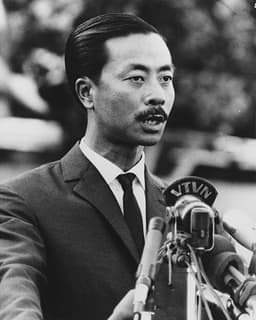
Nguyen Cao Ky
General · Modern
49.0Total
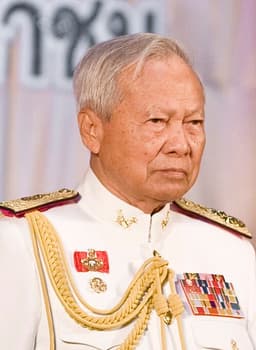
Prem Tinsulanonda
General · Modern
57.2Total
Basic Information
Born
1930
1920
Died
—
—
Era
Modern
Modern
Nationality
Vietnam
Thailand
Occupation
General
General
Civilization
Eastern
Eastern
Score Comparison
Military (10%)
45.0
50.0
Political (20%)
39.4
59.3
Influence (20%)
50.2
54.9
Legacy (20%)
40.0
47.5
Leadership (15%)
67.0
78.0
Strategy (15%)
60.0
60.0
TOTAL
49.0
57.2
Nguyen Cao Ky — Complete Timeline
1963 AD
Commander of South Vietnamese Air ForcePolitical Action◆ Major
Nguyen Cao Ky was appointed commander of the Republic of Vietnam Air Force. He led the air force during the Buddhist crisis and participated in the coup that overthrew President Ngo Dinh Diem.
Air ForceCoupDiem
Impact: national
1965 AD
Appointed Prime MinisterPolitical Action◆ Major
Nguyen Cao Ky became Prime Minister of South Vietnam, leading a military junta. His government intensified the war against the Viet Cong and North Vietnam, with strong US support.
Prime MinisterMilitary juntaVietnam War
Impact: national
1967 AD
Conflict with President ThieuPolitical Action
Nguyen Cao Ky ran for president but lost to Nguyen Van Thieu, becoming vice president. The two leaders had a tense relationship, with Ky later accusing Thieu of corruption and mismanagement of the war.
ElectionThieuRivalry
Impact: nationaldestructive
1975 AD
Exile after fall of SaigonPolitical Action◆ Major
Nguyen Cao Ky fled South Vietnam as Saigon fell to North Vietnamese forces. He settled in the United States, where he became a critic of the communist government and later returned to Vietnam for visits.
ExileFall of SaigonVietnam War
Impact: nationaltragic
Prem Tinsulanonda — Complete Timeline
1980 AD
Appointed Prime Minister after a coupPolitical Action◆ Major
Prem Tinsulanonda was appointed Prime Minister of Thailand by the military after a coup. He served for over eight years, overseeing a period of political stability and economic growth.
Prime MinisterMilitary RuleStability
Impact: national
1981 AD
Survived a coup attemptPolitical Action◆ Major
Prem survived a coup attempt by military officers loyal to the 'Young Turks' faction. The coup failed due to lack of support and the loyalty of key military units, allowing Prem to remain in power.
Coup AttemptPolitical CrisisMilitary
Impact: national
1988 AD
Resigned as Prime MinisterPolitical Action◆ Major
Prem resigned as Prime Minister after the general election, handing over power to a civilian government led by Chatichai Choonhavan. His resignation marked a rare peaceful transition of power in Thai politics.
ResignationDemocratic TransitionPeaceful
Impact: nationalconstructive
2016 AD
Appointed Regent of ThailandPolitical Action
After the death of King Bhumibol, Prem was appointed Regent of Thailand until the ascension of King Maha Vajiralongkorn. He served as a key figure in the transition of the monarchy.
RegentMonarchyTransition
Impact: national
Expert Analysis
Prem Tinsulanonda vs Nguyen Cao Ky
# The General’s Dilemma: Prem Tinsulanonda and Nguyen Cao Ky
In the sweltering heat of Bangkok, August 1981, a soft-spoken general named Prem Tinsulanonda sat in his office, waiting for news from the battlefield. Hours earlier, tanks had rolled into the capital, loyal to the "Young Turks" faction that had once supported him. Yet Prem did not flee. He did not order a counterattack. He simply waited, trusting in a network of alliances and the quiet authority of a king. Three days later, the coup collapsed. Half a world away, another general faced a different kind of reckoning. In April 1975, Nguyen Cao Ky hurriedly boarded a helicopter on a Saigon rooftop, his air force uniform still crisp, as North Vietnamese troops flooded the city. He never returned. Two generals, two Asian nations, two divergent fates—what separated the man who held power for eight years from the one who lost everything in a decade?
Origins
Prem Tinsulanonda was born in 1920 in Songkhla, southern Thailand, into a family of modest means but deep connections to the Buddhist monarchy. His father was a schoolteacher, his mother a devout Buddhist. Thailand, uniquely among Southeast Asian nations, had never been colonized. Its political culture prized subtlety, hierarchy, and the sacred role of the king. Prem grew up in a world where power flowed not through brute force but through patronage, deference, and the art of appearing above the fray.
Nguyen Cao Ky was born in 1930 in Son Tay, northern Vietnam, then part of French Indochina. His family was wealthy, his father a district chief under colonial rule. But Vietnam was a land of fracture—divided by colonialism, war, and ideology. Ky’s generation inherited not stability but a relentless struggle for identity. He trained as a pilot under the French, then under the Americans, learning to fight in the skies over a country that was tearing itself apart.
Rise to Power
Prem’s ascent was gradual, almost invisible. He joined the military in the 1940s, served in counterinsurgency campaigns, and rose through the ranks without ever commanding a major battle. His breakthrough came in 1980, when a military coup toppled a civilian government. The generals needed a figurehead—someone respected, unambitious, and acceptable to the palace. Prem was appointed Prime Minister. He was 60 years old, a career officer who had never sought the spotlight.
Nguyen Cao Ky’s rise was explosive. In 1963, at just 33, he was appointed commander of the South Vietnamese Air Force. He was flamboyant, wearing a purple scarf and twin pearl-handled revolvers, a pilot who led bombing runs himself. In 1965, amid the chaos of coups and countercoups, he became Prime Minister. He was the youngest head of government in the world at the time, and he governed with a swagger that matched the American jets he flew.
Leadership & Governance
Prem governed as a conciliator. His political wisdom score of 68.8 reflects a man who understood that in Thailand, power was not seized but balanced. He survived the 1981 coup attempt not by fighting but by ensuring the military, the bureaucracy, and the monarchy all saw him as indispensable. He cultivated King Bhumibol’s trust, a relationship that would later make him regent. His economic policies stabilized Thailand after years of instability, and he resigned gracefully in 1988, handing power to an elected civilian—a rare act in a country prone to coups.
Ky governed as a warrior. His military score of 61.8 is modest for a general, but his leadership score of 76.3 hints at charisma. He intensified the war against the Viet Cong, welcoming American escalation. But his rule was chaotic. He feuded with President Nguyen Van Thieu, lost the 1967 election, and served as a powerless vice president. Where Prem built bridges, Ky built walls. He alienated Buddhists, intellectuals, and even his own officers. By 1975, when Saigon fell, he had no base left to defend.
Triumph & Tragedy
Prem’s greatest triumph was his longevity. He served as Prime Minister for eight years—a record in modern Thailand—and later as regent, the highest constitutional office. His tragedy was that his legacy became entangled with the 2014 coup, when generals cited his era as a model for military intervention. He died in 2019 at 98, a figure both revered and controversial.
Ky’s greatest moment was perhaps his 1965 decision to restore order after a coup, or his defiant flights over contested jungles. His tragedy was total: the fall of Saigon in 1975, the exile to California, the opening of a liquor store, the decades of bitter memoirs. He died in 2011 at 80, a man who had once commanded an air force, reduced to a footnote in a war America lost.
Character & Destiny
Prem was patient, self-effacing, and deeply attuned to the rhythms of Thai politics. He once said, "The secret of leadership is to know when to lead and when to follow." He followed the king, followed the military, followed the times. His destiny was to be a pivot, not a spear.
Ky was impulsive, proud, and tragically honest. He admitted in his memoirs that South Vietnam was "a country that did not deserve to exist." That honesty, however admirable, was fatal for a leader. His destiny was to fight for a cause that was already lost, and to know it.
Legacy
Prem is remembered as a "kingmaker" and a guardian of stability. His legacy score of 66.8 reflects a mixed judgment: some see him as a wise elder, others as a pillar of military influence that undermined democracy. Yet his name is still spoken with respect in Bangkok.
Ky is remembered, if at all, as a symbol of South Vietnam’s failure. His legacy score of 56.0 is the lowest among these two, a number that captures the tragedy of a man who had courage but not wisdom, ambition but not patience.
Conclusion
Standing on a Bangkok street today, one sees the shadow of Prem Tinsulanonda in every orderly transition of power, every quiet negotiation between palace and barracks. In a Little Saigon strip mall in California, one might find a faded photograph of Nguyen Cao Ky in his purple scarf, a ghost of a war that never ended. Both generals faced the same question: how does a soldier govern a divided nation? Prem answered by becoming a politician who wore a uniform. Ky answered by remaining a pilot who never landed. History, as always, judged the one who learned to stay on the ground.
Rankings
🥇
Prem TinsulanondaLeader
Mil: 50.0Pol: 59.3Inf: 54.9
57.2
🥈
Nguyen Cao Ky
Mil: 45.0Pol: 39.4Inf: 50.2
49.0
+8.2 behind
How This Comparison Works
Algorithm
Each figure is scored on 6 dimensions (0—100 scale) based on structured historical data: Military (10%), Political (20%), Influence (20%), Legacy (20%), Leadership (15%), Strategy (15%). The weighted total produces the final ranking.
Data Sources
Scores are computed from structured sub-indicators in the database. Scale factors adjust for era (Ancient ×0.85, Modern ×1.0) and civilization size (Eastern ×1.05, Other ×0.80) to account for differences in population and military scale.
Maximum 3 Figures
Comparisons are limited to 2—3 figures to ensure readability and statistical meaningfulness.
Error Margins
±5 points per dimension — Sub-scores are derived from historical records with inherent uncertainty. Two figures within 5 points on a dimension should be considered roughly equivalent in that area.
Total Score Accuracy
±3 points overall — The weighted combination of 6 dimensions produces a total score with approximately ±3 points of uncertainty. Differences of less than 3 points are not statistically significant— the figures are effectively tied.
Known Limitations
- Historical records are incomplete and uneven across civilizations
- Figures from oral-tradition societies may be underrepresented
- Occupation labels can misclassify multi-role figures
- Scores measure capability and impact, not moral character
- Quantitative scoring is a comparison tool, not absolute truth
Capability Radar
Military (10%) — Battles & Warfare
Battles
30
20
Win Rate
35
25
Expansion
10
10
Political (20%) — Governance & Reform
Reform
20
55
Diplomacy
25
60
Economy
15
50
Influence (20%) — Cultural & Global Reach
Cultural
15
30
Global
15
30
Legacy (20%) — Historical Impact
Historical
20
40
Longevity
10
35
Leadership (15%) — Power & Stability
Tenure
40
65
Stability
10
60
Strategy (15%) — Tactics & Innovation
Strategy
30
30
Tactics
40
30
Reform
25
35
Similar Comparisons
Comments & Discussion
Prem's Padawan6/16/2026
Prem proved that real power isn't about tanks but about having a king who actually likes you. Ky had Saigon's flashiest flying suit and zero political allies beyond U.S. funding. Prem survived coup attempts because he understood Thai hierarchy like a chess grandmaster. These men aren't comparable — one built a legacy, the other built a landing pad on a rooftop. Thailand's system rewarded patience; Vietnam's war devoured everyone equally.
数据考古学家6/16/2026
说"两位将军不同命运"根本是作弊——完全忽略抗美援越背景。Ky在1975年面对的可是统一全国的正规军,而Prem镇压的不过是一群军校生政变。拿中国援助的北越炮兵对比泰国国王的民意基础,这不叫历史比较,这叫罂粟花比较菊花。唯一公平的是:两人都在失去美国支持后迅速完蛋,只是Ky的倒台被拍成了电影。
Classics Culturist6/16/2026
What's striking is how Buddhism shaped Prem's restraint vs Ky's French-colonial restlessness. Prem's non-action during the 1981 coup mirrors theravada detachment — let karma handle it. Ky, trained by the French and seduced by American swagger, couldn't sit still. He flew fighter jets AND his country into the ground. Prem's legacy? Still advising kings at 98. Ky's? A casino in California. The monk-general beat the pilot-politician precisely because he did less.
政变观察员6/16/2026
最骚的是1981年Prem其实手里没兵——他靠的是诗丽吉王后和炳·廷素拉暖的宫廷关系网。Young Turks坦克都开进曼谷了,结果王室广播一句话就崩盘。反观Ky,1975年4月29日他还有飞机有兵,但西贡的崩溃不是军事失败,是整个政治信任破产。Prem能活靠的是"国王的前将军"身份,Ky失败是因为"美国的空军元帅"标签太沉重。
Revisionist Scrapper6/16/2026
Let's stop romanticizing Prem as some silent genius — he was just lucky Thailand had a functioning monarchy as a pressure valve. Ky's Saigon had no king, no consensus, just competing warlords with American checks. Give Prem a real existential threat like Ky faced, and see how long his "calm waiting" lasts. The comparison is fundamentally flawed: one man managed peacetime politics in a stable kingdom; the other tried to hold together a collapsing client state while being abandoned by his patron.