Loading...
Napoleon Bonaparte vs Pedro I of Brazil
Napoleon Bonaparte leads by 16.3 pts · 2 figures compared
…

Napoleon Bonaparte
General · Modern
70.9Total
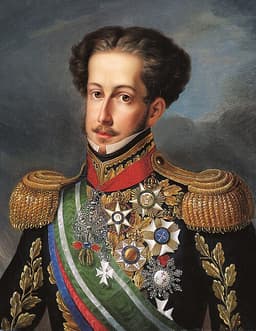
Pedro I of Brazil
Emperor · Modern
54.6Total
Basic Information
Born
1769
1798
Died
1821
1834
Era
Modern
Modern
Nationality
France
Brazil
Occupation
General
Emperor
Civilization
Western
Western
Score Comparison
Military (10%)
94.0
55.0
Political (20%)
72.0
62.7
Influence (20%)
40.0
59.0
Legacy (20%)
80.0
50.0
Leadership (15%)
78.0
53.2
Strategy (15%)
90.0
45.0
TOTAL
70.9
54.6
Napoleon Bonaparte — Complete Timeline
1799 AD
Coup of 18 BrumaireOther◆ Major
Napoleon Bonaparte, with support from his brother Lucien and key political figures, overthrew the Directory in a bloodless coup. He established the Consulate with himself as First Consul, effectively becoming the ruler of France. This event ended the French Revolution's most unstable period.
French RevolutionCoupRise to Power
Impact: regional
1804 AD
Promulgation of the Napoleonic CodeOther◆ Major
Napoleon enacted the Civil Code of the French, known as the Napoleonic Code, a comprehensive set of laws that replaced the fragmented feudal legal systems. The code established legal equality, protected property rights, and secularized law. It became the basis for legal systems in many European and world countries.
Legal ReformNapoleonic CodeCivil Law
Impact: globalconstructive
1805 AD
Battle of AusterlitzWar◆ Major
Napoleon's Grande Arm
Napoleonic WarsBattleDecisive Victory
Impact: global
1812 AD
Invasion of RussiaWar◆ Major
Napoleon led the Grande Arm
Napoleonic WarsInvasionDisaster
Impact: globaldestructive
1815 AD
Battle of WaterlooWar◆ Major
Napoleon's French army was defeated by the combined forces of the Duke of Wellington's Anglo-Allied army and Gebhard Leberecht von Bl
Napoleonic WarsBattleFinal Defeat
Impact: globaldestructive
Pedro I of Brazil — Complete Timeline
1822 AD
Declaration of Independence of BrazilPolitical Action
Pedro I declared Brazil's independence from Portugal on September 7, 1822, at the Ipiranga River in S
Impact: globalprogressive
Coronation as Emperor of BrazilPolitical Action◆ Major
Pedro I was crowned Emperor of Brazil on December 1, 1822, in Rio de Janeiro. The coronation formalized the new imperial government, with Pedro I as constitutional monarch, though he retained significant executive powers.
Impact: nationalconstructive
1823 AD
War of Independence of BrazilWar◆ Major
Pedro I led Brazilian forces against Portuguese loyalists in the War of Independence. Key battles occurred in Bahia, Maranh
Impact: national
Dissolution of the Constituent AssemblyPolitical Action◆ Major
Pedro I dissolved the Constituent Assembly after conflicts over the constitution's limits on imperial power. He then imposed the 1824 Constitution, which granted the emperor extensive powers, including the Moderating Power, centralizing authority.
Impact: nationaldestructive
1831 AD
Abdication of the Brazilian ThronePolitical Action
Pedro I abdicated the Brazilian throne in favor of his five-year-old son Pedro II on April 7, 1831. He returned to Portugal to claim the Portuguese throne, leaving Brazil under a regency until his son came of age.
Impact: national
Expert Analysis
Napoleon Bonaparte vs Pedro I of Brazil
# The Emperor and the Corsican: Two Paths to Power, Two Very Different Destinies
On a September morning in 1822, a twenty-three-year-old prince stood at the banks of the Ipiranga River in São Paulo, tore the Portuguese insignia from his uniform, and shouted a cry that would echo through the Americas: "Independence or death!" Half a world away, just seven years earlier, a forty-five-year-old emperor had watched his own empire crumble on the muddy fields of Waterloo, a final, crushing end to a decade of continental domination. Pedro I of Brazil and Napoleon Bonaparte—one a reluctant revolutionary, the other a relentless conqueror—both seized history by the throat. Yet one built a nation that endured, while the other built an empire that collapsed under the weight of its own ambition. What drove these two men, born a generation apart, to such radically different outcomes?
Origins
Napoleon Bonaparte was born in 1769 on the island of Corsica, a land only recently annexed by France. He came from minor nobility, a family of modest means but fierce pride. His education at French military academies instilled in him a burning desire to prove himself—a Corsican outsider who would make the French mainland bow to his genius. The chaos of the French Revolution provided his ladder: a world where talent, not birth, could propel a man to the top.
Pedro I, by contrast, was born in 1798 in the Queluz Palace near Lisbon, the son of King John VI of Portugal and Queen Carlota Joaquina of Spain. He was royalty by blood, heir to a dynasty, but he grew up in the shadow of Napoleon's wars. When French armies invaded Portugal in 1807, the entire Braganza court fled to Brazil, transforming Rio de Janeiro into the capital of the Portuguese Empire. Pedro arrived as a frightened nine-year-old prince, but he would come to see Brazil not as a colony, but as his home.
These origins shaped everything. Napoleon's hunger was personal—a desperate need to rise, to conquer, to prove that the Corsican boy could outshine the kings of Europe. Pedro's hunger was dynastic—to preserve his family's throne, to hold an empire together when the old order was collapsing.
Rise to Power
Napoleon's ascent was a masterpiece of ambition and timing. At twenty-four, he crushed a royalist uprising in Paris with a "whiff of grapeshot." At twenty-seven, he conquered Italy. At thirty, he was First Consul of France. By 1804, at thirty-five, he crowned himself Emperor in Notre-Dame Cathedral, taking the crown from the Pope's hands and placing it on his own head. Each step was a gamble, each victory a building block for his personal legend. His military score of 94 and strategy score of 93 are not abstractions—they reflect a man who redefined warfare, who could march an army across the Alps in winter and win battles against overwhelming odds.
Pedro's rise was far more constrained. He became regent of Brazil in 1821 when his father returned to Portugal, leaving him to govern a restless colony. The Portuguese court demanded that Brazil return to colonial subservience, stripping Pedro of his powers. Faced with the choice between obedience and rebellion, he chose independence—but not out of revolutionary fervor. He wrote to his father, "I will do everything for the people, but nothing by the people." His declaration of independence on September 7, 1822, was a political maneuver, not a popular uprising. He was crowned emperor on December 1 of that same year, a coronation that formalized his break with Portugal but left the underlying tensions unresolved.
Leadership & Governance
As a leader, Napoleon was a force of nature—and a force of destruction. He reformed French law through the Napoleonic Code, standardizing justice, protecting property rights, and abolishing feudalism. He built schools, roads, and a centralized bureaucracy that modernized France. But his governance was inseparable from his war machine. He appointed his brothers as kings of conquered territories, created a new nobility loyal to himself, and demanded that Europe bend to his will. His political score of 75 reflects a man who was brilliant at seizing power but terrible at sustaining it—he could conquer a kingdom but could not govern a peace.
Pedro governed differently, not because he was wiser, but because he was weaker. He faced a vast, fragmented Brazil with no standing army, no unified economy, and deep regional loyalties. His War of Independence in 1823 was a series of skirmishes against Portuguese garrisons, not the grand campaigns of Napoleon. He dissolved the Constituent Assembly in 1823 after clashing with deputies who wanted to limit his power, then imposed a constitution that gave him strong authority—but he could not enforce it. His leadership score of 74.5 is respectable but not exceptional, because he lacked the iron will to truly command.
Triumph & Tragedy
Napoleon's greatest moment was Austerlitz in 1805, where he destroyed the armies of Russia and Austria in a single day, a victory so complete that it ended the Third Coalition. His worst was Waterloo in 1815, where he staked everything on a gamble and lost, leading to exile and a lonely death on Saint Helena. His tragedy was that he could not stop—every victory demanded another war, every conquest required another army.
Pedro's triumph was the independence of Brazil itself, a peaceful transition compared to the bloodbaths of Spanish America. He kept the country united under a monarchy, avoiding the fragmentation that plagued its neighbors. His tragedy was his inability to rule. The same hot temper that made him declare independence also led him to alienate his allies, mismanage the economy, and lose the loyalty of the Brazilian elite. In 1831, just nine years after his greatest moment, he abdicated the throne in favor of his five-year-old son, Pedro II, and sailed back to Portugal, a failed emperor at thirty-three.
Character & Destiny
Napoleon and Pedro shared a restless energy, a belief in their own destiny, and a willingness to break the rules. But their characters diverged in crucial ways. Napoleon was a strategist who thought in years and continents, building systems that would outlast him. Pedro was a tactician who thought in months and crises, reacting to events rather than shaping them. Napoleon's arrogance was cosmic—he believed he could conquer Russia, defeat the British navy, and remake the world. Pedro's arrogance was personal—he believed his royal blood entitled him to rule, but he lacked the discipline to do so.
Their destinies followed their characters. Napoleon died in exile, a prisoner of the British, but his legend only grew. Pedro died in 1834 in Portugal, fighting for his daughter's right to the Portuguese throne, largely forgotten in the country he had liberated.
Legacy
Today, Napoleon's legacy is immense and contradictory. He is remembered as a military genius, a reformer, and a tyrant. His Napoleonic Code influences civil law across Europe and the Americas. His name is synonymous with ambition, brilliance, and catastrophic overreach. His total score of 82.4 reflects a figure who changed the world, for better and worse.
Pedro's legacy is quieter but more concrete. He gave Brazil its independence, kept it united, and founded an empire that lasted until 1889. His son Pedro II would become one of the most respected monarchs in the Americas. But Pedro I himself is often overshadowed, a transitional figure whose personal failures nearly undid his greatest achievement. His total score of 65.7 reflects a man who succeeded in the moment but could not sustain what he built.
Conclusion
The difference between Napoleon and Pedro is not a matter of talent or ambition. Both were gifted, both were driven, both seized their moment. The difference is that Napoleon built for himself, while Pedro built for his dynasty. Napoleon's empire was a monument to his ego, and when he fell, it shattered. Pedro's empire was a vessel for his family's survival, and when he failed, it endured through his son. In the end, the Corsican outsider who conquered Europe left behind a legend that still burns. The Portuguese prince who gave Brazil its freedom left behind a nation that still stands. Which is the greater legacy? That depends on whether you value the flame or the foundation.
Rankings
🥇
Napoleon BonaparteLeader
Mil: 94.0Pol: 72.0Inf: 40.0
70.9
🥈
Pedro I of Brazil
Mil: 55.0Pol: 62.7Inf: 59.0
54.6
+16.3 behind
How This Comparison Works
Algorithm
Each figure is scored on 6 dimensions (0—100 scale) based on structured historical data: Military (10%), Political (20%), Influence (20%), Legacy (20%), Leadership (15%), Strategy (15%). The weighted total produces the final ranking.
Data Sources
Scores are computed from structured sub-indicators in the database. Scale factors adjust for era (Ancient ×0.85, Modern ×1.0) and civilization size (Eastern ×1.05, Other ×0.80) to account for differences in population and military scale.
Maximum 3 Figures
Comparisons are limited to 2—3 figures to ensure readability and statistical meaningfulness.
Error Margins
±5 points per dimension — Sub-scores are derived from historical records with inherent uncertainty. Two figures within 5 points on a dimension should be considered roughly equivalent in that area.
Total Score Accuracy
±3 points overall — The weighted combination of 6 dimensions produces a total score with approximately ±3 points of uncertainty. Differences of less than 3 points are not statistically significant— the figures are effectively tied.
Known Limitations
- Historical records are incomplete and uneven across civilizations
- Figures from oral-tradition societies may be underrepresented
- Occupation labels can misclassify multi-role figures
- Scores measure capability and impact, not moral character
- Quantitative scoring is a comparison tool, not absolute truth
Capability Radar
Military (10%) — Battles & Warfare
Battles
95
35
Win Rate
90
40
Expansion
95
30
Political (20%) — Governance & Reform
Reform
95
45
Diplomacy
80
50
Economy
85
30
Influence (20%) — Cultural & Global Reach
Cultural
85
40
Global
90
45
Legacy (20%) — Historical Impact
Historical
95
55
Longevity
90
50
Leadership (15%) — Power & Stability
Tenure
85
55
Stability
70
25
Strategy (15%) — Tactics & Innovation
Strategy
95
35
Tactics
98
30
Reform
92
20
Similar Comparisons
Comments & Discussion
ClassicsScholar6/16/2026
Both men chased destiny, but Pedro I's cry at Ipiranga was a theatrical echo of Caesar crossing the Rubicon—except Caesar wrote his own lines, while Pedro was reading his father's. Napoleon etched his name into the bedrock of Western law and military doctrine. Pedro gave Brazil a flag and a debt crisis. Great theater, but theater doesn't build empires.
数据拆解家6/16/2026
说拿破仑不如佩德罗一世?数据不会说谎:拿破仑在位16年征服了欧洲大部分地区,领土最大时达70万平方公里;佩德罗一世统治9年,巴西独立后领土是有了,但内部叛乱不断,1831年就退位跑路,活脱脱一个半途而废的公子哥。要论执行力,科西嘉人甩他几十条街。
NapoleonTheStrategist6/16/2026
Pedro I shouting at a riverbank doesn't make him a Napoleon—it makes him a lucky teenager with a good PR team. Waterloo showed Bonaparte could lose everything in one day, but his governance and Napoleonic Code shaped Europe for centuries. Pedro? He ditched Brazil for Portugal just nine years later. One man built a legal system that still stands; the other built a parade float.
历史滤镜粉碎机6/16/2026
浪漫化的佩德罗一世?拜托,他所谓的"独立或死亡"是个政治表演。真实情况是:他爸葡萄牙国王跑路前留了个烂摊子,佩德罗不过顺势而为。反观拿破仑,从土伦战役到三皇会战,每一步都是硬仗打下来的。佩德罗最大的能力是投胎投得好,拿破仑才是真正的自我创造者。
HistoireRéaliste6/16/2026
Let's be blunt: Pedro I was a colonial real estate speculator who lucked into an empire his father handed him. Napoleon was a strategist who turned a bankrupt, fractured France into a continental powerhouse. Pedro's Brazil endured because Britain and Portugal forced a soft landing; Napoleon's empire fell because he overreached alone. One had training wheels, the other rode without a helmet.