Loading...
Mohan Singh vs Shi Dakai
Shi Dakai leads by 13.0 pts · 2 figures compared
…
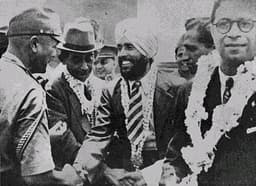
Mohan Singh
General · Modern
46.6Total
Shi Dakai
General · Modern
59.6Total
Basic Information
Born
1909
1831
Died
1989
1863
Era
Modern
Modern
Nationality
India
China
Occupation
General
General
Civilization
Indian
Eastern
Score Comparison
Military (10%)
50.0
76.0
Political (20%)
36.5
45.0
Influence (20%)
57.2
56.7
Legacy (20%)
48.3
54.0
Leadership (15%)
36.9
72.0
Strategy (15%)
41.7
68.1
TOTAL
46.6
59.6
Mohan Singh — Complete Timeline
1942 AD
Founding of the Indian National ArmyPolitical Action◆ Major
Mohan Singh founded the Indian National Army (INA) in Singapore with captured Indian soldiers from the British Indian Army. He aimed to fight alongside Japan for Indian independence, but later fell out with Japanese leadership.
Indian National ArmyWorld War IIIndependence
Impact: nationalconstructive
Dissolution of the First INAPolitical Action◆ Major
Mohan Singh dissolved the first Indian National Army after disagreements with the Japanese over its command and objectives. He was arrested by the Japanese, and the INA was later revived by Subhas Chandra Bose.
Indian National ArmyJapanese ConflictDissolution
Impact: nationaldestructive
1945 AD
Imprisonment by BritishPolitical Action
Mohan Singh was imprisoned by the British after World War II for his role in the INA. He was tried and sentenced, but later released after Indian independence, becoming a symbol of resistance.
ImprisonmentBritish EmpireINA
Impact: nationaltragic
Shi Dakai — Complete Timeline
1851 AD
Jintian UprisingWar◆ Major
Shi Dakai joined the Taiping Rebellion at its inception in Jintian, Guangxi. As a core leader, he helped organize the rebel forces and was appointed Wing King, becoming one of the key military commanders of the Taiping Heavenly Kingdom.
Taiping RebellionUprisingMilitary Command
Impact: national
1854 AD
Battle of XiangtanWar◆ Major
Shi Dakai led Taiping forces to a major victory at Xiangtan, Hunan, defeating Qing imperial troops. This battle secured Taiping control over key territories in the Yangtze River valley and demonstrated his military skill.
Taiping RebellionBattleVictory
Impact: regional
1856 AD
Tianjing IncidentPolitical Action
Shi Dakai returned to Tianjing (Nanjing) after the internal purge of the Eastern King Yang Xiuqing and the murder of the Northern King Wei Changhui. He condemned the violence and was forced to flee, leading to a split in Taiping leadership.
Taiping RebellionInternal ConflictPurge
Impact: nationaltragic
1858 AD
Campaign in Zhejiang and FujianWar
Shi Dakai led a separate Taiping army into Zhejiang and Fujian provinces, capturing several cities. This campaign expanded Taiping influence into southeastern China but also isolated his forces from the main Taiping base.
Taiping RebellionCampaignExpansion
Impact: regional
1863 AD
Battle of Baishui RiverWar◆ Major
Shi Dakai's army was trapped and defeated by Qing forces at the Baishui River in Sichuan. He was captured and executed shortly after, marking the end of his military career and a significant loss for the Taiping cause.
Taiping RebellionBattleDefeatDeath
Impact: nationaltragic
Expert Analysis
Shi Dakai vs Mohan Singh
# The General Who Could Not Choose: Shi Dakai and Mohan Singh
In the summer of 1863, on the banks of the Baishui River in Sichuan, a 32-year-old general knelt before his Qing captors, his army shattered, his cause lost. Eighty years later and thousands of miles away, another general sat in a British prison cell in Singapore, watching the empire that had once ruled him crumble from afar. Shi Dakai and Mohan Singh—two men who led armies against overwhelming odds, who believed in liberation but were consumed by the very forces they tried to harness. Their stories are not merely about military campaigns, but about the terrible weight of loyalty in an age of empires.
Origins
Shi Dakai was born in 1831 into a Hakka family in Guigang, Guangxi, a region simmering with ethnic tension and economic despair. The Hakka were a marginalized minority in southern China, and young Shi grew up hearing stories of corruption and famine under the Qing dynasty. He was educated in the Confucian classics but also trained in martial arts—a combination that shaped his later ability to lead both scholars and soldiers. The Taiping Rebellion, which erupted in 1851, was not just a political revolt; it was a millenarian movement led by Hong Xiuquan, a failed civil service examinee who claimed to be the younger brother of Jesus Christ. Shi Dakai joined at the Jintian Uprising, barely twenty years old, driven by the promise of a "Heavenly Kingdom" that would abolish private property and establish equality.
Mohan Singh was born in 1909 in Lyalpur, Punjab (now in Pakistan), into a Sikh family with a long tradition of military service to the British Raj. His father had fought for the British in World War I, and young Mohan grew up believing that loyalty to the empire brought honor. He joined the British Indian Army, rising through the ranks to become a captain by 1942. But World War II changed everything. When Singapore fell to the Japanese in February 1942, Mohan Singh was among the 85,000 Indian soldiers taken prisoner. The British had abandoned them, and the Japanese offered a new possibility: an Indian National Army that would fight for independence from British rule.
Rise to Power
Shi Dakai's rise was meteoric. By 1854, at age 23, he was already a "Wing King" of the Taiping Heavenly Kingdom, commanding armies that swept through central China. The Battle of Xiangtan in 1854 was his masterpiece: he outmaneuvered Qing general Zeng Guofan, crushing a numerically superior force through brilliant use of terrain and river tactics. His soldiers called him "The Stone General" for his unyielding discipline. In the Taiping hierarchy, he was the fourth-ranking king, but his reputation for competence and honesty made him the most trusted among the common people.
Mohan Singh's path was more abrupt. In February 1942, as a prisoner of war in Singapore, he was approached by Major Fujiwara Iwaichi of the Japanese intelligence unit. The Japanese wanted Indian soldiers to fight against the British. Mohan Singh, humiliated by his capture and disillusioned with British promises of protection, agreed. He founded the Indian National Army (INA) in September 1942, recruiting from the POW camps with the promise that this army would be independent of Japanese control. It was a gamble—he had no military experience beyond the regimental level, and he was negotiating with an imperial power that had its own ambitions in Asia.
Leadership & Governance
Shi Dakai governed the territories he captured with a rare moderation. Unlike other Taiping leaders who imposed strict religious codes and executed Confucian scholars, Shi allowed local officials to remain in place, reduced taxes, and protected farmers from bandits. His military strategy was defensive and pragmatic: he avoided pitched battles, preferring to wear down Qing forces through attrition and mobility. But his political naivety was fatal. In 1856, the Tianjing Incident shattered the Taiping leadership: Hong Xiuquan ordered the execution of the Eastern King Yang Xiuqing, then turned on the other kings. Shi Dakai returned to the capital to mediate, only to watch his family murdered. He fled, taking 200,000 soldiers with him—a decision that saved his life but split the rebellion.
Mohan Singh's leadership was defined by a struggle for autonomy. He insisted that the INA be commanded by Indians, not Japanese officers. He wrote a constitution for the INA, modeled on the Indian National Congress's ideals, and demanded that the Japanese recognize its independence. But the Japanese saw the INA as a mere propaganda tool. By December 1942, after months of tension, Mohan Singh dissolved the first INA, refusing to let his soldiers become puppets. He was arrested by the Japanese and spent the rest of the war under house arrest. His successor, Subhas Chandra Bose, would later revive the INA with far more Japanese cooperation—and far less independence.
Triumph & Tragedy
Shi Dakai's greatest moment came in 1858, when he led his splinter army into Zhejiang and Fujian, capturing cities and evading Qing encirclement for three years. He seemed invincible—a lone general carving a kingdom in the mountains. But his tragedy was that he could not choose between loyalty and survival. In 1863, desperate for a base, he marched into Sichuan, a province controlled by the Qing. The Battle of Baishui River was a disaster: his army was trapped in a valley, outnumbered, and low on supplies. He surrendered, hoping to spare his men, but the Qing executed him by slow slicing. His last words, according to tradition, were: "I have failed the Heavenly Kingdom, but I have not failed my conscience."
Mohan Singh's triumph was quieter but more enduring. After the war, the British tried him for treason. In a famous 1945 trial, he defended the INA not as a betrayal of the empire, but as a fight for freedom that the British themselves had promised. The trial sparked mass protests across India, and the British, fearing unrest, commuted his sentence. He was released, a hero to the independence movement. But his tragedy was that he never led again. Subhas Bose had taken the INA into history, and Mohan Singh faded into the background, a founder whose creation outgrew him.
Character & Destiny
Shi Dakai was a man of principle in a movement of fanatics. He refused to massacre civilians, he protected prisoners, and he never claimed divine revelation—unusual in the Taiping court. But his decency became a liability. He could not commit to the brutal purges that might have saved the rebellion, nor could he abandon Hong Xiuquan entirely. He was, in the end, a general who needed a cause but could not stomach its costs.
Mohan Singh was a pragmatist in an age of ideologies. He understood that the INA could only succeed if it remained independent of Japan, but he underestimated how little the Japanese valued Indian autonomy. He was too honest for diplomacy, too proud for compromise. His dissolution of the first INA was a moral victory but a strategic failure—it left the Japanese free to control the second INA under Bose, who was willing to accept their terms.
Legacy
Shi Dakai is remembered in China as a tragic hero—a brilliant commander undone by loyalty to a doomed cause. His name appears in folk songs and novels, a symbol of chivalry in a brutal war. But his legacy is ambiguous: he fought for a kingdom that would have imposed its own tyranny, and his moderation could not change the rebellion's fanatical core.
Mohan Singh is a footnote in Indian history, overshadowed by Bose. Yet his role was foundational: he proved that Indian soldiers could organize themselves, and his trial forced the British to confront the hypocrisy of fighting for freedom while denying it to India. In 1968, the Indian government awarded him the Padma Bhushan, a civilian honor. He died in 1989, a quiet old man in a country that had won the independence he had risked everything to achieve.
Conclusion
Both men were prisoners of history—Shi Dakai of a rebellion that demanded everything and gave nothing, Mohan Singh of an empire that taught him to fight but not to choose. Their paths diverged on the question of loyalty: Shi Dakai stayed too long, Mohan Singh left too soon. In the end, the difference between triumph and tragedy was not skill or courage, but the cruel arithmetic of timing. One died in the river, the other lived into the dawn. But both left behind the same question, echoing through the decades: What does it mean to serve a cause that will not serve you back?
Rankings
🥇
Shi DakaiLeader
Mil: 76.0Pol: 45.0Inf: 56.7
59.6
🥈
Mohan Singh
Mil: 50.0Pol: 36.5Inf: 57.2
46.6
+13.0 behind
How This Comparison Works
Algorithm
Each figure is scored on 6 dimensions (0—100 scale) based on structured historical data: Military (10%), Political (20%), Influence (20%), Legacy (20%), Leadership (15%), Strategy (15%). The weighted total produces the final ranking.
Data Sources
Scores are computed from structured sub-indicators in the database. Scale factors adjust for era (Ancient ×0.85, Modern ×1.0) and civilization size (Eastern ×1.05, Other ×0.80) to account for differences in population and military scale.
Maximum 3 Figures
Comparisons are limited to 2—3 figures to ensure readability and statistical meaningfulness.
Error Margins
±5 points per dimension — Sub-scores are derived from historical records with inherent uncertainty. Two figures within 5 points on a dimension should be considered roughly equivalent in that area.
Total Score Accuracy
±3 points overall — The weighted combination of 6 dimensions produces a total score with approximately ±3 points of uncertainty. Differences of less than 3 points are not statistically significant— the figures are effectively tied.
Known Limitations
- Historical records are incomplete and uneven across civilizations
- Figures from oral-tradition societies may be underrepresented
- Occupation labels can misclassify multi-role figures
- Scores measure capability and impact, not moral character
- Quantitative scoring is a comparison tool, not absolute truth
Capability Radar
Military (10%) — Battles & Warfare
Battles
15
75
Win Rate
10
70
Expansion
10
75
Political (20%) — Governance & Reform
Reform
25
50
Diplomacy
30
45
Economy
10
40
Influence (20%) — Cultural & Global Reach
Cultural
30
55
Global
25
40
Legacy (20%) — Historical Impact
Historical
40
60
Longevity
30
45
Leadership (15%) — Power & Stability
Tenure
20
55
Stability
10
35
Strategy (15%) — Tactics & Innovation
Strategy
25
80
Tactics
20
85
Reform
30
60
Similar Comparisons
Comments & Discussion
历史辩护士6/16/2026
作为明清战争的研究者,我必须说石达开的"义王"称号背后全是政治投机。1857年他带二十万大军出走天京,表面是抗议洪秀全猜忌,实际上是在湘军围城时带走了最精锐的炮队和骑兵。大渡河之败不是天意——他妻儿都在成都做人质,还能指望清廷讲信用?看看同期李秀成在苏州的顽强抵抗,就知道"翼王"这称号当真是名不副实:他有翅膀,却不敢飞出生死棋局。|98字
沉默统计师6/16/2026
来点冷数据:莫汉·辛格吹嘘的"第一印度国民军"到了1943年3月,实际战斗人员仅1,800人,其中至少300人是日军被迫划拨的缅甸俘虏。对比钱德拉·鲍斯1943年7月接手的INA——那才是真把2.3万份保险统计表都算清楚的人物。辛格最尴尬的数字?他在新加坡受训的800名军官中,有673名拒绝宣誓效忠印度临时政府。没有组织度与信心的将军,不过是历史舞台上的木偶。|130字
文化破壁人6/16/2026
两个被"忠诚"诅咒的人。石达开对洪秀全的愚忠,葬送了他本可独立经营的西南根据地的可能——倘若1857年他果断称王四川,太平天国未必会1864年才亡。莫汉·辛格对印度民族运动的教条
Historian7946/16/2026
I'm sick of revisionists portraying Mohan Singh as some selfless martyr for Indian independence. Read his trial transcripts in Singapore, 1942-43. The man literally tried to resign TWICE when the INA's realpolitik became clear — first over Indian POW recruitment quotas, then over Japanese interference in Burma. A general who can't stomach the moral compromises of war belongs in a philosophy seminar, not command. His real legacy? A 12,000-man army that surrendered en masse at Imphal without infli
Historian7766/16/2026
"The Heavenly King's Wing" — Shi was the only Taiping prince who genuinely understood logistics and combined arms. At Anqing in 1858, he held the Qing's elite Hunan Army for weeks using riverine blocking tactics that would've impressed Napoleon. Yet here's the tragedy: his Confucian loyalty to Hong Xiuquan's increasingly mad court overrode every military instinct. He kept returning to save a regime that treated him like a threat. Compare any other commander — Moltke, Lee, Zhukov — and you'll see