Loading...
Mohan Singh vs Prem Tinsulanonda
Prem Tinsulanonda leads by 10.6 pts · 2 figures compared
…
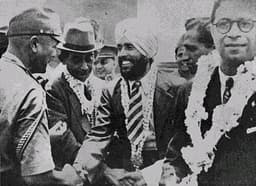
Mohan Singh
General · Modern
46.6Total
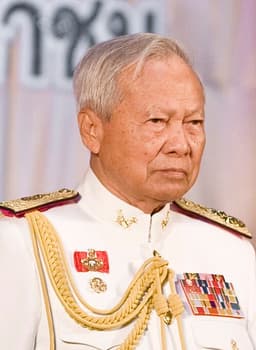
Prem Tinsulanonda
General · Modern
57.2Total
Basic Information
Born
1909
1920
Died
1989
—
Era
Modern
Modern
Nationality
India
Thailand
Occupation
General
General
Civilization
Indian
Eastern
Score Comparison
Military (10%)
50.0
50.0
Political (20%)
36.5
59.3
Influence (20%)
57.2
54.9
Legacy (20%)
48.3
47.5
Leadership (15%)
36.9
78.0
Strategy (15%)
41.7
60.0
TOTAL
46.6
57.2
Mohan Singh — Complete Timeline
1942 AD
Founding of the Indian National ArmyPolitical Action◆ Major
Mohan Singh founded the Indian National Army (INA) in Singapore with captured Indian soldiers from the British Indian Army. He aimed to fight alongside Japan for Indian independence, but later fell out with Japanese leadership.
Indian National ArmyWorld War IIIndependence
Impact: nationalconstructive
Dissolution of the First INAPolitical Action◆ Major
Mohan Singh dissolved the first Indian National Army after disagreements with the Japanese over its command and objectives. He was arrested by the Japanese, and the INA was later revived by Subhas Chandra Bose.
Indian National ArmyJapanese ConflictDissolution
Impact: nationaldestructive
1945 AD
Imprisonment by BritishPolitical Action
Mohan Singh was imprisoned by the British after World War II for his role in the INA. He was tried and sentenced, but later released after Indian independence, becoming a symbol of resistance.
ImprisonmentBritish EmpireINA
Impact: nationaltragic
Prem Tinsulanonda — Complete Timeline
1980 AD
Appointed Prime Minister after a coupPolitical Action◆ Major
Prem Tinsulanonda was appointed Prime Minister of Thailand by the military after a coup. He served for over eight years, overseeing a period of political stability and economic growth.
Prime MinisterMilitary RuleStability
Impact: national
1981 AD
Survived a coup attemptPolitical Action◆ Major
Prem survived a coup attempt by military officers loyal to the 'Young Turks' faction. The coup failed due to lack of support and the loyalty of key military units, allowing Prem to remain in power.
Coup AttemptPolitical CrisisMilitary
Impact: national
1988 AD
Resigned as Prime MinisterPolitical Action◆ Major
Prem resigned as Prime Minister after the general election, handing over power to a civilian government led by Chatichai Choonhavan. His resignation marked a rare peaceful transition of power in Thai politics.
ResignationDemocratic TransitionPeaceful
Impact: nationalconstructive
2016 AD
Appointed Regent of ThailandPolitical Action
After the death of King Bhumibol, Prem was appointed Regent of Thailand until the ascension of King Maha Vajiralongkorn. He served as a key figure in the transition of the monarchy.
RegentMonarchyTransition
Impact: national
Expert Analysis
Prem Tinsulanonda vs Mohan Singh
# The General Who Served and the General Who Rebelled
On a humid August morning in 1981, Bangkok held its breath. Tanks rolled through the streets, and a faction of disgruntled officers calling themselves the "Young Turks" moved to seize power from Prime Minister Prem Tinsulanonda. Across the decades and continents, another general—Mohan Singh—had faced his own moment of reckoning in 1942, standing before captured Indian soldiers in Singapore, asking them to join a new army to fight their British masters. One man would survive his coup attempt and rule for years; the other would see his army dissolve within months. Why did two military men, both stepping onto the political stage from similar positions, meet such different fates?
Origins
Prem Tinsulanonda was born in 1920 in Songkhla, southern Thailand, into a family of modest means but deep loyalty to the monarchy. His father was a schoolteacher, and young Prem absorbed the values of hierarchy, duty, and reverence for King Bhumibol Adulyadej. He entered the military academy at a time when Thailand's army was the undisputed pillar of the state, a force that had shaped every government since the end of absolute monarchy in 1932. Prem's rise was methodical—he fought communist insurgencies in the northeast, earned a reputation for incorruptibility, and never once questioned the sacred bond between the military and the crown.
Mohan Singh, born in 1909 in Punjab, India, grew up under the shadow of the British Raj. His father was a farmer, and young Mohan joined the British Indian Army as a young man, rising through the ranks as a loyal soldier of the empire. But the world war that began in 1939 shattered that loyalty. Captured by the Japanese in Malaya in 1942, Mohan Singh found himself in a strange new world—a prisoner of war offered a chance to turn against his former masters. Where Prem inherited a stable nation with a revered king, Mohan inherited a subcontinent seething with nationalist rage and a colonial power that would never willingly leave.
Rise to Power
Prem's ascent was a slow, deliberate climb. He served as a staff officer, then as a commander in the field against communist guerrillas, and finally as army commander-in-chief in 1978. When a bloodless coup in 1980 toppled the civilian government of Prime Minister Kriangsak Chamanan, the military turned to Prem—a man trusted by both the generals and the palace. He was not a charismatic firebrand; he was a quiet, patient administrator who wore a perpetual half-smile and spoke in measured tones. His power came not from personal ambition but from being the acceptable compromise.
Mohan Singh's rise was a lightning strike. In February 1942, after the fall of Singapore, he met with Japanese Major Fujiwara Iwaichi and agreed to form the Indian National Army from captured Indian soldiers. Within months, 40,000 prisoners of war had volunteered. Mohan Singh became a general overnight, leading an army without a country, fighting for a freedom that seemed impossibly distant. But his rise was built on sand—he had no independent power base, no sovereign state backing him, only the Japanese, who saw the INA as a useful propaganda tool.
Leadership & Governance
As prime minister from 1980 to 1988, Prem governed with a steady hand in a country notorious for coups. He survived the 1981 Young Turk revolt not by crushing his enemies but by letting them collapse under their own incompetence—the coup failed because the military establishment and the palace refused to support it. Prem's political wisdom lay in knowing when to act and when to wait. He liberalized the economy, encouraged foreign investment, and kept Thailand neutral in the Cold War's ideological battles. His military strategy was defensive and pragmatic: contain the communist insurgency through development programs, not just bullets.
Mohan Singh's leadership was a tragedy of good intentions. He founded the INA with a noble dream—to liberate India from British rule—but he had no experience in politics or governance. He clashed with the Japanese over the INA's command structure, insisting that the army must be independent, not a puppet force. The Japanese saw this as ingratitude; Mohan Singh saw it as principle. In December 1942, he dissolved the INA, disillusioned and defeated. He lacked Prem's patience and the institutional support that Prem took for granted.
Triumph & Tragedy
Prem's greatest triumph was simply surviving. He left office voluntarily in 1988 after a general election, handing power to an elected civilian government—a rare peaceful transition in Thai history. His tragedy was that his legacy would later be tarnished by the 2006 coup, which many blamed on his behind-the-scenes influence as a privy councilor. He died in 2019 at the age of 98, a relic of a more stable era.
Mohan Singh's triumph was the idea itself: the INA, even in its failure, inspired millions of Indians. Its soldiers were hailed as heroes when they returned home after the war. But his tragedy was personal—he was imprisoned by the British in 1945, tried, and later released. He lived to see India free, but his role was overshadowed by Subhas Chandra Bose, who took over the INA in 1943 and turned it into a legend. Mohan Singh died in 1989, largely forgotten.
Character & Destiny
Prem was a man of patience and loyalty. He believed in institutions—the monarchy, the military, the bureaucracy—and served them without seeking personal glory. His decisions were shaped by a deep conservatism that valued stability over change. Mohan Singh was a man of passion and principle. He believed in freedom and was willing to risk everything for it, but his impatience and refusal to compromise doomed his project. One man's character led him to become the quiet pillar of a stable state; the other's led him to become a footnote in a larger story.
Legacy
Prem's legacy is the modern Thai state—stable, prosperous, but ultimately fragile. He is remembered as a wise elder, but also as a symbol of military influence that would later destabilize the country. Mohan Singh's legacy is the INA's spirit, which burned bright for a moment and then faded. He is honored in India as a pioneer, but his name lacks the resonance of Bose or Gandhi.
Conclusion
Standing at the end of their lives, both generals might have wondered about the roads not taken. Prem, the servant of kings, might have asked if he could have done more for democracy. Mohan Singh, the rebel without a country, might have asked if he should have been more patient. Their stories remind us that history rewards not just courage or wisdom, but the strange alchemy of time, place, and personality. One general held power; the other held a dream. Both, in their own ways, shaped the world that followed.
Rankings
🥇
Prem TinsulanondaLeader
Mil: 50.0Pol: 59.3Inf: 54.9
57.2
🥈
Mohan Singh
Mil: 50.0Pol: 36.5Inf: 57.2
46.6
+10.6 behind
How This Comparison Works
Algorithm
Each figure is scored on 6 dimensions (0—100 scale) based on structured historical data: Military (10%), Political (20%), Influence (20%), Legacy (20%), Leadership (15%), Strategy (15%). The weighted total produces the final ranking.
Data Sources
Scores are computed from structured sub-indicators in the database. Scale factors adjust for era (Ancient ×0.85, Modern ×1.0) and civilization size (Eastern ×1.05, Other ×0.80) to account for differences in population and military scale.
Maximum 3 Figures
Comparisons are limited to 2—3 figures to ensure readability and statistical meaningfulness.
Error Margins
±5 points per dimension — Sub-scores are derived from historical records with inherent uncertainty. Two figures within 5 points on a dimension should be considered roughly equivalent in that area.
Total Score Accuracy
±3 points overall — The weighted combination of 6 dimensions produces a total score with approximately ±3 points of uncertainty. Differences of less than 3 points are not statistically significant— the figures are effectively tied.
Known Limitations
- Historical records are incomplete and uneven across civilizations
- Figures from oral-tradition societies may be underrepresented
- Occupation labels can misclassify multi-role figures
- Scores measure capability and impact, not moral character
- Quantitative scoring is a comparison tool, not absolute truth
Capability Radar
Military (10%) — Battles & Warfare
Battles
15
20
Win Rate
10
25
Expansion
10
10
Political (20%) — Governance & Reform
Reform
25
55
Diplomacy
30
60
Economy
10
50
Influence (20%) — Cultural & Global Reach
Cultural
30
30
Global
25
30
Legacy (20%) — Historical Impact
Historical
40
40
Longevity
30
35
Leadership (15%) — Power & Stability
Tenure
20
65
Stability
10
60
Strategy (15%) — Tactics & Innovation
Strategy
25
30
Tactics
20
30
Reform
30
35
Similar Comparisons
Comments & Discussion
THE COUP COMPARER6/16/2026
Interesting comparison, but Prem was basically the ultimate political survivor while Mohan Singh was a tragic idealist. Prem played the monarchy card perfectly - his loyalty to King Bhumibol wasn't just genuine, it was his shield. The 1981 coup attempt actually made him stronger because he let the king defuse it while he stayed clean. Meanwhile, Mohan Singh had zero institutional backing in 1942 - just captured soldiers and Japanese promises that evaporated. Prem won because he understood power
穿越时空的军评6/16/2026
军事角度有点偏颇。PREM在泰国军队体系内爬升了四十年,根基深厚;MOHAN SINGH呢?1942年他才从第14旁遮普团被俘,瞬间要组建一支军队对抗英国。一个在自家后院玩权力游戏,一个要在日军阴影下搞民族革命,有什么可比性?PREM的成功说白了就是泰国政治没碎成一地,印度独立前的混乱让MOHAN SINGH根本没机会站稳,历史给他们的舞台大小完全不同。
THE MONARCHY ANALYST6/16/2026
Here's what nobody's mentioning: Prem's entire career was a masterclass in monarchical legitimacy. He literally served as Privy Council president for 19 years after being PM! The man turned himself from general into guardian of the throne. Mohan Singh's INA collapsed because he couldn't offer soldiers a stable alternative to the Raj - just vague promises of free India. Prem offered Thai soldiers something real: a king who'd protect their institution. That's why his troops stayed loyal in '81 whi
江湖历史人6/16/2026
别只看表面!PREM那叫以退为进,1981年政变时他故意不直接对抗,让国王出面收拾残局,自己反倒成了受害者。MOHAN SINGH蠢就蠢在太相信日本人——1942年他对战俘说“印度国民军是你们的机会”,结果日军只是利用他当傀儡。当日本投降命令传来,他的军队三天就散架。说到底,一个靠保王活着,一个靠殖民者画饼,命运早就写好了。