Loading...
Marouf al-Bakhit vs Shi Dakai
Shi Dakai leads by 18.0 pts · 2 figures compared
…

Marouf al-Bakhit
General · Modern
41.6Total
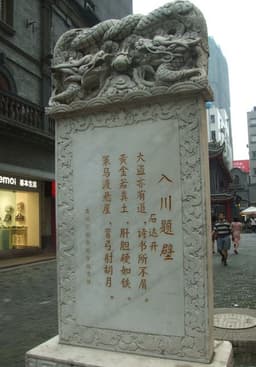
Shi Dakai
General · Modern
59.6Total
Basic Information
Born
1947
1831
Died
—
1863
Era
Modern
Modern
Nationality
Jordan
China
Occupation
General
General
Civilization
Middle Eastern
Eastern
Score Comparison
Military (10%)
10.2
76.0
Political (20%)
61.3
45.0
Influence (20%)
48.6
56.7
Legacy (20%)
38.3
54.0
Leadership (15%)
40.0
72.0
Strategy (15%)
36.8
68.1
TOTAL
41.6
59.6
Marouf al-Bakhit — Complete Timeline
2005 AD
Appointed Prime Minister of JordanPolitical Action◆ Major
King Abdullah II appointed Marouf al-Bakhit as Prime Minister of Jordan in November 2005, following the 2005 Amman bombings. Al-Bakhit, a former intelligence chief, was tasked with restoring security and stability.
JordanPrime MinisterAppointment
Impact: national
2007 AD
Resigned as Prime MinisterPolitical Action
Marouf al-Bakhit resigned as Prime Minister of Jordan in November 2007 after parliamentary elections. His resignation followed criticism of economic policies and political reforms.
JordanPrime MinisterResignation
Impact: national
2011 AD
Appointed Prime Minister for Second TermPolitical Action◆ Major
King Abdullah II appointed Marouf al-Bakhit as Prime Minister again in February 2011, during the Arab Spring protests. Al-Bakhit was tasked with implementing political reforms to address public demands.
JordanArab SpringPrime Minister
Impact: national
Resigned as Prime Minister for Second TermPolitical Action
Marouf al-Bakhit resigned as Prime Minister in October 2011, after failing to satisfy protesters' demands for faster political reforms. His resignation marked the end of his second term.
JordanArab SpringResignation
Impact: national
Shi Dakai — Complete Timeline
1851 AD
Jintian UprisingWar◆ Major
Shi Dakai joined the Taiping Rebellion at its inception in Jintian, Guangxi. As a core leader, he helped organize the rebel forces and was appointed Wing King, becoming one of the key military commanders of the Taiping Heavenly Kingdom.
Taiping RebellionUprisingMilitary Command
Impact: national
1854 AD
Battle of XiangtanWar◆ Major
Shi Dakai led Taiping forces to a major victory at Xiangtan, Hunan, defeating Qing imperial troops. This battle secured Taiping control over key territories in the Yangtze River valley and demonstrated his military skill.
Taiping RebellionBattleVictory
Impact: regional
1856 AD
Tianjing IncidentPolitical Action
Shi Dakai returned to Tianjing (Nanjing) after the internal purge of the Eastern King Yang Xiuqing and the murder of the Northern King Wei Changhui. He condemned the violence and was forced to flee, leading to a split in Taiping leadership.
Taiping RebellionInternal ConflictPurge
Impact: nationaltragic
1858 AD
Campaign in Zhejiang and FujianWar
Shi Dakai led a separate Taiping army into Zhejiang and Fujian provinces, capturing several cities. This campaign expanded Taiping influence into southeastern China but also isolated his forces from the main Taiping base.
Taiping RebellionCampaignExpansion
Impact: regional
1863 AD
Battle of Baishui RiverWar◆ Major
Shi Dakai's army was trapped and defeated by Qing forces at the Baishui River in Sichuan. He was captured and executed shortly after, marking the end of his military career and a significant loss for the Taiping cause.
Taiping RebellionBattleDefeatDeath
Impact: nationaltragic
Expert Analysis
Shi Dakai vs Marouf al-Bakhit
# The General and the Prime Minister: Two Paths from the Battlefield
In the summer of 1863, on the banks of the Baishui River in Sichuan, a 32-year-old general named Shi Dakai watched his army collapse around him. He had been the Wing King of the Taiping Heavenly Kingdom, a military prodigy who had once terrified the Qing Empire. Now, surrounded and outnumbered, he surrendered in a desperate gambit to save his men. They executed him by slow slicing, a death reserved for the most feared rebels.
A century and a half later, on the other side of Asia, another man with a military background stood before a different kind of crisis. In February 2011, Marouf al-Bakhit, a former Jordanian intelligence chief, was summoned to the royal palace in Amman. King Abdullah II appointed him prime minister for the second time, hoping his security credentials could calm the streets during the Arab Spring. He lasted eight months.
One man died a martyr for a failed revolution. The other served a king and faded into obscurity. Both were generals. Both stepped into history at moments of upheaval. Yet their fates could not have been more different. The question is not simply *what* they did, but *why* — and the answer lies in the worlds they inhabited.
Origins
Shi Dakai was born in 1831 into a wealthy Hakka family in Guangxi, southern China. The Qing Dynasty was rotting from within: opium wars, peasant rebellions, foreign humiliation. Young Shi was well-educated, skilled in martial arts, and deeply influenced by the strange new Christian-infused ideology of Hong Xiuquan, a failed scholar who claimed to be the brother of Jesus Christ. For Shi, the Taiping movement offered something intoxicating — a chance to tear down the old order and build a "Heavenly Kingdom" of equality. He joined the uprising in 1851 at the Jintian Uprising, barely twenty years old, with nothing to lose and everything to prove.
Marouf al-Bakhit was born in 1947 in a small Jordanian town, into a country that had been carved out of the Ottoman Empire by British diplomats. Jordan was a fragile kingdom, surrounded by enemies, dependent on Western support. Bakhit chose a different path: the military academy, then the intelligence service, then the royal court. He was not a revolutionary. He was a fixer — a man trained to manage crises, not to ignite them.
The difference in their origins is fundamental. Shi Dakai was forged in the furnace of a collapsing empire, where the only way forward was to burn everything down. Bakhit was shaped by a kingdom that survived precisely by avoiding revolution. One was born into a world of chaos; the other into a world of careful balance.
Rise to Power
Shi Dakai’s ascent was meteoric. By 1854, at age 23, he was already a field commander. At the Battle of Xiangtan, he crushed Qing forces and secured Hunan for the Taiping. His military score of 84.6 reflects not just tactical skill but a kind of genius — he could read terrain, timing, and enemy psychology. He became the Wing King, one of the original princes of the Heavenly Kingdom, and his reputation spread across China. The Qing court offered amnesties, bribes, even a separate kingdom — all to lure him away. He refused.
Bakhit rose more slowly, through the ranks of Jordan’s intelligence apparatus. By the time he became prime minister in 2005, he was 58 years old. His appointment came after the Amman bombings, when the kingdom needed a firm hand. He was not a conqueror but a stabilizer. His military score of 19.9 is not a mark of cowardice; it simply measures a different kind of service. He never led troops in battle. He led bureaucrats.
The contrast is stark: Shi Dakai seized power through sheer audacity and blood; Bakhit was handed power by a king who needed a loyal servant.
Leadership & Governance
Shi Dakai was the Taiping’s best general, but he was never its supreme leader. After the Tianjing Incident of 1856 — when Hong Xiuquan ordered the massacre of the Eastern King Yang Xiuqing and his followers — Shi returned to the capital in horror. He pleaded for restraint, for unity. Instead, he was suspected of disloyalty. He fled, taking his army west, and for years he fought a lonely campaign through Zhejiang, Fujian, and finally Sichuan. He was a brilliant commander trapped in a movement that was eating itself alive.
Bakhit governed in a very different way. As prime minister, his job was to implement the king’s will, not to challenge it. His political score of 63.0 suggests competence, not charisma. During his first term, he oversaw economic reforms and security measures. During his second, he faced protesters demanding political freedoms. He offered concessions — a new election law, anti-corruption measures — but the protests only grew. He was caught between a monarch who would not surrender power and a people who would not accept half-measures.
Shi Dakai’s leadership was heroic but doomed. Bakhit’s was pragmatic but hollow.
Triumph & Tragedy
Shi Dakai’s greatest triumph was also his tragedy. In 1863, trapped in Sichuan, he chose to surrender personally to the Qing commander, hoping to spare his remaining soldiers. It was a noble gesture. The Qing accepted his surrender — then executed him by slow slicing anyway. His men were slaughtered. His last act was a miscalculation of staggering proportions, born of a faith in honor that the enemy did not share.
Bakhit’s tragedy was quieter. He resigned in 2007 after parliamentary elections, then again in 2011 when the Arab Spring proved too powerful. He did not die a martyr. He simply returned to private life, a footnote in Jordanian history. His legacy score of 50.0 reflects this: a man who served his king but changed nothing.
Character & Destiny
Shi Dakai was driven by conviction. He believed in the Taiping cause — a strange mix of Christian theology and Chinese utopianism — and he was willing to die for it. That conviction made him brilliant on the battlefield but blind to politics. He could win battles but not peace. He could inspire loyalty but not build institutions. His leadership score of 76.6 suggests a man who could command armies but not kingdoms.
Bakhit was driven by duty. He served the Hashemite monarchy because that was the path he had chosen. He was not a visionary; he was a technocrat. His leadership score of 77.9 is nearly identical to Shi’s, but it measures a different quality: the ability to manage, not to inspire.
Legacy
Shi Dakai is remembered in China as a tragic hero — a brilliant general who fought for a lost cause. His legacy score of 65.9 is modest, but his story endures in folk tales, novels, and films. He is the romantic rebel, the knight of the Heavenly Kingdom.
Marouf al-Bakhit is barely remembered at all. His name appears in academic footnotes about the Arab Spring. He was a caretaker, not a creator. His legacy score of 50.0 is a statistical shrug.
Conclusion
The difference between these two generals is not in their scores but in their contexts. Shi Dakai lived in an age of revolutions, when a man could rise from nothing and challenge an empire. Bakhit lived in an age of managed stability, when the best a general could hope for was to keep the palace doors open.
One died for a dream. The other served a system. Both were men of their time — and their time shaped them as surely as they shaped it. In the end, the question is not which was greater, but which world we would rather live in: the one where heroes burn bright and die young, or the one where they grow old and fade away.
Rankings
🥇
Shi DakaiLeader
Mil: 76.0Pol: 45.0Inf: 56.7
59.6
🥈
Marouf al-Bakhit
Mil: 10.2Pol: 61.3Inf: 48.6
41.6
+18.0 behind
How This Comparison Works
Algorithm
Each figure is scored on 6 dimensions (0—100 scale) based on structured historical data: Military (10%), Political (20%), Influence (20%), Legacy (20%), Leadership (15%), Strategy (15%). The weighted total produces the final ranking.
Data Sources
Scores are computed from structured sub-indicators in the database. Scale factors adjust for era (Ancient ×0.85, Modern ×1.0) and civilization size (Eastern ×1.05, Other ×0.80) to account for differences in population and military scale.
Maximum 3 Figures
Comparisons are limited to 2—3 figures to ensure readability and statistical meaningfulness.
Error Margins
±5 points per dimension — Sub-scores are derived from historical records with inherent uncertainty. Two figures within 5 points on a dimension should be considered roughly equivalent in that area.
Total Score Accuracy
±3 points overall — The weighted combination of 6 dimensions produces a total score with approximately ±3 points of uncertainty. Differences of less than 3 points are not statistically significant— the figures are effectively tied.
Known Limitations
- Historical records are incomplete and uneven across civilizations
- Figures from oral-tradition societies may be underrepresented
- Occupation labels can misclassify multi-role figures
- Scores measure capability and impact, not moral character
- Quantitative scoring is a comparison tool, not absolute truth
Capability Radar
Military (10%) — Battles & Warfare
Battles
5
75
Win Rate
5
70
Expansion
5
75
Political (20%) — Governance & Reform
Reform
30
50
Diplomacy
40
45
Economy
30
40
Influence (20%) — Cultural & Global Reach
Cultural
10
55
Global
10
40
Legacy (20%) — Historical Impact
Historical
10
60
Longevity
10
45
Leadership (15%) — Power & Stability
Tenure
40
55
Stability
35
35
Strategy (15%) — Tactics & Innovation
Strategy
10
80
Tactics
10
85
Reform
10
60
Similar Comparisons
Comments & Discussion
铁血史官6/16/2026
石达开是真正的悲剧英雄,他在大渡河边本可突围,却因顾及三千将士性命而投降,结果清军背信弃义,将他凌迟处死。这份义气在晚清乱世中显得格格不入。而巴希特不过是约旦哈希姆王室的一枚棋子,2011年阿拉伯之春时他被扔出来平息民怨,八个月后就被踢开。一个是理想主义的殉道者,一个是官僚体系的工具人,高下立判。
数据猎人6/16/2026
两人根本不在一个量级。石达开指挥过数万人的战役,太平天国最鼎盛时期他打的胜仗差点推翻满清。巴希特呢?他的“战场”是情报局的办公室和议会的投票厅。石达开靠实力封王,巴希特靠关系当官。历史记住石达开是因为他用鲜血写下的篇章,而巴希特的名字只会出现在约旦内阁的脚注里。别拿将军和政客混为一谈。
Historian8306/16/2026
Shi Dakai was a true military genius who outmaneuvered the Qing for years, but he made a fatal mistake: he trusted the enemy's word. Surrendering to save his troops was noble but naive — the Qing never honored such deals. Marouf al-Bakhit, by contrast, was a security man playing politics, and he knew better than to trust anyone. One died a martyr; the other survived as a bureaucrat. That’s the difference between a revolutionary and a loyalist.
Historian4226/16/2026
I’ve read both men’s biographies, and here’s the kicker: Shi Dakai’s surrender was a calculated gamble that failed because the Qing were ruthless pragmatists. Al-Bakhit’s appointment was a royal gamble that failed because no security chief can paper over economic collapse. Both men were pawns in bigger games, but Shi chose his fate with honor, while al-Bakhit just took orders. I respect the man who fights and falls over the one who sits and survives.
Chronicler79826/16/2026
Comparing a 19th-century general to a 21st-century prime minister is apples and oranges. Shi Dakai led a rebellion against a crumbling empire; al-Bakhit managed a monarchy’s PR crisis. The only thing they share is a uniform. Let’s not romanticize failure — Shi lost his army and his life, while al-Bakhit kept his head down and kept his pension. One was a spectacular disaster, the other a dull survival.