Loading...
Louis XI of France vs Napoleon Bonaparte
Napoleon Bonaparte leads by 4.7 pts · 2 figures compared
…
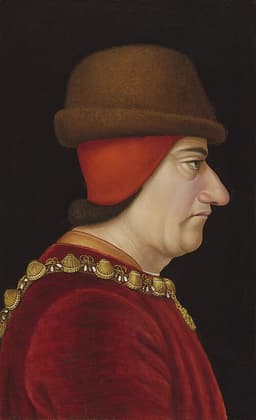
Louis XI of France
Emperor · Medieval
66.2Total

Napoleon Bonaparte
General · Modern
70.9Total
Basic Information
Born
1423
1769
Died
1483
1821
Era
Medieval
Modern
Nationality
France
France
Occupation
Emperor
General
Civilization
Western
Western
Score Comparison
Military (10%)
47.5
94.0
Political (20%)
78.0
72.0
Influence (20%)
65.0
40.0
Legacy (20%)
65.0
80.0
Leadership (15%)
78.0
78.0
Strategy (15%)
55.0
90.0
TOTAL
66.2
70.9
Louis XI of France — Complete Timeline
1464 AD
Established the Postal ServiceReform
Louis XI established a royal postal service, creating a network of relay stations for rapid communication across France. This system improved administrative efficiency and royal control over the realm.
Postal ServiceAdministrationCommunication
Impact: nationalconstructive
1465 AD
Defeated the League of the Public WealWar◆ Major
Louis XI defeated the League of the Public Weal, a coalition of rebellious nobles led by the Duke of Burgundy and the Duke of Berry. The victory at the Battle of Montlh
Civil WarNobilityRoyal Authority
Impact: national
1469 AD
Imprisoned Cardinal BaluePolitical Action
Louis XI imprisoned his own minister, Cardinal Jean Balue, for treason after discovering his secret correspondence with Charles the Bold. Balue was held in an iron cage for over a decade, demonstrating Louis's ruthless treatment of disloyal officials.
ImprisonmentTreasonIron Cage
Impact: nationaldestructive
1474 AD
Supported the Swiss Confederacy against BurgundyWar
Louis XI provided financial and diplomatic support to the Swiss Confederacy in their war against Charles the Bold of Burgundy. This alliance contributed to Burgundy's defeat and the eventual collapse of the Burgundian state.
AllianceSwissBurgundian Wars
Impact: regionalconstructive
1475 AD
Signed the Treaty of PicquignyPolitical Action◆ Major
Louis XI signed the Treaty of Picquigny with King Edward IV of England, ending the Hundred Years' War. The treaty included a payment to Edward IV to withdraw his invading army, securing peace and saving France from invasion.
TreatyHundred Years' WarDiplomacy
Impact: regionalconstructive
1477 AD
Acquired the Duchy of BurgundyWar◆ Major
After the death of Charles the Bold at the Battle of Nancy, Louis XI seized the Duchy of Burgundy and other Burgundian territories. This acquisition significantly expanded the French crown's lands and reduced Burgundian power.
Territorial ExpansionBurgundyRoyal Domain
Impact: regionalconstructive
Napoleon Bonaparte — Complete Timeline
1799 AD
Coup of 18 BrumaireOther◆ Major
Napoleon Bonaparte, with support from his brother Lucien and key political figures, overthrew the Directory in a bloodless coup. He established the Consulate with himself as First Consul, effectively becoming the ruler of France. This event ended the French Revolution's most unstable period.
French RevolutionCoupRise to Power
Impact: regional
1804 AD
Promulgation of the Napoleonic CodeOther◆ Major
Napoleon enacted the Civil Code of the French, known as the Napoleonic Code, a comprehensive set of laws that replaced the fragmented feudal legal systems. The code established legal equality, protected property rights, and secularized law. It became the basis for legal systems in many European and world countries.
Legal ReformNapoleonic CodeCivil Law
Impact: globalconstructive
1805 AD
Battle of AusterlitzWar◆ Major
Napoleon's Grande Arm
Napoleonic WarsBattleDecisive Victory
Impact: global
1812 AD
Invasion of RussiaWar◆ Major
Napoleon led the Grande Arm
Napoleonic WarsInvasionDisaster
Impact: globaldestructive
1815 AD
Battle of WaterlooWar◆ Major
Napoleon's French army was defeated by the combined forces of the Duke of Wellington's Anglo-Allied army and Gebhard Leberecht von Bl
Napoleonic WarsBattleFinal Defeat
Impact: globaldestructive
Expert Analysis
louis-xi-of-france-vs-napoleon-bonaparte
# The Spider and the Eagle
On a winter evening in 1477, a pale, nervous king sat in his castle at Plessis-lès-Tours, surrounded by iron cages and the whispers of spies. He had just swallowed the richest duchy in Europe without firing a single shot. Four centuries later, another Frenchman would conquer a continent with cannon fire and cavalry charges, only to die on a remote island in the South Atlantic. One built a kingdom from shadows; the other built an empire from glory. Both were French. Both reshaped history. But their paths could not have diverged more sharply. Why did the Spider succeed where the Eagle failed?
Origins
Louis XI was born in 1423, into a France broken by the Hundred Years’ War. His father, Charles VII, was a hesitant king, and young Louis grew up watching nobles treat the crown as a plaything. He learned early that trust was a weakness. His nickname, the “Universal Spider,” came not from malice but from his method: he wove webs of intrigue, pulling threads from every corner of his kingdom. He was not a warrior; he was a weaver.
Napoleon Bonaparte, born in 1769 on the island of Corsica, emerged from a very different France. The Revolution had shattered the old order, creating a vacuum where talent, not birth, could rise. Napoleon was a child of the Enlightenment and the cannon’s roar. Where Louis saw a web, Napoleon saw a battlefield. His education was military, his ambition limitless. The era demanded a hero, and Napoleon obliged.
Rise to Power
Louis XI did not seize power; he inherited it in 1461, but inheritance was only the beginning. He spent his early reign fighting his own nobles, particularly the Duke of Burgundy, Charles the Bold. In 1465, the League of the Public Weal—a coalition of rebellious dukes—nearly unseated him. Louis did not crush them in a glorious battle; he negotiated, bribed, and divided them. He understood that a king’s greatest weapon was patience.
Napoleon’s rise was swift and violent. In 1795, he scattered royalist rebels with a “whiff of grapeshot.” By 1799, he had overthrown the Directory in a coup. He was thirty years old. Where Louis maneuvered for decades, Napoleon conquered in months. The Revolution had created a ladder, and Napoleon climbed it with breathtaking speed. His path was straight and bloody; Louis’s was crooked and quiet.
Leadership & Governance
As king, Louis XI was a master of administration. In 1464, he established a royal postal service—relay stations that allowed him to communicate faster than any rival. He imprisoned his own minister, Cardinal Balue, in 1469 when he discovered treason. He signed the Treaty of Picquigny with England in 1475, ending the Hundred Years’ War with a bribe rather than a battle. His greatest coup came in 1477: when Charles the Bold died at Nancy, Louis simply seized Burgundy. No war, no glory—just a signature.
Napoleon governed through conquest and code. His Napoleonic Code standardized law across Europe, abolishing feudalism and establishing meritocracy. But his rule was a constant campaign. He reformed France’s education, economy, and infrastructure, yet his empire rested on military victory. He was a genius of strategy—his 93 out of 100 in that category speaks to his brilliance at Austerlitz in 1805—but he could not stop fighting. Louis built a state; Napoleon built an army.
Triumph & Tragedy
Louis XI’s greatest triumph was the unification of France. By 1483, he had broken the great noble houses, centralized taxation, and expanded royal lands. His tragedy was personal: he died in paranoid isolation, surrounded by guards and cages, terrified of poison. He had won the kingdom but lost his peace.
Napoleon’s triumph was his empire—from the Pyrenees to the Russian border. His tragedy was hubris. The invasion of Russia in 1812 destroyed his Grande Armée. At Waterloo in 1815, his final gamble failed. He died in exile on Saint Helena in 1821, a prisoner of the British. Louis died in his bed; Napoleon died in a cage of the world’s making.
Character & Destiny
Louis XI was cautious, cunning, and cold. He believed that a king must be feared, not loved. He wore shabby clothes, ate simple food, and trusted no one. His personality was defensive: he built walls, both literal and political. Napoleon was the opposite: charismatic, bold, and hungry for glory. He believed in destiny. “Impossible is not French,” he once said. But his ambition became his undoing. Louis’s caution preserved his kingdom; Napoleon’s daring cost him everything.
Legacy
Louis XI is remembered as the architect of modern France. His legacy score of 80 reflects his quiet, enduring impact. He laid the foundations for absolute monarchy, which would reach its peak under Louis XIV. Napoleon’s legacy is more dazzling but more contested. His score of 78 is lower, perhaps because his empire collapsed in his lifetime. Yet his legal reforms, his military innovations, and his myth endure. Louis built a house; Napoleon built a legend.
Conclusion
The Spider and the Eagle both sought to remake France, but they moved in opposite directions. Louis XI worked from the inside out, weaving threads of power that held for centuries. Napoleon Bonaparte worked from the outside in, striking with such force that the world bent—until it broke. One died in a fortress of his own making, the other on a rock in the ocean. Both were French. Both were brilliant. But the Spider understood that history is a slow loom, not a sudden thunderbolt. The Eagle learned that lesson too late.
Rankings
🥇
Napoleon BonaparteLeader
Mil: 94.0Pol: 72.0Inf: 40.0
70.9
🥈
Louis XI of France
Mil: 47.5Pol: 78.0Inf: 65.0
66.2
+4.7 behind
How This Comparison Works
Algorithm
Each figure is scored on 6 dimensions (0—100 scale) based on structured historical data: Military (10%), Political (20%), Influence (20%), Legacy (20%), Leadership (15%), Strategy (15%). The weighted total produces the final ranking.
Data Sources
Scores are computed from structured sub-indicators in the database. Scale factors adjust for era (Ancient ×0.85, Modern ×1.0) and civilization size (Eastern ×1.05, Other ×0.80) to account for differences in population and military scale.
Maximum 3 Figures
Comparisons are limited to 2—3 figures to ensure readability and statistical meaningfulness.
Error Margins
±5 points per dimension — Sub-scores are derived from historical records with inherent uncertainty. Two figures within 5 points on a dimension should be considered roughly equivalent in that area.
Total Score Accuracy
±3 points overall — The weighted combination of 6 dimensions produces a total score with approximately ±3 points of uncertainty. Differences of less than 3 points are not statistically significant— the figures are effectively tied.
Known Limitations
- Historical records are incomplete and uneven across civilizations
- Figures from oral-tradition societies may be underrepresented
- Occupation labels can misclassify multi-role figures
- Scores measure capability and impact, not moral character
- Quantitative scoring is a comparison tool, not absolute truth
Capability Radar
Military (10%) — Battles & Warfare
Battles
45
95
Win Rate
50
90
Expansion
60
95
Political (20%) — Governance & Reform
Reform
80
95
Diplomacy
90
80
Economy
75
85
Influence (20%) — Cultural & Global Reach
Cultural
60
85
Global
65
90
Legacy (20%) — Historical Impact
Historical
80
95
Longevity
75
90
Leadership (15%) — Power & Stability
Tenure
85
85
Stability
70
70
Strategy (15%) — Tactics & Innovation
Strategy
70
95
Tactics
55
98
Reform
65
92
Similar Comparisons
Comments & Discussion
SpiderWebStrategist6/17/2026
Louis XI was the better strategist because he understood that wars are won before they're fought. While Napoleon charged across Europe burning through 600,000 men in Russia alone, Louis dissolved the Burgundian threat by bribing Swiss mercenaries and exploiting internal divisions. The Spider never lost an army because he never committed one when diplomacy and gold worked faster. Glory fades; consolidation lasts.
RevolutionarySpirit_18806/17/2026
Comparing a medieval schemer to Napoleon is like comparing a candle to the sun. Napoleon didn't just conquer—he liberated Europe from feudal chains with the Napoleonic Code, meritocracy, and religious tolerance. Louis XI tortured prisoners in iron cages and crushed regional identities. The Eagle gave France modern institutions; the Spider gave us paranoia and censorship. I know who I'd follow.
历史真相挖掘机6/17/2026
你们都被拿破仑的军事神话骗了。统计显示他在位16年打了60场战役,平均每三个月就打一次仗,最后活活打空了法国整整一代青年。路易十一在位22年,用联姻和条约吞并了勃艮第、安茹等大片领土,法国人口反而增长了。战争狂人有什么资格跟治国大师比?
冷兵器爱好者6/17/2026
拿破仑的失败根源在于他不懂后勤。1812年征俄,他的大军只有战马就带了15万匹,结果冻死饿死大半。反观路易十一,连打仗都要先算清楚粮草,1475年对英作战时用年金买通爱德华四世退兵,一仗没打就解决危机。这种精打细算的智慧,比什么奥斯特里茨战役都高明。