Loading...
Li Zicheng vs Zhang Xianzhong
Li Zicheng leads by 2.4 pts · 2 figures compared
…
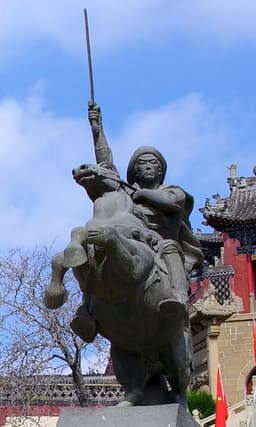
Li Zicheng
Revolutionary · Modern
43.5Total

Zhang Xianzhong
Revolutionary · Modern
41.1Total
Basic Information
Born
1606
1606
Died
1645
1647
Era
Modern
Modern
Nationality
China
China
Occupation
Revolutionary
Revolutionary
Civilization
Eastern
Eastern
Score Comparison
Military (10%)
50.0
55.0
Political (20%)
27.9
35.0
Influence (20%)
52.5
44.8
Legacy (20%)
44.2
40.0
Leadership (15%)
39.0
35.4
Strategy (15%)
43.3
38.3
TOTAL
43.5
41.1
Li Zicheng — Complete Timeline
1644 AD
Captured Beijing and Ended the Ming DynastyWar
Li Zicheng led his rebel army to capture Beijing. The Chongzhen Emperor committed suicide, ending the Ming dynasty. Li Zicheng proclaimed the Shun dynasty and briefly ruled from the Forbidden City before being defeated by Qing forces.
Ming-Qing TransitionRebellionBeijing
Impact: globaldestructive
Defeated at the Battle of Shanhai PassWar◆ Major
Li Zicheng's army was defeated by the combined forces of Wu Sangui and the Manchus at the Battle of Shanhai Pass. The defeat forced him to abandon Beijing and retreat westward, effectively ending his control over northern China.
Ming-Qing TransitionBattleDefeat
Impact: globaltragic
Proclaimed the Shun DynastyPolitical Action◆ Major
After capturing Beijing, Li Zicheng formally proclaimed the establishment of the Shun dynasty in Xi'an. He adopted the title of emperor and began implementing his own administrative policies, though his rule was short-lived.
Shun DynastyProclamationRebellion
Impact: nationalconstructive
1645 AD
Killed in Jiugong MountainWar◆ Major
Li Zicheng was killed by a local militia while fleeing through Jiugong Mountain in Hubei province. His death marked the end of the Shun dynasty and the collapse of his rebellion, though some accounts claim he survived and became a monk.
Shun DynastyDeathRebellion
Impact: nationaltragic
Zhang Xianzhong — Complete Timeline
1630 AD
Launched Rebellion in ShaanxiWar◆ Major
Zhang Xianzhong joined a peasant rebellion in Shaanxi province during the late Ming dynasty. He quickly rose to become a major rebel leader, gathering a large army and establishing a base of operations in the region.
Ming DynastyRebellionShaanxi
Impact: regionaldestructive
1644 AD
Captured and Sacked ChengduWar◆ Major
Zhang Xianzhong captured the city of Chengdu, the capital of Sichuan province. He then proclaimed the Daxi dynasty and made Chengdu his capital. The capture was accompanied by widespread destruction and massacres of the local population.
Ming-Qing TransitionSichuanMassacre
Impact: regionaldestructive
Proclaimed the Daxi DynastyPolitical Action◆ Major
Zhang Xianzhong proclaimed the Daxi (Great Western) dynasty in Sichuan. He established a government and minted his own coinage. His rule was characterized by extreme violence, including the systematic killing of scholars, officials, and civilians.
Daxi DynastyProclamationSichuan
Impact: regionaldestructive
1647 AD
Killed in Battle Against Qing ForcesWar◆ Major
Zhang Xianzhong was killed in battle against Qing forces in Xichong, Sichuan. His death led to the collapse of the Daxi dynasty. The Qing conquest of Sichuan was completed shortly after, but the province had been devastated by years of warfare.
Qing DynastyBattleDeath
Impact: regionaltragic
Expert Analysis
Zhang Xianzhong vs Li Zicheng
# The Rebel Kings of Chaos: Li Zicheng and Zhang Xianzhong
On a spring morning in 1644, two men born in the same year, in the same famine-stricken province of Shaanxi, stood at the threshold of power that would define China’s destiny for centuries. One would enter Beijing as its conqueror, only to flee weeks later in disgrace; the other would carve out a bloody kingdom in Sichuan, remembered not for his rule but for the silence he left behind. How did two rebels, sharing the same desperate origins, end up on such divergent paths—one briefly touching the dragon throne, the other sinking into infamy?
Origins
Li Zicheng and Zhang Xianzhong both emerged from the cauldron of the late Ming dynasty, a time when corruption, drought, and famine had turned northern China into a powder keg. Li was born into a peasant family in Mizhi County, Shaanxi, around 1606. As a young man, he worked as a postal courier—a lowly but stable job—until the Ming government, desperate to cut costs, abolished the postal system. Thrown into unemployment, Li drifted into banditry, then rebellion. Zhang Xianzhong, born in Yan’an, Shaanxi, also around 1606, came from an even more desperate background. He was a soldier in the Ming army before deserting, then a cattle thief, and finally a rebel. Where Li’s early life suggested a man pushed into revolt by circumstance, Zhang’s hinted at a natural predator.
Their era shaped them profoundly. The Ming dynasty was collapsing under its own weight—emperors isolated in the Forbidden City, bureaucrats hoarding grain while peasants starved, and a professional army that could no longer feed or pay its soldiers. Both men understood that in such chaos, survival meant ruthlessness. But they interpreted that lesson differently.
Rise to Power
Li Zicheng rose through the ranks of peasant armies with a reputation for discipline and generosity. In 1633, he joined forces with another rebel leader, Gao Yingxiang, and after Gao’s death, Li inherited his followers. His turning point came in 1641, when he captured Luoyang and executed the Ming prince there, distributing the prince’s vast grain stores to the starving populace. This act—calculated, strategic, and merciful—won him a wave of popular support. By 1643, Li controlled much of northern China, and his army moved with an almost religious fervor, chanting “Welcome the King Chuang, and you shall have no taxes.”
Zhang Xianzhong’s rise was bloodier and more erratic. He first gained notoriety in 1630 by launching a rebellion in Shaanxi, but he oscillated between fighting the Ming and surrendering to them—a pattern of betrayal that made him feared and distrusted. In 1641, he captured Xiangyang in Hubei, but unlike Li, he did not win hearts; he emptied treasuries and massacred officials. His reputation for cruelty preceded him, and when he moved into Sichuan in 1644, he did so as a terror, not a liberator.
Leadership & Governance
Li Zicheng, after capturing Beijing in April 1644 and ending the Ming dynasty, proclaimed the Shun dynasty in Xi’an. His leadership style was that of a peasant king: simple, direct, and suspicious of the scholar-officials who had once oppressed him. He attempted to govern by reducing taxes and redistributing land, but he failed to secure the loyalty of the Ming bureaucracy or the military. His greatest tactical error was underestimating the Manchu threat. When Wu Sangui, the Ming general guarding the Shanhai Pass, defected to the Manchus, Li’s army—exhausted and overconfident—was crushed at the Battle of Shanhai Pass in May 1644. Li’s political wisdom, measured at a score of 40.3, proved fatally inadequate for the complexities of empire.
Zhang Xianzhong, in contrast, ruled Sichuan through terror. After capturing Chengdu in 1644, he proclaimed the Daxi dynasty and minted his own coins, but his governance consisted largely of purges. He ordered massacres that, by some accounts, depopulated vast areas of Sichuan. His military score of 63.4 reflects his tactical skill in battle, but his leadership score of 34.5 reveals a man who could not inspire loyalty—only fear. His strategy score of 45.9 suggests a mind focused on immediate conquest rather than long-term survival.
Triumph & Tragedy
Li Zicheng’s greatest moment was also his tragedy. Entering Beijing in 1644, he stood at the pinnacle of a peasant rebellion that had toppled a 276-year dynasty. But his triumph lasted only forty-two days. His army, drunk on victory, looted the city; his officials tortured Ming loyalists for hidden wealth; and his failure to negotiate with Wu Sangui sealed his doom. Fleeing Beijing, Li was killed in 1645 by a local militia in Jiugong Mountain, Hubei—a peasant killed by peasants.
Zhang Xianzhong’s tragedy was more drawn out. He ruled Sichuan for three years, but his paranoia grew into madness. In 1647, facing Qing forces, he was killed in battle at Xichong. His Daxi dynasty collapsed immediately, and Sichuan lay so devastated that it took decades to repopulate. Zhang’s influence score of 62.9 is high, but it is the influence of a cautionary tale.
Character & Destiny
The difference between these two men lies in their character. Li Zicheng was a pragmatist who believed that winning the people would win the empire—until he forgot that lesson in Beijing. Zhang Xianzhong was a nihilist who believed that fear alone could hold power. Both were wrong. Li’s downfall came from his inability to transition from rebel to ruler; Zhang’s from his inability to see beyond destruction. The Chongzhen Emperor, the last Ming ruler, famously wrote on his clothes before hanging himself: “Let the rebels dismember my corpse, but do not harm my people.” Neither rebel honored that plea.
Legacy
Li Zicheng is remembered as a tragic figure—a man who nearly succeeded, whose failures paved the way for the Qing dynasty. His legacy score of 62.0 reflects a complex memory: a hero to some, a warning to others. Zhang Xianzhong, with a legacy score of 56.0, is remembered as a monster. In Sichuan, folk tales still whisper of the “Sichuan massacre,” and his name is synonymous with cruelty.
Conclusion
Sitting in the ruins of a dynasty, Li Zicheng and Zhang Xianzhong shared a moment in history that could have gone either way. One chose mercy, then forgot it; the other chose terror, and never knew anything else. Their stories remind us that in times of collapse, character is destiny—and that the difference between a failed rebellion and a failed dynasty is often measured not in strategy, but in the choices made when power is finally within reach.
Rankings
🥇
Li ZichengLeader
Mil: 50.0Pol: 27.9Inf: 52.5
43.5
🥈
Zhang Xianzhong
Mil: 55.0Pol: 35.0Inf: 44.8
41.1
+2.4 behind
How This Comparison Works
Algorithm
Each figure is scored on 6 dimensions (0—100 scale) based on structured historical data: Military (10%), Political (20%), Influence (20%), Legacy (20%), Leadership (15%), Strategy (15%). The weighted total produces the final ranking.
Data Sources
Scores are computed from structured sub-indicators in the database. Scale factors adjust for era (Ancient ×0.85, Modern ×1.0) and civilization size (Eastern ×1.05, Other ×0.80) to account for differences in population and military scale.
Maximum 3 Figures
Comparisons are limited to 2—3 figures to ensure readability and statistical meaningfulness.
Error Margins
±5 points per dimension — Sub-scores are derived from historical records with inherent uncertainty. Two figures within 5 points on a dimension should be considered roughly equivalent in that area.
Total Score Accuracy
±3 points overall — The weighted combination of 6 dimensions produces a total score with approximately ±3 points of uncertainty. Differences of less than 3 points are not statistically significant— the figures are effectively tied.
Known Limitations
- Historical records are incomplete and uneven across civilizations
- Figures from oral-tradition societies may be underrepresented
- Occupation labels can misclassify multi-role figures
- Scores measure capability and impact, not moral character
- Quantitative scoring is a comparison tool, not absolute truth
Capability Radar
Military (10%) — Battles & Warfare
Battles
55
55
Win Rate
60
50
Expansion
65
60
Political (20%) — Governance & Reform
Reform
15
5
Diplomacy
20
10
Economy
10
5
Influence (20%) — Cultural & Global Reach
Cultural
40
20
Global
35
15
Legacy (20%) — Historical Impact
Historical
55
35
Longevity
30
25
Leadership (15%) — Power & Stability
Tenure
20
30
Stability
5
5
Strategy (15%) — Tactics & Innovation
Strategy
55
40
Tactics
50
45
Reform
30
10
Similar Comparisons
Comments & Discussion
史痴书生6/16/2026
张献忠的“屠蜀”记载可信度存疑,《荒书》等清初文献明显掺了政治水分。四川人口暴跌,清军与南明拉锯战才是主因,全推给一人太省事。李自成进北京后拷掠百官、逼反吴三桂,纯属自毁长城——两人都是乱世产物,但张献忠至少建了大西政权,李自成连政权都没稳固就垮了。别拿道德标签当历史分析。
QuantCritic6/16/2026
The real gulf between Li and Zhang isn't glory vs. infamy—it's data. Zhang's Sichuan campaign cost maybe 500K to 1M lives over eight years, but Li's northern rampage from 1640-44 displaced 3-5M people and broke Ming tax base. Yet we obsess over Chengdu "ghost cities" while ignoring that Li's brief reign triggered the Qing takeover, which killed over 25M through 1662. Li's incompetence had a bigger body count than Zhang's cruelty. Scale matters more than reputation.
混世评说6/16/2026
两人同年同省出身很有趣,但李自成是理想主义失败者,张献忠是务实机会主义者。李闯王叫“迎闯王不纳粮”,结果进京后粮仓空虚还纵兵抢掠;张献忠早看透世道,干脆屠戮权贵、分田地,西朝虽短但治下四川底层反而活过一阵。一个死于九宫山乡勇,一个战死西充凤凰山——乱世里不是好人坏人,是赢家和输家。
RiseFallAncient6/16/2026
Zhang Xianzhong's Sichuan depopulation narrative serves as a convenient myth for Qing legitimacy. Between 1644 and 1681, disease, Qing campaigns, and refugee flight reduced Sichuan's registered population from ~3M to under 500K. Blaming one man lets later dynasties ignore their own complicity in the demographic disaster. Li Zicheng's failure was simpler: he couldn't transition from bandit to bureaucrat. Both are cautionary tales—Zhang told by victors, Li told by losers.
Historian2346/16/2026
Let's not romanticize these two. Li Zicheng was a tactless occupier who couldn't hold Beijing for even 42 days, while Zhang Xianzhong's "reward" in Sichuan was so brutal that his rival's remnants had to repopulate the province later. Both were destructive forces with zero administrative skill—the real difference is that Li briefly touched glory through Ming incompetence, while Zhang only earned himself a villain's epitaph. Their "divergent paths" are just two flavors of failure.