Loading...
This comparison has not been analyzed yet.
One-time AI generation (~1 minute). Scores and timeline are already available below.
Li Zicheng vs Stepan Bandera
Li Zicheng leads by 1.5 pts · 2 figures compared
…
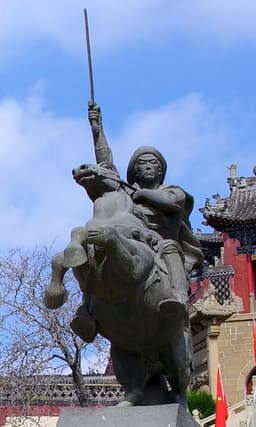
Li Zicheng
Revolutionary · Modern
43.5Total

Stepan Bandera
Revolutionary · Modern
42.0Total
Basic Information
Born
1606
1909
Died
1645
1959
Era
Modern
Modern
Nationality
China
Ukraine
Occupation
Revolutionary
Revolutionary
Civilization
Eastern
Western
Score Comparison
Military (10%)
50.0
45.0
Political (20%)
27.9
29.3
Influence (20%)
52.5
50.2
Legacy (20%)
44.2
40.8
Leadership (15%)
39.0
40.9
Strategy (15%)
43.3
42.3
TOTAL
43.5
42.0
Li Zicheng — Complete Timeline
1644 AD
Captured Beijing and Ended the Ming DynastyWar
Li Zicheng led his rebel army to capture Beijing. The Chongzhen Emperor committed suicide, ending the Ming dynasty. Li Zicheng proclaimed the Shun dynasty and briefly ruled from the Forbidden City before being defeated by Qing forces.
Ming-Qing TransitionRebellionBeijing
Impact: globaldestructive
Defeated at the Battle of Shanhai PassWar◆ Major
Li Zicheng's army was defeated by the combined forces of Wu Sangui and the Manchus at the Battle of Shanhai Pass. The defeat forced him to abandon Beijing and retreat westward, effectively ending his control over northern China.
Ming-Qing TransitionBattleDefeat
Impact: globaltragic
Proclaimed the Shun DynastyPolitical Action◆ Major
After capturing Beijing, Li Zicheng formally proclaimed the establishment of the Shun dynasty in Xi'an. He adopted the title of emperor and began implementing his own administrative policies, though his rule was short-lived.
Shun DynastyProclamationRebellion
Impact: nationalconstructive
1645 AD
Killed in Jiugong MountainWar◆ Major
Li Zicheng was killed by a local militia while fleeing through Jiugong Mountain in Hubei province. His death marked the end of the Shun dynasty and the collapse of his rebellion, though some accounts claim he survived and became a monk.
Shun DynastyDeathRebellion
Impact: nationaltragic
Stepan Bandera — Complete Timeline
1941 AD
Proclaimed Independence of UkrainePolitical Action◆ Major
Following the German invasion of the Soviet Union, Bandera and the OUN-B proclaimed an independent Ukrainian state in Lviv. This act was not recognized by Nazi Germany, which arrested Bandera and suppressed the declaration.
Ukrainian IndependenceOUNWorld War II
Impact: regional
Imprisoned in Sachsenhausen Concentration CampPolitical Action◆ Major
Bandera was arrested by the Gestapo and imprisoned in the Sachsenhausen concentration camp. He was held in a special section for political prisoners, where he remained until 1944, while his followers continued the nationalist struggle.
ImprisonmentNazi GermanySachsenhausen
Impact: regionaltragic
1945 AD
Led OUN-B from ExilePolitical Action◆ Major
After the war, Bandera settled in West Germany and continued to lead the OUN-B faction from exile. He organized anti-Soviet activities and maintained a network of supporters, becoming a symbol of Ukrainian nationalism.
ExileOUNCold War
Impact: regional
1959 AD
Assassinated by KGB Agent Bohdan StashynskyPolitical Action
Bandera was assassinated in Munich by KGB agent Bohdan Stashynsky using a cyanide spray gun. His death was a major blow to the Ukrainian nationalist movement in exile and highlighted Soviet efforts to eliminate opposition.
AssassinationKGBCold War
Impact: globaltragic
This comparison has not been analyzed yet.
One-time AI generation (~1 minute). Scores and timeline are already available below.
Rankings
🥇
Li ZichengLeader
Mil: 50.0Pol: 27.9Inf: 52.5
43.5
🥈
Stepan Bandera
Mil: 45.0Pol: 29.3Inf: 50.2
42.0
+1.5 behind
How This Comparison Works
Algorithm
Each figure is scored on 6 dimensions (0—100 scale) based on structured historical data: Military (10%), Political (20%), Influence (20%), Legacy (20%), Leadership (15%), Strategy (15%). The weighted total produces the final ranking.
Data Sources
Scores are computed from structured sub-indicators in the database. Scale factors adjust for era (Ancient ×0.85, Modern ×1.0) and civilization size (Eastern ×1.05, Other ×0.80) to account for differences in population and military scale.
Maximum 3 Figures
Comparisons are limited to 2—3 figures to ensure readability and statistical meaningfulness.
Error Margins
±5 points per dimension — Sub-scores are derived from historical records with inherent uncertainty. Two figures within 5 points on a dimension should be considered roughly equivalent in that area.
Total Score Accuracy
±3 points overall — The weighted combination of 6 dimensions produces a total score with approximately ±3 points of uncertainty. Differences of less than 3 points are not statistically significant— the figures are effectively tied.
Known Limitations
- Historical records are incomplete and uneven across civilizations
- Figures from oral-tradition societies may be underrepresented
- Occupation labels can misclassify multi-role figures
- Scores measure capability and impact, not moral character
- Quantitative scoring is a comparison tool, not absolute truth
Capability Radar
Military (10%) — Battles & Warfare
Battles
55
10
Win Rate
60
10
Expansion
65
10
Political (20%) — Governance & Reform
Reform
15
25
Diplomacy
20
20
Economy
10
10
Influence (20%) — Cultural & Global Reach
Cultural
40
40
Global
35
30
Legacy (20%) — Historical Impact
Historical
55
40
Longevity
30
35
Leadership (15%) — Power & Stability
Tenure
20
20
Stability
5
10
Strategy (15%) — Tactics & Innovation
Strategy
55
15
Tactics
50
15
Reform
30
20
Similar Comparisons
Comments & Discussion
No comments yet. Be the first to share your thoughts!