Loading...
This comparison has not been analyzed yet.
One-time AI generation (~1 minute). Scores and timeline are already available below.
Li Shi vs Qasim Khan
Qasim Khan leads by 0.1 pts · 2 figures compared
…
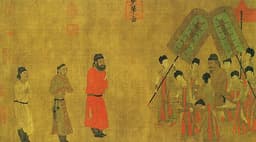
Li Shi
Emperor · Medieval
51.5Total

Qasim Khan
Emperor · Medieval
51.6Total
Basic Information
Born
742
1480
Died
805
1521
Era
Medieval
Medieval
Nationality
China
Kazakh Khanate
Occupation
Emperor
Emperor
Civilization
Eastern
Eastern
Score Comparison
Military (10%)
25.9
45.0
Political (20%)
68.0
53.8
Influence (20%)
51.8
55.7
Legacy (20%)
45.0
46.7
Leadership (15%)
72.0
66.0
Strategy (15%)
36.8
35.0
TOTAL
51.5
51.6
Li Shi — Complete Timeline
780 AD
Implementation of the Two-Tax SystemReform◆ Major
Li Shi adopted the Two-Tax System proposed by Chancellor Yang Yan. This reform replaced the equal-field system with a simplified tax based on land and property, collected twice a year. It increased revenue but also increased the burden on peasants.
Tax ReformTwo-Tax SystemFiscal Policy
Impact: nationalconstructive
783 AD
Suppression of the Jingyuan MutinyWar◆ Major
Troops from Jingyuan mutinied in Chang'an, forcing Li Shi to flee. The mutineers supported Zhu Ci as emperor. Li Shi's forces, with help from loyalist jiedushi, eventually suppressed the rebellion and recaptured the capital in 784.
MutinyRebellionCapital Recapture
Impact: nationaldestructive
785 AD
Reassertion of Central Authority over FanzhenPolitical Action
After the Jingyuan Mutiny, Li Shi attempted to reduce the power of military governors by appointing civil officials and rotating commanders. These efforts had limited success, as the fanzhen remained largely autonomous.
FanzhenCentralization AttemptMilitary Governors
Impact: national
805 AD
Death of Li ShiOther
Li Shi died in 805 after a reign marked by attempts at fiscal and administrative reform. His death led to a succession crisis and the brief reign of his son, who was soon deposed by eunuchs.
DeathSuccession Crisis
Impact: national
Qasim Khan — Complete Timeline
1500 AD
Consolidation of Kazakh Khanate TerritoryPolitical Action◆ Major
Qasim Khan expanded and consolidated the territory of the Kazakh Khanate, bringing most of the steppe regions under his control. He secured the eastern borders against the Moghulistan and the western borders against the Nogai Horde, establishing the khanate as a major regional power.
Territorial ExpansionKazakh Khanate
Impact: regionalconstructive
1510 AD
Alliance with the Timurid EmpirePolitical Action
Qasim Khan formed a diplomatic alliance with the Timurid ruler Babur, providing military support against the Shaybanid Uzbeks. This alliance helped secure the southern borders of the Kazakh Khanate and facilitated trade along the Silk Road.
DiplomacyAllianceTimurids
Impact: regionalconstructive
1511 AD
Codification of the Qasym Khannyn Qasqa ZholyReform◆ Major
Qasim Khan compiled and codified the first written legal code of the Kazakh Khanate, known as the 'Qasym Khannyn Qasqa Zholy' (Bright Path of Qasim Khan). This code regulated criminal, civil, and military law, establishing a unified legal framework for the nomadic Kazakh tribes and strengthening the khan's authority.
Legal CodeKazakh KhanateReform
Impact: nationalconstructive
This comparison has not been analyzed yet.
One-time AI generation (~1 minute). Scores and timeline are already available below.
Rankings
🥇
Qasim KhanLeader
Mil: 45.0Pol: 53.8Inf: 55.7
51.6
🥈
Li Shi
Mil: 25.9Pol: 68.0Inf: 51.8
51.5
+0.1 behind
How This Comparison Works
Algorithm
Each figure is scored on 6 dimensions (0—100 scale) based on structured historical data: Military (10%), Political (20%), Influence (20%), Legacy (20%), Leadership (15%), Strategy (15%). The weighted total produces the final ranking.
Data Sources
Scores are computed from structured sub-indicators in the database. Scale factors adjust for era (Ancient ×0.85, Modern ×1.0) and civilization size (Eastern ×1.05, Other ×0.80) to account for differences in population and military scale.
Maximum 3 Figures
Comparisons are limited to 2—3 figures to ensure readability and statistical meaningfulness.
Error Margins
±5 points per dimension — Sub-scores are derived from historical records with inherent uncertainty. Two figures within 5 points on a dimension should be considered roughly equivalent in that area.
Total Score Accuracy
±3 points overall — The weighted combination of 6 dimensions produces a total score with approximately ±3 points of uncertainty. Differences of less than 3 points are not statistically significant— the figures are effectively tied.
Known Limitations
- Historical records are incomplete and uneven across civilizations
- Figures from oral-tradition societies may be underrepresented
- Occupation labels can misclassify multi-role figures
- Scores measure capability and impact, not moral character
- Quantitative scoring is a comparison tool, not absolute truth
Capability Radar
Military (10%) — Battles & Warfare
Battles
20
45
Win Rate
15
50
Expansion
5
55
Political (20%) — Governance & Reform
Reform
65
70
Diplomacy
40
50
Economy
60
40
Influence (20%) — Cultural & Global Reach
Cultural
30
45
Global
20
30
Legacy (20%) — Historical Impact
Historical
40
50
Longevity
30
40
Leadership (15%) — Power & Stability
Tenure
70
60
Stability
30
55
Strategy (15%) — Tactics & Innovation
Strategy
15
45
Tactics
10
40
Reform
5
30
Similar Comparisons
Comments & Discussion
No comments yet. Be the first to share your thoughts!