Loading...
Emperor Taizu of Liao vs Qasim Khan
Emperor Taizu of Liao leads by 15.2 pts · 2 figures compared
…
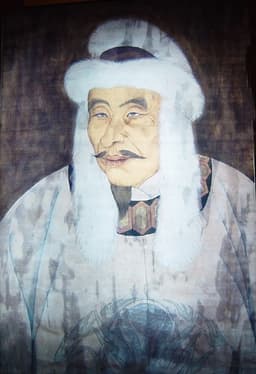
Emperor Taizu of Liao
Emperor · Medieval
66.8Total

Qasim Khan
Emperor · Medieval
51.6Total
Basic Information
Born
872
1480
Died
926
1521
Era
Medieval
Medieval
Nationality
China
Kazakh Khanate
Occupation
Emperor
Emperor
Civilization
Eastern
Eastern
Score Comparison
Military (10%)
76.0
45.0
Political (20%)
78.0
53.8
Influence (20%)
72.0
55.7
Legacy (20%)
40.0
46.7
Leadership (15%)
80.0
66.0
Strategy (15%)
75.0
35.0
TOTAL
66.8
51.6
Emperor Taizu of Liao — Complete Timeline
907 AD
Founding of the Liao DynastyPolitical Action
Abaoji, a Khitan chieftain, unified the Khitan tribes and proclaimed himself emperor, founding the Liao dynasty. This established the first major steppe-based dynasty to rule parts of northern China.
Dynasty FoundingUnification
Impact: regionalconstructive
916 AD
Establishment of the Dual Administration SystemReform◆ Major
Emperor Taizu established a dual administration system, with separate institutions for Khitan and Chinese subjects. This allowed the Liao to effectively govern both nomadic and agricultural populations, a model later adopted by other conquest dynasties.
Government ReformAdministration
Impact: regionalconstructive
920 AD
Creation of the Khitan ScriptCultural◆ Major
Emperor Taizu ordered the creation of a Khitan script, based on Chinese characters, to write the Khitan language. This script was used for official documents and inscriptions, promoting Khitan culture and administration.
Writing SystemCultural Development
Impact: regionalconstructive
926 AD
Conquest of the Bohai KingdomWar◆ Major
Emperor Taizu led a campaign that conquered the Bohai Kingdom in Manchuria. This victory expanded Liao territory eastward and eliminated a rival state, securing the Liao's eastern frontier.
ConquestExpansion
Impact: regionalconstructive
Death of Emperor TaizuPolitical Action
Emperor Taizu died during a campaign against the Bohai Kingdom. His death led to a succession struggle among his sons, but his son Yel
DeathSuccession
Impact: national
Qasim Khan — Complete Timeline
1500 AD
Consolidation of Kazakh Khanate TerritoryPolitical Action◆ Major
Qasim Khan expanded and consolidated the territory of the Kazakh Khanate, bringing most of the steppe regions under his control. He secured the eastern borders against the Moghulistan and the western borders against the Nogai Horde, establishing the khanate as a major regional power.
Territorial ExpansionKazakh Khanate
Impact: regionalconstructive
1510 AD
Alliance with the Timurid EmpirePolitical Action
Qasim Khan formed a diplomatic alliance with the Timurid ruler Babur, providing military support against the Shaybanid Uzbeks. This alliance helped secure the southern borders of the Kazakh Khanate and facilitated trade along the Silk Road.
DiplomacyAllianceTimurids
Impact: regionalconstructive
1511 AD
Codification of the Qasym Khannyn Qasqa ZholyReform◆ Major
Qasim Khan compiled and codified the first written legal code of the Kazakh Khanate, known as the 'Qasym Khannyn Qasqa Zholy' (Bright Path of Qasim Khan). This code regulated criminal, civil, and military law, establishing a unified legal framework for the nomadic Kazakh tribes and strengthening the khan's authority.
Legal CodeKazakh KhanateReform
Impact: nationalconstructive
Expert Analysis
Origins
Emperor Taizu of Liao, born Yelü Abaoji in 872 AD, was a member of the Yelü clan of the Khitan people, a nomadic confederation in present-day northeastern China. His father was a tribal chieftain, and Abaoji grew up amidst the power struggles of the Khitan tribes. He received a traditional steppe education, mastering horsemanship and archery, but also learned Chinese literacy, which later influenced his administrative reforms. The Khitan were vassals of the Tang dynasty, but as Tang declined, the Khitan began to assert independence.
Qasim Khan, born around 1445 AD, was a descendant of Jochi, son of Genghis Khan, and belonged to the ruling house of the Kazakh Khanate. His father was Janibek Khan, one of the founders of the Kazakh Khanate. Qasim grew up in the steppe, learning the nomadic traditions of warfare and governance. He became a prominent military leader under his uncle Burunduk Khan, but his early life details are sparse due to limited historical records. Unlike Abaoji, Qasim did not have exposure to a settled civilization's bureaucracy; his world was purely nomadic.
Rise to Power
Abaoji rose to prominence by uniting the Khitan tribes. In 901 AD, he became the chieftain of the Yila tribe and began a series of campaigns against neighboring tribes. By 907 AD, he had unified the eight Khitan tribes and was elected as their Khan. He then proclaimed himself emperor, founding the Liao dynasty in 916 AD. His rise was marked by strategic marriages and alliances, as well as military conquests. Key turning points included his defeat of the Xi and Shiwei tribes, and the adoption of Chinese-style court rituals to legitimize his rule.
Qasim Khan's rise was more gradual. After the death of his father Janibek, the Kazakh Khanate was led by Burunduk Khan. Qasim served as a commander, gaining prestige through raids and battles against the Shaybanid Uzbeks. In 1511 AD, after Burunduk's death, Qasim became the Khan. He consolidated power by forming alliances, notably with the Timurid ruler Babur, and by defeating rival claimants. His rise was less dramatic than Abaoji's, as the Kazakh Khanate was already established; Qasim's task was to expand and strengthen it.
Leadership & Governance
Abaoji's leadership was innovative. He established a dual administration system, with a northern court for Khitan affairs and a southern court for Chinese subjects, each with its own bureaucracy. This allowed him to rule a multi-ethnic empire effectively. He also created the Khitan script, based on Chinese characters, to promote Khitan culture. His military campaigns expanded the Liao territory significantly, conquering the Bohai Kingdom in 926 AD. Abaoji scored 78.0 in political skill, reflecting his administrative reforms.
Qasim Khan's governance was more traditional. His major achievement was the codification of the Qasym Khannyn Qasqa Zholy (Bright Path of Qasim Khan), a legal code that regulated nomadic life, including property rights, inheritance, and criminal penalties. This code helped unify the Kazakh tribes under a single legal framework. However, his political score is 53.8, lower than Abaoji, because his reforms were less systematic and his state less centralized. He relied on alliances and personal authority rather than institutionalized bureaucracy.
Triumph & Tragedy
Abaoji's greatest triumph was founding the Liao dynasty, which lasted over 200 years. His conquest of the Bohai Kingdom added valuable agricultural land and resources. However, his greatest failure was his death during a campaign in 926 AD, which triggered a succession crisis. His son Yelü Deguang eventually succeeded, but the transition was unstable. Additionally, his heavy reliance on Chinese advisers alienated some Khitan nobles, leading to internal tensions.
Qasim Khan's triumph was the codification of the Kazakh legal code, which provided stability and is remembered as a foundational document. He also expanded the Khanate's territory, securing the eastern borders. His failure was the lack of a strong central government; after his death, the Khanate fragmented. His alliance with Babur did not lead to lasting gains, as the Shaybanids remained a threat. His military score is 45.0, indicating limited expansion compared to Abaoji's 76.0.
Character & Destiny
Abaoji was pragmatic and visionary. He adopted Chinese administrative practices but preserved Khitan identity, showing flexibility. His character was decisive, as seen in his swift unification of tribes and creation of a script. His destiny was to build a lasting empire, but his death at age 54 cut short his plans. Historians note his ability to balance tradition and innovation.
Qasim Khan was a consolidator rather than an innovator. He respected steppe traditions and sought to unify through law rather than conquest. His character was diplomatic, as shown by his alliances. His destiny was to provide a legal foundation for the Kazakh Khanate, but his legacy was overshadowed by later fragmentation. He died around 1522 AD, and his code remained influential but was not fully implemented.
Legacy
Abaoji's legacy is immense. The Liao dynasty ruled northern China for two centuries, and his dual administration system influenced later dynasties like the Yuan and Qing. The Khitan script is a unique cultural achievement, though it fell out of use. His political score of 78.0 reflects his lasting impact on governance. In contrast, Qasim Khan's legacy is primarily within Kazakh national identity. His legal code is celebrated as a symbol of statehood, but its practical impact was limited. His influence score is 55.7, lower than Abaoji's 72.0.
Conclusion
Emperor Taizu of Liao had a greater impact than Qasim Khan. His total score of 66.8 surpasses Qasim's 51.6 by 15.2 points. Abaoji founded a dynasty that reshaped East Asian geopolitics, introduced innovative governance systems, and left a cultural mark. Qasim Khan's contributions were important for the Kazakh Khanate but lacked the scale and durability of Abaoji's achievements. While both were significant figures in their regions, Abaoji's influence on history is more profound and lasting.
Rankings
🥇
Emperor Taizu of LiaoLeader
Mil: 76.0Pol: 78.0Inf: 72.0
66.8
🥈
Qasim Khan
Mil: 45.0Pol: 53.8Inf: 55.7
51.6
+15.2 behind
How This Comparison Works
Algorithm
Each figure is scored on 6 dimensions (0—100 scale) based on structured historical data: Military (10%), Political (20%), Influence (20%), Legacy (20%), Leadership (15%), Strategy (15%). The weighted total produces the final ranking.
Data Sources
Scores are computed from structured sub-indicators in the database. Scale factors adjust for era (Ancient ×0.85, Modern ×1.0) and civilization size (Eastern ×1.05, Other ×0.80) to account for differences in population and military scale.
Maximum 3 Figures
Comparisons are limited to 2—3 figures to ensure readability and statistical meaningfulness.
Error Margins
±5 points per dimension — Sub-scores are derived from historical records with inherent uncertainty. Two figures within 5 points on a dimension should be considered roughly equivalent in that area.
Total Score Accuracy
±3 points overall — The weighted combination of 6 dimensions produces a total score with approximately ±3 points of uncertainty. Differences of less than 3 points are not statistically significant— the figures are effectively tied.
Known Limitations
- Historical records are incomplete and uneven across civilizations
- Figures from oral-tradition societies may be underrepresented
- Occupation labels can misclassify multi-role figures
- Scores measure capability and impact, not moral character
- Quantitative scoring is a comparison tool, not absolute truth
Capability Radar
Military (10%) — Battles & Warfare
Battles
75
45
Win Rate
80
50
Expansion
85
55
Political (20%) — Governance & Reform
Reform
90
70
Diplomacy
80
50
Economy
75
40
Influence (20%) — Cultural & Global Reach
Cultural
65
45
Global
60
30
Legacy (20%) — Historical Impact
Historical
75
50
Longevity
70
40
Leadership (15%) — Power & Stability
Tenure
85
60
Stability
70
55
Strategy (15%) — Tactics & Innovation
Strategy
85
45
Tactics
70
40
Reform
90
30
Similar Comparisons
Comments & Discussion
No comments yet. Be the first to share your thoughts!