Loading...
This comparison has not been analyzed yet.
One-time AI generation (~1 minute). Scores and timeline are already available below.
Kurt Meyer vs Prem Tinsulanonda
Prem Tinsulanonda leads by 11.7 pts · 2 figures compared
…

Kurt Meyer
General · Modern
45.5Total
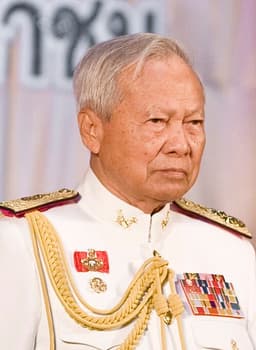
Prem Tinsulanonda
General · Modern
57.2Total
Basic Information
Born
1910
1920
Died
1961
—
Era
Modern
Modern
Nationality
Germany
Thailand
Occupation
General
General
Civilization
Western
Eastern
Score Comparison
Military (10%)
52.5
50.0
Political (20%)
26.4
59.3
Influence (20%)
58.0
54.9
Legacy (20%)
45.0
47.5
Leadership (15%)
35.4
78.0
Strategy (15%)
52.5
60.0
TOTAL
45.5
57.2
Kurt Meyer — Complete Timeline
1944 AD
Command of the 12th SS Panzer Division HitlerjugendWar◆ Major
Meyer was appointed commander of the 12th SS Panzer Division Hitlerjugend in August 1944, becoming the youngest German divisional commander at age 34. He led the division during the Battle of the Falaise Pocket.
Normandy CampaignCommandYouth
Impact: regional
1945 AD
War Crimes ConvictionPolitical Action◆ Major
After the war, Meyer was tried by a Canadian military court for war crimes, including the murder of Canadian prisoners of war. He was found guilty and sentenced to death, later commuted to life imprisonment, and released in 1954.
War CrimesTrialImprisonment
Impact: nationaldestructive
Prem Tinsulanonda — Complete Timeline
1980 AD
Appointed Prime Minister after a coupPolitical Action◆ Major
Prem Tinsulanonda was appointed Prime Minister of Thailand by the military after a coup. He served for over eight years, overseeing a period of political stability and economic growth.
Prime MinisterMilitary RuleStability
Impact: national
1981 AD
Survived a coup attemptPolitical Action◆ Major
Prem survived a coup attempt by military officers loyal to the 'Young Turks' faction. The coup failed due to lack of support and the loyalty of key military units, allowing Prem to remain in power.
Coup AttemptPolitical CrisisMilitary
Impact: national
1988 AD
Resigned as Prime MinisterPolitical Action◆ Major
Prem resigned as Prime Minister after the general election, handing over power to a civilian government led by Chatichai Choonhavan. His resignation marked a rare peaceful transition of power in Thai politics.
ResignationDemocratic TransitionPeaceful
Impact: nationalconstructive
2016 AD
Appointed Regent of ThailandPolitical Action
After the death of King Bhumibol, Prem was appointed Regent of Thailand until the ascension of King Maha Vajiralongkorn. He served as a key figure in the transition of the monarchy.
RegentMonarchyTransition
Impact: national
This comparison has not been analyzed yet.
One-time AI generation (~1 minute). Scores and timeline are already available below.
Rankings
🥇
Prem TinsulanondaLeader
Mil: 50.0Pol: 59.3Inf: 54.9
57.2
🥈
Kurt Meyer
Mil: 52.5Pol: 26.4Inf: 58.0
45.5
+11.7 behind
How This Comparison Works
Algorithm
Each figure is scored on 6 dimensions (0—100 scale) based on structured historical data: Military (10%), Political (20%), Influence (20%), Legacy (20%), Leadership (15%), Strategy (15%). The weighted total produces the final ranking.
Data Sources
Scores are computed from structured sub-indicators in the database. Scale factors adjust for era (Ancient ×0.85, Modern ×1.0) and civilization size (Eastern ×1.05, Other ×0.80) to account for differences in population and military scale.
Maximum 3 Figures
Comparisons are limited to 2—3 figures to ensure readability and statistical meaningfulness.
Error Margins
±5 points per dimension — Sub-scores are derived from historical records with inherent uncertainty. Two figures within 5 points on a dimension should be considered roughly equivalent in that area.
Total Score Accuracy
±3 points overall — The weighted combination of 6 dimensions produces a total score with approximately ±3 points of uncertainty. Differences of less than 3 points are not statistically significant— the figures are effectively tied.
Known Limitations
- Historical records are incomplete and uneven across civilizations
- Figures from oral-tradition societies may be underrepresented
- Occupation labels can misclassify multi-role figures
- Scores measure capability and impact, not moral character
- Quantitative scoring is a comparison tool, not absolute truth
Capability Radar
Military (10%) — Battles & Warfare
Battles
65
20
Win Rate
60
25
Expansion
30
10
Political (20%) — Governance & Reform
Reform
5
55
Diplomacy
10
60
Economy
5
50
Influence (20%) — Cultural & Global Reach
Cultural
30
30
Global
30
30
Legacy (20%) — Historical Impact
Historical
40
40
Longevity
20
35
Leadership (15%) — Power & Stability
Tenure
10
65
Stability
5
60
Strategy (15%) — Tactics & Innovation
Strategy
60
30
Tactics
75
30
Reform
20
35
Similar Comparisons
Comments & Discussion
No comments yet. Be the first to share your thoughts!