Loading...
Julius Maada Bio vs Prem Tinsulanonda
Prem Tinsulanonda leads by 6.0 pts · 2 figures compared
…
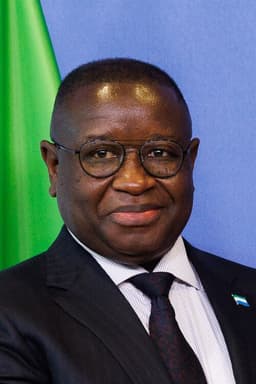
Julius Maada Bio
General · Modern
51.2Total
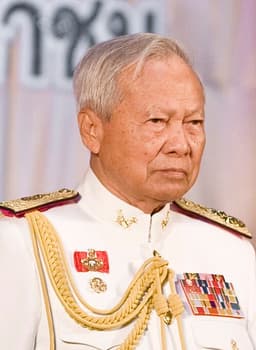
Prem Tinsulanonda
General · Modern
57.2Total
Basic Information
Born
1964
1920
Died
—
—
Era
Modern
Modern
Nationality
Sierra Leone
Thailand
Occupation
General
General
Civilization
Other
Eastern
Score Comparison
Military (10%)
50.0
50.0
Political (20%)
45.0
59.3
Influence (20%)
53.3
54.9
Legacy (20%)
45.0
47.5
Leadership (15%)
70.0
78.0
Strategy (15%)
43.7
60.0
TOTAL
51.2
57.2
Julius Maada Bio — Complete Timeline
1992 AD
1992 Sierra Leonean coup d'étatPolitical Action◆ Major
Julius Maada Bio was a member of the National Provisional Ruling Council (NPRC) that overthrew President Joseph Momoh in a military coup. Bio served as a key figure in the junta, which promised to end the civil war but faced criticism for human rights abuses.
CoupSierra LeoneCivil War
Impact: nationaldestructive
1996 AD
Brief tenure as head of statePolitical Action◆ Major
Bio led a palace coup within the NPRC in January 1996, becoming head of state. He oversaw the transition to civilian rule, handing over power to Ahmad Tejan Kabbah after elections in March 1996, a move that earned him praise for restoring democracy.
TransitionDemocracyCoup
Impact: nationalconstructive
2018 AD
Election as President of Sierra LeonePolitical Action◆ Major
Bio won the 2018 Sierra Leonean presidential election as the candidate of the Sierra Leone People's Party, defeating Samura Kamara in a runoff. His victory marked a return to power for the SLPP after a decade in opposition.
ElectionSierra LeonePresidency
Impact: nationalconstructive
2023 AD
Re-election amid economic challengesPolitical Action◆ Major
Bio was re-elected in 2023 with 56.6% of the vote, but the election was disputed by the opposition. His second term has been marked by economic difficulties, including high inflation and debt, as well as allegations of authoritarianism.
ElectionSierra LeoneEconomy
Impact: national
Prem Tinsulanonda — Complete Timeline
1980 AD
Appointed Prime Minister after a coupPolitical Action◆ Major
Prem Tinsulanonda was appointed Prime Minister of Thailand by the military after a coup. He served for over eight years, overseeing a period of political stability and economic growth.
Prime MinisterMilitary RuleStability
Impact: national
1981 AD
Survived a coup attemptPolitical Action◆ Major
Prem survived a coup attempt by military officers loyal to the 'Young Turks' faction. The coup failed due to lack of support and the loyalty of key military units, allowing Prem to remain in power.
Coup AttemptPolitical CrisisMilitary
Impact: national
1988 AD
Resigned as Prime MinisterPolitical Action◆ Major
Prem resigned as Prime Minister after the general election, handing over power to a civilian government led by Chatichai Choonhavan. His resignation marked a rare peaceful transition of power in Thai politics.
ResignationDemocratic TransitionPeaceful
Impact: nationalconstructive
2016 AD
Appointed Regent of ThailandPolitical Action
After the death of King Bhumibol, Prem was appointed Regent of Thailand until the ascension of King Maha Vajiralongkorn. He served as a key figure in the transition of the monarchy.
RegentMonarchyTransition
Impact: national
Expert Analysis
Prem Tinsulanonda vs Julius Maada Bio
# The General’s Dilemma: Two Paths from Power to Peace
On a humid August morning in 1988, Prem Tinsulanonda walked out of Government House in Bangkok with the quiet dignity of a man who had just done something extraordinary: he had surrendered power. Not to a rival general, not to a coup, but to an election. Half a world away and three decades later, Julius Maada Bio stood before a cheering crowd in Freetown in 2018, a former coup leader now taking the oath as a democratically elected president. Both men were generals who chose democracy. But their journeys—and their destinations—could not have been more different.
Origins
Prem Tinsulanonda was born in 1920 in Songkhla, southern Thailand, into a world where absolute monarchy had given way to constitutional rule, but where the military remained the invisible hand guiding the nation. His father was a judge, his mother a devout Buddhist. Young Prem grew up in a society that prized hierarchy, deference, and the careful management of appearances. He entered military academy at a time when Thailand’s generals saw themselves not as conquerors but as stewards—guardians of a fragile democracy that needed constant, firm guidance.
Julius Maada Bio, born in 1964 in a small village in southern Sierra Leone, came of age in a nation unraveling. His father was a teacher, his mother a farmer. By the time Bio reached adolescence, Sierra Leone’s post-independence promise had curdled into corruption, poverty, and the specter of civil war. The military here was not a guardian but a predator—and often the only ladder out of desperation. Bio joined the army not out of patriotic fervor but out of necessity. It was a career, not a calling.
Rise to Power
Prem’s ascent was patient, almost invisible. He rose through the ranks of the Thai army with the careful step of a man who understood that in Thai politics, timing was everything. When a coup in 1980 brought chaos, the military turned to Prem as a compromise candidate—a general who was respected but not feared, competent but not ambitious. He was appointed prime minister in March 1980, a position he would hold for over eight years. His power came not from seizing it but from being chosen to hold it.
Bio’s rise was violent and sudden. In 1992, at just 28 years old, he was part of the National Provisional Ruling Council that overthrew President Joseph Momoh. Sierra Leone was collapsing—rebels in the east, a bankrupt treasury, a demoralized army. The young officers believed they could save the country. By 1996, Bio had led a palace coup within the ruling council, becoming head of state himself. He was 32. He had taken power with guns, not ballots.
Leadership & Governance
Here the two generals diverged in ways that reveal the deepest truths about their worlds. Prem governed Thailand with a light hand and a heavy sense of obligation. He was not a reformer in the Western sense—he did not seek to remake society. Instead, he managed it: balancing factions within the military, soothing the monarchy, allowing civilian politicians room to operate. His leadership style was that of a chairman, not a commander. He survived a coup attempt in 1981 by the “Young Turks” faction, not by crushing them but by outlasting them, relying on the loyalty of the king and the institutional stability of the Thai state.
Bio, by contrast, inherited a nation in flames. His brief tenure as head of state in 1996 was consumed by one overriding goal: ending a brutal civil war and returning the country to civilian rule. He negotiated with rebels, faced down his own hardliners, and—most remarkably—oversaw elections and stepped down when they were won by Ahmad Tejan Kabbah. It was an act almost unprecedented in West African military history. But Bio’s governance was always a balancing act between idealism and survival. His return to power in 2018 and re-election in 2023 have been marked by economic crisis, disputed results, and accusations of authoritarian drift.
Triumph & Tragedy
Prem’s greatest triumph was his resignation in 1988. After eight years, he called an election, accepted the victory of Chatichai Choonhavan, and walked away. It was a quiet, almost boring act—and that was its genius. In a region where generals clung to power until they were dragged out, Prem showed that military leaders could be temporary stewards. His tragedy was that he never fully left. He remained a shadowy figure behind the scenes, serving as regent after King Bhumibol’s death in 2016, a reminder that democracy in Thailand always had a military safety net.
Bio’s triumph was the 1996 transition itself—a coup leader who chose democracy over dictatorship. It gave him a moral authority that few African strongmen possess. His tragedy is that his second coming, as elected president, has been less inspiring. The 2023 election was marred by disputes, the economy is in crisis, and the former reformer now looks like a politician fighting to stay in power. The student who overthrew a dictator has become the man accused of suppressing dissent.
Character & Destiny
Prem was a man of silences. He spoke little, revealed less, and governed through networks and whispers. His personality was perfectly suited to a Thailand that valued stability over drama, hierarchy over heroism. He was not a visionary—he was a caretaker. And that may be why he succeeded: he never believed he was indispensable.
Bio is a man of contradictions. He overthrew a government and then gave up power. He returned as a democrat and then faced accusations of undermining democracy. His character is restless, ambitious, and genuinely conflicted. He wants to be both a strongman and a savior, a reformer and a ruler. That tension has defined his career—and may yet define his downfall.
Legacy
Prem Tinsulanonda is remembered in Thailand as a stabilizing force, a general who handed over power and then watched over it from the shadows. His legacy is mixed: he helped preserve democracy, but also helped ensure that the military would always have a seat at the table. He died at 98, having outlived almost every rival, a quiet monument to a certain kind of authoritarian paternalism.
Julius Maada Bio is still writing his legacy. He is remembered as the coup leader who chose democracy, but his second term will determine whether he is seen as a genuine democrat or just another general who learned to win elections. The world watches, hoping for the former, bracing for the latter.
Conclusion
Two generals, two countries, two paths from power to peace. Prem’s story is one of restraint, of knowing when to hold and when to let go. Bio’s story is one of redemption, of a man trying to escape his own past. Both remind us that generals can be democrats—but also that the uniform never fully washes off. The question their lives pose is not whether soldiers can govern, but whether they can ever truly stop being soldiers. The answer, in both Bangkok and Freetown, remains unsettled.
Rankings
🥇
Prem TinsulanondaLeader
Mil: 50.0Pol: 59.3Inf: 54.9
57.2
🥈
Julius Maada Bio
Mil: 50.0Pol: 45.0Inf: 53.3
51.2
+6.0 behind
How This Comparison Works
Algorithm
Each figure is scored on 6 dimensions (0—100 scale) based on structured historical data: Military (10%), Political (20%), Influence (20%), Legacy (20%), Leadership (15%), Strategy (15%). The weighted total produces the final ranking.
Data Sources
Scores are computed from structured sub-indicators in the database. Scale factors adjust for era (Ancient ×0.85, Modern ×1.0) and civilization size (Eastern ×1.05, Other ×0.80) to account for differences in population and military scale.
Maximum 3 Figures
Comparisons are limited to 2—3 figures to ensure readability and statistical meaningfulness.
Error Margins
±5 points per dimension — Sub-scores are derived from historical records with inherent uncertainty. Two figures within 5 points on a dimension should be considered roughly equivalent in that area.
Total Score Accuracy
±3 points overall — The weighted combination of 6 dimensions produces a total score with approximately ±3 points of uncertainty. Differences of less than 3 points are not statistically significant— the figures are effectively tied.
Known Limitations
- Historical records are incomplete and uneven across civilizations
- Figures from oral-tradition societies may be underrepresented
- Occupation labels can misclassify multi-role figures
- Scores measure capability and impact, not moral character
- Quantitative scoring is a comparison tool, not absolute truth
Capability Radar
Military (10%) — Battles & Warfare
Battles
15
20
Win Rate
20
25
Expansion
5
10
Political (20%) — Governance & Reform
Reform
50
55
Diplomacy
55
60
Economy
45
50
Influence (20%) — Cultural & Global Reach
Cultural
30
30
Global
20
30
Legacy (20%) — Historical Impact
Historical
35
40
Longevity
25
35
Leadership (15%) — Power & Stability
Tenure
55
65
Stability
40
60
Strategy (15%) — Tactics & Innovation
Strategy
20
30
Tactics
25
30
Reform
10
35
Similar Comparisons
Comments & Discussion
Prem's Paradox6/16/2026
Prem didn't just hand over power — he invented a blueprint for military exit that has zero equivalent in West Africa. The 1991 coup in Thailand happened because civilians failed, not because Prem's system was weak. Bio's military-intervention-turned-democracy narrative? That's just rebranding. Compare Prem's 8 years of stability with Bio's still-unfinished transition. One created a system; the other created a resume. That's the real distinction.
Silent Architect6/16/2026
普密蓬国王去世那天,我关注的不是王室,而是炳上将如何悄然退场。他1988年交权后活得比任何政变者都长,这就是泰国精英政治的终极智慧——掌权时不说话,退位后成圣人。而比奥?2018年的微笑总统,2023年就闹出选举争议。一个留下了制度,一个留下了instagram。事实胜于表演。
Data Dismantler6/16/2026
Let's talk metrics. Under Prem: Thailand GDP growth averaged 7.4% from 1980-1988. Under Bio: Sierra Leone's poverty rate remained above 50% his entire term. Prem's military maintained discipline; Bio's army still struggles with command. You want to compare paths to peace? Prem's path was paved with economic integration; Bio's with amnesty deals that broke down. Numbers don't lie about who built anything lasting.
Revisionist Realist6/16/2026
炳·廷素拉暖的"交权神话"被严重夸大了。他1988年离开是因为军方内部派系已无法控制,而泰王需要新面孔。比奥至少是从枪杆子里直接走进投票箱,这是非洲政治的硬核转型——有瑕疵,但真实。炳那种优雅撤退不过是泰国宫廷政治的芭蕾舞,比奥的处境才像真正在泥潭里挣扎着走向民主。亚洲的"稳定叙事"总把遮羞布当勋章。
Classics Scholar6/16/2026
Prem embodies the Aristotelian ideal of the 'phronimos' — the practical leader who knows when to yield power to preserve the polis. His 1988 departure wasn't weakness; it was the highest form of political wisdom. Bio, by contrast, mirrors Plato's cycle of regimes — from military rule to democracy, but with the shadow of tyranny never far. One built a legacy; the other is still trapped in history's loop.