Loading...
Joseph Stalin vs Otto von Bismarck
Joseph Stalin leads by 3.0 pts · 2 figures compared
…
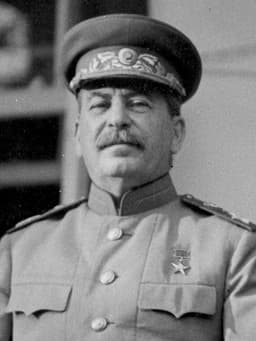
Joseph Stalin
Politician · Modern
68.8Total
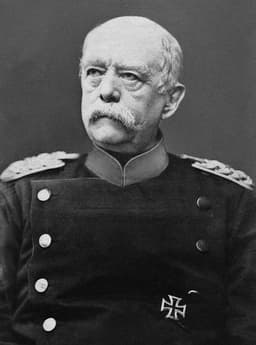
Otto von Bismarck
Politician · Modern
65.8Total
Basic Information
Born
1878
1815
Died
1953
1898
Era
Modern
Modern
Nationality
Russia
Germany
Occupation
Politician
Politician
Civilization
Western
Western
Score Comparison
Military (10%)
75.0
55.0
Political (20%)
70.0
85.0
Influence (20%)
72.0
82.0
Legacy (20%)
55.0
40.0
Leadership (15%)
80.0
80.0
Strategy (15%)
70.0
50.0
TOTAL
68.8
65.8
Joseph Stalin — Complete Timeline
1928 AD
Launched the First Five-Year PlanReform
Stalin initiated a series of centralized economic plans aimed at rapid industrialization and collectivization of agriculture. The First Five-Year Plan set ambitious targets for heavy industry, leading to significant growth but also severe shortages and human cost.
Impact: global
1929 AD
Implemented forced collectivization of agricultureReform
Stalin ordered the consolidation of individual peasant farms into collective farms (kolkhozy). This was met with resistance, leading to the liquidation of kulaks (wealthy peasants) as a class. The policy caused a catastrophic famine, particularly in Ukraine (Holodomor), resulting in millions of deaths.
Impact: nationaldestructive
1937 AD
Conducted the Great Purge (Great Terror)Political Action
Stalin orchestrated a campaign of political repression against alleged enemies of the state. Millions were arrested, executed, or sent to the Gulag labor camps. The purges targeted the Communist Party, military leadership, intellectuals, and ordinary citizens, consolidating Stalin's absolute power.
Impact: nationaldestructive
1945 AD
Led the Soviet Union to victory in World War IIWar
Stalin served as Supreme Commander of the Soviet armed forces. The Soviet Union bore the brunt of the war against Nazi Germany, suffering immense casualties. The Red Army's victory at Stalingrad and the capture of Berlin were key turning points. The war ended with Soviet domination of Eastern Europe.
Impact: global
Established the Eastern Bloc and the Iron CurtainPolitical Action◆ Major
After WWII, Stalin imposed communist governments in Eastern European countries occupied by the Red Army, creating a buffer zone against the West. This division of Europe into Soviet and Western spheres of influence marked the beginning of the Cold War.
Impact: globaldestructive
Otto von Bismarck — Complete Timeline
1870 AD
Franco-Prussian WarWar
Bismarck provoked France into declaring war by editing the Ems Dispatch to appear insulting. The resulting conflict saw Prussia and its allies decisively defeat France, leading to the fall of Napoleon III, the capture of Paris, and the annexation of Alsace-Lorraine.
WarProvocationAnnexation
Impact: globaldestructive
1871 AD
Unification of Germany ProclaimedPolitical Action
Following the Franco-Prussian War, Bismarck orchestrated the proclamation of the German Empire in the Hall of Mirrors at Versailles. King Wilhelm I of Prussia was declared German Emperor, uniting the German states under Prussian leadership and establishing the Second Reich.
UnificationGerman EmpireNationalism
Impact: globalconstructive
1878 AD
Enactment of the Anti-Socialist LawsPolitical Action◆ Major
After two assassination attempts on Kaiser Wilhelm I, Bismarck pushed through laws banning socialist organizations, publications, and meetings. The laws remained in force until 1890, suppressing the Social Democratic Party while Bismarck simultaneously introduced welfare reforms to undercut its appeal.
RepressionSocialismWelfare State
Impact: nationaldestructive
Congress of BerlinPolitical Action◆ Major
Bismarck hosted the Congress of Berlin to revise the Treaty of San Stefano and resolve the Eastern Crisis. He acted as 'honest broker,' reducing Russian gains, granting independence to Romania, Serbia, and Montenegro, and placing Bosnia-Herzegovina under Austro-Hungarian administration.
DiplomacyBalkansBalance of Power
Impact: global
1883 AD
Establishment of the Welfare StateReform◆ Major
Bismarck introduced the Health Insurance Bill (1883), Accident Insurance Bill (1884), and Old Age and Disability Insurance Bill (1889). These laws created the first modern welfare state, providing workers with social security and aiming to reduce support for socialist movements.
Social ReformWelfareInsurance
Impact: globalprogressive
1890 AD
Dismissal as ChancellorPolitical Action◆ Major
Emperor Wilhelm II forced Bismarck to resign due to policy disagreements, particularly over anti-socialist laws and foreign policy. Bismarck's departure marked the end of an era, leading to a more aggressive German foreign policy and the eventual unraveling of his alliance system.
ResignationWilhelm IIPolicy Shift
Impact: global
Expert Analysis
Otto von Bismarck vs Joseph Stalin
# The Iron and the Blood
In the winter of 1890, Otto von Bismarck, the Iron Chancellor who had forged a German Empire with his will, stood in the snow at the train station in Berlin, dismissed by a young emperor who had grown tired of his shadow. Forty years earlier, in a small town in Georgia, a boy named Ioseb Dzhugashvili was born into poverty, his father a cobbler who beat him, his mother a devout woman who dreamed he would become a priest. Neither man could have imagined that their lives would come to define the very meaning of modern state power—one through unification and welfare, the other through industrialization and terror.
Origins
Bismarck came from the Prussian Junker aristocracy, landed gentry who had served the Hohenzollern kings for centuries. He was born in 1815, the year Napoleon was finally defeated, and he grew up in a world where the old order was struggling to contain the revolutionary forces unleashed by France. His education at Göttingen and Berlin was that of a gentleman—law, history, philosophy—but he was restless, a wild student who fought duels and drank heavily before settling into the life of a country squire. His conservatism was instinctive, rooted in the soil of his estates and the class that had ruled them.
Stalin’s origins could not have been more different. Born in 1878 in Gori, a dusty town in the Russian Caucasus, he was the son of a failed shoemaker and a washerwoman. His father’s violence and his mother’s piety shaped a boy who was both brilliant and bitter. He won a scholarship to the Tiflis Theological Seminary, where he was introduced to radical literature and began his lifelong war against authority. Where Bismarck inherited a place in the world, Stalin had to claw his way out of nothing—and that hunger never left him.
Rise to Power
Bismarck entered politics as a reactionary, a man who defended the Prussian monarchy against the liberal revolutions of 1848. But he was no simple traditionalist. He understood that power required flexibility. In 1862, King Wilhelm I appointed him Minister President of Prussia to resolve a constitutional crisis over military funding. Bismarck’s solution was simple: he governed without a budget, ignoring parliament, and declared that the great questions of the day would be decided not by speeches and majority resolutions—but by “blood and iron.” He was gambling that success would silence his critics.
Stalin’s rise was slower, more cunning. After the Bolshevik Revolution of 1917, he held minor posts, but he saw that Lenin’s illness meant a succession crisis was coming. He positioned himself as the unremarkable man, the one no one feared—until he had the files. As General Secretary of the Communist Party, he controlled appointments, placing his loyalists in every key position. By the time Lenin died in 1924, Stalin had already built a machine that would crush his rivals: Trotsky, Zinoviev, Kamenev—one by one, they fell. Where Bismarck had used war to unify a nation, Stalin used bureaucracy to strangle a party.
Leadership & Governance
Bismarck governed through a paradox. He was an authoritarian who created the most progressive social welfare system of his age. In the 1880s, he introduced health insurance, accident insurance, and old-age pensions—not out of compassion, but out of calculation. He needed to steal the thunder from the Socialists, to bind the working class to the state with the golden chains of security. His foreign policy was equally cunning: he built a web of alliances that kept France isolated and Germany safe, a delicate balance he maintained for two decades.
Stalin governed through terror. The First Five-Year Plan, launched in 1928, forced the Soviet Union into breakneck industrialization. Steel mills rose in the Urals, dams spanned the Dnieper, and millions of peasants were driven into collective farms. The human cost was staggering: famine in Ukraine, exile to the Gulag, executions of “saboteurs” and “wreckers.” The Great Purge of 1937-38 consumed the Communist Party itself—three-quarters of the Central Committee were shot. Where Bismarck had built a welfare state to pacify his people, Stalin built a police state to control his.
Triumph & Tragedy
Bismarck’s greatest triumph was the unification of Germany. In 1870, he provoked France into declaring war by editing the Ems Dispatch—a diplomatic telegram—to make it seem as though King Wilhelm had insulted the French ambassador. The Franco-Prussian War was swift and decisive, and in January 1871, in the Hall of Mirrors at Versailles, the German Empire was proclaimed. It was Bismarck’s masterpiece. But his tragedy came later: he was dismissed in 1890 by Kaiser Wilhelm II, who wanted to rule without him. The Iron Chancellor spent his final years writing memoirs and watching his creations unravel.
Stalin’s greatest triumph was victory in World War II. As Supreme Commander, he directed the Soviet war effort that broke the back of the Nazi war machine at Stalingrad and Kursk, then drove the Red Army all the way to Berlin. But the cost was unimaginable: 27 million Soviet dead. His tragedy was that he could not stop. After the war, he imposed communist regimes across Eastern Europe, drawing the Iron Curtain and plunging the world into the Cold War. He died in 1953, paranoid and isolated, having purged his own doctors.
Character & Destiny
Bismarck was a man of immense charm and immense ruthlessness. He could be charming with diplomats, terrifying with subordinates, and sentimental with his family. He drank heavily, ate enormously, and suffered from hypochondria. His personality was that of a chess player who always thought several moves ahead—but who could not see that his own king, the Kaiser, would eventually checkmate him.
Stalin was a man of immense paranoia and immense patience. He trusted no one, not even his closest allies. He kept his enemies close, his friends closer, and his victims in the basement. His personality was that of a spider who had spun a web so vast that he could feel every tremor—and who killed anything that moved.
Legacy
Bismarck left behind a unified Germany, a welfare state, and a diplomatic tradition that would influence Europe for generations. But he also left behind a militarized empire that his successors would lead into catastrophe. His legacy is ambiguous: the father of German unity, the architect of the welfare state, and the forger of the sword that would cut Europe in half.
Stalin left behind a superpower, an industrialized Soviet Union, and a model of totalitarianism that became a byword for terror. He also left behind a system that could not survive without him. His legacy is darker: the victor of the Great Patriotic War, the architect of the Gulag, and the man who killed more of his own people than any enemy ever could.
Conclusion
Standing at the train station in 1890, Bismarck told a friend that the young Kaiser would break the empire. He was right. Stalin, dying in his dacha in 1953, told no one—and left a world that would spend forty years staring into the nuclear abyss. Both men understood that power is a terrible thing. One used it to build a nation; the other, to build a prison. The difference was not in their ambition—both were limitless—but in their humanity. Bismarck, for all his ruthlessness, never forgot that the state existed for the people. Stalin, for all his brilliance, never remembered that the people existed for anything but the state. That is the difference between iron and blood.
Rankings
🥇
Joseph StalinLeader
Mil: 75.0Pol: 70.0Inf: 72.0
68.8
🥈
Otto von Bismarck
Mil: 55.0Pol: 85.0Inf: 82.0
65.8
+3.0 behind
How This Comparison Works
Algorithm
Each figure is scored on 6 dimensions (0—100 scale) based on structured historical data: Military (10%), Political (20%), Influence (20%), Legacy (20%), Leadership (15%), Strategy (15%). The weighted total produces the final ranking.
Data Sources
Scores are computed from structured sub-indicators in the database. Scale factors adjust for era (Ancient ×0.85, Modern ×1.0) and civilization size (Eastern ×1.05, Other ×0.80) to account for differences in population and military scale.
Maximum 3 Figures
Comparisons are limited to 2—3 figures to ensure readability and statistical meaningfulness.
Error Margins
±5 points per dimension — Sub-scores are derived from historical records with inherent uncertainty. Two figures within 5 points on a dimension should be considered roughly equivalent in that area.
Total Score Accuracy
±3 points overall — The weighted combination of 6 dimensions produces a total score with approximately ±3 points of uncertainty. Differences of less than 3 points are not statistically significant— the figures are effectively tied.
Known Limitations
- Historical records are incomplete and uneven across civilizations
- Figures from oral-tradition societies may be underrepresented
- Occupation labels can misclassify multi-role figures
- Scores measure capability and impact, not moral character
- Quantitative scoring is a comparison tool, not absolute truth
Capability Radar
Military (10%) — Battles & Warfare
Battles
85
60
Win Rate
80
70
Expansion
85
80
Political (20%) — Governance & Reform
Reform
90
90
Diplomacy
70
95
Economy
85
80
Influence (20%) — Cultural & Global Reach
Cultural
70
65
Global
95
75
Legacy (20%) — Historical Impact
Historical
95
85
Longevity
80
70
Leadership (15%) — Power & Stability
Tenure
95
85
Stability
60
70
Strategy (15%) — Tactics & Innovation
Strategy
85
85
Tactics
60
55
Reform
90
75
Similar Comparisons
Comments & Discussion
IronOracle6/16/2026
Bismarck’s welfare state was a masterstroke of cynical social control, not humanitarianism. By introducing old-age pensions and health insurance in the 1880s, he literally stole the socialist thunder out from under the nascent SPD while locking workers into loyalty to the Kaiser. Stalin never understood such nuanced co-optation—he just shot everyone. The Iron Chancellor understood that giving bread lets you keep the whip in reserve. Stalin? All whip, no bread that wasn't poisoned.
血色铁锤6/16/2026
拿统一德国和工业化苏联比根本是关公战秦琼。俾斯麦靠着三次王朝战争就搞定了德意志,小打小闹死几万人。斯大林从1928年用五年计划把一穷二白的苏联变成超级大国,背后的集体化饿死几百万人、古拉格关几百万——要论铁血,俾斯麦那点手段在斯大林面前不过是幼儿园级别的灌铅骰子。
SteppeSkeptic6/16/2026
The body count math alone makes this comparison absurd. Bismarck fought three quick, decisive wars totaling about 130,000 dead for all sides combined. Stalin’s peacetime decisions—collectivization, the Great Terror, the Holodomor—killed more than 15 million of his own citizens. But here's the thing Stalin haters dodge: he did it while industrializing a feudal backwater in a single decade. Bismarck inherited a modern state. Stalin built one from mud and corpses.
紫禁城的档案员6/16/2026
史料从不撒谎:俾斯麦稳定了欧洲和平四十年,维也纳体系之后的拼图被他完美补齐。斯大林?他继承的是彼得大帝以来扩张的俄罗斯帝国,结果柏林墙修完才发现自己把半个欧洲都搞成了敌对阵营。俾斯麦下台后德国还能保持强国姿态二十年,斯大林死了没几年赫鲁晓夫就要否定他——谁的战略更牢固,一目了然。
RedDawnScholar6/16/2026
You revisionists love to downplay Bismarck's brutality. He deliberately starved Poles in the 1880s Ostflucht policies, forced Catholic bishops into exile during the Kulturkampf, and banned the Social Democrats while cutting deals with bankers. The difference is purely aesthetic: Bismarck wore a white uniform and dueled with sabers; Stalin wore a tunic and used a signed warrant. Same game of consolidated state power, different century's tools for the same filth.