Loading...
Charles de Gaulle vs Joseph Stalin
Joseph Stalin leads by 0.6 pts · 2 figures compared
…
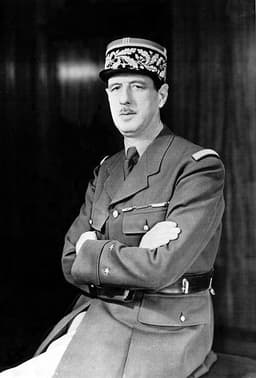
Charles de Gaulle
Politician · Modern
68.2Total
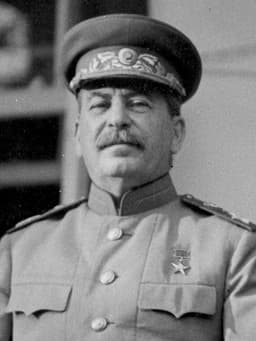
Joseph Stalin
Politician · Modern
68.8Total
Basic Information
Born
1890
1878
Died
1970
1953
Era
Modern
Modern
Nationality
France
Russia
Occupation
Politician
Politician
Civilization
Western
Western
Score Comparison
Military (10%)
55.0
75.0
Political (20%)
75.0
70.0
Influence (20%)
65.0
72.0
Legacy (20%)
68.0
55.0
Leadership (15%)
78.0
80.0
Strategy (15%)
65.0
70.0
TOTAL
68.2
68.8
Charles de Gaulle — Complete Timeline
1940 AD
Appeal of 18 June 1940Political Action
From London, de Gaulle broadcast a radio appeal urging French resistance against Nazi occupation. He called on French soldiers and citizens to continue the fight, founding the Free French Forces and becoming the symbol of French defiance.
World War IIResistanceLeadership
Impact: nationalconstructive
1958 AD
Founding of the Fifth RepublicPolitical Action
De Gaulle returned to power during the Algerian crisis and oversaw the drafting of a new constitution. The Fifth Republic established a strong executive presidency, replacing the unstable parliamentary system of the Fourth Republic.
ConstitutionGovernment ReformPolitical System
Impact: nationalconstructive
1962 AD
End of the Algerian WarPolitical Action◆ Major
De Gaulle negotiated the
DecolonizationPeace TreatyAlgeria
Impact: regionalconstructive
1968 AD
May 1968 CrisisPolitical Action◆ Major
Mass student protests and general strikes paralyzed France, challenging de Gaulle's government. De Gaulle briefly fled to Germany, then returned to dissolve the National Assembly and call elections, which his party won, but his authority was weakened.
ProtestPolitical CrisisSocial Unrest
Impact: nationaldestructive
1969 AD
Resignation as PresidentPolitical Action
De Gaulle resigned after losing a referendum on regional reform and Senate restructuring. The defeat marked the end of his political career, as he withdrew from public life and died the following year.
ResignationPolitical DefeatReferendum
Impact: nationaltragic
Joseph Stalin — Complete Timeline
1928 AD
Launched the First Five-Year PlanReform
Stalin initiated a series of centralized economic plans aimed at rapid industrialization and collectivization of agriculture. The First Five-Year Plan set ambitious targets for heavy industry, leading to significant growth but also severe shortages and human cost.
Impact: global
1929 AD
Implemented forced collectivization of agricultureReform
Stalin ordered the consolidation of individual peasant farms into collective farms (kolkhozy). This was met with resistance, leading to the liquidation of kulaks (wealthy peasants) as a class. The policy caused a catastrophic famine, particularly in Ukraine (Holodomor), resulting in millions of deaths.
Impact: nationaldestructive
1937 AD
Conducted the Great Purge (Great Terror)Political Action
Stalin orchestrated a campaign of political repression against alleged enemies of the state. Millions were arrested, executed, or sent to the Gulag labor camps. The purges targeted the Communist Party, military leadership, intellectuals, and ordinary citizens, consolidating Stalin's absolute power.
Impact: nationaldestructive
1945 AD
Led the Soviet Union to victory in World War IIWar
Stalin served as Supreme Commander of the Soviet armed forces. The Soviet Union bore the brunt of the war against Nazi Germany, suffering immense casualties. The Red Army's victory at Stalingrad and the capture of Berlin were key turning points. The war ended with Soviet domination of Eastern Europe.
Impact: global
Established the Eastern Bloc and the Iron CurtainPolitical Action◆ Major
After WWII, Stalin imposed communist governments in Eastern European countries occupied by the Red Army, creating a buffer zone against the West. This division of Europe into Soviet and Western spheres of influence marked the beginning of the Cold War.
Impact: globaldestructive
Expert Analysis
Charles de Gaulle vs Joseph Stalin
### The General and the Tyrant: De Gaulle, Stalin, and the Two Faces of 20th-Century Power
In the summer of 1940, two men stood at the edge of history, each gazing into an abyss that would define the century. One, a tall, aloof French brigadier general broadcasting alone from a London studio, had nothing but his voice and an unshakable belief in France. The other, a short, mustachioed Georgian in the Kremlin, had an entire empire at his command—and the will to drown it in blood to keep it. Both would reshape their nations, lead them through war, and leave legacies that still cast long shadows. But the paths they took, and the worlds they built, could not have been more different. Why did one become a liberator and the other a monster? The answer lies not in the grand sweep of history, but in the small, terrible choices made in moments of crisis.
**Origins**
De Gaulle was born into a devoutly Catholic, patriotic family in Lille, 1890. His father taught him that France was a sacred idea, a civilization to be defended. He grew up reading philosophy and dreaming of military glory, but his character was shaped by defeat: he was a prisoner of war in World War I, where he tried to escape five times, and he spent the interwar years writing books on armored warfare that were ignored by his superiors. He was a man of ideas, stubborn and aristocratic, who believed that a nation’s greatness was a matter of will.
Stalin was born Ioseb Jughashvili in 1878 in Gori, Georgia, a small town in the Russian Empire. His father beat him; his mother prayed for him to become a priest. Instead, he found his calling in revolutionary conspiracy. He was a bank robber, an exile, a man who learned to trust no one. Where de Gaulle saw nations as sacred, Stalin saw them as raw material. His worldview was forged in the brutal underground of the Bolshevik movement, where betrayal was routine and survival meant crushing all rivals. He emerged not as a patriot but as a machine.
**Rise to Power**
De Gaulle’s rise was a series of desperate gambles. In June 1940, as France collapsed before the Nazi blitzkrieg, he was a junior general with no political base. His Appeal of 18 June was an act of sheer audacity—a voice crying in the wilderness. He spent the war as a lonely exile, battling not only Hitler but also Churchill and Roosevelt, who saw him as a petulant nuisance. Yet he never wavered. He built the Free French Forces from scratch, and when Paris was liberated in 1944, he walked down the Champs-Élysées as the embodiment of a resurrected nation.
Stalin’s rise was a long, patient crawl through the gears of the Communist Party. After Lenin’s death in 1924, he positioned himself as a gray bureaucrat—collecting power through appointments, not speeches. By 1928, he had sidelined Trotsky, Zinoviev, and Kamenev. But he did not stop. The Great Purge of 1937-1938 was his masterpiece of paranoia: he eliminated three-quarters of the Red Army’s senior officers, along with millions of ordinary citizens. By the time Hitler invaded in 1941, Stalin was the undisputed master of a terrified nation.
**Leadership & Governance**
De Gaulle’s leadership was built on clarity and distance. He believed that a leader must be a “man of character”—someone who could say no. In 1958, when the Algerian War threatened to tear France apart, he returned to power and founded the Fifth Republic, a constitution designed to give the president strong, stable authority. He then did the unthinkable: he granted Algeria independence, facing down assassination plots and mutinies by his own generals. His governance was austere, almost paternal. He modernized France’s economy, built an independent nuclear deterrent, and withdrew from NATO’s military command. He was not popular in the way a celebrity is; he was respected in the way a father is.
Stalin’s leadership was built on terror and calculation. He launched the First Five-Year Plan in 1928 to industrialize the Soviet Union at breakneck speed. It worked: by 1940, the USSR was a superpower. But the cost was measured in millions of lives—famine in Ukraine, forced labor in the Gulag. His collectivization of agriculture was a war against his own people. As a wartime commander, he was ruthless but effective. He listened to his generals (unlike Hitler), and he allowed them to win the Battle of Stalingrad. Yet even in victory, he was paranoid. He sent captured Soviet soldiers to camps rather than home, fearing they had been contaminated by the West.
**Triumph & Tragedy**
De Gaulle’s greatest moment was the end of the Algerian War in 1962. He had staked his reputation on a policy that contradicted everything his supporters believed. When the Évian Accords were signed, he had saved France from a colonial quagmire and restored its moral standing. But his tragedy came in May 1968. Student protests and a general strike paralyzed France. De Gaulle, the man of iron, briefly fled to Germany to consult with his generals. He returned, called an election, and won. But the spell was broken. He resigned in 1969 after losing a minor referendum. He died a year later, a lonely giant.
Stalin’s triumph was the Red Army’s capture of Berlin in 1945. He had led the Soviet Union through the most devastating war in history, losing 27 million people, and emerged as one of the world’s two superpowers. But his tragedy was the system he built. The Eastern Bloc he imposed on Europe was a prison. The Iron Curtain he drew divided the continent for 40 years. And inside the USSR, the terror continued until his death in 1953. He died not in battle, but in his dacha, surrounded by terrified aides who feared he might still be alive.
**Character & Destiny**
De Gaulle’s character was his destiny. He was aloof, proud, and convinced of his own historical role. He once said, “I am France.” This was not arrogance; it was a kind of faith. He believed that a leader must embody the nation’s soul, not its appetite. His decisions were often unpopular, but they were principled. He could compromise on tactics, never on identity.
Stalin’s character was also his destiny, but in a darker key. He was suspicious, vengeful, and devoid of sentiment. He once told a visitor, “One death is a tragedy; a million deaths is a statistic.” He believed that the state was an engine, and people were fuel. He did not want to be loved; he wanted to be feared. And he succeeded.
**Legacy**
De Gaulle’s legacy is the Fifth Republic, which still governs France. He is remembered as the man who said no to Hitler, no to colonialism, and no to American hegemony. His name adorns airports, aircraft carriers, and plazas. But his real legacy is an idea: that a nation can be reborn through will.
Stalin’s legacy is more ambiguous. He industrialized Russia, defeated Hitler, and built a superpower. But he also murdered millions. In modern Russia, he is sometimes rehabilitated as a strong leader who restored order. In the West, he is the archetype of the totalitarian. His name evokes not a nation, but a system.
**Conclusion**
Standing at the edge of the 21st century, we can see that de Gaulle and Stalin represent two poles of leadership. One believed that power was a trust; the other believed it was a weapon. One built a republic; the other built a prison. Both were men of immense will, but they used that will for opposite ends. The difference between them is not in their ambitions—both wanted glory for their nation—but in their understanding of what a nation is. For de Gaulle, France was a people. For Stalin, the Soviet Union was a project. And in that difference lies the moral of the 20th century: the ends do not justify the means; the means become the ends.
Rankings
🥇
Joseph StalinLeader
Mil: 75.0Pol: 70.0Inf: 72.0
68.8
🥈
Charles de Gaulle
Mil: 55.0Pol: 75.0Inf: 65.0
68.2
+0.6 behind
How This Comparison Works
Algorithm
Each figure is scored on 6 dimensions (0—100 scale) based on structured historical data: Military (10%), Political (20%), Influence (20%), Legacy (20%), Leadership (15%), Strategy (15%). The weighted total produces the final ranking.
Data Sources
Scores are computed from structured sub-indicators in the database. Scale factors adjust for era (Ancient ×0.85, Modern ×1.0) and civilization size (Eastern ×1.05, Other ×0.80) to account for differences in population and military scale.
Maximum 3 Figures
Comparisons are limited to 2—3 figures to ensure readability and statistical meaningfulness.
Error Margins
±5 points per dimension — Sub-scores are derived from historical records with inherent uncertainty. Two figures within 5 points on a dimension should be considered roughly equivalent in that area.
Total Score Accuracy
±3 points overall — The weighted combination of 6 dimensions produces a total score with approximately ±3 points of uncertainty. Differences of less than 3 points are not statistically significant— the figures are effectively tied.
Known Limitations
- Historical records are incomplete and uneven across civilizations
- Figures from oral-tradition societies may be underrepresented
- Occupation labels can misclassify multi-role figures
- Scores measure capability and impact, not moral character
- Quantitative scoring is a comparison tool, not absolute truth
Capability Radar
Military (10%) — Battles & Warfare
Battles
60
85
Win Rate
55
80
Expansion
20
85
Political (20%) — Governance & Reform
Reform
95
90
Diplomacy
90
70
Economy
70
85
Influence (20%) — Cultural & Global Reach
Cultural
70
70
Global
80
95
Legacy (20%) — Historical Impact
Historical
85
95
Longevity
75
80
Leadership (15%) — Power & Stability
Tenure
85
95
Stability
75
60
Strategy (15%) — Tactics & Innovation
Strategy
85
85
Tactics
70
60
Reform
80
90
Similar Comparisons
Comments & Discussion
IronRésistance6/16/2026
De Gaulle had the moral clarity of a man who owned nothing but his conviction; Stalin had the machinery of mass murder. The difference isn't scale—it's choice. De Gaulle refused to surrender even when France collapsed in six weeks. Stalin signed 1,580 death sentences in 1937 alone. The General built a movement on a radio speech; the Tyrant built a cult on millions of graves. End of story.
元帅之影6/16/2026
拿戴高乐跟斯大林比统治风格?简直是把修道院院长和黑帮教父放一块儿。斯大林用饥饿摧毁乌克兰,戴高乐用流亡团结法兰西。一个让自家红军士兵踩地雷去清理战场,另一个宁可背对戴高乐主义者也要独守伦敦。暴君与国父的区别,根本在于:你死后,人们是立碑还是拆碑。
GoebbelsWouldBlush6/16/2026
Let's talk hard numbers: Stalin's USSR lost 27 million people in WWII, but his pre-war purges executed at least 680,000 "enemies of the people." De Gaulle's Free French suffered about 20,000 total combat deaths. That's not a leadership comparison; that's a binary star system where one is a neutron star of authoritarian efficiency and the other is a dying ember of democratic resistance. Don't romanticize brutality.
历史寒光6/16/2026
你们忘了最重要的一件事:时间节点。1940年6月,斯大林还在忙着跟希特勒做交易送粮食。戴高乐在同一个月选择一无所有地反抗。斯大林1939年签了《苏德互不侵犯条约》,戴高乐1940年建立自由法国。那个在后世被称为“伟大卫国战争”的东西,如果没有1941年希特勒的背刺,根本就不会有。而戴高乐的选择,没有任何外部推动,纯粹是孤勇。谁的硬度更高?
MapleSyrupRealist6/16/2026
The real difference is institutional legacy. Stalin left a hyper-centralized police state that took decades to even partially dismantle. De Gaulle left the Fifth Republic—still standing, still democratic, still imperfect. One man's system required permanent terror to function; the other's required a strong presidency and referendums. The fact that we compare a man who wrote war theory with a man who personally edited execution lists tells you everything about how desperate we are for equivalency