Loading...
This comparison has not been analyzed yet.
One-time AI generation (~1 minute). Scores and timeline are already available below.
Ivan VI vs Swarup Singh of Udaipur
Ivan VI leads by 14.6 pts · 2 figures compared
…
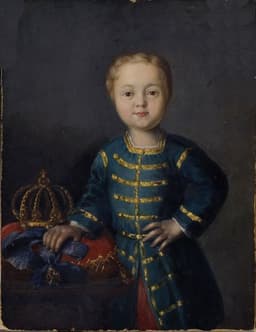
Ivan VI
Emperor · Modern
57.9Total

Swarup Singh of Udaipur
Emperor · Modern
43.3Total
Basic Information
Born
1740
1815
Died
1764
1861
Era
Modern
Modern
Nationality
Russia
India
Occupation
Emperor
Emperor
Civilization
Western
Indian
Score Comparison
Military (10%)
20.5
21.2
Political (20%)
57.3
35.1
Influence (20%)
68.0
49.4
Legacy (20%)
52.0
38.3
Leadership (15%)
76.8
67.0
Strategy (15%)
57.2
39.6
TOTAL
57.9
43.3
Ivan VI — Complete Timeline
1740 AD
Accession as Emperor of RussiaPolitical Action◆ Major
Ivan VI was proclaimed emperor at the age of two months after the death of Anna of Russia, with Ernst Johann von Biron as regent. His accession was part of Anna's plan to secure the succession for her family line, but it immediately triggered a power struggle.
SuccessionInfant TsarRegency
Impact: national
1741 AD
Overthrow and ImprisonmentPolitical Action◆ Major
Ivan VI was deposed in a coup led by Elizabeth of Russia, who seized the throne. He was imprisoned in the Shlisselburg Fortress, where he spent the rest of his life in solitary confinement. His name was erased from official records, and he was referred to as the 'nameless prisoner'.
CoupImprisonmentElizabeth
Impact: nationaltragic
1764 AD
Murder in Shlisselburg FortressOther◆ Major
Ivan VI was killed by his guards during an attempted rescue by Lieutenant Vasily Mirovich. The rescue attempt aimed to restore him to the throne, but the guards followed orders to kill him if any escape was attempted. His death ended any possibility of a restoration.
AssassinationRescue AttemptShlisselburg
Impact: nationaltragic
Swarup Singh of Udaipur — Complete Timeline
1842 AD
Accession as Maharana of MewarPolitical Action◆ Major
Swarup Singh became Maharana of Mewar at age 27 after the death of his father. His reign was marked by cooperation with the British East India Company, especially during the Indian Rebellion of 1857.
AccessionMewarMaharana
Impact: regional
1850 AD
Construction of Swarup Vilas PalaceCultural
Swarup Singh built the Swarup Vilas Palace in Udaipur, a blend of Rajput and Mughal architecture. The palace served as a royal residence and reflected his patronage of traditional arts.
ArchitectureUdaipurPalace
constructive
1857 AD
Support to British during Indian Rebellion of 1857War◆ Major
Swarup Singh provided military and logistical support to the British during the Indian Rebellion of 1857. He sent troops to help suppress the uprising in central India, earning British gratitude and securing Mewar's autonomy.
1857 RebellionBritish SupportMewar
Impact: regional
1861 AD
Death and successionOther
Swarup Singh died in 1861 after a 19-year reign. He was succeeded by his son Shambhu Singh. His loyalty to the British ensured Mewar's stability during the turbulent period of the 1857 rebellion.
DeathSuccessionMewar
Impact: regional
This comparison has not been analyzed yet.
One-time AI generation (~1 minute). Scores and timeline are already available below.
Rankings
🥇
Ivan VILeader
Mil: 20.5Pol: 57.3Inf: 68.0
57.9
🥈
Swarup Singh of Udaipur
Mil: 21.2Pol: 35.1Inf: 49.4
43.3
+14.6 behind
How This Comparison Works
Algorithm
Each figure is scored on 6 dimensions (0—100 scale) based on structured historical data: Military (10%), Political (20%), Influence (20%), Legacy (20%), Leadership (15%), Strategy (15%). The weighted total produces the final ranking.
Data Sources
Scores are computed from structured sub-indicators in the database. Scale factors adjust for era (Ancient ×0.85, Modern ×1.0) and civilization size (Eastern ×1.05, Other ×0.80) to account for differences in population and military scale.
Maximum 3 Figures
Comparisons are limited to 2—3 figures to ensure readability and statistical meaningfulness.
Error Margins
±5 points per dimension — Sub-scores are derived from historical records with inherent uncertainty. Two figures within 5 points on a dimension should be considered roughly equivalent in that area.
Total Score Accuracy
±3 points overall — The weighted combination of 6 dimensions produces a total score with approximately ±3 points of uncertainty. Differences of less than 3 points are not statistically significant— the figures are effectively tied.
Known Limitations
- Historical records are incomplete and uneven across civilizations
- Figures from oral-tradition societies may be underrepresented
- Occupation labels can misclassify multi-role figures
- Scores measure capability and impact, not moral character
- Quantitative scoring is a comparison tool, not absolute truth
Capability Radar
Military (10%) — Battles & Warfare
Battles
35
10
Win Rate
37
15
Expansion
45
5
Political (20%) — Governance & Reform
Reform
58
10
Diplomacy
61
35
Economy
64
15
Influence (20%) — Cultural & Global Reach
Cultural
65
15
Global
78
10
Legacy (20%) — Historical Impact
Historical
69
20
Longevity
74
10
Leadership (15%) — Power & Stability
Tenure
58
40
Stability
71
30
Strategy (15%) — Tactics & Innovation
Strategy
44
10
Tactics
51
10
Reform
50
5
Similar Comparisons
Comments & Discussion
No comments yet. Be the first to share your thoughts!