Loading...
Ivan VI vs Julius Caesar
Julius Caesar leads by 24.9 pts · 2 figures compared
…
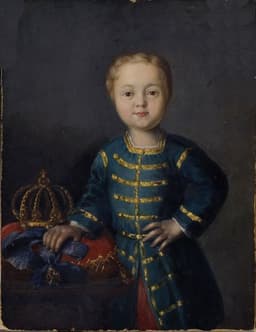
Ivan VI
Emperor · Modern
57.9Total

Julius Caesar
General · Ancient
82.8Total
Basic Information
Born
1740
-100
Died
1764
-44
Era
Modern
Ancient
Nationality
Russia
Roman Republic
Occupation
Emperor
General
Civilization
Western
Western
Score Comparison
Military (10%)
20.5
88.0
Political (20%)
57.3
78.0
Influence (20%)
68.0
85.0
Legacy (20%)
52.0
82.0
Leadership (15%)
76.8
80.0
Strategy (15%)
57.2
85.0
TOTAL
57.9
82.8
Ivan VI — Complete Timeline
1740 AD
Accession as Emperor of RussiaPolitical Action◆ Major
Ivan VI was proclaimed emperor at the age of two months after the death of Anna of Russia, with Ernst Johann von Biron as regent. His accession was part of Anna's plan to secure the succession for her family line, but it immediately triggered a power struggle.
SuccessionInfant TsarRegency
Impact: national
1741 AD
Overthrow and ImprisonmentPolitical Action◆ Major
Ivan VI was deposed in a coup led by Elizabeth of Russia, who seized the throne. He was imprisoned in the Shlisselburg Fortress, where he spent the rest of his life in solitary confinement. His name was erased from official records, and he was referred to as the 'nameless prisoner'.
CoupImprisonmentElizabeth
Impact: nationaltragic
1764 AD
Murder in Shlisselburg FortressOther◆ Major
Ivan VI was killed by his guards during an attempted rescue by Lieutenant Vasily Mirovich. The rescue attempt aimed to restore him to the throne, but the guards followed orders to kill him if any escape was attempted. His death ended any possibility of a restoration.
AssassinationRescue AttemptShlisselburg
Impact: nationaltragic
Julius Caesar — Complete Timeline
58 BC
Gallic WarsWar◆ Major
Caesar, as proconsul of Gaul, launched a series of campaigns that conquered all of Gaul (modern France, Belgium, and parts of Switzerland). He fought numerous battles, including against the Helvetii, the Belgae, and the Gallic chieftain Vercingetorix. The wars brought immense wealth and a loyal army to Caesar.
Gallic WarsConquestRoman Expansion
Impact: regional
49 BC
Crossing the RubiconPolitical Action◆ Major
Caesar led Legio XIII across the Rubicon River into Italy, defying the Roman Senate's order to disband his army. This act triggered a civil war against Pompey and the Optimates, ultimately leading to Caesar's dictatorship and the end of the Roman Republic.
Roman Civil WarEnd of RepublicPower Struggle
Impact: global
48 BC
Battle of PharsalusWar◆ Major
Caesar's outnumbered army defeated the larger forces of Pompey the Great at Pharsalus in Greece. Caesar's tactical use of a reserve line to counter Pompey's cavalry charge proved decisive. Pompey fled to Egypt, where he was assassinated, leaving Caesar as the undisputed master of the Roman world.
Roman Civil WarBattleDecisive Victory
Impact: regional
44 BC
Appointment as Dictator for LifePolitical Action◆ Major
The Roman Senate appointed Caesar dictator perpetuo (dictator for life), granting him unprecedented personal power. This move concentrated military, legislative, and judicial authority in one person, effectively ending the Roman Republic's traditional system of checks and balances and alarming many senators.
DictatorshipEnd of RepublicPower Consolidation
Impact: regionaldestructive
Assassination on the Ides of MarchPolitical Action◆ Major
A group of Roman senators, led by Marcus Junius Brutus and Gaius Cassius Longinus, stabbed Caesar to death at a meeting of the Senate in the Theatre of Pompey. The assassination was intended to restore the Republic, but instead triggered another civil war that led to the rise of the Roman Empire.
AssassinationRoman PoliticsEnd of Republic
Impact: globaldestructive
Expert Analysis
ivan-vi-vs-julius-caesar
# The Emperor Who Never Ruled
In the summer of 1764, a young man lay dead in a damp cell of the Shlisselburg Fortress, stabbed by his own guards. His name was Ivan VI, and he had been emperor of Russia at the age of two months. Across the centuries and the continent, another man had died by violence too—Julius Caesar, stabbed twenty-three times on the floor of the Roman Senate. One was the architect of an empire, the other its forgotten victim. What separates a figure who reshapes the world from one who is merely swept away by it? The answer lies not in destiny, but in the raw, brutal machinery of opportunity, character, and timing.
Origins
Julius Caesar was born into the patrician Julian clan in 100 BCE, a family of ancient lineage but modest political clout. Rome was a republic in crisis—torn between senatorial oligarchs and populist reformers, its armies conquering the Mediterranean while its institutions corroded. Caesar’s childhood was marked by civil war and proscriptions; his father died when he was sixteen. He learned early that survival meant maneuvering between factions, and that glory was the only currency that mattered.
Ivan VI was born in 1740, the great-nephew of Empress Anna of Russia. His father was a German prince, his mother a niece of Anna. Russia was an autocracy where power flowed from the palace, not the people. Ivan’s infancy coincided with a succession crisis: Anna had no children of her own, and the throne was a prize for whichever faction could seize it. He was never taught to rule—he was simply a signature on a decree, a body on a throne.
The contrast is stark. Caesar grew up in a world where a man could rise through talent, ruthlessness, and luck. Ivan was born into a system where birth alone decided everything—and where birth could just as easily condemn you.
Rise to Power
Caesar’s path was a ladder of calculated gambles. He fled Rome to avoid Sulla’s proscriptions, then returned to build a career as a lawyer, priest, and military tribune. His real ascent began in 60 BCE, when he formed the First Triumvirate with Pompey and Crassus. The conquest of Gaul from 58 to 50 BCE gave him an army, wealth, and a legend. When the Senate ordered him to disband, he crossed the Rubicon in 49 BCE—an act of war that launched a civil war. By 45 BCE, he was dictator of Rome.
Ivan’s rise was not his own. On October 28, 1740, Empress Anna died, and the two-month-old was proclaimed emperor. The real power was Ernst Johann von Biron, a German favorite who had ruled as Anna’s regent. Within weeks, Biron was overthrown by Ivan’s mother, Anna Leopoldovna, who became regent. The infant emperor was a puppet in a court of wolves. There was no campaign, no speech, no battle—just a cradle and a crown.
Leadership & Governance
Caesar governed as a revolutionary reformer. He centralized the Roman state, reformed the calendar, granted citizenship to provincials, and launched massive public works. His military genius was absolute: at Alesia in 52 BCE, he besieged a Gallic army while simultaneously fighting off a relief force, a feat of logistics and nerve. But his rule was autocratic. He was made dictator for life in 44 BCE, and his contempt for the Senate’s traditions alienated even his allies.
Ivan never governed. From 1741 to 1764, he lived in solitary confinement. His only “reign” was a legal fiction. The real rulers were Elizabeth, who deposed him in a coup on December 6, 1741, and then Catherine the Great, who kept him imprisoned. He was a threat not because of anything he did, but because of what he represented—a legitimate heir.
Triumph & Tragedy
Caesar’s greatest triumph was the conquest of Gaul, which added a vast territory to the Roman sphere and made him the richest man in the Republic. His tragedy was the Ides of March, March 15, 44 BCE, when senators he had pardoned stabbed him to death. He died at the height of his power, leaving behind a civil war that ended the Republic.
Ivan’s only triumph was survival—for twenty-three years in a dungeon. His tragedy was his murder in 1764, when a lieutenant named Vasily Mirovich tried to rescue him. The guards, following orders, killed the prisoner to prevent his escape. He was twenty-three years old, and most of Russia had forgotten he existed.
Character & Destiny
Caesar was ambitious, calculating, and charismatic. He forgave his enemies—a policy that ultimately killed him. He believed in his own star, and he was right, until the moment he was wrong. His character drove him to take risks that would have destroyed lesser men, and it was that same character that made him a target.
Ivan was a blank slate. He had no character because he had no life. He was a symbol, not a person. His destiny was decided by others: by Anna’s choice of regent, by Elizabeth’s ambition, by Catherine’s fear. He was not a man who made history; he was history’s footnote, a name in a ledger.
Legacy
Caesar’s legacy is the Roman Empire. His name became a title—Kaiser, Tsar—and his reforms shaped Western governance for two millennia. He is remembered as a genius and a tyrant, a hero and a warning.
Ivan VI is remembered, if at all, as a tragedy. His story is a cautionary tale about the randomness of power in autocratic systems. He has no monuments, no battles, no laws. He is a ghost in the Russian historical record, a child who was emperor for a year and a prisoner for a lifetime.
Conclusion
What drove these two men to such different fates? Not ability—Ivan might have been a capable ruler if given the chance. Not circumstance—both were born into turbulent times. The difference was agency. Caesar seized history by the throat; Ivan was history’s hostage. In the end, the world remembers those who act, not those who are acted upon. The Ides of March claimed a dictator; the Shlisselburg cell swallowed a name. One became a legend; the other, a lesson.
Rankings
🥇
Julius CaesarLeader
Mil: 88.0Pol: 78.0Inf: 85.0
82.8
🥈
Ivan VI
Mil: 20.5Pol: 57.3Inf: 68.0
57.9
+24.9 behind
How This Comparison Works
Algorithm
Each figure is scored on 6 dimensions (0—100 scale) based on structured historical data: Military (10%), Political (20%), Influence (20%), Legacy (20%), Leadership (15%), Strategy (15%). The weighted total produces the final ranking.
Data Sources
Scores are computed from structured sub-indicators in the database. Scale factors adjust for era (Ancient ×0.85, Modern ×1.0) and civilization size (Eastern ×1.05, Other ×0.80) to account for differences in population and military scale.
Maximum 3 Figures
Comparisons are limited to 2—3 figures to ensure readability and statistical meaningfulness.
Error Margins
±5 points per dimension — Sub-scores are derived from historical records with inherent uncertainty. Two figures within 5 points on a dimension should be considered roughly equivalent in that area.
Total Score Accuracy
±3 points overall — The weighted combination of 6 dimensions produces a total score with approximately ±3 points of uncertainty. Differences of less than 3 points are not statistically significant— the figures are effectively tied.
Known Limitations
- Historical records are incomplete and uneven across civilizations
- Figures from oral-tradition societies may be underrepresented
- Occupation labels can misclassify multi-role figures
- Scores measure capability and impact, not moral character
- Quantitative scoring is a comparison tool, not absolute truth
Capability Radar
Military (10%) — Battles & Warfare
Battles
35
95
Win Rate
37
92
Expansion
45
97
Political (20%) — Governance & Reform
Reform
58
90
Diplomacy
61
85
Economy
64
82
Influence (20%) — Cultural & Global Reach
Cultural
65
88
Global
78
94
Legacy (20%) — Historical Impact
Historical
69
95
Longevity
74
96
Leadership (15%) — Power & Stability
Tenure
58
75
Stability
71
60
Strategy (15%) — Tactics & Innovation
Strategy
44
94
Tactics
51
96
Reform
50
88
Similar Comparisons
Comments & Discussion
No comments yet. Be the first to share your thoughts!