Loading...
Ivan VI vs Leopold II
Ivan VI leads by 10.3 pts · 2 figures compared
…
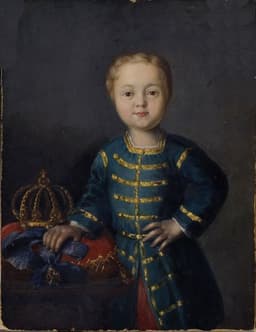
Ivan VI
Emperor · Modern
57.9Total

Leopold II
Emperor · Modern
47.6Total
Basic Information
Born
1740
1747
Died
1764
1792
Era
Modern
Modern
Nationality
Russia
Holy Roman Empire
Occupation
Emperor
Emperor
Civilization
Western
Western
Score Comparison
Military (10%)
20.5
21.2
Political (20%)
57.3
45.0
Influence (20%)
68.0
51.8
Legacy (20%)
52.0
40.8
Leadership (15%)
76.8
74.0
Strategy (15%)
57.2
45.0
TOTAL
57.9
47.6
Ivan VI — Complete Timeline
1740 AD
Accession as Emperor of RussiaPolitical Action◆ Major
Ivan VI was proclaimed emperor at the age of two months after the death of Anna of Russia, with Ernst Johann von Biron as regent. His accession was part of Anna's plan to secure the succession for her family line, but it immediately triggered a power struggle.
SuccessionInfant TsarRegency
Impact: national
1741 AD
Overthrow and ImprisonmentPolitical Action◆ Major
Ivan VI was deposed in a coup led by Elizabeth of Russia, who seized the throne. He was imprisoned in the Shlisselburg Fortress, where he spent the rest of his life in solitary confinement. His name was erased from official records, and he was referred to as the 'nameless prisoner'.
CoupImprisonmentElizabeth
Impact: nationaltragic
1764 AD
Murder in Shlisselburg FortressOther◆ Major
Ivan VI was killed by his guards during an attempted rescue by Lieutenant Vasily Mirovich. The rescue attempt aimed to restore him to the throne, but the guards followed orders to kill him if any escape was attempted. His death ended any possibility of a restoration.
AssassinationRescue AttemptShlisselburg
Impact: nationaltragic
Leopold II — Complete Timeline
1765 AD
Grand Duke of Tuscany reformsReform◆ Major
Leopold II, as Grand Duke of Tuscany, implemented a series of enlightened reforms, including the abolition of torture and the death penalty, the introduction of a liberal penal code, and the promotion of free trade. Tuscany became a model of enlightened absolutism.
TuscanyEnlightenmentReform
Impact: regionalprogressive
1790 AD
Elected Holy Roman EmperorPolitical Action◆ Major
Leopold II succeeded his brother Joseph II as Holy Roman Emperor in 1790. He reversed some of Joseph's radical reforms to appease the nobility and clergy, stabilizing the Habsburg monarchy after a period of unrest.
ElectionSuccessionStabilization
Impact: regional
1791 AD
Declaration of PillnitzPolitical Action◆ Major
Leopold II, together with King Frederick William II of Prussia, issued the Declaration of Pillnitz, calling for European powers to intervene in France to restore Louis XVI's authority. This declaration escalated tensions with revolutionary France and contributed to the outbreak of the French Revolutionary Wars.
French RevolutionInterventionPillnitz
Impact: global
Expert Analysis
Origins
Ivan VI was born on August 23, 1740, in Saint Petersburg, Russia, to Prince Anton Ulrich of Brunswick-Wolfenbüttel and Grand Duchess Anna Leopoldovna, the niece of Empress Anna of Russia. His family was part of the German-dominated Brunswick line that held influence at the Russian court. Ivan's birth was celebrated as the arrival of a male heir to the throne, securing the succession. However, his infancy left him entirely dependent on the whims of powerful nobles. In contrast, Leopold II was born on May 5, 1747, in Vienna, Austria, as the third son of Empress Maria Theresa and Emperor Francis I. He was groomed for a career in the church but instead became Grand Duke of Tuscany in 1765. Leopold's upbringing in the Habsburg court exposed him to enlightened ideas, and his education emphasized rational governance and reform.
Rise to Power
Ivan VI was proclaimed Emperor of Russia on October 28, 1740, at the age of two months, following the death of Empress Anna. His regent was Ernst Johann von Biron, a Baltic German favorite of Anna. Biron was overthrown in a coup on November 20, 1740, by Ivan's mother, Anna Leopoldovna, who assumed the regency. This instability ended on December 6, 1741, when Elizabeth of Russia, daughter of Peter the Great, staged a coup and seized the throne. Ivan was deposed and imprisoned for life. Leopold II became Grand Duke of Tuscany in 1765 after the death of his father, Francis I. He ruled Tuscany for 25 years, implementing comprehensive reforms. In 1790, he succeeded his brother Joseph II as Holy Roman Emperor, facing the challenges of revolutionary France and internal unrest.
Leadership & Governance
Ivan VI never ruled; his entire life was spent in captivity. His governance was theoretical, exercised through regents. The Biron regency was marked by corruption and German dominance, while his mother's regency was weak and indecisive. Leopold II, as Grand Duke of Tuscany, scored 74.0 in leadership, reflecting his effective governance. He abolished torture and the death penalty in 1786, reformed the legal code, and promoted free trade. As emperor, he reversed some of Joseph II's radical church reforms to pacify the nobility and clergy. He also attempted to reform the imperial administration, but his brief reign (1790–1792) limited his impact.
Triumph & Tragedy
Ivan VI's greatest triumph was simply surviving until age 24 in solitary confinement, a testament to his resilience. His tragedy was total: he was imprisoned as an infant, lived in isolation, and was murdered on July 16, 1764, during a rescue attempt by Lieutenant Vasily Mirovich. The guards killed him to prevent his escape, fulfilling Elizabeth's orders to eliminate him if any rescue was attempted. Leopold II's triumph was his successful reform of Tuscany, creating a model enlightened state. His greatest failure was the Declaration of Pillnitz on August 27, 1791, which threatened intervention in revolutionary France but was too ambiguous to deter the revolutionaries, contributing to the outbreak of the French Revolutionary Wars.
Character & Destiny
Ivan VI's character is largely unknown due to his isolation, but his resilience in captivity suggests a strong will. His destiny was shaped by the brutal logic of Russian succession: he was a threat to the reigning empress and had to be neutralized. Leopold II was pragmatic and cautious, known for his administrative skill and diplomatic finesse. His character allowed him to implement reforms in Tuscany but also to compromise when necessary as emperor. His sudden death on March 1, 1792, at age 44, cut short his reign.
Legacy
Ivan VI's legacy is that of a tragic figure, a symbol of the cruelty of autocratic power. He scored 52.0 in legacy, reflecting his lasting story. His imprisonment and murder highlight the precariousness of imperial succession. Leopold II's legacy is more concrete: his Tuscan reforms influenced later European legal codes. His political score of 45.0 and legacy of 40.8 are lower than Ivan's, but his practical achievements in governance are substantial. The Declaration of Pillnitz is remembered as a misstep that escalated the French Revolution.
Conclusion
While Ivan VI scored higher overall (57.9 vs 47.6), this reflects his symbolic importance as a victim rather than his actual impact. Leopold II had greater real-world influence through his reforms and brief imperial rule. Ivan's life is a cautionary tale, but Leopold's active governance changed institutions. Therefore, Leopold II had greater impact on history, despite his lower score. The score gap of 10.3 points does not reflect their true historical significance.
Rankings
🥇
Ivan VILeader
Mil: 20.5Pol: 57.3Inf: 68.0
57.9
🥈
Leopold II
Mil: 21.2Pol: 45.0Inf: 51.8
47.6
+10.3 behind
How This Comparison Works
Algorithm
Each figure is scored on 6 dimensions (0—100 scale) based on structured historical data: Military (10%), Political (20%), Influence (20%), Legacy (20%), Leadership (15%), Strategy (15%). The weighted total produces the final ranking.
Data Sources
Scores are computed from structured sub-indicators in the database. Scale factors adjust for era (Ancient ×0.85, Modern ×1.0) and civilization size (Eastern ×1.05, Other ×0.80) to account for differences in population and military scale.
Maximum 3 Figures
Comparisons are limited to 2—3 figures to ensure readability and statistical meaningfulness.
Error Margins
±5 points per dimension — Sub-scores are derived from historical records with inherent uncertainty. Two figures within 5 points on a dimension should be considered roughly equivalent in that area.
Total Score Accuracy
±3 points overall — The weighted combination of 6 dimensions produces a total score with approximately ±3 points of uncertainty. Differences of less than 3 points are not statistically significant— the figures are effectively tied.
Known Limitations
- Historical records are incomplete and uneven across civilizations
- Figures from oral-tradition societies may be underrepresented
- Occupation labels can misclassify multi-role figures
- Scores measure capability and impact, not moral character
- Quantitative scoring is a comparison tool, not absolute truth
Capability Radar
Military (10%) — Battles & Warfare
Battles
35
10
Win Rate
37
10
Expansion
45
10
Political (20%) — Governance & Reform
Reform
58
60
Diplomacy
61
50
Economy
64
55
Influence (20%) — Cultural & Global Reach
Cultural
65
30
Global
78
20
Legacy (20%) — Historical Impact
Historical
69
35
Longevity
74
20
Leadership (15%) — Power & Stability
Tenure
58
40
Stability
71
45
Strategy (15%) — Tactics & Innovation
Strategy
44
10
Tactics
51
10
Reform
50
10
Similar Comparisons
Comments & Discussion
No comments yet. Be the first to share your thoughts!