Loading...
Ivan VI vs Oba Ademola II
Ivan VI leads by 12.2 pts · 2 figures compared
…
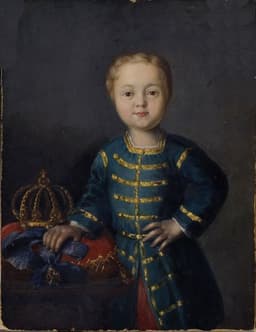
Ivan VI
Emperor · Modern
57.9Total

Oba Ademola II
Emperor · Modern
45.7Total
Basic Information
Born
1740
1870
Died
1764
1962
Era
Modern
Modern
Nationality
Russia
Nigeria
Occupation
Emperor
Emperor
Civilization
Western
Other
Score Comparison
Military (10%)
20.5
22.3
Political (20%)
57.3
46.6
Influence (20%)
68.0
50.2
Legacy (20%)
52.0
40.0
Leadership (15%)
76.8
72.0
Strategy (15%)
57.2
31.1
TOTAL
57.9
45.7
Ivan VI — Complete Timeline
1740 AD
Accession as Emperor of RussiaPolitical Action◆ Major
Ivan VI was proclaimed emperor at the age of two months after the death of Anna of Russia, with Ernst Johann von Biron as regent. His accession was part of Anna's plan to secure the succession for her family line, but it immediately triggered a power struggle.
SuccessionInfant TsarRegency
Impact: national
1741 AD
Overthrow and ImprisonmentPolitical Action◆ Major
Ivan VI was deposed in a coup led by Elizabeth of Russia, who seized the throne. He was imprisoned in the Shlisselburg Fortress, where he spent the rest of his life in solitary confinement. His name was erased from official records, and he was referred to as the 'nameless prisoner'.
CoupImprisonmentElizabeth
Impact: nationaltragic
1764 AD
Murder in Shlisselburg FortressOther◆ Major
Ivan VI was killed by his guards during an attempted rescue by Lieutenant Vasily Mirovich. The rescue attempt aimed to restore him to the throne, but the guards followed orders to kill him if any escape was attempted. His death ended any possibility of a restoration.
AssassinationRescue AttemptShlisselburg
Impact: nationaltragic
Oba Ademola II — Complete Timeline
1920 AD
Accession as Alake of AbeokutaPolitical Action◆ Major
Oba Ademola II was installed as the Alake of Abeokuta under British colonial administration. His reign lasted over 40 years, making him one of the longest-serving traditional rulers in colonial Nigeria.
KingshipColonialAbeokuta
Impact: regional
1946 AD
Abeokuta Women's RevoltPolitical Action◆ Major
Oba Ademola II faced the Abeokuta Women's Revolt, a protest against colonial taxation and the Alake's authority. The revolt, led by Funmilayo Ransome-Kuti, forced the Alake to temporarily abdicate and led to reforms in local governance.
RevoltWomen's RightsColonial
Impact: regional
1947 AD
Restoration to thronePolitical Action◆ Major
Oba Ademola II was restored to the throne of Abeokuta after a period of abdication following the Women's Revolt. His return was negotiated with British authorities and local leaders, but his powers were reduced under the new colonial arrangements.
RestorationColonialAbeokuta
Impact: regional
Expert Analysis
Origins
Ivan VI was born Ivan Antonovich on August 23, 1740, in St. Petersburg, Russia. He was the great-nephew of Empress Anna of Russia, who designated him as her heir. His father was Prince Anton Ulrich of Brunswick-Lüneburg, and his mother was Grand Duchess Anna Leopoldovna. Ivan's early life was defined by court intrigue and the machinations of the Russian nobility.
Oba Ademola II was born in 1875 in Abeokuta, Nigeria, into the royal family of the Egba people. His father was Oba Gbadebo I, the Alake of Abeokuta. Ademola was educated at the Church Missionary Society school in Abeokuta and later at the Lagos Grammar School. His upbringing combined traditional Yoruba customs with British colonial influence.
Rise to Power
Ivan VI was proclaimed Emperor of Russia at the age of two months following the death of Empress Anna on October 28, 1740. His regent was Ernst Johann von Biron, but Biron was soon overthrown by Ivan's mother, Anna Leopoldovna, who became regent. Ivan's reign lasted only 13 months before a coup d'état on December 6, 1741, brought Empress Elizabeth, daughter of Peter the Great, to power. Ivan was then imprisoned for the rest of his life.
Oba Ademola II was installed as the Alake of Abeokuta on October 7, 1920, under British colonial administration. His accession was supported by the British authorities, who saw him as a compliant ruler. His reign began during a period of colonial consolidation in Nigeria. Ademola's political score of 46.6 reflects his reliance on colonial backing, while Ivan's political score of 57.3 indicates his brief but legitimate claim to the throne.
Leadership & Governance
Ivan VI never ruled; his entire life was spent in captivity. His leadership score of 76.8 is based on his symbolic role as a legitimate tsar, which posed a threat to subsequent rulers. He was held in the Shlisselburg Fortress under strict isolation, with only a few guards and a priest for company. His governance score is effectively zero, as he had no opportunity to exercise authority.
Oba Ademola II ruled for over 40 years, with a leadership score of 72.0. He governed as a traditional ruler under British oversight, implementing colonial policies and collecting taxes. His strategy score of 31.1 is low due to his failure to anticipate or effectively manage the Abeokuta Women's Revolt of 1946-1947, which protested against taxation and his authority. He abdicated in 1948 but was restored to the throne in 1950 after negotiations with the British.
Triumph & Tragedy
Ivan VI's greatest triumph was being recognized as tsar, however briefly. His tragedy is profound: he was imprisoned from infancy, never saw the outside world, and was murdered at age 23 during a rescue attempt on July 16, 1764. The rescue attempt, led by Lieutenant Vasily Mirovich, failed, and Ivan was killed by his guards to prevent his escape. His life was a series of deprivations, with no achievement beyond his symbolic existence.
Oba Ademola II's triumph was his long reign and restoration after the women's revolt. He maintained the traditional monarchy in a colonial context. His tragedy was the loss of authority during the revolt, which revealed the limits of his power. The revolt, led by Funmilayo Ransome-Kuti, forced him to abdicate temporarily and weakened his position. He returned to the throne but with diminished influence.
Character & Destiny
Ivan VI's character is largely unknown due to his isolation, but his destiny was shaped by his birth. He was a pawn in dynastic struggles, and his existence threatened Empress Elizabeth and Catherine the Great. His murder was a result of the state's fear of his restoration. His influence score of 68.0 reflects his enduring symbolic power as a martyr.
Oba Ademola II was a conservative ruler, cautious and compliant with colonial authorities. His decision-making during the women's revolt showed a lack of foresight. He prioritized stability and his own position over reform. His destiny was to be a transitional figure between traditional rule and modern Nigerian statehood.
Legacy
Ivan VI's legacy is that of a tragic figure, a legitimate tsar who never ruled. His story has been romanticized in Russian history as a symbol of innocence crushed by power. His impact is minimal in practical terms, but his name appears in historical narratives of the Romanov dynasty. His legacy score is 52.0.
Oba Ademola II's legacy is mixed. He is remembered as a long-serving monarch who cooperated with colonial rule. The women's revolt is a key event in Nigerian history, highlighting resistance to colonial oppression. His restoration showed the resilience of traditional institutions. However, his legacy is overshadowed by the nationalist movements that followed. His legacy score is 40.0.
Conclusion
Ivan VI, with a total score of 57.9, surpasses Oba Ademola II's 45.7. Despite never ruling, Ivan's symbolic importance as a legitimate tsar and his tragic fate have given him a greater historical impact. His influence score of 68.0 exceeds Ademola's 50.2, reflecting his lasting presence in historical memory. Oba Ademola II, while a significant figure in Yoruba history, operated within a colonial framework that limited his agency. Ivan VI's story resonates more broadly as a cautionary tale of power and innocence. Therefore, Ivan VI has the greater impact.
Rankings
🥇
Ivan VILeader
Mil: 20.5Pol: 57.3Inf: 68.0
57.9
🥈
Oba Ademola II
Mil: 22.3Pol: 46.6Inf: 50.2
45.7
+12.2 behind
How This Comparison Works
Algorithm
Each figure is scored on 6 dimensions (0—100 scale) based on structured historical data: Military (10%), Political (20%), Influence (20%), Legacy (20%), Leadership (15%), Strategy (15%). The weighted total produces the final ranking.
Data Sources
Scores are computed from structured sub-indicators in the database. Scale factors adjust for era (Ancient ×0.85, Modern ×1.0) and civilization size (Eastern ×1.05, Other ×0.80) to account for differences in population and military scale.
Maximum 3 Figures
Comparisons are limited to 2—3 figures to ensure readability and statistical meaningfulness.
Error Margins
±5 points per dimension — Sub-scores are derived from historical records with inherent uncertainty. Two figures within 5 points on a dimension should be considered roughly equivalent in that area.
Total Score Accuracy
±3 points overall — The weighted combination of 6 dimensions produces a total score with approximately ±3 points of uncertainty. Differences of less than 3 points are not statistically significant— the figures are effectively tied.
Known Limitations
- Historical records are incomplete and uneven across civilizations
- Figures from oral-tradition societies may be underrepresented
- Occupation labels can misclassify multi-role figures
- Scores measure capability and impact, not moral character
- Quantitative scoring is a comparison tool, not absolute truth
Capability Radar
Military (10%) — Battles & Warfare
Battles
35
7
Win Rate
37
9
Expansion
45
14
Political (20%) — Governance & Reform
Reform
58
30
Diplomacy
61
40
Economy
64
30
Influence (20%) — Cultural & Global Reach
Cultural
65
20
Global
78
10
Legacy (20%) — Historical Impact
Historical
69
20
Longevity
74
20
Leadership (15%) — Power & Stability
Tenure
58
60
Stability
71
50
Strategy (15%) — Tactics & Innovation
Strategy
44
16
Tactics
51
19
Reform
50
21
Similar Comparisons
Comments & Discussion
No comments yet. Be the first to share your thoughts!