Loading...
Ito Hirobumi vs Midhat Pasha
Ito Hirobumi leads by 9.5 pts · 2 figures compared
…
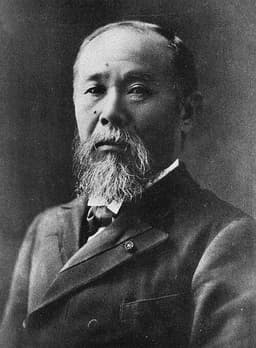
Ito Hirobumi
Politician · Modern
73.8Total
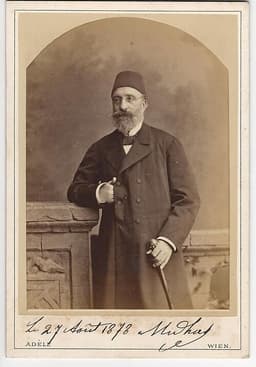
Midhat Pasha
Politician · Modern
64.3Total
Basic Information
Born
1841
1822
Died
1909
1884
Era
Modern
Modern
Nationality
Japan
Ottoman Empire
Occupation
Politician
Politician
Civilization
Eastern
Middle Eastern
Score Comparison
Military (10%)
50.0
10.0
Political (20%)
86.0
78.0
Influence (20%)
71.0
82.0
Legacy (20%)
80.0
72.0
Leadership (15%)
80.9
62.0
Strategy (15%)
60.0
38.3
TOTAL
73.8
64.3
Ito Hirobumi — Complete Timeline
1882 AD
Establishment of the Bank of JapanReform◆ Major
Under Ito Hirobumi's leadership, the Bank of Japan was established as the nation's central bank. It was modeled after European central banks and aimed to stabilize the currency and control inflation. This institution was crucial for Japan's economic modernization and industrial growth.
Central BankEconomic ReformModernization
Impact: nationalconstructive
1885 AD
First Prime Minister of JapanPolitical Action◆ Major
Ito Hirobumi became the first Prime Minister of Japan under the new cabinet system. He served four non-consecutive terms and was instrumental in shaping the modern Japanese state. His tenure focused on centralizing power, modernizing the economy, and strengthening the military.
Prime MinisterCabinet SystemMeiji Period
Impact: nationalconstructive
1889 AD
Drafting of the Meiji ConstitutionReform
Ito Hirobumi led the drafting of the Meiji Constitution, which established a constitutional monarchy with a bicameral parliament (the Diet). The constitution granted the emperor sovereign power but also provided for elected representatives. It was promulgated in 1889 and remained in effect until 1947.
ConstitutionMeiji PeriodGovernment Reform
Impact: nationalconstructive
1909 AD
Assassination at Harbin StationPolitical Action◆ Major
Ito Hirobumi was assassinated by Korean nationalist An Jung-geun at Harbin railway station in Manchuria. Ito was on a mission to negotiate with Russian officials regarding Korea. His death shocked Japan and was used to justify the formal annexation of Korea in 1910.
AssassinationKoreaAnnexation
Impact: globaltragic
Midhat Pasha — Complete Timeline
1864 AD
Governorship of the Danube VilayetReform◆ Major
As governor of the Danube Vilayet from 1864 to 1868, Midhat Pasha implemented extensive reforms. He built roads, bridges, and schools, established a provincial bank, and promoted agricultural development. His administration became a model for Tanzimat provincial governance.
GovernorshipReformInfrastructure
Impact: regionalconstructive
1872 AD
Appointment as Grand VizierPolitical Action◆ Major
Midhat Pasha was appointed Grand Vizier for the first time in 1872. He had previously served as governor of the Danube Vilayet and was known for his reformist ideas. His tenure was short-lived due to opposition from conservative factions and the sultan.
AppointmentReformOttoman Politics
Impact: nationalconstructive
1876 AD
Proclamation of the Ottoman Constitution of 1876Reform
Midhat Pasha was the chief architect of the first Ottoman Constitution, proclaimed on December 23, 1876. The constitution established a bicameral parliament, guaranteed civil liberties, and limited the sultan's powers. It was a landmark in Ottoman modernization, though it was suspended in 1878.
ConstitutionReformParliament
Impact: nationalprogressive
1881 AD
Exile and TrialPolitical Action◆ Major
Midhat Pasha was arrested in 1881 on charges of involvement in the murder of Sultan Abd
ExileTrialExecution
Impact: nationaltragic
Expert Analysis
Ito Hirobumi vs Midhat Pasha
# The Constitution Makers: Ito Hirobumi and Midhat Pasha
On a December morning in 1889, Ito Hirobumi stood before the Emperor of Japan as the Meiji Constitution was proclaimed, a document he had spent years crafting in secret, studying European models in Berlin and Vienna. Half a world away and thirteen years earlier, on another December day in 1876, Midhat Pasha had watched as cannons fired to announce the Ottoman Empire's first constitution—a charter he had written with his own hand, believing it would save a dying empire. Both men had reached the pinnacle of reform, yet one would die at an assassin's bullet after decades of service, and the other would be strangled in a prison cell, his life's work undone. Why did their paths diverge so dramatically?
Origins
Ito Hirobumi was born in 1841 to a low-ranking samurai family in Hagi, a domain that simmered with resentment against the Tokugawa shogunate. His father was a farmer who had purchased samurai status, and young Ito grew up in a world where rigid hierarchy clashed with rising ambition. The arrival of Commodore Perry's black ships in 1853, when Ito was twelve, shattered Japan's isolation and set his generation on a desperate quest to learn from the West. He would later travel to England as a student, returning with a clear vision: Japan must modernize or be colonized.
Midhat Pasha, born in 1822 in Istanbul, came from a different world entirely. His father was a respected Islamic judge, and Midhat received a traditional religious education. But the Ottoman Empire was already the "sick man of Europe," losing territories to Russia and nationalist uprisings. While Ito's Japan was still intact, Midhat's empire was visibly crumbling. This difference haunted everything they attempted.
Rise to Power
Ito's rise was meteoric and strategic. After the Meiji Restoration of 1868, he became one of the "Meiji oligarchs," a small group of brilliant young men who effectively ran Japan. He served in key ministries, studied constitutions abroad, and by 1885 became Japan's first Prime Minister under the new cabinet system. His path was one of careful alliance-building with the emperor, the military, and the emerging industrial class.
Midhat's path was more turbulent. He made his reputation as governor of the Danube Vilayet from 1864 to 1868, where he built roads, bridges, and schools, earning a reputation as a reformer who could actually deliver results. His appointment as Grand Vizier in 1872 was a triumph, but it was also a trap. The Ottoman court was a snake pit of palace intrigues, and Midhat lacked the political base that Ito had built. He was a reformer without a party, a statesman without a stable network.
Leadership & Governance
Ito's genius was his understanding that reform required institutional permanence. The Meiji Constitution of 1889 was not a gift to the people but a carefully calibrated instrument of power. It established a constitutional monarchy, a bicameral parliament, and an independent judiciary—but it also reserved ultimate authority for the emperor, who was guided by Ito and his allies. The Bank of Japan, established in 1882 under Ito's leadership, stabilized the currency and financed industrialization. Everything Ito did was designed to create lasting structures.
Midhat's approach was more idealistic and more desperate. The Ottoman Constitution of 1876 was a bold document that promised civil rights, parliamentary government, and equality for all subjects regardless of religion. But Midhat had to push it through against the opposition of Sultan Abdülhamid II, who signed it only under pressure. Where Ito had a decade to prepare, Midhat had months. Where Ito worked with a unified elite, Midhat faced a divided court, foreign creditors, and nationalist revolts in the Balkans.
Triumph & Tragedy
Ito's greatest triumph was the Meiji Constitution itself, which lasted until 1947 and provided the framework for Japan's transformation into a world power. His tragedy came in 1909, when he was assassinated by Korean nationalist An Jung-geun at Harbin station in Manchuria. Ito had become the symbol of Japanese imperialism, and his death marked the end of the era of civilian leadership in Japan.
Midhat's triumph was the constitution, but it lasted barely two years. Sultan Abdülhamid II suspended it in 1878, citing the war with Russia. Midhat was arrested in 1881, charged with complicity in the murder of Sultan Abdülaziz, and sentenced to death—a sentence commuted to exile. In 1884, he was strangled in his prison cell in Taif, Arabia. His constitution was not revived until 1908, and by then the empire was too weak to survive.
Character & Destiny
Ito was a pragmatist, a realist who understood that power must be built brick by brick. He was ruthless when necessary, but he was also patient. He could wait years for the right moment to act. Midhat was a man of principle, driven by a vision of a liberal, multi-ethnic empire. He believed that the right idea, presented at the right moment, could change everything. But he underestimated how deeply the sultan and the old elites opposed change.
Their personalities shaped their fates. Ito's success came from his ability to compromise with power, to embed reform within existing hierarchies. Midhat's tragedy was his refusal to compromise, his belief that the constitution was a moral document, not a political one. He gave the sultan a constitution, but he forgot to give him a reason to keep it.
Legacy
Ito Hirobumi is remembered as the father of modern Japan. The Meiji Constitution, the Bank of Japan, the cabinet system—all bear his imprint. His face was on the 1,000 yen note for decades. But he is also remembered as the architect of Japanese colonialism in Korea, a legacy that complicates his reputation.
Midhat Pasha is remembered as a martyr of Ottoman liberalism. His constitution was a beacon for reformers across the Middle East, and his death became a symbol of the sultan's tyranny. But his failure also revealed the limits of reform in an empire that could not reconcile its diverse peoples.
Conclusion
Standing at Harbin station in 1909, Ito Hirobumi was shot by a man who saw him as an enemy of Korean independence. Sitting in his prison cell in 1884, Midhat Pasha was strangled by men who saw him as a traitor to Ottoman tradition. Both were reformers, both were constitution-makers, both were destroyed by the forces they tried to control. But Ito's constitution survived him, while Midhat's was buried with him. The difference was not in their vision—both dreamed of a modern, constitutional state. The difference was in the soil where they planted their dreams. Japan was a nation, unified and determined. The Ottoman Empire was an empire, divided and dying. One reformer built a house that stood for generations. The other built a house that collapsed before he could live in it.
Rankings
🥇
Ito HirobumiLeader
Mil: 50.0Pol: 86.0Inf: 71.0
73.8
🥈
Midhat Pasha
Mil: 10.0Pol: 78.0Inf: 82.0
64.3
+9.5 behind
How This Comparison Works
Algorithm
Each figure is scored on 6 dimensions (0—100 scale) based on structured historical data: Military (10%), Political (20%), Influence (20%), Legacy (20%), Leadership (15%), Strategy (15%). The weighted total produces the final ranking.
Data Sources
Scores are computed from structured sub-indicators in the database. Scale factors adjust for era (Ancient ×0.85, Modern ×1.0) and civilization size (Eastern ×1.05, Other ×0.80) to account for differences in population and military scale.
Maximum 3 Figures
Comparisons are limited to 2—3 figures to ensure readability and statistical meaningfulness.
Error Margins
±5 points per dimension — Sub-scores are derived from historical records with inherent uncertainty. Two figures within 5 points on a dimension should be considered roughly equivalent in that area.
Total Score Accuracy
±3 points overall — The weighted combination of 6 dimensions produces a total score with approximately ±3 points of uncertainty. Differences of less than 3 points are not statistically significant— the figures are effectively tied.
Known Limitations
- Historical records are incomplete and uneven across civilizations
- Figures from oral-tradition societies may be underrepresented
- Occupation labels can misclassify multi-role figures
- Scores measure capability and impact, not moral character
- Quantitative scoring is a comparison tool, not absolute truth
Capability Radar
Military (10%) — Battles & Warfare
Battles
0
0
Win Rate
0
0
Expansion
70
0
Political (20%) — Governance & Reform
Reform
95
85
Diplomacy
90
70
Economy
80
60
Influence (20%) — Cultural & Global Reach
Cultural
75
55
Global
80
55
Legacy (20%) — Historical Impact
Historical
85
70
Longevity
80
60
Leadership (15%) — Power & Stability
Tenure
85
65
Stability
85
40
Strategy (15%) — Tactics & Innovation
Strategy
0
0
Tactics
0
0
Reform
85
10
Similar Comparisons
Comments & Discussion
IronicIto6/16/2026
The real tragedy? Midhat Pasha actually drafted a genuinely liberal constitution with parliamentary sovereignty, while Ito cherry-picked the most authoritarian parts of Prussian and Austrian models. He specifically studied under Rudolf von Gneist and Lorenz von Stein—two men who believed constitutions should preserve monarchical power, not limit it. The Meiji Constitution literally made the Emperor "sacred and inviolable" (Article 3) while the Diet had almost no real power over the military budg
历史铁匠6/16/2026
Midhat比Ito早了整整13年搞出宪法,但奥斯曼帝国的苏丹阿卜杜勒·哈米德二世把宪法扔进垃圾桶只用了两年。1878年他解散议会,把Midhat流放到阿拉伯半岛,最后在塔伊夫监狱里用绳子勒死他。而Ito的明治宪法撑了几十年,直到二战战败才被改写。这不是个人能力的差距——是日本军国主义精英比奥斯曼宫廷官僚更懂如何用宪法包装独裁。
DataSkepticDan6/16/2026
The survival rate argument is silly. Two data points don't make a trend. Midhat's constitution collapsed because the Ottoman Empire was already hemorrhaging territory—between 1875-1878 alone they lost Bosnia, Bulgaria, and large chunks of the Balkans to rebellion and Russian invasion. Meanwhile, Japan in 1889 had no external enemies, a unified ethnic population, and was riding an economic boom from the industrial revolution. Compare apples to apples: put Midhat in 1880s Japan with a stable geopo
周游世界一书生6/16/2026
Midhat是真正的文人改革家——他父亲是伊斯兰法官,他自己从基层地方官做起,在尼什、多瑙河和巴格达当省长时搞过土改、修过路、建过孤儿院。他的宪法思想来自奥斯曼帝国的坦齐马特改革传统,而不是照抄欧洲课本。而Ito基本上是个政治投机分子,年轻时在日本学兰学、青年时跑去英国镀金,回来之后看风转向,抛弃了当初的激进派朋友。两人都搞宪法,但一个为了救国,一个为了固权。
SwordAndScepter6/16/2026
Let's be honest about the core difference: Ito understood that constitutions don't exist in a vacuum. He spent years building the institutional infrastructure first—a modern bureaucracy, a professional military loyal to the state, an education system that indoctrinated imperial loyalty. The Meiji Constitution was the capstone of a decades-long transformation. Midhat tried to put a constitutional roof on a house that was already caving in. His fatal error was believing that a piece of paper could