Loading...
Ishida Mitsunari vs Prem Tinsulanonda
Prem Tinsulanonda leads by 6.5 pts · 2 figures compared
…

Ishida Mitsunari
General · Modern
50.7Total
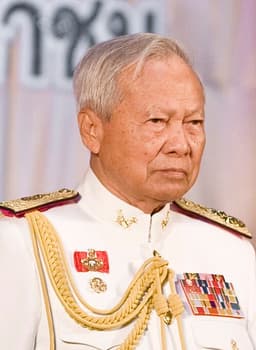
Prem Tinsulanonda
General · Modern
57.2Total
Basic Information
Born
1560
1920
Died
1600
—
Era
Modern
Modern
Nationality
Japan
Thailand
Occupation
General
General
Civilization
Eastern
Eastern
Score Comparison
Military (10%)
40.0
50.0
Political (20%)
48.0
59.3
Influence (20%)
53.3
54.9
Legacy (20%)
48.3
47.5
Leadership (15%)
54.2
78.0
Strategy (15%)
60.0
60.0
TOTAL
50.7
57.2
Ishida Mitsunari — Complete Timeline
1600 AD
Battle of SekigaharaWar
Ishida Mitsunari commanded the Western Army at Sekigahara against Tokugawa Ieyasu. His forces were defeated due to defections and tactical errors, leading to the establishment of the Tokugawa shogunate.
Sengoku PeriodBattleWestern Army
Impact: nationaldestructive
Siege of Fushimi CastleWar◆ Major
Ishida Mitsunari besieged Fushimi Castle, held by Torii Mototada for Tokugawa Ieyasu. The castle fell after a fierce defense, but the siege delayed the Western Army's movements.
Sengoku PeriodSiegeFushimi
Impact: regionaldestructive
Execution of Ishida MitsunariOther◆ Major
After the Battle of Sekigahara, Ishida Mitsunari was captured by Tokugawa forces. He was executed by beheading in Kyoto, ending his role as a leading opponent of Tokugawa Ieyasu.
Sengoku PeriodExecutionSekigahara
Impact: nationaltragic
Formation of the Western ArmyPolitical Action◆ Major
Ishida Mitsunari formed the Western Army, an alliance of daimyo opposed to Tokugawa Ieyasu. He gathered support from powerful clans like the Mori, Shimazu, and Ukita to challenge Tokugawa's dominance.
Sengoku PeriodAllianceWestern Army
Impact: national
Prem Tinsulanonda — Complete Timeline
1980 AD
Appointed Prime Minister after a coupPolitical Action◆ Major
Prem Tinsulanonda was appointed Prime Minister of Thailand by the military after a coup. He served for over eight years, overseeing a period of political stability and economic growth.
Prime MinisterMilitary RuleStability
Impact: national
1981 AD
Survived a coup attemptPolitical Action◆ Major
Prem survived a coup attempt by military officers loyal to the 'Young Turks' faction. The coup failed due to lack of support and the loyalty of key military units, allowing Prem to remain in power.
Coup AttemptPolitical CrisisMilitary
Impact: national
1988 AD
Resigned as Prime MinisterPolitical Action◆ Major
Prem resigned as Prime Minister after the general election, handing over power to a civilian government led by Chatichai Choonhavan. His resignation marked a rare peaceful transition of power in Thai politics.
ResignationDemocratic TransitionPeaceful
Impact: nationalconstructive
2016 AD
Appointed Regent of ThailandPolitical Action
After the death of King Bhumibol, Prem was appointed Regent of Thailand until the ascension of King Maha Vajiralongkorn. He served as a key figure in the transition of the monarchy.
RegentMonarchyTransition
Impact: national
Expert Analysis
Origins
Ishida Mitsunari was born in 1559 in the Omi Province of Japan, the son of Ishida Masatsugu, a retainer of the Azai clan. His family served the Azai before falling under Oda Nobunaga's sphere. Mitsunari's early career was as a page to Toyotomi Hideyoshi, where he gained administrative experience. He rose as a capable bureaucrat, managing logistics and finances for Hideyoshi's campaigns. In contrast, Prem Tinsulanonda was born on August 26, 1920, in Songkhla, Thailand, into a family of Chinese descent. He attended the Chulachomklao Royal Military Academy and later furthered his education in the United States. His early career was as a cavalry officer, serving in World War II and the Korean War.
Rise to Power
Ishida Mitsunari's rise was tied to his loyalty to Toyotomi Hideyoshi. He became one of Hideyoshi's key administrators, overseeing the logistics of the invasion of Korea (1592-1598). After Hideyoshi's death in 1598, Mitsunari emerged as a leader of the anti-Tokugawa faction, forming the Western Army in 1600. His political maneuvering, however, alienated many daimyo. Prem Tinsulanonda rose through the Thai military hierarchy, becoming a general. In 1980, after a coup, he was appointed Prime Minister by the military. He consolidated power by balancing factions within the military and monarchy, surviving a coup attempt in 1981 by the 'Young Turks' faction. His political acumen allowed him to remain in office for over eight years.
Leadership & Governance
Ishida Mitsunari's leadership was administrative and bureaucratic. He focused on logistics and coalition-building, but his rigid personality and poor interpersonal skills led to defections. At Sekigahara, his command was undermined by betrayals from Kobayakawa Hideaki and others. His governance style was top-down, relying on order and loyalty. Prem Tinsulanonda's leadership was conciliatory and pragmatic. He oversaw a period of political stability, promoting economic growth and maintaining good relations with the monarchy. He skillfully navigated military and civilian spheres, stepping down after elections in 1988. His leadership score of 78.0 contrasts with Mitsunari's 54.2.
Triumph & Tragedy
Ishida Mitsunari's greatest success was organizing the Western Army, a coalition of powerful clans like the Mori and Shimazu. However, his failure at Sekigahara in 1600 was catastrophic, leading to his capture and execution. His inability to secure loyalty proved fatal. Prem Tinsulanonda's triumphs include surviving a coup attempt and overseeing a peaceful transition of power. He was appointed Regent after King Bhumibol's death in 2016, a testament to his trustworthiness. His tragedy lies in his association with military interventions, and his legacy is mixed between stability and authoritarianism.
Character & Destiny
Ishida Mitsunari was meticulous and principled but lacked charisma. His stubbornness alienated allies, sealing his fate. He scored 60.0 in strategy, but his political score of 48.0 reflects his inability to forge lasting alliances. Prem Tinsulanonda was calm, diplomatic, and adaptable. His military score of 50.0 and political score of 59.3 indicate a balanced but not exceptional profile. His destiny was to be a stabilizing force in Thai politics, though his reliance on the military constrained his democratic credentials.
Legacy
Ishida Mitsunari is remembered as a tragic figure who failed to prevent Tokugawa hegemony. His legacy is one of loyalty and defeat, studied in Japanese history. Prem Tinsulanonda is remembered as a key figure in Thailand's modern political stability, serving as Prime Minister and Regent. His influence on Thai politics, particularly the role of the military, endures. However, his legacy is contested due to his authoritarian tendencies.
Conclusion
Prem Tinsulanonda had a greater impact due to his longer tenure and role in shaping modern Thailand. His total score of 57.2 exceeds Mitsunari's 50.7. While Mitsunari's defeat at Sekigahara was a pivotal event, it was a failure that led to Tokugawa dominance. Prem's governance provided stability and continuity, influencing Thailand's political structure. Thus, Prem's legacy is more substantial in terms of sustained influence.
Rankings
🥇
Prem TinsulanondaLeader
Mil: 50.0Pol: 59.3Inf: 54.9
57.2
🥈
Ishida Mitsunari
Mil: 40.0Pol: 48.0Inf: 53.3
50.7
+6.5 behind
How This Comparison Works
Algorithm
Each figure is scored on 6 dimensions (0—100 scale) based on structured historical data: Military (10%), Political (20%), Influence (20%), Legacy (20%), Leadership (15%), Strategy (15%). The weighted total produces the final ranking.
Data Sources
Scores are computed from structured sub-indicators in the database. Scale factors adjust for era (Ancient ×0.85, Modern ×1.0) and civilization size (Eastern ×1.05, Other ×0.80) to account for differences in population and military scale.
Maximum 3 Figures
Comparisons are limited to 2—3 figures to ensure readability and statistical meaningfulness.
Error Margins
±5 points per dimension — Sub-scores are derived from historical records with inherent uncertainty. Two figures within 5 points on a dimension should be considered roughly equivalent in that area.
Total Score Accuracy
±3 points overall — The weighted combination of 6 dimensions produces a total score with approximately ±3 points of uncertainty. Differences of less than 3 points are not statistically significant— the figures are effectively tied.
Known Limitations
- Historical records are incomplete and uneven across civilizations
- Figures from oral-tradition societies may be underrepresented
- Occupation labels can misclassify multi-role figures
- Scores measure capability and impact, not moral character
- Quantitative scoring is a comparison tool, not absolute truth
Capability Radar
Military (10%) — Battles & Warfare
Battles
45
20
Win Rate
30
25
Expansion
25
10
Political (20%) — Governance & Reform
Reform
40
55
Diplomacy
30
60
Economy
35
50
Influence (20%) — Cultural & Global Reach
Cultural
30
30
Global
20
30
Legacy (20%) — Historical Impact
Historical
45
40
Longevity
35
35
Leadership (15%) — Power & Stability
Tenure
35
65
Stability
20
60
Strategy (15%) — Tactics & Innovation
Strategy
40
30
Tactics
55
30
Reform
20
35
Similar Comparisons
Comments & Discussion
No comments yet. Be the first to share your thoughts!