Loading...
Ishida Mitsunari vs Prayut Chan-o-cha
Ishida Mitsunari leads by 2.6 pts · 2 figures compared
…

Ishida Mitsunari
General · Modern
50.7Total
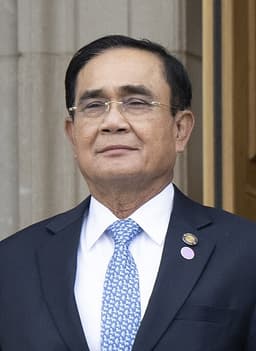
Prayut Chan-o-cha
General · Modern
48.1Total
Basic Information
Born
1560
1954
Died
1600
—
Era
Modern
Modern
Nationality
Japan
Thailand
Occupation
General
General
Civilization
Eastern
Eastern
Score Comparison
Military (10%)
40.0
10.2
Political (20%)
48.0
68.0
Influence (20%)
53.3
51.8
Legacy (20%)
48.3
40.8
Leadership (15%)
54.2
68.0
Strategy (15%)
60.0
35.7
TOTAL
50.7
48.1
Ishida Mitsunari — Complete Timeline
1600 AD
Battle of SekigaharaWar
Ishida Mitsunari commanded the Western Army at Sekigahara against Tokugawa Ieyasu. His forces were defeated due to defections and tactical errors, leading to the establishment of the Tokugawa shogunate.
Sengoku PeriodBattleWestern Army
Impact: nationaldestructive
Siege of Fushimi CastleWar◆ Major
Ishida Mitsunari besieged Fushimi Castle, held by Torii Mototada for Tokugawa Ieyasu. The castle fell after a fierce defense, but the siege delayed the Western Army's movements.
Sengoku PeriodSiegeFushimi
Impact: regionaldestructive
Execution of Ishida MitsunariOther◆ Major
After the Battle of Sekigahara, Ishida Mitsunari was captured by Tokugawa forces. He was executed by beheading in Kyoto, ending his role as a leading opponent of Tokugawa Ieyasu.
Sengoku PeriodExecutionSekigahara
Impact: nationaltragic
Formation of the Western ArmyPolitical Action◆ Major
Ishida Mitsunari formed the Western Army, an alliance of daimyo opposed to Tokugawa Ieyasu. He gathered support from powerful clans like the Mori, Shimazu, and Ukita to challenge Tokugawa's dominance.
Sengoku PeriodAllianceWestern Army
Impact: national
Prayut Chan-o-cha — Complete Timeline
2014 AD
Led the 2014 military coupPolitical Action
General Prayut Chan-o-cha, as Army Commander-in-Chief, led a coup d'
CoupMilitaryThailand
Impact: nationaldestructive
Appointed Prime Minister by military legislaturePolitical Action◆ Major
Following the coup, Prayut was appointed Prime Minister by the military-controlled National Legislative Assembly. He assumed executive power, leading a government that promised reforms and national reconciliation.
AppointmentMilitary RuleThailand
Impact: national
2017 AD
Promulgation of the 2017 ConstitutionReform◆ Major
Prayut's government oversaw the drafting and approval of a new constitution that strengthened the military's political role and created a fully appointed Senate. The charter was criticized for entrenching military influence.
ConstitutionMilitaryThailand
Impact: national
2019 AD
Re-elected Prime Minister after 2019 electionPolitical Action◆ Major
Prayut was re-elected Prime Minister following a general election that was criticized for being manipulated to favor pro-military parties. He formed a coalition government, continuing his rule under a civilian facade.
ElectionContinuityThailand
Impact: national
Expert Analysis
Origins
Ishida Mitsunari was born in 1559 in the Omi Province of Japan, into a samurai family of modest means. His father was a retainer of the Azai clan, but Mitsunari rose through service to Toyotomi Hideyoshi, becoming a key administrator. He was known for his meticulous record-keeping and logistical skills, which earned him Hideyoshi's trust. Prayut Chan-o-cha was born on March 21, 1954, in Nakhon Ratchasima, Thailand, into a middle-class family. He attended the Armed Forces Academies Preparatory School and later the Chulachomklao Royal Military Academy, graduating in 1976. His early career was shaped by the Thai military's internal security operations.
Rise to Power
Mitsunari's rise came through administrative excellence under Hideyoshi. He was appointed to key positions, including as one of the Five Commissioners governing Osaka. After Hideyoshi's death in 1598, he aligned with the young heir Toyotomi Hideyori against Tokugawa Ieyasu. In 1600, he formed the Western Army, a coalition of daimyo including the Mori and Shimazu clans, to oppose Ieyasu. Prayut rose through the Thai military hierarchy, becoming Army Commander-in-Chief in 2010. He led the 2014 coup d'état on May 22, citing the need to restore order after months of political turmoil. The coup overthrew the caretaker government of Yingluck Shinawatra. He was appointed Prime Minister by the military-controlled National Legislative Assembly in August 2014.
Leadership & Governance
Mitsunari's leadership was characterized by strict adherence to protocol and reliance on alliances. He failed to maintain loyalty among key allies, notably Kobayakawa Hideaki, whose defection at Sekigahara sealed his defeat. His governance style was bureaucratic, focused on administration rather than battlefield command. Prayut's leadership is authoritarian, emphasizing stability and order. He oversaw the drafting of the 2017 Constitution, which entrenched military influence and created a fully appointed Senate. His government suppressed dissent, restricted media, and prosecuted critics under lèse-majesté laws. While Mitsunari's political score is 48.0, Prayut's is 68.0, reflecting his ability to consolidate power.
Triumph & Tragedy
Mitsunari's greatest success was assembling the Western Army, a coalition of powerful clans that initially outnumbered Ieyasu's forces. However, his failure to secure loyalty led to the disaster at Sekigahara on October 21, 1600, where his army was routed. He was captured and executed in Kyoto. Prayut's triumph was the successful coup and subsequent consolidation of power, leading to his re-election in 2019 despite electoral manipulation allegations. His tragedy is the erosion of democratic institutions and international criticism. His legacy score of 40.8 reflects limited long-term positive impact.
Character & Destiny
Mitsunari was known as a meticulous planner but tactically inflexible. His character alienated potential allies; the Shimazu and Mori clans withheld full support. His destiny was sealed by his inability to adapt, scoring 60.0 in strategy but only 54.2 in leadership. Prayut is seen as cautious and controlling, with a low strategy score of 35.7. His military background shapes his governance, prioritizing order over freedom. His leadership score of 68.0 indicates effectiveness in maintaining power, but his destiny is tied to Thailand's polarized politics.
Legacy
Mitsunari's legacy is as the defeated commander at Sekigahara, a turning point that established the Tokugawa shogunate for 250 years. He is remembered as a loyalist but flawed leader. His influence score of 53.3 reflects his role in Japanese history. Prayut's legacy is the 2014 coup and the 2017 Constitution, which shifted Thailand towards military-dominated governance. He is criticized internationally but supported by conservative Thais. His legacy score of 40.8 is lower, as his impact may be reversed.
Conclusion
Ishida Mitsunari had a greater impact on history, scoring 50.7 overall versus Prayut's 48.1. Despite his defeat, Sekigahara was a pivotal event that shaped Japan's early modern period. Prayut's coup, while significant, is part of Thailand's recurring cycle of military interventions. Mitsunari's strategic score of 60.0 outweighs Prayut's 35.7, and his legacy endures in historical narratives. Therefore, Ishida Mitsunari's impact is more profound and lasting.
Rankings
🥇
Ishida MitsunariLeader
Mil: 40.0Pol: 48.0Inf: 53.3
50.7
🥈
Prayut Chan-o-cha
Mil: 10.2Pol: 68.0Inf: 51.8
48.1
+2.6 behind
How This Comparison Works
Algorithm
Each figure is scored on 6 dimensions (0—100 scale) based on structured historical data: Military (10%), Political (20%), Influence (20%), Legacy (20%), Leadership (15%), Strategy (15%). The weighted total produces the final ranking.
Data Sources
Scores are computed from structured sub-indicators in the database. Scale factors adjust for era (Ancient ×0.85, Modern ×1.0) and civilization size (Eastern ×1.05, Other ×0.80) to account for differences in population and military scale.
Maximum 3 Figures
Comparisons are limited to 2—3 figures to ensure readability and statistical meaningfulness.
Error Margins
±5 points per dimension — Sub-scores are derived from historical records with inherent uncertainty. Two figures within 5 points on a dimension should be considered roughly equivalent in that area.
Total Score Accuracy
±3 points overall — The weighted combination of 6 dimensions produces a total score with approximately ±3 points of uncertainty. Differences of less than 3 points are not statistically significant— the figures are effectively tied.
Known Limitations
- Historical records are incomplete and uneven across civilizations
- Figures from oral-tradition societies may be underrepresented
- Occupation labels can misclassify multi-role figures
- Scores measure capability and impact, not moral character
- Quantitative scoring is a comparison tool, not absolute truth
Capability Radar
Military (10%) — Battles & Warfare
Battles
45
5
Win Rate
30
5
Expansion
25
5
Political (20%) — Governance & Reform
Reform
40
30
Diplomacy
30
40
Economy
35
35
Influence (20%) — Cultural & Global Reach
Cultural
30
20
Global
20
20
Legacy (20%) — Historical Impact
Historical
45
20
Longevity
35
15
Leadership (15%) — Power & Stability
Tenure
35
60
Stability
20
25
Strategy (15%) — Tactics & Innovation
Strategy
40
15
Tactics
55
10
Reform
20
20
Similar Comparisons
Comments & Discussion
No comments yet. Be the first to share your thoughts!