Loading...
Huang Xing vs Shi Dakai
Shi Dakai leads by 2.1 pts · 2 figures compared
…
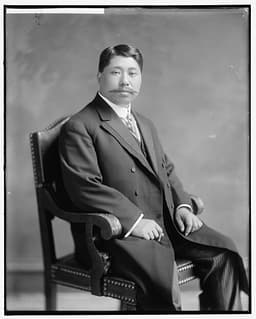
Huang Xing
General · Modern
57.5Total
Shi Dakai
General · Modern
59.6Total
Basic Information
Born
1874
1831
Died
1916
1863
Era
Modern
Modern
Nationality
China
China
Occupation
General
General
Civilization
Eastern
Eastern
Score Comparison
Military (10%)
46.7
76.0
Political (20%)
53.8
45.0
Influence (20%)
62.0
56.7
Legacy (20%)
56.0
54.0
Leadership (15%)
62.0
72.0
Strategy (15%)
60.0
68.1
TOTAL
57.5
59.6
Huang Xing — Complete Timeline
1905 AD
Co-founded the TongmenghuiPolitical Action◆ Major
Huang Xing co-founded the Tongmenghui (Revolutionary Alliance) in Tokyo with Sun Yat-sen. He became its military leader, organizing armed uprisings against the Qing dynasty.
TongmenghuiRevolutionMilitary
Impact: nationalconstructive
1911 AD
Led the Wuchang UprisingWar
Huang Xing led the Wuchang Uprising, which sparked the Xinhai Revolution. He commanded revolutionary forces against Qing troops, securing initial victories that led to the dynasty's collapse.
Xinhai RevolutionUprisingMilitary
Impact: nationalconstructive
1912 AD
Served as Minister of War in the RepublicPolitical Action◆ Major
Huang Xing served as Minister of War in the provisional government of the Republic of China. He worked to organize a national army and defend the republic against counter-revolutionary forces.
GovernmentMilitaryRepublic
Impact: nationalconstructive
1913 AD
Led the Second Revolution Against Yuan ShikaiWar◆ Major
Huang Xing led the Second Revolution, an armed uprising against President Yuan Shikai's authoritarian rule. The rebellion failed due to lack of coordination and military inferiority, forcing Huang into exile.
Second RevolutionYuan ShikaiExile
Impact: nationaltragic
1916 AD
Died in Exile in ShanghaiPolitical Action
Huang Xing died in Shanghai after returning from exile in Japan and the United States. His death marked the loss of a key military leader of the Chinese revolution, though his legacy endured.
DeathExileRevolution
Impact: nationaltragic
Shi Dakai — Complete Timeline
1851 AD
Jintian UprisingWar◆ Major
Shi Dakai joined the Taiping Rebellion at its inception in Jintian, Guangxi. As a core leader, he helped organize the rebel forces and was appointed Wing King, becoming one of the key military commanders of the Taiping Heavenly Kingdom.
Taiping RebellionUprisingMilitary Command
Impact: national
1854 AD
Battle of XiangtanWar◆ Major
Shi Dakai led Taiping forces to a major victory at Xiangtan, Hunan, defeating Qing imperial troops. This battle secured Taiping control over key territories in the Yangtze River valley and demonstrated his military skill.
Taiping RebellionBattleVictory
Impact: regional
1856 AD
Tianjing IncidentPolitical Action
Shi Dakai returned to Tianjing (Nanjing) after the internal purge of the Eastern King Yang Xiuqing and the murder of the Northern King Wei Changhui. He condemned the violence and was forced to flee, leading to a split in Taiping leadership.
Taiping RebellionInternal ConflictPurge
Impact: nationaltragic
1858 AD
Campaign in Zhejiang and FujianWar
Shi Dakai led a separate Taiping army into Zhejiang and Fujian provinces, capturing several cities. This campaign expanded Taiping influence into southeastern China but also isolated his forces from the main Taiping base.
Taiping RebellionCampaignExpansion
Impact: regional
1863 AD
Battle of Baishui RiverWar◆ Major
Shi Dakai's army was trapped and defeated by Qing forces at the Baishui River in Sichuan. He was captured and executed shortly after, marking the end of his military career and a significant loss for the Taiping cause.
Taiping RebellionBattleDefeatDeath
Impact: nationaltragic
Expert Analysis
Huang Xing vs Shi Dakai
# The Two Paths of Rebellion: Shi Dakai and Huang Xing
On a sweltering June day in 1863, a man in his early thirties knelt beside the Baishui River in Sichuan, his hands bound, his eyes fixed on the mountains he would never cross. Fifty-three years later, in a Shanghai hospital bed, another revolutionary drew his last breath, surrounded by comrades who would soon scatter into the fractious politics of a newborn republic. Both men had dedicated their lives to overthrowing the Qing dynasty. One was executed as a rebel king; the other died a founder of a nation. Why did their fates diverge so sharply? The answer lies not merely in their choices, but in the worlds that shaped them.
Origins
Shi Dakai was born in 1831 into a prosperous Hakka family in Guangxi, a province simmering with ethnic tension and economic despair. The Qing dynasty, then in its twilight, was buckling under the weight of population growth, official corruption, and the humiliating Opium Wars. Shi received a classical Confucian education, but the times demanded more than poetry. When Hong Xiuquan, a failed scholar who believed himself the brother of Jesus, began preaching a strange blend of Christian millenarianism and Chinese social justice, Shi was drawn in. He was barely twenty years old.
Huang Xing came of age in a different China. Born in 1874 in Hunan, he grew up as the Qing dynasty staggered toward collapse. The Taiping Rebellion had been crushed, but its ghost haunted the land. Huang studied in Japan, where young Chinese intellectuals soaked up Western ideas of constitutional government, nationalism, and military discipline. He was a modern man in a modernizing movement, shaped not by messianic visions but by the cold logic of political organization.
The difference was generational and philosophical. Shi Dakai believed he was building the Heavenly Kingdom on earth. Huang Xing believed he was building a republic.
Rise to Power
Shi Dakai’s entry into history was sudden and violent. In 1851, he joined the Jintian Uprising, the spark that ignited the Taiping Rebellion. The Qing military, corrupt and demoralized, crumbled before the Taiping armies. Shi rose fast. By 1854, at the Battle of Xiangtan, he commanded forces that crushed imperial troops, securing Hunan for the rebellion. His reputation as a brilliant tactician spread. He was young, fearless, and loyal.
Huang Xing’s rise was slower, more deliberate. In 1905, in Tokyo, he co-founded the Tongmenghui with Sun Yat-sen, becoming the organization’s military commander. His moment came in 1911, when the Wuchang Uprising accidentally ignited the Xinhai Revolution. Huang rushed to the front lines, leading revolutionary forces against Qing loyalists. Unlike Shi, who inherited a ready-made army of believers, Huang had to build his from students, secret societies, and defecting soldiers.
Leadership & Governance
Shi Dakai was a military genius but a political naïf. His leadership score of 76.6 and strategy score of 81.6 reflect a man who could win battles but not manage a kingdom. After the Tianjing Incident of 1856—a bloody purge in which the Eastern King Yang Xiuqing was killed and the Western King Wei Changhui massacred thousands—Shi returned to the capital to restore order. He was horrified by the carnage. He tried to mediate, but the Taiping court was a nest of paranoia and ambition. He left, taking his army on a separate campaign into Zhejiang and Fujian. It was a decision born of disgust, not strategy.
Huang Xing, with a political score of 62.7 and a leadership score of 75.5, understood that military victory meant nothing without political structure. After the Wuchang Uprising, he served as Minister of War in the provisional government, trying to build a national army from scratch. He failed, but he understood the task. When Yuan Shikai, the Qing general turned president, began to consolidate autocratic power, Huang led the Second Revolution in 1913. It was a disaster—poorly planned, poorly supplied, easily crushed. But it was a political act, not a religious crusade.
Triumph & Tragedy
Shi Dakai’s greatest triumph was his survival and independence. For years, he led his army through southern China, evading Qing forces, winning battles, building a reputation as the "Wing King" who could not be pinned down. His tragedy came at the Baishui River in 1863. Outnumbered, exhausted, betrayed by a local chieftain, his army was trapped. He surrendered, hoping to spare his men. The Qing executed him by slow slicing. He was thirty-two.
Huang Xing’s triumph was the Wuchang Uprising itself—a chaotic, desperate gamble that somehow toppled a dynasty. His tragedy was the aftermath. The republic he helped found was stillborn, choked by warlords, foreign powers, and the ambitions of men like Yuan Shikai. Huang spent his final years in exile, writing, fundraising, watching his dream slip away. He died in 1916, at forty-two, of illness and exhaustion.
Character & Destiny
Shi Dakai was a man of honor in a movement of fanatics. He refused to participate in the Tianjing purges. He tried to protect civilians. He surrendered to save his soldiers. These virtues made him beloved but ineffective. The Taiping Rebellion needed a ruthless politician, not a chivalrous general.
Huang Xing was a man of principle in a world of pragmatists. He believed in democracy, constitutionalism, and the rule of law. He refused to compromise with Yuan Shikai, even when compromise might have saved lives. His integrity made him respected but marginalized. The early republic needed a Machiavelli, not a martyr.
Legacy
Shi Dakai is remembered as a tragic hero, a "Chinese Roland" whose brilliance was wasted by the madness of his cause. His legacy score of 65.9 reflects a figure who is honored but not studied, a symbol of lost potential. In Sichuan, where he died, local legends still speak of the Wing King who fought to the last.
Huang Xing’s legacy is more complex. His score of 66.6 places him alongside other founders of modern China, but he is overshadowed by Sun Yat-sen, the "Father of the Republic." Yet without Huang’s military leadership, the Xinhai Revolution might have fizzled. He is the forgotten architect of a fragile house.
Conclusion
Standing at the Baishui River in 1863, Shi Dakai saw the face of an old China—a China of dynastic cycles, peasant rebellions, and millenarian dreams. Lying in a Shanghai hospital in 1916, Huang Xing saw the face of a new China—a China of constitutions, parliaments, and endless political struggle. Both failed. Both died young. But their failures illuminate the chasm between two eras: the age of heavenly kingdoms and the age of earthly republics. One man fought for God; the other fought for law. Both lost to history, but history lost something greater when they died.
Rankings
🥇
Shi DakaiLeader
Mil: 76.0Pol: 45.0Inf: 56.7
59.6
🥈
Huang Xing
Mil: 46.7Pol: 53.8Inf: 62.0
57.5
+2.1 behind
How This Comparison Works
Algorithm
Each figure is scored on 6 dimensions (0—100 scale) based on structured historical data: Military (10%), Political (20%), Influence (20%), Legacy (20%), Leadership (15%), Strategy (15%). The weighted total produces the final ranking.
Data Sources
Scores are computed from structured sub-indicators in the database. Scale factors adjust for era (Ancient ×0.85, Modern ×1.0) and civilization size (Eastern ×1.05, Other ×0.80) to account for differences in population and military scale.
Maximum 3 Figures
Comparisons are limited to 2—3 figures to ensure readability and statistical meaningfulness.
Error Margins
±5 points per dimension — Sub-scores are derived from historical records with inherent uncertainty. Two figures within 5 points on a dimension should be considered roughly equivalent in that area.
Total Score Accuracy
±3 points overall — The weighted combination of 6 dimensions produces a total score with approximately ±3 points of uncertainty. Differences of less than 3 points are not statistically significant— the figures are effectively tied.
Known Limitations
- Historical records are incomplete and uneven across civilizations
- Figures from oral-tradition societies may be underrepresented
- Occupation labels can misclassify multi-role figures
- Scores measure capability and impact, not moral character
- Quantitative scoring is a comparison tool, not absolute truth
Capability Radar
Military (10%) — Battles & Warfare
Battles
35
75
Win Rate
30
70
Expansion
20
75
Political (20%) — Governance & Reform
Reform
60
50
Diplomacy
55
45
Economy
30
40
Influence (20%) — Cultural & Global Reach
Cultural
40
55
Global
40
40
Legacy (20%) — Historical Impact
Historical
55
60
Longevity
45
45
Leadership (15%) — Power & Stability
Tenure
40
55
Stability
25
35
Strategy (15%) — Tactics & Innovation
Strategy
45
80
Tactics
40
85
Reform
50
60
Similar Comparisons
Comments & Discussion
飞虎王6/16/2026
石达开是悲剧英雄,黄兴是务实斗士。我站黄兴——他活着见证了武昌起义,而石达开的天国梦早就在大渡河畔碎了。黄兴练兵、筹款、搞炸弹,像个现代革命家;石达开却困在洪秀全的宗教幻想里,连战略撤退都做不到。别拿“宁死不屈”美化败局,活着才能改变历史。
RiceBreaker6/16/2026
Classicist here: Both men failed, but their failures teach opposite lessons. Shi Dakai embodied the Confucian tragic hero—loyal to an unworthy king, Hong Xiuquan, until the end. He died for a doomed theocracy. Huang Xing, schooled in Japanese militarism and Western constitutionalism, knew loyalty had limits; he broke with Sun Yat-sen when needed. One clung to feudal virtue; the other adapted. That's why Huang's bones rest in a republic, not a rebel's grave.
湘江刀客6/16/2026
别扯什么“革命先驱”,黄兴就是国民党早期的一个军阀头子。他搞起义全靠日本资助,二次革命失败就跑路,比石达开差远了。石达开至少在天京事变后单干,带兵转战六省,连左宗棠都佩服他。黄兴除了在黄花岗流了点血,还有什么?史盲才吹他是“国父”。
LudditeGuard6/16/2026
Data skeptic: The body count tells the story. Shi's Taiping Rebellion killed 20-30 million people—one of history's bloodiest wars. Huang's 1911 Revolution caused maybe 10,000 deaths. One was a millenarian bloodbath; the other a political coup dressed as a revolution. Respecting Shi as a rebel ignores the human cost. Huang's path—targeted assassinations, negotiated settlements—was morally superior, even if less romantic. Choose the butcher who saved lives, not the king who drowned China in blood.
Historian9806/16/2026
Huang Xing's revolutionaries had rifles and cannons—Shi Dakai's Taiping army relied on swords and outdated matchlocks. That's the real difference. By 1911, even a modest arsenal could dislodge the Qing; in 1863, Shi faced Zeng Guofan's well-drilled Xiang Army with peasant conscripts. Huang triumphed because technology shifted the balance, not because his cause was purer. Don't romanticize martyrdom when firepower tells the truth.