Loading...
Ho Chi Minh vs Napoleon Bonaparte
Napoleon Bonaparte leads by 8.0 pts · 2 figures compared
…
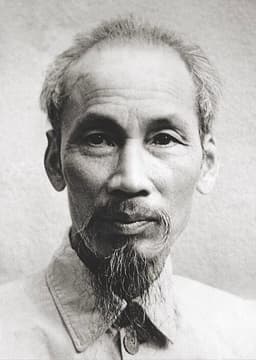
Ho Chi Minh
Revolutionary · Modern
62.9Total

Napoleon Bonaparte
General · Modern
70.9Total
Basic Information
Born
1890
1769
Died
1969
1821
Era
Modern
Modern
Nationality
Vietnam
France
Occupation
Revolutionary
General
Civilization
Eastern
Western
Score Comparison
Military (10%)
55.0
94.0
Political (20%)
72.0
72.0
Influence (20%)
62.0
40.0
Legacy (20%)
58.0
80.0
Leadership (15%)
72.0
78.0
Strategy (15%)
58.0
90.0
TOTAL
62.9
70.9
Ho Chi Minh — Complete Timeline
1941 AD
Establishment of the Viet MinhPolitical Action◆ Major
Ho Chi Minh founded the Viet Minh (League for the Independence of Vietnam) in southern China. This coalition of nationalist and communist groups became the primary force for Vietnamese independence, fighting both Japanese occupation and French colonialism.
Viet MinhIndependence MovementWorld War II
Impact: nationalconstructive
1945 AD
Declaration of Independence of VietnamPolitical Action
Ho Chi Minh proclaimed the Democratic Republic of Vietnam in Hanoi's Ba Dinh Square, citing the US Declaration of Independence. This established the Viet Minh government and began the struggle for independence from French colonial rule.
IndependenceVietnamDecolonization
Impact: nationalconstructive
1954 AD
Battle of Dien Bien PhuWar
Ho Chi Minh's Viet Minh forces, under General Giap, defeated the French garrison at Dien Bien Phu. This victory ended French colonial rule in Indochina and led to the Geneva Accords dividing Vietnam at the 17th parallel.
Vietnam WarDecolonizationFrench Indochina
Impact: regional
Geneva AccordsPolitical Action◆ Major
Ho Chi Minh's delegation signed the Geneva Accords, temporarily dividing Vietnam at the 17th parallel. The agreement promised nationwide elections in 1956, which were never held, leading to the permanent division of Vietnam.
Geneva ConferenceDivision of VietnamDiplomacy
Impact: regional
1959 AD
Start of the Vietnam WarWar
Ho Chi Minh's government in North Vietnam authorized armed struggle against the US-backed South Vietnamese regime. This escalated into the Vietnam War, a prolonged conflict that resulted in millions of deaths and US withdrawal in 1973.
Vietnam WarCold WarCommunism
Impact: globaldestructive
Napoleon Bonaparte — Complete Timeline
1799 AD
Coup of 18 BrumaireOther◆ Major
Napoleon Bonaparte, with support from his brother Lucien and key political figures, overthrew the Directory in a bloodless coup. He established the Consulate with himself as First Consul, effectively becoming the ruler of France. This event ended the French Revolution's most unstable period.
French RevolutionCoupRise to Power
Impact: regional
1804 AD
Promulgation of the Napoleonic CodeOther◆ Major
Napoleon enacted the Civil Code of the French, known as the Napoleonic Code, a comprehensive set of laws that replaced the fragmented feudal legal systems. The code established legal equality, protected property rights, and secularized law. It became the basis for legal systems in many European and world countries.
Legal ReformNapoleonic CodeCivil Law
Impact: globalconstructive
1805 AD
Battle of AusterlitzWar◆ Major
Napoleon's Grande Arm
Napoleonic WarsBattleDecisive Victory
Impact: global
1812 AD
Invasion of RussiaWar◆ Major
Napoleon led the Grande Arm
Napoleonic WarsInvasionDisaster
Impact: globaldestructive
1815 AD
Battle of WaterlooWar◆ Major
Napoleon's French army was defeated by the combined forces of the Duke of Wellington's Anglo-Allied army and Gebhard Leberecht von Bl
Napoleonic WarsBattleFinal Defeat
Impact: globaldestructive
Expert Analysis
ho-chi-minh-vs-napoleon-bonaparte
# The Corsican and the Mandarin: Two Paths to Power
On a June morning in 1815, Napoleon Bonaparte stood on a muddy field in Belgium, watching his Imperial Guard march into cannon fire for the last time. A hundred and thirty-four years later, on a September day in 1945, Ho Chi Minh stood in Hanoi’s Ba Dinh Square, reading a declaration of independence that borrowed from Thomas Jefferson. One man commanded the most feared army in Europe; the other had never led a battalion into battle. Yet both changed the world. What made the difference between the emperor who conquered a continent and the revolutionary who outlasted an empire?
Origins
Napoleon was born in 1769 on Corsica, an island that had become French only months before his birth. His family were minor nobility, poor enough to feel the sting of poverty but proud enough to resent the French aristocracy who looked down on them. He spoke Italian before French, carried a lifelong grudge against the establishment, and entered military school at nine—a short, intense boy with a prodigious memory and no patience for authority. The French Revolution, which erupted when he was twenty, was his great stroke of luck: it cleared away the old officers and opened the path for talent.
Ho Chi Minh, born in 1890 in central Vietnam, came from a different kind of poverty. His father was a Confucian scholar who refused to work for the French colonial administration and scraped by teaching. Young Nguyen Sinh Cung—he would change his name many times—grew up in a thatched hut, watching French officials humiliate his countrymen. While Napoleon devoured military history, Ho read Confucian classics and learned to hate colonial rule. The difference in their starting points was profound: Napoleon inherited a revolutionary tradition that would lift him; Ho inherited a colonial humiliation that would define him.
Rise to Power
Napoleon’s rise was a military comet. In 1793, at twenty-four, he drove the British from Toulon and became a brigadier general. By 1796 he commanded the Army of Italy, where he won six battles in a month, marched on Vienna, and dictated peace terms to the Austrian emperor. He was twenty-seven. The key turning point came in 1799, when he returned from Egypt to find the revolutionary government in chaos. In the coup of 18 Brumaire, he seized power not with an army but with a handful of grenadiers and a speech that stuttered into silence. He became First Consul, then Emperor in 1804, and spent the next decade redrawing the map of Europe.
Ho Chi Minh’s path was slower and more treacherous. For thirty years he was a wanderer: a cook’s assistant on a French steamer, a gardener in London, a photo retoucher in Paris, a Comintern agent in Moscow, a prisoner in Hong Kong. He founded the Vietnamese Communist Party in 1930, but spent most of the next decade in exile. The turning point came in 1941, when he returned to Vietnam after thirty years abroad and founded the Viet Minh in a cave near the Chinese border. He was fifty-one years old—Napoleon’s age at Waterloo. While Napoleon rose through victory, Ho rose through endurance.
Leadership & Governance
Napoleon ruled with a combination of military genius and administrative brilliance that has rarely been matched. His 94.0 military score reflects campaigns that are still studied in war colleges: Austerlitz, where he destroyed a Russo-Austrian army twice his size; Jena, where he shattered the Prussian state in a single day; the Six Days Campaign of 1814, where he defeated four allied armies with a handful of conscripts. His political score of 75.0 understates his greatest achievement: the Napoleonic Code, which swept away feudal laws and established equality before the law, religious toleration, and property rights across Europe. He was a tyrant, but a reforming one.
Ho Chi Minh’s leadership was of a different kind entirely. His military score of 55.0 reflects the fact that he never commanded troops; his general Vo Nguyen Giap won the battles. His political score of 67.8 seems modest, but it misses the quality that made him dangerous: he understood patience. While Napoleon demanded immediate victory, Ho accepted that the Vietnam War would take twenty years. He built a movement through slogans, letters, and personal example—living in a simple stilt house, refusing luxury, projecting the image of “Uncle Ho.” His leadership score of 84.8 captures what the numbers cannot: he inspired devotion because he seemed to ask nothing for himself.
Triumph & Tragedy
Napoleon’s greatest moment was Austerlitz in 1805, where he lured the allies onto a frozen lake and shattered their center with a feigned retreat. His worst was Russia in 1812: 600,000 men marched east; fewer than 100,000 came back. The tragedy was that he could not stop. After Austerlitz, he had Europe at his feet; he could have made peace. But he kept fighting—Spain, Austria, Russia, Prussia, until the whole continent united against him. Waterloo in 1815 was just the final punctuation.
Ho Chi Minh’s triumph was Dien Bien Phu in 1954, where Viet Minh soldiers dragged artillery up jungle mountainsides and smashed a French fortress that was supposed to be impregnable. The tragedy came immediately afterward: the Geneva Accords divided Vietnam at the 17th parallel, and Ho accepted a partition that was supposed to be temporary. It became permanent, and the war with America began in 1959. Ho died in 1969, six years before his troops marched into Saigon. He never saw the unified Vietnam he had spent his life building.
Character & Destiny
Napoleon was driven by a hunger that could never be satisfied. “Impossible is not in my dictionary,” he said, and he meant it. He worked eighteen hours a day, dictated letters to four secretaries simultaneously, and believed that he could impose his will on reality. This confidence made him invincible at Austerlitz and suicidal at Moscow. His personality was his destiny: he could not stop because stopping meant admitting limits, and limits were the one thing he could not accept.
Ho Chi Minh was the opposite: a man who accepted limits and worked around them. He had seen the French army, the American army, the Chinese army—he knew he could not defeat them in a conventional war. So he fought a different kind of war: guerrilla warfare, political warfare, a war of attrition that would wear down the enemy’s will. “You will kill ten of our men,” he told the French, “and we will kill one of yours, and in the end, it is you who will tire.” Napoleon would never have said this. Napoleon would have attacked.
Legacy
Napoleon left behind a divided legacy. In France, he is a national hero whose code and institutions still shape the country. In Europe, he is a conqueror who killed millions and inspired nationalism as a reaction against his rule. His total score of 82.4 reflects a figure too large to judge simply: a genius who destroyed himself, a liberator who became a tyrant.
Ho Chi Minh left behind a unified Vietnam and a model of revolutionary warfare that inspired movements from Algeria to Cuba. His legacy is more straightforward because his goals were simpler: independence, unity, freedom from foreign rule. But the Vietnam he built was poor, isolated, and authoritarian—not the paradise he had promised. His total score of 69.3 understates his historical impact, for he defeated two great powers with almost nothing.
Conclusion
Standing at the end of their lives, the two men could not have been more different: Napoleon, dying on a remote Atlantic island, dictating his memoirs and blaming everyone but himself; Ho, dying in Hanoi, his country still at war, his dream still unfulfilled. Yet both understood something essential: that history is made by those who act, who seize the moment, who refuse to accept what is given. Napoleon seized too much and lost everything. Ho seized just enough and won. In the end, the difference between them is not talent or courage but patience—the one virtue Napoleon never learned.
Rankings
🥇
Napoleon BonaparteLeader
Mil: 94.0Pol: 72.0Inf: 40.0
70.9
🥈
Ho Chi Minh
Mil: 55.0Pol: 72.0Inf: 62.0
62.9
+8.0 behind
How This Comparison Works
Algorithm
Each figure is scored on 6 dimensions (0—100 scale) based on structured historical data: Military (10%), Political (20%), Influence (20%), Legacy (20%), Leadership (15%), Strategy (15%). The weighted total produces the final ranking.
Data Sources
Scores are computed from structured sub-indicators in the database. Scale factors adjust for era (Ancient ×0.85, Modern ×1.0) and civilization size (Eastern ×1.05, Other ×0.80) to account for differences in population and military scale.
Maximum 3 Figures
Comparisons are limited to 2—3 figures to ensure readability and statistical meaningfulness.
Error Margins
±5 points per dimension — Sub-scores are derived from historical records with inherent uncertainty. Two figures within 5 points on a dimension should be considered roughly equivalent in that area.
Total Score Accuracy
±3 points overall — The weighted combination of 6 dimensions produces a total score with approximately ±3 points of uncertainty. Differences of less than 3 points are not statistically significant— the figures are effectively tied.
Known Limitations
- Historical records are incomplete and uneven across civilizations
- Figures from oral-tradition societies may be underrepresented
- Occupation labels can misclassify multi-role figures
- Scores measure capability and impact, not moral character
- Quantitative scoring is a comparison tool, not absolute truth
Capability Radar
Military (10%) — Battles & Warfare
Battles
65
95
Win Rate
60
90
Expansion
55
95
Political (20%) — Governance & Reform
Reform
85
95
Diplomacy
90
80
Economy
40
85
Influence (20%) — Cultural & Global Reach
Cultural
75
85
Global
75
90
Legacy (20%) — Historical Impact
Historical
85
95
Longevity
70
90
Leadership (15%) — Power & Stability
Tenure
70
85
Stability
50
70
Strategy (15%) — Tactics & Innovation
Strategy
80
95
Tactics
70
98
Reform
75
92
Similar Comparisons
Comments & Discussion
No comments yet. Be the first to share your thoughts!