Loading...
Ho Chi Minh vs Lech Walesa
Ho Chi Minh leads by 10.5 pts · 2 figures compared
…
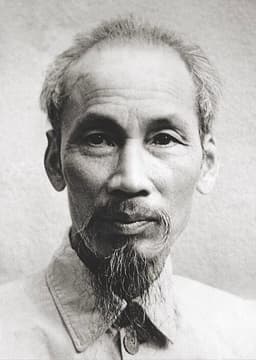
Ho Chi Minh
Revolutionary · Modern
62.9Total

Lech Walesa
Revolutionary · Modern
52.4Total
Basic Information
Born
1890
1943
Died
1969
—
Era
Modern
Modern
Nationality
Vietnam
Poland
Occupation
Revolutionary
Revolutionary
Civilization
Eastern
Western
Score Comparison
Military (10%)
55.0
14.2
Political (20%)
72.0
72.0
Influence (20%)
62.0
62.0
Legacy (20%)
58.0
56.0
Leadership (15%)
72.0
48.8
Strategy (15%)
58.0
33.6
TOTAL
62.9
52.4
Ho Chi Minh — Complete Timeline
1941 AD
Establishment of the Viet MinhPolitical Action◆ Major
Ho Chi Minh founded the Viet Minh (League for the Independence of Vietnam) in southern China. This coalition of nationalist and communist groups became the primary force for Vietnamese independence, fighting both Japanese occupation and French colonialism.
Viet MinhIndependence MovementWorld War II
Impact: nationalconstructive
1945 AD
Declaration of Independence of VietnamPolitical Action
Ho Chi Minh proclaimed the Democratic Republic of Vietnam in Hanoi's Ba Dinh Square, citing the US Declaration of Independence. This established the Viet Minh government and began the struggle for independence from French colonial rule.
IndependenceVietnamDecolonization
Impact: nationalconstructive
1954 AD
Battle of Dien Bien PhuWar
Ho Chi Minh's Viet Minh forces, under General Giap, defeated the French garrison at Dien Bien Phu. This victory ended French colonial rule in Indochina and led to the Geneva Accords dividing Vietnam at the 17th parallel.
Vietnam WarDecolonizationFrench Indochina
Impact: regional
Geneva AccordsPolitical Action◆ Major
Ho Chi Minh's delegation signed the Geneva Accords, temporarily dividing Vietnam at the 17th parallel. The agreement promised nationwide elections in 1956, which were never held, leading to the permanent division of Vietnam.
Geneva ConferenceDivision of VietnamDiplomacy
Impact: regional
1959 AD
Start of the Vietnam WarWar
Ho Chi Minh's government in North Vietnam authorized armed struggle against the US-backed South Vietnamese regime. This escalated into the Vietnam War, a prolonged conflict that resulted in millions of deaths and US withdrawal in 1973.
Vietnam WarCold WarCommunism
Impact: globaldestructive
Lech Walesa — Complete Timeline
1980 AD
Founding of SolidarityPolitical Action
Walesa co-founded the Solidarity trade union in August 1980 after leading the Gda
SolidarityLabor Movement
Impact: globalprogressive
1981 AD
Martial Law and ImprisonmentPolitical Action◆ Major
Walesa was arrested and interned on December 13, 1981, when General Jaruzelski imposed martial law in Poland. He was held for 11 months, while Solidarity was banned and its leaders suppressed.
Martial LawRepression
Impact: nationaltragic
1983 AD
Nobel Peace PrizeCultural◆ Major
Walesa was awarded the Nobel Peace Prize on December 10, 1983, for his nonviolent struggle for workers' rights and democracy. He was unable to collect it in person due to travel restrictions.
Nobel PrizePeace
Impact: globalconstructive
1989 AD
Round Table TalksPolitical Action
Walesa led Solidarity in the Round Table Talks with the communist government from February to April 1989. The agreements led to partially free elections, which Solidarity won, ending communist rule in Poland.
TransitionDemocracy
Impact: globalconstructive
1990 AD
President of PolandPolitical Action◆ Major
Walesa was elected President of Poland on December 22, 1990, in the first direct presidential election. His presidency focused on economic reform and NATO integration, but was marked by political conflicts and declining popularity.
PresidencyDemocracy
Impact: national
Expert Analysis
Ho Chi Minh vs Lech Walesa
### The Quiet Revolutionary and the Electrician: Ho Chi Minh and Lech Walesa
In the autumn of 1990, an electrician from the Baltic coast walked into the presidential palace in Warsaw. Lech Walesa, once a shipyard worker with a drooping mustache and a gift for the grand gesture, had just been elected Poland's first non-communist president in half a century. Half a world away, in a modest stilt house in Hanoi, an old man with a wispy beard and a lifetime of exile had been dead for twenty-one years. Ho Chi Minh never saw his Vietnam united. Walesa saw his Poland free. Both men toppled empires, but the paths they walked could not have been more different. The question is why.
### Origins
Ho Chi Minh was born in 1890 in a village in central Vietnam, the son of a Confucian scholar-official who had resisted French colonial rule. His real name was Nguyen Sinh Cung, and he grew up in a world of rice paddies, bamboo groves, and the quiet humiliation of foreign occupation. He left Vietnam as a young man, working as a cook on a steamship, and spent the next three decades wandering the globe—London, Paris, Moscow, Canton. He was a man shaped by the great ideological storms of the twentieth century: nationalism, communism, anti-colonialism. He read Marx, Lenin, and the American Declaration of Independence. By the time he returned to Vietnam in 1941, he had become a revolutionary without a country, a man who had learned to survive on patience and cunning.
Lech Walesa was born in 1943 in a small village in German-occupied Poland, the son of a carpenter. His world was one of Catholic piety, manual labor, and the heavy hand of Soviet-backed communism. He never left Poland for more than brief trips. He became an electrician at the Gdańsk Shipyard, a trade that gave him access to the heart of Poland’s industrial economy. Where Ho was shaped by exile and ideology, Walesa was shaped by the daily grind of the workplace and the church. He was a man of the factory floor, not the library. His revolution would be a workers’ revolution, not a peasant one.
### Rise to Power
Ho Chi Minh entered history in 1941, when he founded the Viet Minh in southern China. He was fifty-one years old, a veteran of decades of obscurity. The opportunity came with World War II: the Japanese occupied Vietnam, the French colonial administration collapsed, and a power vacuum opened. Ho seized it. In August 1945, after Japan’s surrender, he declared Vietnam’s independence in Hanoi’s Ba Dinh Square, reading a document that began with a direct quote from Thomas Jefferson. It was a masterstroke of political theater. But the French returned, and Ho’s rise turned into a thirty-year war.
Walesa’s rise was faster. In August 1980, at the age of thirty-seven, he climbed over the fence of the Gdańsk Shipyard to lead a strike. Within weeks, he had co-founded Solidarity, a trade union that became a mass movement of ten million people. The opportunity came from economic crisis and the weakening of Soviet power. Walesa was not a theorist; he was a charismatic negotiator, a man who knew how to speak to workers and how to face down police. His rise was a matter of months, not decades.
### Leadership & Governance
Ho Chi Minh was a master of political organization and guerrilla strategy. He led a movement that was both a military force and a government-in-waiting. He delegated military command to General Vo Nguyen Giap, who crushed the French at Dien Bien Phu in 1954, a victory that forced the Geneva Accords and the division of Vietnam. But Ho’s political wisdom had limits. He accepted the temporary partition at the 17th parallel, believing elections would unify the country. They never came. And when the United States intervened, Ho authorized armed struggle in 1959, plunging Vietnam into another war. He was a revolutionary first, a nation-builder second. His governance was austere, disciplined, and unyielding.
Walesa was a different kind of leader. He was a public figure, a man who thrived on the stage and the microphone. He was not a military strategist; his power was moral and political. During martial law in 1981, he was arrested and interned for eleven months. He emerged not as a martyr but as a symbol of resilience. In 1989, he led Solidarity in the Round Table Talks, negotiating a peaceful transition from communism to democracy. His presidency, from 1990 to 1995, was messy and divisive. He was a better revolutionary than a president. But his achievement was immense: he helped dismantle a communist regime without a civil war.
### Triumph & Tragedy
Ho Chi Minh’s greatest moment was the declaration of independence in 1945. His tragedy was that he never saw the country he dreamed of. He died in 1969, six years before North Vietnamese tanks rolled into Saigon. He had spent his entire life for a goal he did not live to see fulfilled.
Walesa’s greatest moment was the Nobel Peace Prize in 1983, which gave him a global platform. His tragedy was more personal: he was a hero of the struggle but a flawed leader in power. He alienated allies, his presidency was marked by infighting, and he lost re-election in 1995. He had led a nation to freedom but could not lead it into the future.
### Character & Destiny
Ho Chi Minh was ascetic, cunning, and deeply ideological. He lived simply, wrote poetry, and believed in the ultimate victory of the revolution. His personality was one of iron patience. He waited decades for his chance. Walesa was impulsive, charismatic, and pragmatic. He was a man of the moment, a natural leader of crowds. He did not wait; he acted. Their destinies reflected their eras. Ho’s revolution required a long war, a sacrifice of generations. Walesa’s revolution required a single decade, a negotiation, a nonviolent struggle. The difference was not just in the men but in the worlds they faced.
### Legacy
Ho Chi Minh is remembered as the father of modern Vietnam. His name is on streets, stamps, and portraits across the country. His legacy is the unified nation he never saw. But it is also a legacy of war, of a divided people, of a communist state that survived but did not flourish. Walesa is remembered as the electrician who brought down a wall. His legacy is the peaceful transition, the end of the Cold War in Europe. But it is also a legacy of disappointment—a hero who could not govern, a symbol who became a politician.
### Conclusion
Standing at the end of the twentieth century, we see two revolutions, two men, two outcomes. Ho Chi Minh fought for independence and won a country that remained poor and isolated. Lech Walesa fought for freedom and won a country that joined the European Union. One revolution was military, the other was moral. One ended in victory, the other in democracy. Both men were shaped by their times, and both shaped their times in return. The electrician and the wanderer—each, in his own way, changed the world. And we are still living with what they left behind.
Rankings
🥇
Ho Chi MinhLeader
Mil: 55.0Pol: 72.0Inf: 62.0
62.9
🥈
Lech Walesa
Mil: 14.2Pol: 72.0Inf: 62.0
52.4
+10.5 behind
How This Comparison Works
Algorithm
Each figure is scored on 6 dimensions (0—100 scale) based on structured historical data: Military (10%), Political (20%), Influence (20%), Legacy (20%), Leadership (15%), Strategy (15%). The weighted total produces the final ranking.
Data Sources
Scores are computed from structured sub-indicators in the database. Scale factors adjust for era (Ancient ×0.85, Modern ×1.0) and civilization size (Eastern ×1.05, Other ×0.80) to account for differences in population and military scale.
Maximum 3 Figures
Comparisons are limited to 2—3 figures to ensure readability and statistical meaningfulness.
Error Margins
±5 points per dimension — Sub-scores are derived from historical records with inherent uncertainty. Two figures within 5 points on a dimension should be considered roughly equivalent in that area.
Total Score Accuracy
±3 points overall — The weighted combination of 6 dimensions produces a total score with approximately ±3 points of uncertainty. Differences of less than 3 points are not statistically significant— the figures are effectively tied.
Known Limitations
- Historical records are incomplete and uneven across civilizations
- Figures from oral-tradition societies may be underrepresented
- Occupation labels can misclassify multi-role figures
- Scores measure capability and impact, not moral character
- Quantitative scoring is a comparison tool, not absolute truth
Capability Radar
Military (10%) — Battles & Warfare
Battles
65
9
Win Rate
60
14
Expansion
55
17
Political (20%) — Governance & Reform
Reform
85
85
Diplomacy
90
80
Economy
40
55
Influence (20%) — Cultural & Global Reach
Cultural
75
70
Global
75
70
Legacy (20%) — Historical Impact
Historical
85
75
Longevity
70
65
Leadership (15%) — Power & Stability
Tenure
70
65
Stability
50
60
Strategy (15%) — Tactics & Innovation
Strategy
80
21
Tactics
70
24
Reform
75
27
Similar Comparisons
Comments & Discussion
Historian3156/16/2026
Ho Chi Minh's 1945 declaration of independence quoting the American Declaration was brilliant theater, but it masks a darker truth. He was a Leninist who spent decades in Moscow's orbit, suppressing dissent the moment he got power. Walesa, by contrast, was an accidental revolutionary who stumbled into leadership via a shipyard strike. One was a trained conspirator, the other a working man who learned on the job. Vietnam got a steely ideologue; Poland got an electrician who could fix his own coun