Loading...
Ho Chi Minh vs Julius Caesar
Julius Caesar leads by 19.9 pts · 2 figures compared
…
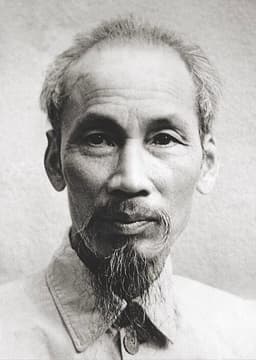
Ho Chi Minh
Revolutionary · Modern
62.9Total

Julius Caesar
General · Ancient
82.8Total
Basic Information
Born
1890
-100
Died
1969
-44
Era
Modern
Ancient
Nationality
Vietnam
Roman Republic
Occupation
Revolutionary
General
Civilization
Eastern
Western
Score Comparison
Military (10%)
55.0
88.0
Political (20%)
72.0
78.0
Influence (20%)
62.0
85.0
Legacy (20%)
58.0
82.0
Leadership (15%)
72.0
80.0
Strategy (15%)
58.0
85.0
TOTAL
62.9
82.8
Ho Chi Minh — Complete Timeline
1941 AD
Establishment of the Viet MinhPolitical Action◆ Major
Ho Chi Minh founded the Viet Minh (League for the Independence of Vietnam) in southern China. This coalition of nationalist and communist groups became the primary force for Vietnamese independence, fighting both Japanese occupation and French colonialism.
Viet MinhIndependence MovementWorld War II
Impact: nationalconstructive
1945 AD
Declaration of Independence of VietnamPolitical Action
Ho Chi Minh proclaimed the Democratic Republic of Vietnam in Hanoi's Ba Dinh Square, citing the US Declaration of Independence. This established the Viet Minh government and began the struggle for independence from French colonial rule.
IndependenceVietnamDecolonization
Impact: nationalconstructive
1954 AD
Battle of Dien Bien PhuWar
Ho Chi Minh's Viet Minh forces, under General Giap, defeated the French garrison at Dien Bien Phu. This victory ended French colonial rule in Indochina and led to the Geneva Accords dividing Vietnam at the 17th parallel.
Vietnam WarDecolonizationFrench Indochina
Impact: regional
Geneva AccordsPolitical Action◆ Major
Ho Chi Minh's delegation signed the Geneva Accords, temporarily dividing Vietnam at the 17th parallel. The agreement promised nationwide elections in 1956, which were never held, leading to the permanent division of Vietnam.
Geneva ConferenceDivision of VietnamDiplomacy
Impact: regional
1959 AD
Start of the Vietnam WarWar
Ho Chi Minh's government in North Vietnam authorized armed struggle against the US-backed South Vietnamese regime. This escalated into the Vietnam War, a prolonged conflict that resulted in millions of deaths and US withdrawal in 1973.
Vietnam WarCold WarCommunism
Impact: globaldestructive
Julius Caesar — Complete Timeline
58 BC
Gallic WarsWar◆ Major
Caesar, as proconsul of Gaul, launched a series of campaigns that conquered all of Gaul (modern France, Belgium, and parts of Switzerland). He fought numerous battles, including against the Helvetii, the Belgae, and the Gallic chieftain Vercingetorix. The wars brought immense wealth and a loyal army to Caesar.
Gallic WarsConquestRoman Expansion
Impact: regional
49 BC
Crossing the RubiconPolitical Action◆ Major
Caesar led Legio XIII across the Rubicon River into Italy, defying the Roman Senate's order to disband his army. This act triggered a civil war against Pompey and the Optimates, ultimately leading to Caesar's dictatorship and the end of the Roman Republic.
Roman Civil WarEnd of RepublicPower Struggle
Impact: global
48 BC
Battle of PharsalusWar◆ Major
Caesar's outnumbered army defeated the larger forces of Pompey the Great at Pharsalus in Greece. Caesar's tactical use of a reserve line to counter Pompey's cavalry charge proved decisive. Pompey fled to Egypt, where he was assassinated, leaving Caesar as the undisputed master of the Roman world.
Roman Civil WarBattleDecisive Victory
Impact: regional
44 BC
Appointment as Dictator for LifePolitical Action◆ Major
The Roman Senate appointed Caesar dictator perpetuo (dictator for life), granting him unprecedented personal power. This move concentrated military, legislative, and judicial authority in one person, effectively ending the Roman Republic's traditional system of checks and balances and alarming many senators.
DictatorshipEnd of RepublicPower Consolidation
Impact: regionaldestructive
Assassination on the Ides of MarchPolitical Action◆ Major
A group of Roman senators, led by Marcus Junius Brutus and Gaius Cassius Longinus, stabbed Caesar to death at a meeting of the Senate in the Theatre of Pompey. The assassination was intended to restore the Republic, but instead triggered another civil war that led to the rise of the Roman Empire.
AssassinationRoman PoliticsEnd of Republic
Impact: globaldestructive
Expert Analysis
ho-chi-minh-vs-julius-caesar
# The General and the Revolutionary
On a January morning in 49 BCE, a Roman general stood at the edge of a small river in northern Italy. The Rubicon was not much to look at—a trickle of water then, as now—but crossing it with an army meant civil war, a direct challenge to the Senate that had raised him. Four miles away, back in Rome, the senators who had tried to strip him of command were already trembling. Julius Caesar paused, then gave the order. Two thousand years later, on a September afternoon in 1945, a gaunt man in a plain khaki suit stood before a crowd in Hanoi's Ba Dinh Square. He read a declaration that borrowed phrases from the American Revolution, proclaiming independence for a nation that had been a French colony for nearly a century. Ho Chi Minh, too, was crossing a Rubicon of his own—but his river was the tide of history itself, and his enemy was an empire that would soon return with tanks.
Origins
Caesar was born into the chaos of the dying Roman Republic, a world of senatorial intrigue, slave revolts, and civil wars. His family, the Julii, claimed descent from the goddess Venus, but they were patricians of modest means in an age when money bought power. Young Caesar learned early that in Rome, reputation was currency. He wore his toga loose to hide his thin frame, cultivated a refined manner, and borrowed heavily to stage lavish games that won him the people's love. His world was one of marble and blood, where a man could rise by eloquence, bribery, or the sword—and Caesar would master all three.
Ho Chi Minh's origins could not have been more different. Born Nguyen Sinh Cung in 1890 in the village of Kim Lien, central Vietnam, he grew up under the shadow of French colonial rule. His father, a Confucian scholar, refused to learn French and was dismissed from government service. Young Ho wandered through a landscape of rice paddies and imperial ruins, absorbing the bitterness of a civilization that had been humiliated by foreigners. While Caesar learned rhetoric from Cicero's speeches, Ho learned resistance from the poetry of Vietnamese patriots. At twenty-one, he signed onto a French steamer as a cook's assistant, beginning a thirty-year exile that would take him to Harlem, London, Paris, Moscow, and Canton. The world, not the Senate, was his classroom.
Rise to Power
Caesar's path was a ladder of military commands and political alliances. He served as governor of Further Spain, where he conquered tribes and filled his coffers. Then came the alliance with Pompey and Crassus—the First Triumvirate—which bought him the governorship of Gaul. Over eight years, from 58 to 50 BCE, Caesar did what no Roman had done: he conquered all of Gaul, crossed the Rhine into Germany, and landed on the shores of Britain. His Commentaries on the Gallic Wars turned military reports into propaganda, making his name synonymous with invincibility. When the Senate ordered him to disband his army, he chose war.
Ho Chi Minh's rise was slower, more circuitous, and far more ideological. He spent years in Paris, where he joined the French Communist Party and wrote fiery articles under the name Nguyen Ai Quoc ("Nguyen the Patriot"). In Moscow, he studied Marxism-Leninism. In China, he organized Vietnamese exiles. Unlike Caesar, who commanded legions from the start, Ho spent decades as a shadowy organizer, a man who wrote manifestos and built networks. His turning point came in 1941, when he crossed back into Vietnam after thirty years abroad and founded the Viet Minh, a coalition of nationalists and communists united by one goal: independence. He was fifty-one years old, with no army and no weapons, only a vision.
Leadership & Governance
Caesar governed as he fought: with speed, audacity, and a willingness to break rules. As dictator, he reformed the calendar (giving us the Julian calendar), granted citizenship to provincials, and launched massive public works. He was lenient to former enemies—pardoning Brutus and Cassius, who would later kill him—but his clemency was a tactic, not a virtue. He centralized power in his own hands, packed the Senate with his supporters, and accepted the title "dictator for life." His military genius lay in improvisation: at the Battle of Alesia, he built a ring of fortifications around the Gauls while simultaneously besieging a relief army, a feat of engineering and logistics that still stuns military historians.
Ho Chi Minh's leadership style was the opposite. He was not a military commander—that was General Vo Nguyen Giap's role—but a political strategist who understood that in a war of national liberation, the people were the terrain. He lived simply, dressed in peasant clothes, and spoke in parables. His governance was austere and ideological: land reform, mass education, and relentless propaganda. The 1954 victory at Dien Bien Phu was Giap's triumph, but Ho's vision sustained it—the idea that a small, agrarian nation could defeat a European power through sheer will and sacrifice. His political wisdom lay in patience: he knew that the Vietnam War would be a marathon, not a sprint, and that the United States, like France, would eventually tire.
Triumph & Tragedy
Caesar's greatest moment was his triumph in Rome after Gaul—a parade of captives, treasure, and golden crowns that lasted for days. His tragedy was the Ides of March, 44 BCE, when sixty senators stabbed him to death in the Theater of Pompey. He fell at the foot of a statue of his old rival, Pompey, bleeding from twenty-three wounds. His last act, according to legend, was to pull his toga over his face, preserving his dignity in death.
Ho Chi Minh's triumph was the 1954 Geneva Accords, which recognized Vietnam's independence and temporarily divided the country. His tragedy was that the division became permanent, and he never lived to see unification. He died in 1969, six years before the fall of Saigon, having spent his final years watching his country burn under American bombing. His last will, written on a scrap of paper, asked for his ashes to be scattered across Vietnam's three regions—north, central, and south—a wish denied by his own party.
Character & Destiny
Caesar was driven by an insatiable hunger for glory—*ambitio*, the Romans called it, the desire to be first. He was charming, ruthless, and calculating, a man who could weep at the death of a political enemy and then order a massacre. His destiny was to destroy the Republic he loved, because he could not imagine a world where he was not its master. His personality shaped every decision: the crossing of the Rubicon, the affair with Cleopatra, the refusal to disband his bodyguard. He believed in his own star, and it carried him to the top—then abandoned him.
Ho Chi Minh was driven by something colder: a conviction that history was on his side. He was not charismatic in the Roman sense—he did not inspire personal loyalty so much as ideological commitment. He could be ruthless, purging rivals and enforcing party discipline, but he also had a human touch, writing poems to children and sharing meals with peasants. His destiny was to become a symbol, a face on posters and a name in slogans, while the real power lay with the party he had created. In the end, the revolutionary consumed the man.
Legacy
Caesar's legacy is the Roman Empire. His adopted heir, Octavian, became Augustus, the first emperor, and the world Caesar helped create lasted for five centuries in the West and a thousand years in the East. His name became a title—*Kaiser*, *Tsar*—and his writings shaped Western military thought for two millennia. But he also left a warning: that one man's ambition can destroy a republic.
Ho Chi Minh's legacy is a unified Vietnam, a nation of nearly 100 million people that fought off France and the United States. His name adorns the capital city, and his embalmed body lies in a mausoleum in Hanoi, a pilgrimage site for millions. But he also left a one-party state that still suppresses dissent, a revolution that devoured its own children. In Vietnam today, he is both father of the nation and ghost of its unfinished dreams.
Conclusion
Caesar and Ho Chi Minh were men of different worlds—one ancient, one modern; one Western, one Eastern; one a conqueror, one a liberator. Yet both understood something profound about power: that it is not given, but taken. Caesar took it with legions and gold; Ho took it with patience and ideology. One built an empire that crumbled; the other built a nation that endures. Perhaps the deepest difference is this: Caesar died believing he had won, while Ho died knowing he had not—yet. The Rubicon and the Red River both ran with blood, but only one still flows toward the sea.
Rankings
🥇
Julius CaesarLeader
Mil: 88.0Pol: 78.0Inf: 85.0
82.8
🥈
Ho Chi Minh
Mil: 55.0Pol: 72.0Inf: 62.0
62.9
+19.9 behind
How This Comparison Works
Algorithm
Each figure is scored on 6 dimensions (0—100 scale) based on structured historical data: Military (10%), Political (20%), Influence (20%), Legacy (20%), Leadership (15%), Strategy (15%). The weighted total produces the final ranking.
Data Sources
Scores are computed from structured sub-indicators in the database. Scale factors adjust for era (Ancient ×0.85, Modern ×1.0) and civilization size (Eastern ×1.05, Other ×0.80) to account for differences in population and military scale.
Maximum 3 Figures
Comparisons are limited to 2—3 figures to ensure readability and statistical meaningfulness.
Error Margins
±5 points per dimension — Sub-scores are derived from historical records with inherent uncertainty. Two figures within 5 points on a dimension should be considered roughly equivalent in that area.
Total Score Accuracy
±3 points overall — The weighted combination of 6 dimensions produces a total score with approximately ±3 points of uncertainty. Differences of less than 3 points are not statistically significant— the figures are effectively tied.
Known Limitations
- Historical records are incomplete and uneven across civilizations
- Figures from oral-tradition societies may be underrepresented
- Occupation labels can misclassify multi-role figures
- Scores measure capability and impact, not moral character
- Quantitative scoring is a comparison tool, not absolute truth
Capability Radar
Military (10%) — Battles & Warfare
Battles
65
95
Win Rate
60
92
Expansion
55
97
Political (20%) — Governance & Reform
Reform
85
90
Diplomacy
90
85
Economy
40
82
Influence (20%) — Cultural & Global Reach
Cultural
75
88
Global
75
94
Legacy (20%) — Historical Impact
Historical
85
95
Longevity
70
96
Leadership (15%) — Power & Stability
Tenure
70
75
Stability
50
60
Strategy (15%) — Tactics & Innovation
Strategy
80
94
Tactics
70
96
Reform
75
88
Similar Comparisons
Comments & Discussion
No comments yet. Be the first to share your thoughts!