Loading...
Hideki Tojo vs Suchinda Kraprayoon
Hideki Tojo leads by 16.8 pts · 2 figures compared
…
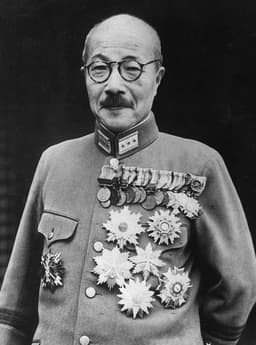
Hideki Tojo
General · Modern
53.9Total
Suchinda Kraprayoon
General · Modern
37.1Total
Basic Information
Born
1884
1933
Died
1948
—
Era
Modern
Modern
Nationality
Japan
Thailand
Occupation
General
General
Civilization
Eastern
Eastern
Score Comparison
Military (10%)
70.0
10.2
Political (20%)
48.0
27.9
Influence (20%)
55.0
47.1
Legacy (20%)
50.0
37.5
Leadership (15%)
53.2
45.0
Strategy (15%)
55.0
39.6
TOTAL
53.9
37.1
Hideki Tojo — Complete Timeline
1941 AD
Attack on Pearl HarborWar
As Prime Minister, Hideki Tojo authorized the attack on the US naval base at Pearl Harbor, Hawaii. The surprise attack brought the United States into World War II. Tojo's decision was based on the belief that war with the US was inevitable due to resource embargoes and diplomatic failures.
World War IIPearl HarborUS-Japan War
Impact: globaldestructive
Appointment as Prime MinisterPolitical Action◆ Major
Hideki Tojo was appointed Prime Minister of Japan, replacing Fumimaro Konoe. He retained his position as Army Minister and later took on other portfolios, consolidating power. His appointment marked the ascendancy of the military faction in the Japanese government and the shift towards total war.
Prime MinisterMilitary GovernmentWorld War II
Impact: national
1942 AD
Fall of SingaporeWar◆ Major
Under Tojo's leadership, Japanese forces captured Singapore from the British in a swift campaign. The fall of Singapore was one of the worst British military defeats in history. It demonstrated Japanese military prowess and led to the occupation of a key strategic location in Southeast Asia.
World War IISingaporeJapanese Victory
Impact: global
1948 AD
Execution by the International Military Tribunal for the Far EastPolitical Action◆ Major
Hideki Tojo was found guilty of war crimes by the International Military Tribunal for the Far East and sentenced to death. He was executed by hanging on December 23, 1948. His trial and execution symbolized the Allied effort to hold Japanese leaders accountable for wartime atrocities.
War CrimesExecutionTokyo Trials
Impact: globaltragic
Suchinda Kraprayoon — Complete Timeline
1991 AD
Leadership of the 1991 Thai Coup d'ÉtatPolitical Action◆ Major
General Suchinda Kraprayoon led the National Peace Keeping Council in a bloodless coup that overthrew Prime Minister Chatichai Choonhavan. The coup was justified by claims of corruption and political instability, establishing a military junta.
CoupMilitary JuntaPower Seizure
Impact: nationaldestructive
1992 AD
Appointment as Prime MinisterPolitical Action◆ Major
After a general election, Suchinda was appointed Prime Minister despite not being an elected MP. His appointment sparked widespread protests, as it was seen as a continuation of military rule and a violation of democratic principles.
Prime MinisterControversyMilitary Rule
Impact: nationaldestructive
Black May 1992 Uprising and ResignationPolitical Action
Massive pro-democracy protests in Bangkok, led by Chamlong Srimuang, demanded Suchinda's resignation. The military crackdown resulted in dozens of deaths. King Bhumibol intervened, leading to Suchinda's resignation and the restoration of civilian government.
UprisingBlack MayResignation
Impact: nationaltragic
Expert Analysis
Hideki Tojo vs Suchinda Kraprayoon
# The General Who Would Be King: Hideki Tojo and Suchinda Kraprayoon
In the spring of 1992, Bangkok’s streets filled with hundreds of thousands of protesters, their voices rising against a general who had seized power. Forty-seven years earlier, on a December morning in 1941, another general had set in motion a chain of events that would bring fire and ruin to the Pacific. Both men wore uniforms, both commanded armies, and both believed they could rule their nations. But where one led his country to catastrophic defeat and the hangman’s noose, the other was driven from office in a matter of weeks, his ambitions crumbling before a tide of popular fury. The difference between them tells us something profound about power, timing, and the unforgiving judgment of history.
Origins
Hideki Tojo was born in 1884 into a samurai family that had served the Japanese military for generations. His father, a lieutenant general, instilled in him a rigid sense of duty and a belief that the army was the soul of the nation. Japan in Tojo’s youth was a rising empire, flush with victory in the Russo-Japanese War and hungry for a place among the world’s great powers. The military was not merely an institution but a sacred calling, and Tojo absorbed this ethos completely. He was a man of discipline, not imagination—a bureaucrat in uniform who saw the world in terms of orders, obedience, and the iron logic of national survival.
Suchinda Kraprayoon, born in 1933, came of age in a different Asia. Thailand had never been colonized, a fact that shaped its military’s self-image as guardians of national independence rather than conquerors. Suchinda graduated from the Chulachomklao Royal Military Academy and rose through the ranks during the Cold War, when Thailand’s generals saw themselves as bulwarks against communism. The Thai military was political, deeply embedded in business and bureaucracy, but it operated within a framework—however fragile—of constitutional monarchy and periodic elections. Suchinda was a product of this system, not a revolutionary.
Rise to Power
Tojo’s path to power was the path of the samurai state. He served as chief of staff of the Kwantung Army in Manchuria, where he earned a reputation as a ruthless administrator, then as army minister in 1940. When Prime Minister Fumimaro Konoe resigned in October 1941, unable to resist the military’s demand for war with the United States, Tojo stepped into the vacuum. He became prime minister while retaining his army portfolio, a concentration of power that made him effectively a military dictator. The attack on Pearl Harbor followed two months later, on December 7, 1941—a decision Tojo authorized with the cold certainty of a man who believed Japan had no other choice.
Suchinda’s rise was more theatrical. In February 1991, he led the National Peace Keeping Council in a bloodless coup that overthrew Prime Minister Chatichai Choonhavan, whom the military accused of corruption. For a year, the junta ruled, and Suchinda promised elections. When the votes were held in March 1992, the pro-military party won, but the constitution allowed Suchinda to be appointed prime minister despite not being an elected member of parliament. On April 7, 1992, he took office. The response was immediate: protests erupted in Bangkok, led by Chamlong Srimuang, a former general turned democracy activist.
Leadership & Governance
Tojo governed as a wartime autocrat. He centralized control over Japan’s war economy, suppressed dissent through the dreaded Kempetai military police, and drove the country deeper into a conflict it could not win. His military strategy was aggressive but inflexible: after the stunning victories of 1942—the fall of Singapore in February, the conquest of the Philippines—Japan’s forces were overextended, unable to sustain supply lines or adapt to American industrial might. Tojo’s political wisdom was fatally narrow. He saw negotiation as weakness, retreat as dishonor, and surrender as unthinkable. By 1944, when American forces broke through Japan’s defensive perimeter at Saipan, Tojo was forced to resign, his leadership discredited.
Suchinda’s governance lasted barely two months. He offered no grand vision, no mobilization for war, no ideology beyond the military’s traditional claim to order and stability. When the protests swelled in May 1992, he ordered a crackdown. Soldiers fired into crowds; dozens were killed, hundreds wounded. The television images of bloodied students and monks shocked Thailand and the world. King Bhumibol Adulyadej, the revered monarch, intervened, summoning Suchinda and Chamlong to the palace. On May 24, Suchinda resigned.
Triumph & Tragedy
Tojo’s greatest moment was also his most terrible. The attack on Pearl Harbor was a tactical masterpiece, achieving complete surprise and crippling the U.S. Pacific Fleet. But it was a strategic catastrophe, awakening a sleeping giant and ensuring Japan’s eventual defeat. His fall was equally dramatic: after resigning in 1944, he attempted suicide in 1945, shooting himself in the chest, but survived. The International Military Tribunal for the Far East tried him for war crimes, including the mistreatment of prisoners of war and the atrocities committed across occupied Asia. On December 23, 1948, he was hanged.
Suchinda’s tragedy was smaller in scale but no less poignant. He had the power of the state behind him, but he faced a society that had changed while he was in uniform. The Black May uprising of 1992 was not a revolution; it was a demand that the military return to its barracks. Suchinda’s failure was not one of strategy but of legitimacy. He could not govern because the people would not let him.
Character & Destiny
Tojo was a man of iron will and narrow vision. He believed in hierarchy, obedience, and the inevitability of conflict. His personality—rigid, humorless, fanatically dedicated—matched the militarism that consumed Japan in the 1930s. He was, in many ways, the perfect product of his era: a general who saw politics as an extension of war and war as the highest expression of national purpose. That worldview led Japan to ruin and himself to the gallows.
Suchinda was a different kind of general. He was not a fanatic but an opportunist, a man who saw the military’s role as managing rather than transforming society. He lacked Tojo’s ideological conviction and, perhaps, his courage. When the king spoke, Suchinda obeyed. His destiny was not a trial and execution but a quiet retirement, a footnote in Thailand’s turbulent political history.
Legacy
Tojo’s legacy is one of the darkest in modern history. In Japan, he is remembered as a war criminal, though a small minority still reveres him as a patriot. His name is synonymous with militarism, aggression, and the horrors of World War II. The Tokyo Trials condemned him not only for his actions but for the system he represented—a system that placed the state above humanity and the army above the law.
Suchinda’s legacy is more ambiguous. The Black May uprising strengthened Thailand’s democracy, but the military would return to power again, most recently in 2014. Suchinda himself faded into obscurity, living quietly in Bangkok. He is remembered, if at all, as a symbol of the old order that could not withstand the new.
Conclusion
Two generals, two nations, two centuries. Tojo and Suchinda both believed that soldiers could rule better than civilians. One led his country into a war that killed millions and ended with his own execution. The other led a coup that collapsed before a crowd of unarmed citizens. The difference between them is not merely one of scale but of time. Tojo governed in an age of empires, when war was the final arbiter of power. Suchinda governed in an age of televisions and protests, when legitimacy came from the people, not the sword. History does not repeat itself, but it does offer warnings. The general who forgets that he serves the nation, not the other way around, will find his throne overturned—whether by a foreign fleet or a crowd on the street.
Rankings
🥇
Hideki TojoLeader
Mil: 70.0Pol: 48.0Inf: 55.0
53.9
🥈
Suchinda Kraprayoon
Mil: 10.2Pol: 27.9Inf: 47.1
37.1
+16.8 behind
How This Comparison Works
Algorithm
Each figure is scored on 6 dimensions (0—100 scale) based on structured historical data: Military (10%), Political (20%), Influence (20%), Legacy (20%), Leadership (15%), Strategy (15%). The weighted total produces the final ranking.
Data Sources
Scores are computed from structured sub-indicators in the database. Scale factors adjust for era (Ancient ×0.85, Modern ×1.0) and civilization size (Eastern ×1.05, Other ×0.80) to account for differences in population and military scale.
Maximum 3 Figures
Comparisons are limited to 2—3 figures to ensure readability and statistical meaningfulness.
Error Margins
±5 points per dimension — Sub-scores are derived from historical records with inherent uncertainty. Two figures within 5 points on a dimension should be considered roughly equivalent in that area.
Total Score Accuracy
±3 points overall — The weighted combination of 6 dimensions produces a total score with approximately ±3 points of uncertainty. Differences of less than 3 points are not statistically significant— the figures are effectively tied.
Known Limitations
- Historical records are incomplete and uneven across civilizations
- Figures from oral-tradition societies may be underrepresented
- Occupation labels can misclassify multi-role figures
- Scores measure capability and impact, not moral character
- Quantitative scoring is a comparison tool, not absolute truth
Capability Radar
Military (10%) — Battles & Warfare
Battles
65
5
Win Rate
40
5
Expansion
70
5
Political (20%) — Governance & Reform
Reform
30
5
Diplomacy
35
10
Economy
25
5
Influence (20%) — Cultural & Global Reach
Cultural
30
5
Global
55
5
Legacy (20%) — Historical Impact
Historical
55
10
Longevity
40
5
Leadership (15%) — Power & Stability
Tenure
60
10
Stability
20
5
Strategy (15%) — Tactics & Innovation
Strategy
50
10
Tactics
55
10
Reform
45
5
Similar Comparisons
Comments & Discussion
SamuraiCodeBreaker6/16/2026
Tojo was a strategic catastrophe disguised as discipline. He micromanaged the Pacific War from Tokyo. He overruled Yamamoto's Pearl Harbor plan to include a third wave against oil tanks and repair docks—a decision that let the US Navy recover in six months instead of two years. Suchinda was a clumsy authoritarian who lasted three months. Tojo got four years and millions killed. One was a failed tactician; the other was just a failed actor. Don't romanticize either.
墨脱之鉴6/16/2026
Tojo这种人,本质上是个会写行政文件的刽子手。他亲手签署了《战阵训》,要求士兵“宁死不降”,结果太平洋战场上日军在塞班、硫磺岛等地集体自杀,让整个民族白死了几十万人。Suchinda至少没让泰国士兵去送死,他撤了。别拿“时代不同”洗地,一个人的底线不是由时间决定的,是由脑子决定的。