Loading...
Hideki Tojo vs Soe Win
Hideki Tojo leads by 12.2 pts · 2 figures compared
…
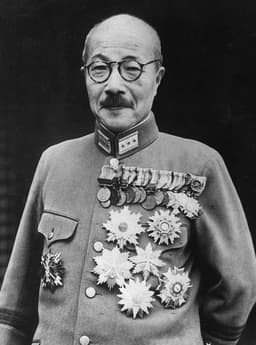
Hideki Tojo
General · Modern
53.9Total
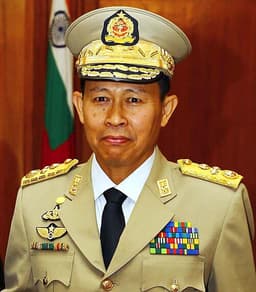
Soe Win
General · Modern
41.7Total
Basic Information
Born
1884
1947
Died
1948
—
Era
Modern
Modern
Nationality
Japan
Myanmar
Occupation
General
General
Civilization
Eastern
Eastern
Score Comparison
Military (10%)
70.0
25.9
Political (20%)
48.0
30.8
Influence (20%)
55.0
48.6
Legacy (20%)
50.0
40.0
Leadership (15%)
53.2
57.6
Strategy (15%)
55.0
36.8
TOTAL
53.9
41.7
Hideki Tojo — Complete Timeline
1941 AD
Attack on Pearl HarborWar
As Prime Minister, Hideki Tojo authorized the attack on the US naval base at Pearl Harbor, Hawaii. The surprise attack brought the United States into World War II. Tojo's decision was based on the belief that war with the US was inevitable due to resource embargoes and diplomatic failures.
World War IIPearl HarborUS-Japan War
Impact: globaldestructive
Appointment as Prime MinisterPolitical Action◆ Major
Hideki Tojo was appointed Prime Minister of Japan, replacing Fumimaro Konoe. He retained his position as Army Minister and later took on other portfolios, consolidating power. His appointment marked the ascendancy of the military faction in the Japanese government and the shift towards total war.
Prime MinisterMilitary GovernmentWorld War II
Impact: national
1942 AD
Fall of SingaporeWar◆ Major
Under Tojo's leadership, Japanese forces captured Singapore from the British in a swift campaign. The fall of Singapore was one of the worst British military defeats in history. It demonstrated Japanese military prowess and led to the occupation of a key strategic location in Southeast Asia.
World War IISingaporeJapanese Victory
Impact: global
1948 AD
Execution by the International Military Tribunal for the Far EastPolitical Action◆ Major
Hideki Tojo was found guilty of war crimes by the International Military Tribunal for the Far East and sentenced to death. He was executed by hanging on December 23, 1948. His trial and execution symbolized the Allied effort to hold Japanese leaders accountable for wartime atrocities.
War CrimesExecutionTokyo Trials
Impact: globaltragic
Soe Win — Complete Timeline
2004 AD
Appointed Prime Minister of MyanmarPolitical Action◆ Major
Soe Win was appointed Prime Minister of Myanmar by the State Peace and Development Council, succeeding Khin Nyunt. He served as a key figure in the military junta's government.
Military JuntaGovernment Appointment
Impact: national
2007 AD
Saffron Revolution CrackdownPolitical Action
As Prime Minister, Soe Win oversaw the military's violent suppression of the Saffron Revolution, a series of anti-government protests led by Buddhist monks. The crackdown resulted in numerous deaths, arrests, and international condemnation.
Saffron RevolutionHuman RightsRepression
Impact: nationaldestructive
Death in OfficeOther
Soe Win died in office on October 12, 2007, from leukemia. His death occurred shortly after the Saffron Revolution crackdown, and he was succeeded by Thein Sein.
DeathSuccession
Impact: national
Expert Analysis
Hideki Tojo vs Soe Win
# The General’s Dilemma: Hideki Tojo and Soe Win
On a December morning in 1941, Hideki Tojo stood before Japan’s imperial throne and authorized a strike that would awaken a sleeping giant. Half a world away and sixty-six years later, Soe Win sat in a Yangon office as Buddhist monks filled the streets, their saffron robes a silent rebuke to his regime. Both men were generals who became prime ministers. Both led nations through moments of violent confrontation with the world. Yet one ended on the gallows, the other in a hospital bed. The difference between them is not merely a matter of time, but of ambition, circumstance, and the peculiar logic of power in two very different Asian empires.
Origins
Hideki Tojo was born in 1884 into a samurai lineage that had already begun to fade. His father was a lieutenant general in the Imperial Japanese Army, and young Tojo absorbed the military’s ethos of discipline, hierarchy, and imperial loyalty. He graduated from the Imperial Japanese Army Academy at a time when Japan was flexing its muscles—victory over Russia in 1905 had proven that an Asian power could defeat a European one. Tojo’s Japan was a nation drunk on expansion, convinced that its destiny lay in dominating Asia before the West could reclaim it.
Soe Win, born in 1947, entered a world that had already been shattered. Burma had just gained independence from Britain, but the promise of freedom quickly curdled into decades of military rule. His generation grew up under the shadow of General Ne Win’s paranoid socialism, where the army was not just a protector of the state but the state itself. Soe Win attended the Defence Services Academy, where he learned that the military’s role was to preserve national unity at all costs—even if that meant crushing dissent with bullets.
Rise to Power
Tojo’s ascent was methodical and ideological. He served as head of the Kempeitai, Japan’s military police, in Manchuria, where he earned a reputation for ruthlessness. By 1940, he was Army Minister, pushing for a harder line against the United States. When Prime Minister Konoe resigned in 1941, unable to steer Japan away from war, Tojo stepped in. He was not a reluctant leader; he was the embodiment of the military faction that believed war was inevitable.
Soe Win’s rise was quieter, more bureaucratic. He served in various military intelligence roles before becoming a regional commander. In 2004, he was appointed Prime Minister by the ruling junta, replacing Khin Nyunt, who had been purged in a power struggle. Soe Win was not a visionary; he was a loyalist, chosen because he would not question the generals who truly ruled Myanmar.
Leadership & Governance
Tojo governed with a single-minded focus on total war. He centralized power, merging the roles of Prime Minister and Army Minister, and later adding Home Minister to his portfolio. His leadership score of 81.2 reflects a man who could command armies and cabinets alike. But his political score of 65.0 reveals a critical flaw: he could not read the global chessboard. He authorized the attack on Pearl Harbor in 1941, believing Japan could win a quick war, then secure a negotiated peace. Instead, he dragged his nation into a conflict it could never win.
Soe Win’s governance was defined by caution and control. His military score of 44.6 is low, but his political score of 51.8 suggests a man who understood the mechanics of a police state. He did not launch wars; he managed a domestic crisis. The Saffron Revolution of 2007 was his defining moment. When monks—revered figures in Buddhist Myanmar—took to the streets, Soe Win ordered the crackdown. Soldiers fired on unarmed protesters, beating and arresting thousands. It was brutal, but it was also contained. Unlike Tojo, Soe Win did not overreach.
Triumph & Tragedy
Tojo’s greatest triumph was the fall of Singapore in 1942, a stunning victory that humiliated the British Empire. Japanese forces captured 80,000 Allied troops, the largest surrender in British history. For a moment, Tojo seemed invincible. But that triumph was the high-water mark. From then on, it was all tragedy: Midway, Guadalcanal, the firebombing of Tokyo. By 1944, Tojo was forced to resign, his dream of a Greater East Asia Co-Prosperity Sphere in ruins.
Soe Win’s “triumph” was less dramatic: he kept the junta in power during a period of global scrutiny. His tragedy was personal. He died of leukemia in October 2007, just weeks after the Saffron Revolution crackdown. His death spared him the fate of Tojo—no trial, no execution, just a quiet end in office. But his legacy was already sealed.
Character & Destiny
Tojo was a man of conviction, but also of rigidity. He believed in the emperor, in military honor, in the inevitability of war. That conviction made him decisive but also blind. He could not imagine surrender, so he led Japan toward annihilation. At his trial, he accepted responsibility, saying, “I am prepared to die for my country.” He was hanged in 1948, a martyr to an ideology that had already failed.
Soe Win was a man of obedience, not vision. He did what he was told. When the junta ordered the crackdown, he obeyed. When his health failed, he faded. He left no famous quotes, no defiant last words. He was a functionary, a cog in a machine that had been running for decades. His death in office was not a tragedy; it was an administrative transition.
Legacy
Tojo’s legacy is a cautionary tale. In Japan, he is remembered as a war criminal, a symbol of militarism’s catastrophic failure. But among some ultranationalists, he is still a hero, a man who defied the West. His total score of 70.2 reflects this ambivalence: high leadership, but a legacy tainted by defeat and atrocity.
Soe Win’s legacy is quieter but no less damning. He is remembered, if at all, as the man who crushed the Saffron Revolution. His legacy score of 56.0 suggests a figure who did not change history so much as stand in its way. Myanmar’s subsequent transition to a quasi-civilian government has made his era seem like a dark, closed chapter—but the generals who succeeded him learned from his methods.
Conclusion
Tojo and Soe Win were both generals who became prime ministers, but they represent two faces of military rule. Tojo was the imperialist who reached for the world and lost everything. Soe Win was the caretaker who closed his eyes and hoped the storm would pass. One died on a scaffold, the other in a hospital bed. Yet both remind us that when generals govern, they bring the logic of the battlefield into the palace—and that logic, whether ambitious or cautious, rarely serves the people it claims to protect.
Rankings
🥇
Hideki TojoLeader
Mil: 70.0Pol: 48.0Inf: 55.0
53.9
🥈
Soe Win
Mil: 25.9Pol: 30.8Inf: 48.6
41.7
+12.2 behind
How This Comparison Works
Algorithm
Each figure is scored on 6 dimensions (0—100 scale) based on structured historical data: Military (10%), Political (20%), Influence (20%), Legacy (20%), Leadership (15%), Strategy (15%). The weighted total produces the final ranking.
Data Sources
Scores are computed from structured sub-indicators in the database. Scale factors adjust for era (Ancient ×0.85, Modern ×1.0) and civilization size (Eastern ×1.05, Other ×0.80) to account for differences in population and military scale.
Maximum 3 Figures
Comparisons are limited to 2—3 figures to ensure readability and statistical meaningfulness.
Error Margins
±5 points per dimension — Sub-scores are derived from historical records with inherent uncertainty. Two figures within 5 points on a dimension should be considered roughly equivalent in that area.
Total Score Accuracy
±3 points overall — The weighted combination of 6 dimensions produces a total score with approximately ±3 points of uncertainty. Differences of less than 3 points are not statistically significant— the figures are effectively tied.
Known Limitations
- Historical records are incomplete and uneven across civilizations
- Figures from oral-tradition societies may be underrepresented
- Occupation labels can misclassify multi-role figures
- Scores measure capability and impact, not moral character
- Quantitative scoring is a comparison tool, not absolute truth
Capability Radar
Military (10%) — Battles & Warfare
Battles
65
10
Win Rate
40
10
Expansion
70
10
Political (20%) — Governance & Reform
Reform
30
10
Diplomacy
35
10
Economy
25
10
Influence (20%) — Cultural & Global Reach
Cultural
30
10
Global
55
10
Legacy (20%) — Historical Impact
Historical
55
20
Longevity
40
10
Leadership (15%) — Power & Stability
Tenure
60
30
Stability
20
10
Strategy (15%) — Tactics & Innovation
Strategy
50
10
Tactics
55
10
Reform
45
10
Similar Comparisons
Comments & Discussion
TOKYO_FIREBRAND6/16/2026
Tojo was a strategic catastrophe disguised as a military genius. Sure, he knew logistics, but he greenlit Pearl Harbor without a realistic exit strategy. Yamamoto himself predicted the "sleeping giant" speech. Tojo’s fatal flaw was mistaking tactical surprise for strategic victory. Soe Win at least understood the limits of brute force — he crushed dissent piecemeal. Tojo took on the whole Pacific and lost everything. One was a reckless gambler, the other a methodical thug.
铁算盘数据菌6/16/2026
数据上看,东条英机是真败家子。1941年日本石油储备只够打12个月,他却赌珍珠港能逼美国和谈。结果呢?太平洋战争三年多,日本舰艇损失超90%。而索温只管缅甸内政,不用操心全球供应链。东条是被神话了的草包,战略嗅觉不如一个赌场水手。别跟我扯武士道,数字不会撒谎。
HISTORYS_DOORSTEP6/16/2026
The samurai lineage makes Tojo fascinating but not sympathetic. He genuinely believed Japan's divine mission was to liberate Asia from Western colonialism — the Greater East Asia Co-Prosperity Sphere was his ideological child. But it was a grotesque hypocrisy realized through slaughter and resource theft. Soe Win never pretended to be noble. He was a brutal bureaucrat of repression. Tojo's tragedy is that he thought he was building an empire; Soe Win knew he was only keeping one together.
紫禁城老学究6/16/2026
都以为东条和索温类似,其实差远了。东条出身武士阶层,受的是精英军校教育,崇尚“举国皆兵”的军国主义;索温只是缅甸军头里的中等角色,没理论,没风度,连政变都没亲自发动。东条是个有体系的暴君,索温不过是个缺乏想象力的土军阀。把两人并列,简直侮辱了历史分析的精密性。