Loading...
Hideki Tojo vs Shi Dakai
Shi Dakai leads by 5.7 pts · 2 figures compared
…
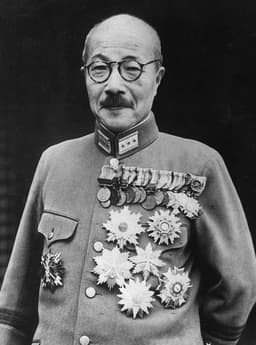
Hideki Tojo
General · Modern
53.9Total
Shi Dakai
General · Modern
59.6Total
Basic Information
Born
1884
1831
Died
1948
1863
Era
Modern
Modern
Nationality
Japan
China
Occupation
General
General
Civilization
Eastern
Eastern
Score Comparison
Military (10%)
70.0
76.0
Political (20%)
48.0
45.0
Influence (20%)
55.0
56.7
Legacy (20%)
50.0
54.0
Leadership (15%)
53.2
72.0
Strategy (15%)
55.0
68.1
TOTAL
53.9
59.6
Hideki Tojo — Complete Timeline
1941 AD
Attack on Pearl HarborWar
As Prime Minister, Hideki Tojo authorized the attack on the US naval base at Pearl Harbor, Hawaii. The surprise attack brought the United States into World War II. Tojo's decision was based on the belief that war with the US was inevitable due to resource embargoes and diplomatic failures.
World War IIPearl HarborUS-Japan War
Impact: globaldestructive
Appointment as Prime MinisterPolitical Action◆ Major
Hideki Tojo was appointed Prime Minister of Japan, replacing Fumimaro Konoe. He retained his position as Army Minister and later took on other portfolios, consolidating power. His appointment marked the ascendancy of the military faction in the Japanese government and the shift towards total war.
Prime MinisterMilitary GovernmentWorld War II
Impact: national
1942 AD
Fall of SingaporeWar◆ Major
Under Tojo's leadership, Japanese forces captured Singapore from the British in a swift campaign. The fall of Singapore was one of the worst British military defeats in history. It demonstrated Japanese military prowess and led to the occupation of a key strategic location in Southeast Asia.
World War IISingaporeJapanese Victory
Impact: global
1948 AD
Execution by the International Military Tribunal for the Far EastPolitical Action◆ Major
Hideki Tojo was found guilty of war crimes by the International Military Tribunal for the Far East and sentenced to death. He was executed by hanging on December 23, 1948. His trial and execution symbolized the Allied effort to hold Japanese leaders accountable for wartime atrocities.
War CrimesExecutionTokyo Trials
Impact: globaltragic
Shi Dakai — Complete Timeline
1851 AD
Jintian UprisingWar◆ Major
Shi Dakai joined the Taiping Rebellion at its inception in Jintian, Guangxi. As a core leader, he helped organize the rebel forces and was appointed Wing King, becoming one of the key military commanders of the Taiping Heavenly Kingdom.
Taiping RebellionUprisingMilitary Command
Impact: national
1854 AD
Battle of XiangtanWar◆ Major
Shi Dakai led Taiping forces to a major victory at Xiangtan, Hunan, defeating Qing imperial troops. This battle secured Taiping control over key territories in the Yangtze River valley and demonstrated his military skill.
Taiping RebellionBattleVictory
Impact: regional
1856 AD
Tianjing IncidentPolitical Action
Shi Dakai returned to Tianjing (Nanjing) after the internal purge of the Eastern King Yang Xiuqing and the murder of the Northern King Wei Changhui. He condemned the violence and was forced to flee, leading to a split in Taiping leadership.
Taiping RebellionInternal ConflictPurge
Impact: nationaltragic
1858 AD
Campaign in Zhejiang and FujianWar
Shi Dakai led a separate Taiping army into Zhejiang and Fujian provinces, capturing several cities. This campaign expanded Taiping influence into southeastern China but also isolated his forces from the main Taiping base.
Taiping RebellionCampaignExpansion
Impact: regional
1863 AD
Battle of Baishui RiverWar◆ Major
Shi Dakai's army was trapped and defeated by Qing forces at the Baishui River in Sichuan. He was captured and executed shortly after, marking the end of his military career and a significant loss for the Taiping cause.
Taiping RebellionBattleDefeatDeath
Impact: nationaltragic
Expert Analysis
Hideki Tojo vs Shi Dakai
# The Iron Cage of Duty: Hideki Tojo and Shi Dakai
On a December morning in 1941, a Japanese prime minister in a general’s uniform received word that his gamble had succeeded beyond all expectations. Thousands of miles away and nearly a century earlier, a young rebel commander watched his army sweep across the plains of Hunan, convinced that heaven itself had chosen his cause. Both men believed they were instruments of fate. Both would die by execution. Yet the paths that led them to these moments—and the judgments history has passed upon them—could not be more different.
Origins
Hideki Tojo was born in 1884 into a samurai family that had served Japan’s military for generations. His father, a lieutenant general in the Imperial Army, instilled in him a rigid code of discipline and unquestioning loyalty. The Japan of Tojo’s youth was modernizing feverishly, its leaders obsessed with catching up to Western powers. Tojo absorbed this ethos completely: the nation was a machine, and every citizen a cog that must turn without complaint.
Shi Dakai came into the world in 1831, in a China that was collapsing. The Qing Dynasty was rotting from within, opium had sapped the nation’s strength, and peasant misery was reaching its breaking point. Unlike Tojo, Shi Dakai was born into relative wealth—his family were landowners in Guangxi. But he was also a Hakka, an ethnic minority often despised by mainstream Chinese society. This dual identity—privileged yet marginalized—shaped a man who could lead armies but never fully trust the powerful.
Rise to Power
Tojo’s ascent was methodical, almost bureaucratic. He graduated from the Imperial Japanese Army Academy, then the Army War College, then served as a military attaché in Germany. He climbed rank by rank, building a reputation as a ruthless administrator who could cut through indecision. In 1937, he became chief of staff of the Kwantung Army in Manchuria, where he directed operations with cold efficiency. By 1941, when Emperor Hirohito needed a prime minister who would pursue war without hesitation, Tojo was the obvious choice.
Shi Dakai’s rise was revolutionary in every sense. In 1851, at age twenty, he joined the Jintian Uprising led by Hong Xiuquan, a failed scholar who claimed to be the younger brother of Jesus Christ. The Taiping Heavenly Kingdom was born in blood and fire, and Shi Dakai quickly distinguished himself. While other rebel leaders fought for personal power, Shi Dakai fought with tactical brilliance and, crucially, with mercy. He spared civilians, forbade looting, and won the loyalty of ordinary people wherever he marched.
Leadership & Governance
Tojo governed Japan as a military dictatorship in all but name. He served simultaneously as Prime Minister, Army Minister, and later Chief of the General Staff—concentrating more power than any Japanese leader since the shogunate. His leadership style was rigid, hierarchical, and intolerant of dissent. He believed that willpower alone could overcome material disadvantages, a fatal delusion that led Japan into a war it could not win. His political score of 65.0 reflects this: he was efficient at crushing opposition but incapable of strategic flexibility.
Shi Dakai, by contrast, was the rare Taiping leader who understood that military victory required political wisdom. After the Tianjing Incident of 1856—a bloody purge in which the Eastern King Yang Xiuqing was murdered and thousands of rebels killed each other—Shi Dakai returned to the capital to restore order. He governed the territories under his control with relative moderation, winning over local elites and implementing land reforms. His military score of 84.6 and strategy score of 81.6 reflect genuine brilliance on the battlefield, but his political score of 64.8 reveals the limitation: in a movement torn by factionalism, even the best general could not hold it together.
Triumph & Tragedy
Tojo’s greatest moment was also his nation’s greatest crime. The attack on Pearl Harbor on December 7, 1941, was a tactical masterpiece that temporarily crippled the U.S. Pacific Fleet. The fall of Singapore in 1942 followed—a stunning victory that humiliated the British Empire and gave Japan control of Southeast Asia. But triumph was fleeting. Tojo had no exit strategy, no plan for how to end a war against an industrial giant. By 1944, when Saipan fell and American bombers began incinerating Japanese cities, Tojo was forced to resign. In 1948, he was hanged as a war criminal.
Shi Dakai’s tragedy was more personal. After the Tianjing Incident, he grew disillusioned with Hong Xiuquan’s paranoia and the constant infighting among the Taiping kings. In 1857, he led his own army away from the capital, embarking on a quixotic campaign through Zhejiang, Fujian, and finally into Sichuan. For six years, he fought brilliantly but aimlessly, winning battles but losing the war. In 1863, his army was trapped at the Baishui River in Sichuan. To save his remaining soldiers, Shi Dakai surrendered himself to the Qing authorities. They executed him slowly, by the thousand cuts.
Character & Destiny
Tojo was a man who saw the world through a single lens: duty to the emperor and the nation. He once said, “The only thing we can do is to fight.” There was no room for doubt, no capacity for moral reflection. When asked after the war why Japan had attacked Pearl Harbor, he replied simply: “It was the only way.” This rigidity was his strength as a military administrator and his fatal weakness as a national leader. He could mobilize a nation for war but could not save it from destruction.
Shi Dakai was more complex. He was a brilliant tactician who believed in the Taiping cause but was too honorable for the politics the cause required. He refused to massacre civilians, refused to betray his comrades, refused to seize power when he could have. His final act—surrendering himself to save his men—was either noble or naive, depending on one’s perspective. The Qing executioners gave him no credit for it.
Legacy
Tojo’s legacy is one of utter condemnation. He is remembered as the face of Japanese militarism, the man who dragged his nation into catastrophic war. At Yasukuni Shrine, he is enshrined as a war hero, a status that continues to inflame international relations. But among most historians and the Japanese public, he is a cautionary tale—the ultimate proof that blind obedience to authority can lead to national suicide.
Shi Dakai’s legacy is more ambiguous. In China, he is remembered as the “Wing King,” a tragic hero of the Taiping Rebellion. His military brilliance is acknowledged, but his ultimate failure—the inability to unite the rebel movement—is also mourned. Some see him as a romantic figure, a man of principle in an age of treachery. Others view him as a wasted talent, a general who could have changed history if he had been more ruthless.
Conclusion
What separates these two men is not talent or ambition, but the moral framework within which they operated. Tojo was a product of a system that exalted the state above all else, a system that turned duty into a cage. Shi Dakai was a product of a revolution that promised liberation but devoured its own children. Both were brilliant in their domains; both were destroyed by forces larger than themselves. But history judges them differently because one fought for a cause that was wrong, and the other fought for a cause that failed. In the end, that distinction—between evil and tragedy—may be the most important one of all.
Rankings
🥇
Shi DakaiLeader
Mil: 76.0Pol: 45.0Inf: 56.7
59.6
🥈
Hideki Tojo
Mil: 70.0Pol: 48.0Inf: 55.0
53.9
+5.7 behind
How This Comparison Works
Algorithm
Each figure is scored on 6 dimensions (0—100 scale) based on structured historical data: Military (10%), Political (20%), Influence (20%), Legacy (20%), Leadership (15%), Strategy (15%). The weighted total produces the final ranking.
Data Sources
Scores are computed from structured sub-indicators in the database. Scale factors adjust for era (Ancient ×0.85, Modern ×1.0) and civilization size (Eastern ×1.05, Other ×0.80) to account for differences in population and military scale.
Maximum 3 Figures
Comparisons are limited to 2—3 figures to ensure readability and statistical meaningfulness.
Error Margins
±5 points per dimension — Sub-scores are derived from historical records with inherent uncertainty. Two figures within 5 points on a dimension should be considered roughly equivalent in that area.
Total Score Accuracy
±3 points overall — The weighted combination of 6 dimensions produces a total score with approximately ±3 points of uncertainty. Differences of less than 3 points are not statistically significant— the figures are effectively tied.
Known Limitations
- Historical records are incomplete and uneven across civilizations
- Figures from oral-tradition societies may be underrepresented
- Occupation labels can misclassify multi-role figures
- Scores measure capability and impact, not moral character
- Quantitative scoring is a comparison tool, not absolute truth
Capability Radar
Military (10%) — Battles & Warfare
Battles
65
75
Win Rate
40
70
Expansion
70
75
Political (20%) — Governance & Reform
Reform
30
50
Diplomacy
35
45
Economy
25
40
Influence (20%) — Cultural & Global Reach
Cultural
30
55
Global
55
40
Legacy (20%) — Historical Impact
Historical
55
60
Longevity
40
45
Leadership (15%) — Power & Stability
Tenure
60
55
Stability
20
35
Strategy (15%) — Tactics & Innovation
Strategy
50
80
Tactics
55
85
Reform
45
60
Similar Comparisons
Comments & Discussion
铁笼战神6/16/2026
说Tojo和Shi Dakai都是命运工具?扯!Tojo就是个彻头彻尾的军国主义赌徒,偷袭珍珠港不是命运安排,是他自己孤注一掷。而Shi Dakai在太平天国后期力挽狂澜,大渡河悲剧虽惨烈,但他誓死不降的气节比Tojo东京审判时的懦夫辩解强万倍。一个是侵略者,一个是反抗者,别拿历史宿命论糊弄人。
DataSkeptic6/16/2026
This comparison cherry-picks romantic narratives over hard metrics. Tojo directed a war machine that killed 3+ million civilians across Asia—Shi Dakai's Taiping campaigns had ~20 million total deaths, but he personally held zero command authority over industrial-scale atrocities. The "both died by execution" framing is hollow: one was a war criminal hanged by Allied tribunal, the other was a rebel commander tortured to death by Qing slow-slicing. Apples and poisoned oranges.
ClassicsScholar6/16/2026
The structural parallel is compelling but morally bankrupt. Both embodied Weber's "ethics of responsibility"—Tojo in service to a modernizing emperor-state, Shi Dakai to a heterodox theocracy. Yet Shi's 1863 letter to the Qing general, begging to exchange his life for his surrendering troops, reveals a Confucian sense of hierarchical duty utterly absent in Tojo's self-serving militarism. Shi failed nobly; Tojo succeeded monstrously.
历史迷眼6/16/2026
别被所谓“忠诚”遮了眼!Tojo就是个政治蠢货,亲自兼任陆军大臣、参谋总长,把日本军政系统搞成一团乱麻,最终拖垮帝国。而Shi Dakai二十岁就带队夺取安庆,天京事变后他拒绝内斗,带兵西征四川,军事才能和对大局的把握远超Tojo。一个官僚式的死脑筋,一个真正的战术大师,哪来的可比性?
RevisionistCritic6/16/2026
This analysis sanitizes Tojo's agency while romanticizing Shi's failure. Tojo wasn't just "a cog in a machine"—he actively helped design and enforce the Tojo Cabinet's genocidal policies, from Unit 731 to comfort women. Meanwhile, Shi Dakai's "noble sacrifice" overlooks that his troops massacred civilians when supplies ran low. Both were violent men in violent times. The difference isn't moral—it's that Tojo's side lost the information war and Shi's side won the romantic one.