Loading...
Hideki Tojo vs Prayut Chan-o-cha
Hideki Tojo leads by 5.8 pts · 2 figures compared
…
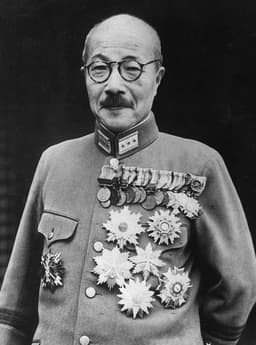
Hideki Tojo
General · Modern
53.9Total
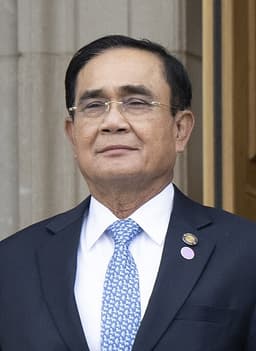
Prayut Chan-o-cha
General · Modern
48.1Total
Basic Information
Born
1884
1954
Died
1948
—
Era
Modern
Modern
Nationality
Japan
Thailand
Occupation
General
General
Civilization
Eastern
Eastern
Score Comparison
Military (10%)
70.0
10.2
Political (20%)
48.0
68.0
Influence (20%)
55.0
51.8
Legacy (20%)
50.0
40.8
Leadership (15%)
53.2
68.0
Strategy (15%)
55.0
35.7
TOTAL
53.9
48.1
Hideki Tojo — Complete Timeline
1941 AD
Attack on Pearl HarborWar
As Prime Minister, Hideki Tojo authorized the attack on the US naval base at Pearl Harbor, Hawaii. The surprise attack brought the United States into World War II. Tojo's decision was based on the belief that war with the US was inevitable due to resource embargoes and diplomatic failures.
World War IIPearl HarborUS-Japan War
Impact: globaldestructive
Appointment as Prime MinisterPolitical Action◆ Major
Hideki Tojo was appointed Prime Minister of Japan, replacing Fumimaro Konoe. He retained his position as Army Minister and later took on other portfolios, consolidating power. His appointment marked the ascendancy of the military faction in the Japanese government and the shift towards total war.
Prime MinisterMilitary GovernmentWorld War II
Impact: national
1942 AD
Fall of SingaporeWar◆ Major
Under Tojo's leadership, Japanese forces captured Singapore from the British in a swift campaign. The fall of Singapore was one of the worst British military defeats in history. It demonstrated Japanese military prowess and led to the occupation of a key strategic location in Southeast Asia.
World War IISingaporeJapanese Victory
Impact: global
1948 AD
Execution by the International Military Tribunal for the Far EastPolitical Action◆ Major
Hideki Tojo was found guilty of war crimes by the International Military Tribunal for the Far East and sentenced to death. He was executed by hanging on December 23, 1948. His trial and execution symbolized the Allied effort to hold Japanese leaders accountable for wartime atrocities.
War CrimesExecutionTokyo Trials
Impact: globaltragic
Prayut Chan-o-cha — Complete Timeline
2014 AD
Led the 2014 military coupPolitical Action
General Prayut Chan-o-cha, as Army Commander-in-Chief, led a coup d'
CoupMilitaryThailand
Impact: nationaldestructive
Appointed Prime Minister by military legislaturePolitical Action◆ Major
Following the coup, Prayut was appointed Prime Minister by the military-controlled National Legislative Assembly. He assumed executive power, leading a government that promised reforms and national reconciliation.
AppointmentMilitary RuleThailand
Impact: national
2017 AD
Promulgation of the 2017 ConstitutionReform◆ Major
Prayut's government oversaw the drafting and approval of a new constitution that strengthened the military's political role and created a fully appointed Senate. The charter was criticized for entrenching military influence.
ConstitutionMilitaryThailand
Impact: national
2019 AD
Re-elected Prime Minister after 2019 electionPolitical Action◆ Major
Prayut was re-elected Prime Minister following a general election that was criticized for being manipulated to favor pro-military parties. He formed a coalition government, continuing his rule under a civilian facade.
ElectionContinuityThailand
Impact: national
Expert Analysis
Hideki Tojo vs Prayut Chan-o-cha
# The General as Statesman
On a December morning in 1941, Hideki Tojo stood before the Japanese Diet and declared that the Empire was now at war with the United States and Great Britain. Half a world away and seventy-three years later, another general in a different Asian nation stepped before television cameras in Bangkok to announce that his army had seized power, promising order after months of political chaos. Both men were generals who became prime ministers. Both believed the military held the answers to their nations' problems. Yet one led his country to catastrophic defeat and the hangman's noose, while the other presided over a decade of relative stability. The difference lies not merely in circumstance, but in the very nature of their ambitions and the eras that produced them.
Origins
Hideki Tojo was born in 1884 into a samurai family that had served the Emperor for generations. His father, a lieutenant general, instilled in him the rigid values of bushido—loyalty, discipline, and absolute obedience. Tojo graduated from the Imperial Japanese Army Academy at a time when Japan was flexing its muscles, having defeated China in 1895 and Russia in 1905. The lesson was clear: military strength equaled national greatness. Tojo absorbed this ethos completely, becoming known as "Razor Tojo" for his sharp, uncompromising mind.
Prayut Chan-o-cha, born in 1954, came of age in a very different Asia. Thailand had never been colonized, and its military had long played a role in politics—there had been eighteen coups since 1932. Prayut's father was a military officer, and young Prayut entered the Chulachomklao Royal Military Academy during the Vietnam War era, when Thailand's army saw itself as a bulwark against communism. Unlike Tojo, Prayut grew up in a world where generals did not conquer empires but managed crises.
Rise to Power
Tojo's path was forged in war. He served as a military attaché in Germany and Switzerland, commanded troops in Manchuria, and rose through the ranks as Japan's military became increasingly dominant in civilian affairs. By 1941, as Army Minister, he was the most powerful man in Japan. When Prime Minister Konoe resigned, unable to restrain the military's war fever, Tojo took his place. The appointment was less a political choice than a recognition of reality: the army would not be led by civilians.
Prayut's rise was slower and more bureaucratic. He commanded peacekeeping forces in southern Thailand, dealt with insurgencies, and climbed the army hierarchy methodically. In 2010, he played a key role in suppressing Red Shirt protests, killing ninety-one people. By 2014, when political paralysis gripped Thailand, Prayut declared martial law, then led a coup. Unlike Tojo, who inherited a nation already committed to expansion, Prayut seized power from a government he claimed was incapable of governing.
Leadership & Governance
Tojo ruled as a military dictator in all but name. He served simultaneously as Prime Minister, Army Minister, and later Chief of the General Staff. He centralized power, suppressed dissent, and pushed Japan deeper into war. His military strategy was aggressive and ultimately suicidal. The attack on Pearl Harbor in December 1941 was a tactical masterpiece but a strategic catastrophe. The fall of Singapore in 1942 was his greatest triumph—the capture of 80,000 British troops. But Tojo had no plan for victory, only for conquest. He micromanaged campaigns, ignored intelligence, and refused to consider peace even as Japan's situation grew desperate.
Prayut governed differently. He did not start wars or conquer territory. Instead, he wrote a new constitution in 2017 that entrenched military influence, created a handpicked senate, and weakened political parties. He managed the economy, courted foreign investment, and maintained stability—at the cost of democracy. His critics called him authoritarian; his supporters said he brought order. He "retired" from the army to become a civilian prime minister, then won a controversial election in 2019. Where Tojo was a gambler who bet everything on war, Prayut was a cautious manager who bet on control.
Triumph & Tragedy
Tojo's greatest moment was also the beginning of his end. The attack on Pearl Harbor unified Japan and stunned the world. But within six months, Japan's naval superiority was broken at Midway. Tojo's tragedy was that he could not stop. By 1944, American forces were closing in, and Tojo resigned in disgrace. In 1948, he was hanged for war crimes, his last words reportedly a prayer for peace. His legacy is one of catastrophic overreach.
Prayut's triumph was survival. He remained prime minister for nearly nine years, longer than any elected Thai leader. His tragedy was that his rule deepened Thailand's political divisions. The 2019 election was widely seen as rigged, and protests erupted again in 2020. In 2022, a court suspended him, and he finally retired. He left office not in a coffin but in a limousine, a quiet end for a general who promised order and delivered only a fragile peace.
Character & Destiny
Tojo was a true believer. He embodied the militaristic fanaticism of prewar Japan, convinced that the Emperor was divine and that war was purifying. His personality—rigid, arrogant, humorless—drove him to ignore all advice against attacking America. He once said, "Sometimes it is necessary to shut one's eyes to the truth." That blindness destroyed him.
Prayut was a pragmatist. He had no grand ideology, only a belief that the army knew best. His personality—blunt, paternalistic, often baffled by democracy—led him to see politics as a mess to be cleaned up. He once told reporters, "Don't ask me about human rights. I'm a soldier." He did not seek war; he sought control. That difference saved his life but limited his legacy.
Legacy
Tojo is remembered as a war criminal, a symbol of Japanese militarism at its worst. In Japan, he is a figure of shame and caution. His name appears in history books as a warning. His score of 68.3 in Legacy reflects a deeply negative reputation.
Prayut's legacy is more ambiguous. His score of 57.2 suggests a leader who left no lasting mark. Some Thais see him as a necessary strongman who prevented chaos. Others see him as a general who stole democracy. He did not destroy his country, but he did not build it up either. He simply held it in place.
Conclusion
History judges generals by the wars they fight and the peace they leave behind. Tojo fought a war of annihilation and lost everything. Prayut fought a war of attrition against democracy and won a stalemate. Both believed that soldiers made better rulers than politicians. Tojo proved that a general without limits can destroy a nation. Prayut proved that a general without vision can only preserve it. In the end, the difference between them is not just time or place, but the difference between ambition and caution, between the sword and the shackle. Both failed their people, but in very different ways.
Rankings
🥇
Hideki TojoLeader
Mil: 70.0Pol: 48.0Inf: 55.0
53.9
🥈
Prayut Chan-o-cha
Mil: 10.2Pol: 68.0Inf: 51.8
48.1
+5.8 behind
How This Comparison Works
Algorithm
Each figure is scored on 6 dimensions (0—100 scale) based on structured historical data: Military (10%), Political (20%), Influence (20%), Legacy (20%), Leadership (15%), Strategy (15%). The weighted total produces the final ranking.
Data Sources
Scores are computed from structured sub-indicators in the database. Scale factors adjust for era (Ancient ×0.85, Modern ×1.0) and civilization size (Eastern ×1.05, Other ×0.80) to account for differences in population and military scale.
Maximum 3 Figures
Comparisons are limited to 2—3 figures to ensure readability and statistical meaningfulness.
Error Margins
±5 points per dimension — Sub-scores are derived from historical records with inherent uncertainty. Two figures within 5 points on a dimension should be considered roughly equivalent in that area.
Total Score Accuracy
±3 points overall — The weighted combination of 6 dimensions produces a total score with approximately ±3 points of uncertainty. Differences of less than 3 points are not statistically significant— the figures are effectively tied.
Known Limitations
- Historical records are incomplete and uneven across civilizations
- Figures from oral-tradition societies may be underrepresented
- Occupation labels can misclassify multi-role figures
- Scores measure capability and impact, not moral character
- Quantitative scoring is a comparison tool, not absolute truth
Capability Radar
Military (10%) — Battles & Warfare
Battles
65
5
Win Rate
40
5
Expansion
70
5
Political (20%) — Governance & Reform
Reform
30
30
Diplomacy
35
40
Economy
25
35
Influence (20%) — Cultural & Global Reach
Cultural
30
20
Global
55
20
Legacy (20%) — Historical Impact
Historical
55
20
Longevity
40
15
Leadership (15%) — Power & Stability
Tenure
60
60
Stability
20
25
Strategy (15%) — Tactics & Innovation
Strategy
50
15
Tactics
55
10
Reform
45
20
Similar Comparisons
Comments & Discussion
RAZOR'S EDGE6/16/2026
Tojo was a product of militaristic imperialism that had nowhere to go but total war; Prayut was a bureaucratic fixer who seized power from a faltering democracy. The difference isn't ambition—it's context. Tojo genuinely believed in expanding Japan's empire through blood and steel, while Prayut mostly wanted traffic to run on time and protesters to shut up. One is a cautionary tale; the other is just a generically strongman.
泰山崩于前6/16/2026
比权力还重要的事:东条英机背的是整个军国主义体系的生死存亡,而巴育只背了一套“维稳就能继续执政”的剧本。一个狂到认为珍珠港不是冒险而是必然;一个精到知道政变是例行公事,不会自取灭亡。唯一共同点?两人都把军队当万能药,但东条吃出来的是尸体堆,巴育吃出来的是政商关系网。历史对激进者比对保守者狠多了。
FIELD MARSHAL'S SHADOW6/16/2026
The analysis misses a crucial military difference: Tojo actually fought battles. He commanded the Kwantung Army in Manchuria and understood combat firsthand. Prayut's entire career was shuffling papers and commanding ceremonial units. Tojo knew what war costs in blood; Prayut never had to make that calculation. That's why Tojo's hubris led to national suicide while Prayut's just led to corruption. Experience doesn't always teach wisdom, but inexperience guarantees cowardice dressed as prudence.
黄粱一梦6/16/2026
历史讽刺在于:东条英机是一个想把日本推向世界顶峰的狂热赌徒,结果赌成了废墟;而巴育是一个只想守住小圈子和军队利益的官僚,却意外成了“稳定”的象征。前者的野心摧毁了一切,后者的无力保护了一切。真正可怕的不是野心家的失败,而是连野心都没有的将领,竟也被封为“战略家”。泰国的“成功密码”不是明智,只是想得少、做得出。
THE CHINESE GENERAL'S SON6/16/2026
Forget the samurai lineage—Tojo's real tragedy was that he believed Japan could win a war of attrition against the U.S. Prayut understood you can't fight China, America, or even your own people indefinitely. One was a true believer in imperial destiny; the other is a pragmatist who knows when to back down. That's not morality—it's basic strategic literacy. Tojo failed because he overestimated Japan; Prayut succeeded because he underestimated everyone else equally.