Loading...
Hideki Tojo vs Pedro I of Brazil
Pedro I of Brazil leads by 0.7 pts · 2 figures compared
…
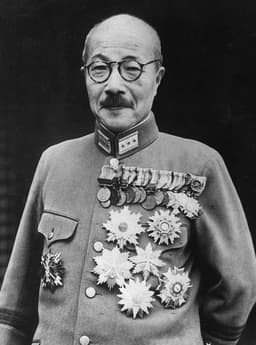
Hideki Tojo
General · Modern
53.9Total
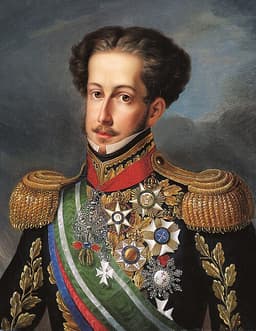
Pedro I of Brazil
Emperor · Modern
54.6Total
Basic Information
Born
1884
1798
Died
1948
1834
Era
Modern
Modern
Nationality
Japan
Brazil
Occupation
General
Emperor
Civilization
Eastern
Western
Score Comparison
Military (10%)
70.0
55.0
Political (20%)
48.0
62.7
Influence (20%)
55.0
59.0
Legacy (20%)
50.0
50.0
Leadership (15%)
53.2
53.2
Strategy (15%)
55.0
45.0
TOTAL
53.9
54.6
Hideki Tojo — Complete Timeline
1941 AD
Attack on Pearl HarborWar
As Prime Minister, Hideki Tojo authorized the attack on the US naval base at Pearl Harbor, Hawaii. The surprise attack brought the United States into World War II. Tojo's decision was based on the belief that war with the US was inevitable due to resource embargoes and diplomatic failures.
World War IIPearl HarborUS-Japan War
Impact: globaldestructive
Appointment as Prime MinisterPolitical Action◆ Major
Hideki Tojo was appointed Prime Minister of Japan, replacing Fumimaro Konoe. He retained his position as Army Minister and later took on other portfolios, consolidating power. His appointment marked the ascendancy of the military faction in the Japanese government and the shift towards total war.
Prime MinisterMilitary GovernmentWorld War II
Impact: national
1942 AD
Fall of SingaporeWar◆ Major
Under Tojo's leadership, Japanese forces captured Singapore from the British in a swift campaign. The fall of Singapore was one of the worst British military defeats in history. It demonstrated Japanese military prowess and led to the occupation of a key strategic location in Southeast Asia.
World War IISingaporeJapanese Victory
Impact: global
1948 AD
Execution by the International Military Tribunal for the Far EastPolitical Action◆ Major
Hideki Tojo was found guilty of war crimes by the International Military Tribunal for the Far East and sentenced to death. He was executed by hanging on December 23, 1948. His trial and execution symbolized the Allied effort to hold Japanese leaders accountable for wartime atrocities.
War CrimesExecutionTokyo Trials
Impact: globaltragic
Pedro I of Brazil — Complete Timeline
1822 AD
Declaration of Independence of BrazilPolitical Action
Pedro I declared Brazil's independence from Portugal on September 7, 1822, at the Ipiranga River in S
Impact: globalprogressive
Coronation as Emperor of BrazilPolitical Action◆ Major
Pedro I was crowned Emperor of Brazil on December 1, 1822, in Rio de Janeiro. The coronation formalized the new imperial government, with Pedro I as constitutional monarch, though he retained significant executive powers.
Impact: nationalconstructive
1823 AD
War of Independence of BrazilWar◆ Major
Pedro I led Brazilian forces against Portuguese loyalists in the War of Independence. Key battles occurred in Bahia, Maranh
Impact: national
Dissolution of the Constituent AssemblyPolitical Action◆ Major
Pedro I dissolved the Constituent Assembly after conflicts over the constitution's limits on imperial power. He then imposed the 1824 Constitution, which granted the emperor extensive powers, including the Moderating Power, centralizing authority.
Impact: nationaldestructive
1831 AD
Abdication of the Brazilian ThronePolitical Action
Pedro I abdicated the Brazilian throne in favor of his five-year-old son Pedro II on April 7, 1831. He returned to Portugal to claim the Portuguese throne, leaving Brazil under a regency until his son came of age.
Impact: national
Expert Analysis
Hideki Tojo vs Pedro I of Brazil
### The Emperor and the General: Two Paths to Power, Two Destinies
On a September morning in 1822, a young prince stood at the banks of the Ipiranga River in São Paulo, tore the Portuguese insignia from his uniform, and shouted a cry that would echo across a continent. On a December morning in 1941, a stern-faced prime minister in Tokyo gave a final nod, and within hours, aircraft carriers launched a strike that would shatter the peace of the Pacific. Pedro I of Brazil and Hideki Tojo never met, never corresponded, and governed worlds apart. Yet both men seized history by the throat at moments of supreme crisis. One built a nation; the other helped destroy one. Why did their paths diverge so dramatically? The answer lies not merely in their choices, but in the forces that shaped them before they ever took power.
### Origins
Pedro was born a prince of the House of Braganza, but his childhood was one of exile and flight. In 1807, when Napoleon’s armies marched into Portugal, the royal family fled to Brazil under British escort. Young Pedro grew up in Rio de Janeiro, a prince without a throne, surrounded by a court that felt like a shadow of its former self. He was educated hastily, indulged excessively, and developed a temperament that was impulsive, passionate, and magnetic. He learned to ride and fight, but also to dance and charm. His world was one of transition—a monarchy adrift in a colony that was rapidly outgrowing its mother country.
Hideki Tojo was born into a different kind of exile. His father was a samurai turned army officer, part of a warrior class that had lost its purpose after Japan’s Meiji Restoration. The old feudal order was gone; the new industrial empire was still being forged. Tojo grew up in a household of discipline and austerity, where duty was everything and personal feeling was weakness. He attended military academy, then staff college, and rose through the ranks by being efficient, ruthless, and utterly loyal. While Pedro learned to command through charisma, Tojo learned to command through fear.
### Rise to Power
Pedro’s rise was almost accidental. When his father, King João VI, returned to Portugal in 1821 under pressure from liberal revolutionaries, he left young Pedro as regent of Brazil. The Portuguese parliament then tried to reduce Brazil to colonial status, stripping it of autonomy. Pedro faced a choice: submit to Lisbon or lead a rebellion. He chose rebellion, but not because he was a natural revolutionary. He was a prince who wanted to keep his throne. The independence movement gave him a cause; his own ambition gave him the nerve.
Tojo’s rise was methodical. He served as chief of the military police in Manchuria, then as head of the Kwantung Army’s secret police, where he earned a reputation for brutality and efficiency. He became Army Minister in 1940, and when Prime Minister Konoe resigned in October 1941 over the failure of diplomatic talks with the United States, Tojo was the obvious successor. He was not a popular figure; he was a necessary one. The army trusted him; the emperor tolerated him; the nation followed him into war.
### Leadership & Governance
Pedro I governed as a monarch in a land that was not sure it wanted one. He imposed a constitution in 1824 after dissolving the Constituent Assembly, but it was a liberal document by the standards of the time—it guaranteed civil rights, established a separation of powers, and created a legislature. Yet Pedro himself was no liberal. He ruled by decree when it suited him, suppressed rebellions, and alienated both the landowners and the urban elites. His military leadership during the War of Independence was competent but not brilliant; he won because the Portuguese were weak and divided, not because he was a great strategist.
Tojo governed as a dictator in a nation already at war. He held the posts of Prime Minister, Army Minister, and Home Minister simultaneously, concentrating power in a way that had no precedent in modern Japan. His military decisions—the attack on Pearl Harbor, the conquest of Singapore—were bold and initially successful. But he had no vision beyond conquest. He did not build institutions; he dismantled them. He did not seek peace; he escalated war. His governance was a machine designed for destruction, and it worked until the machine broke.
### Triumph & Tragedy
Pedro’s greatest moment was the declaration of independence itself—a single act that transformed a colony into an empire. His greatest tragedy was his failure to consolidate that empire. He lost the province of Cisplatina (modern Uruguay), faced constant rebellions, and grew so unpopular that he was forced to abdicate in 1831, leaving his five-year-old son to rule in his place. He returned to Portugal, where he died three years later, exhausted and embittered.
Tojo’s greatest triumph was the fall of Singapore in February 1942, when 80,000 British troops surrendered to a smaller Japanese force. It was the worst military disaster in British history. His greatest tragedy was the war itself. By 1944, Japan was losing. Tojo was forced to resign after the fall of Saipan, but he had already set in motion a catastrophe that would end with atomic bombs and unconditional surrender. He attempted suicide in 1945, failed, and was executed as a war criminal in 1948.
### Character & Destiny
Pedro was a man of passion but not of principle. He loved Brazil, but he loved his own freedom more. He could charm a crowd, but he could not govern a nation. His impulsiveness made him a revolutionary; his impatience made him a failure. Tojo was a man of principle but not of passion. He believed in duty, hierarchy, and the divine destiny of Japan. He could organize an army, but he could not question a strategy. His discipline made him a general; his rigidity made him a destroyer.
### Legacy
Pedro I is remembered as the founder of Brazil, but also as a flawed and restless monarch. His son, Pedro II, would reign for nearly fifty years and bring stability to the empire. The father is a footnote to the son’s greatness. Tojo is remembered as the architect of Japan’s wartime disaster. In Japan, his legacy is contested—some see him as a scapegoat, others as a villain. In the rest of the world, he is a symbol of militarism and defeat.
### Conclusion
Pedro and Tojo were both men who rose to power in moments of national crisis. One built a nation from a colony; the other drove a nation into ruin. The difference was not in their intelligence or their courage, but in their vision. Pedro, for all his flaws, wanted to create something new. Tojo wanted only to preserve something old. That is the difference between a founder and a destroyer—and it is a difference that history never forgets.
Rankings
🥇
Pedro I of BrazilLeader
Mil: 55.0Pol: 62.7Inf: 59.0
54.6
🥈
Hideki Tojo
Mil: 70.0Pol: 48.0Inf: 55.0
53.9
+0.7 behind
How This Comparison Works
Algorithm
Each figure is scored on 6 dimensions (0—100 scale) based on structured historical data: Military (10%), Political (20%), Influence (20%), Legacy (20%), Leadership (15%), Strategy (15%). The weighted total produces the final ranking.
Data Sources
Scores are computed from structured sub-indicators in the database. Scale factors adjust for era (Ancient ×0.85, Modern ×1.0) and civilization size (Eastern ×1.05, Other ×0.80) to account for differences in population and military scale.
Maximum 3 Figures
Comparisons are limited to 2—3 figures to ensure readability and statistical meaningfulness.
Error Margins
±5 points per dimension — Sub-scores are derived from historical records with inherent uncertainty. Two figures within 5 points on a dimension should be considered roughly equivalent in that area.
Total Score Accuracy
±3 points overall — The weighted combination of 6 dimensions produces a total score with approximately ±3 points of uncertainty. Differences of less than 3 points are not statistically significant— the figures are effectively tied.
Known Limitations
- Historical records are incomplete and uneven across civilizations
- Figures from oral-tradition societies may be underrepresented
- Occupation labels can misclassify multi-role figures
- Scores measure capability and impact, not moral character
- Quantitative scoring is a comparison tool, not absolute truth
Capability Radar
Military (10%) — Battles & Warfare
Battles
65
35
Win Rate
40
40
Expansion
70
30
Political (20%) — Governance & Reform
Reform
30
45
Diplomacy
35
50
Economy
25
30
Influence (20%) — Cultural & Global Reach
Cultural
30
40
Global
55
45
Legacy (20%) — Historical Impact
Historical
55
55
Longevity
40
50
Leadership (15%) — Power & Stability
Tenure
60
55
Stability
20
25
Strategy (15%) — Tactics & Innovation
Strategy
50
35
Tactics
55
30
Reform
45
20
Similar Comparisons
Comments & Discussion
SamuraiScribe6/16/2026
Pedro was impetuous and grand, but Tojo was a bureaucratic butcher. Pedro rode into history shouting “Independência ou Morte!” while Tojo stayed in his office approving death lists. One led from the front, the other from a desk. Pedro’s 1822 cry echoed through South America; Tojo’s 1941 nod condemned millions to fire and famine. Give me a flawed romantic over a cold strategist any day.
数据屠夫6/16/2026
别扯什么“民族英雄”对比,这两个人根本不在一个暴力级别。Tojo直接下令进攻珍珠港,导致至少2400美军死亡,日本在亚洲屠了几百万人;Pedro搞独立战争,伤亡顶多几千。一个搞屠杀,一个打小仗,数据上看Tojo杀的人多出几百倍。吹Pedro“建立国家”?他建立的是奴隶制帝国,1822年巴西四成人口是奴隶。两位都是压迫者,一个更狠而已。
史记判官6/16/2026
Peço perdão, mas拿Pedro和Tojo比简直侮辱历史。Pedro宣布独立时,周边国家至少还有玻利瓦尔等人在搞共和革命,他不是纯粹的空想家;Tojo呢?他掌权时的日本已经是铁血军国,他不过是系统里的最高执行者。两人时代背景差太多,一个在19世纪搞民族国家建设,一个在20世纪搞侵略扩军。要想对比,请找同时代的人,比如佩德罗和拿破仑,Tojo和墨索里尼。
RomanRat6/16/2026
Pedro I was a Romantic-era monarch who loved music, women, and public displays of courage. Tojo was a militarist bureaucrat who wore the same uniform every day and micromanaged army logistics. The true distinction is cultural: Pedro belonged to a world of liberal revolutions and national awakening; Tojo to one of ultranationalist paranoia and industrial slaughter. I’ll take a flawed emperor over a perfect fascist any morning.
Historian9936/16/2026
Pedro I was a constitutional monarch who voluntarily abdicated in 1831 to return to Portugal and fight for his daughter’s claim—a bizarre but principled act. Tojo clung to power until the last atomic flash, then attempted suicide. The difference in their endings tells you everything: one could walk away from power, the other could not live without it. History judges character by exits, not entrances.