Loading...
Hideki Tojo vs Nguyen Cao Ky
Hideki Tojo leads by 4.9 pts · 2 figures compared
…
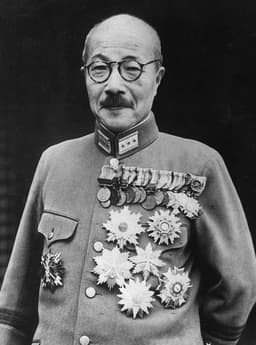
Hideki Tojo
General · Modern
53.9Total
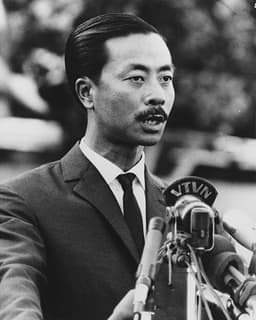
Nguyen Cao Ky
General · Modern
49.0Total
Basic Information
Born
1884
1930
Died
1948
—
Era
Modern
Modern
Nationality
Japan
Vietnam
Occupation
General
General
Civilization
Eastern
Eastern
Score Comparison
Military (10%)
70.0
45.0
Political (20%)
48.0
39.4
Influence (20%)
55.0
50.2
Legacy (20%)
50.0
40.0
Leadership (15%)
53.2
67.0
Strategy (15%)
55.0
60.0
TOTAL
53.9
49.0
Hideki Tojo — Complete Timeline
1941 AD
Attack on Pearl HarborWar
As Prime Minister, Hideki Tojo authorized the attack on the US naval base at Pearl Harbor, Hawaii. The surprise attack brought the United States into World War II. Tojo's decision was based on the belief that war with the US was inevitable due to resource embargoes and diplomatic failures.
World War IIPearl HarborUS-Japan War
Impact: globaldestructive
Appointment as Prime MinisterPolitical Action◆ Major
Hideki Tojo was appointed Prime Minister of Japan, replacing Fumimaro Konoe. He retained his position as Army Minister and later took on other portfolios, consolidating power. His appointment marked the ascendancy of the military faction in the Japanese government and the shift towards total war.
Prime MinisterMilitary GovernmentWorld War II
Impact: national
1942 AD
Fall of SingaporeWar◆ Major
Under Tojo's leadership, Japanese forces captured Singapore from the British in a swift campaign. The fall of Singapore was one of the worst British military defeats in history. It demonstrated Japanese military prowess and led to the occupation of a key strategic location in Southeast Asia.
World War IISingaporeJapanese Victory
Impact: global
1948 AD
Execution by the International Military Tribunal for the Far EastPolitical Action◆ Major
Hideki Tojo was found guilty of war crimes by the International Military Tribunal for the Far East and sentenced to death. He was executed by hanging on December 23, 1948. His trial and execution symbolized the Allied effort to hold Japanese leaders accountable for wartime atrocities.
War CrimesExecutionTokyo Trials
Impact: globaltragic
Nguyen Cao Ky — Complete Timeline
1963 AD
Commander of South Vietnamese Air ForcePolitical Action◆ Major
Nguyen Cao Ky was appointed commander of the Republic of Vietnam Air Force. He led the air force during the Buddhist crisis and participated in the coup that overthrew President Ngo Dinh Diem.
Air ForceCoupDiem
Impact: national
1965 AD
Appointed Prime MinisterPolitical Action◆ Major
Nguyen Cao Ky became Prime Minister of South Vietnam, leading a military junta. His government intensified the war against the Viet Cong and North Vietnam, with strong US support.
Prime MinisterMilitary juntaVietnam War
Impact: national
1967 AD
Conflict with President ThieuPolitical Action
Nguyen Cao Ky ran for president but lost to Nguyen Van Thieu, becoming vice president. The two leaders had a tense relationship, with Ky later accusing Thieu of corruption and mismanagement of the war.
ElectionThieuRivalry
Impact: nationaldestructive
1975 AD
Exile after fall of SaigonPolitical Action◆ Major
Nguyen Cao Ky fled South Vietnam as Saigon fell to North Vietnamese forces. He settled in the United States, where he became a critic of the communist government and later returned to Vietnam for visits.
ExileFall of SaigonVietnam War
Impact: nationaltragic
Expert Analysis
Hideki Tojo vs Nguyen Cao Ky
The General Who Had No Tomorrow
On the morning of December 23, 1948, Hideki Tojo climbed the thirteen steps of the gallows at Sugamo Prison. He had tried to shoot himself two months earlier, but the bullet missed his heart. Now, he wore a white shirt and khaki trousers, his face impassive. Half a world away and a generation later, in the spring of 1975, Nguyen Cao Ky stood on a rooftop in Saigon, clutching a helicopter rope as the last American chopper lifted off. Below him, the city he had once ruled was falling. One man faced execution; the other faced exile. Both were generals who became prime ministers in desperate wars. Their paths were parallel, their outcomes inverted—and the reasons lie deep in the soil of history.
Origins
Hideki Tojo was born in 1884 into a samurai family, the son of a lieutenant general. His childhood was austere, his education rigid. Imperial Japan was modernizing at gunpoint, and its military culture demanded absolute obedience. Tojo entered the Army Academy at sixteen, graduated tenth in his class, and spent years in the shadow of his father’s reputation. He was not brilliant—his classmates called him “the razor” for his sharp, narrow focus—but he was relentless. The Japan of his youth was a rising power, hungry for resources, humiliated by Western condescension. Tojo absorbed that hunger and that humiliation as if they were oxygen.
Nguyen Cao Ky was born in 1930 in Hanoi, then part of French Indochina. His father was a minor civil servant; his family was neither rich nor poor. He grew up under colonial rule, watching French officials drink coffee in white suits while Vietnamese peasants carried their luggage. He joined the Vietnamese National Army, trained by the French, and by 1963 commanded the Republic of Vietnam Air Force. He wore a purple scarf and a black flight jacket, smoked American cigarettes, and flew his own fighter jets into battle. He was young, handsome, and impulsive—a pilot who believed that speed and audacity could solve anything.
Tojo was forged in the furnace of imperial ambition. Ky was born into the chaos of a nation that had never been whole.
Rise to Power
Tojo rose slowly, through decades of staff work and command. He served as a military attaché in Berlin, studied German efficiency, and returned to Japan with a conviction that war was inevitable. In 1937 he led the Kwantung Army’s gendarmerie in Manchuria, crushing dissent with iron efficiency. By 1940 he was Army Minister, pushing for alliance with Germany and war with the United States. When Prime Minister Konoe resigned in October 1941, unable to control the military, Tojo took his place. He was fifty-seven years old, grey-haired, and utterly certain.
Ky’s rise was faster and more chaotic. In 1963 he led the coup that overthrew President Diem, flying his jet low over the presidential palace as a gesture of intimidation. Two years later, in 1965, he became prime minister at age thirty-five, the youngest leader in South Vietnam’s history. He ruled from a military junta, his power resting on the loyalty of paratroopers and fighter pilots. He had no party, no ideology, no long-term plan—only the conviction that he could win the war if given enough American bombs.
Leadership & Governance
Tojo governed as a military bureaucrat. He micromanaged the war effort, issued detailed orders to field commanders, and demanded reports on everything from rice rations to rifle production. He was not charismatic—he spoke in a monotone, his speeches full of slogans about “the spirit of Yamato.” But he was efficient. Under his leadership, Japan conquered Southeast Asia in six months. The fall of Singapore in February 1942 was his greatest triumph: 80,000 British troops surrendered to a smaller Japanese force. Tojo wept with joy when he heard the news.
Ky governed as a warlord. He flew his own plane to the front lines, visited troops in the field, and once threatened to bomb a Buddhist pagoda if the monks did not stop protesting. He was erratic, but he was also brave. He understood that South Vietnam’s survival depended on holding the countryside, not just the cities. He pushed for land reform and pacification programs, but his government was corrupt and unstable. In 1967 he ran for president and lost to Nguyen Van Thieu, then accepted the vice presidency—a decision that surprised everyone. He had chosen duty over ambition.
Triumph & Tragedy
Tojo’s triumph was the conquest of Asia. His tragedy was the war he could not win. By 1944, Japan was losing: the navy was shattered at Midway, the army was starving in the jungles of New Guinea, and American bombers were burning Tokyo to ash. Tojo refused to consider surrender. He tightened censorship, arrested dissenters, and ordered suicidal banzai charges. When the Americans landed on Saipan, he knew the end was near, but he could not stop. In July 1944, he was forced to resign. He had led Japan to the edge of annihilation.
Ky’s triumph was survival. He kept South Vietnam alive through the Tet Offensive of 1968, when communist forces nearly broke the country. He flew combat missions, rallied troops, and refused to evacuate. His tragedy was that survival was not enough. The war dragged on, American support evaporated, and corruption ate the government from within. In 1975, as North Vietnamese tanks rolled into Saigon, Ky fled. He had lost everything—his country, his cause, his identity. He spent the rest of his life in California, running a liquor store.
Character & Destiny
Tojo was a man of iron will and narrow vision. He believed in hierarchy, discipline, and the divine destiny of Japan. He could not imagine defeat, and so he could not prepare for it. When the end came, he tried to take his own life, but failed. At his trial, he accepted responsibility for the war and the atrocities committed by his soldiers. He did not apologize. He said, “I am prepared to die for my country.”
Ky was a man of charm and impulsiveness. He believed in action, not reflection. He could imagine defeat—he had seen it coming for years—but he could not prevent it. In exile, he changed. He wrote a memoir, became a critic of the war he had fought, and even visited Vietnam in 2004, where he was greeted with hostility. He died in 2011, a forgotten man in a forgotten cause.
Legacy
Tojo is remembered as a war criminal. His name is synonymous with Japanese militarism, the Rape of Nanking, and the Bataan Death March. In Japan, he is a ghost—a figure of shame and silence. His legacy is a warning about the dangers of unchecked nationalism and military arrogance.
Ky is remembered, if at all, as a footnote. He was a minor player in a major tragedy, a man who fought for a cause that was already lost. His legacy is a reminder that not all wars have heroes, and not all leaders leave monuments.
Conclusion
Standing on that gallows in 1948, Hideki Tojo had no tomorrow. He had gambled everything on a war he could not win and lost. Nguyen Cao Ky, gripping that helicopter rope in 1975, had no tomorrow either. He had fought for a country that collapsed beneath his feet. Both men believed they were saving their nations. Both were wrong. Their stories are mirrors held up to history—reflecting not glory, but the terrible cost of certainty.
Rankings
🥇
Hideki TojoLeader
Mil: 70.0Pol: 48.0Inf: 55.0
53.9
🥈
Nguyen Cao Ky
Mil: 45.0Pol: 39.4Inf: 50.2
49.0
+4.9 behind
How This Comparison Works
Algorithm
Each figure is scored on 6 dimensions (0—100 scale) based on structured historical data: Military (10%), Political (20%), Influence (20%), Legacy (20%), Leadership (15%), Strategy (15%). The weighted total produces the final ranking.
Data Sources
Scores are computed from structured sub-indicators in the database. Scale factors adjust for era (Ancient ×0.85, Modern ×1.0) and civilization size (Eastern ×1.05, Other ×0.80) to account for differences in population and military scale.
Maximum 3 Figures
Comparisons are limited to 2—3 figures to ensure readability and statistical meaningfulness.
Error Margins
±5 points per dimension — Sub-scores are derived from historical records with inherent uncertainty. Two figures within 5 points on a dimension should be considered roughly equivalent in that area.
Total Score Accuracy
±3 points overall — The weighted combination of 6 dimensions produces a total score with approximately ±3 points of uncertainty. Differences of less than 3 points are not statistically significant— the figures are effectively tied.
Known Limitations
- Historical records are incomplete and uneven across civilizations
- Figures from oral-tradition societies may be underrepresented
- Occupation labels can misclassify multi-role figures
- Scores measure capability and impact, not moral character
- Quantitative scoring is a comparison tool, not absolute truth
Capability Radar
Military (10%) — Battles & Warfare
Battles
65
30
Win Rate
40
35
Expansion
70
10
Political (20%) — Governance & Reform
Reform
30
20
Diplomacy
35
25
Economy
25
15
Influence (20%) — Cultural & Global Reach
Cultural
30
15
Global
55
15
Legacy (20%) — Historical Impact
Historical
55
20
Longevity
40
10
Leadership (15%) — Power & Stability
Tenure
60
40
Stability
20
10
Strategy (15%) — Tactics & Innovation
Strategy
50
30
Tactics
55
40
Reform
45
25
Similar Comparisons
Comments & Discussion
SamuraiSergeant6/16/2026
Tojo and Ky both wore flamboyant uniforms and preached absolute loyalty, but Tojo’s militarism was rooted in samurai fatalism—he didn't blink at ordering 100,000 deaths at Bataan. Ky was a peacock with a revolver, a pilot who'd buy his sidearm by the color. Tojo faced a tribunal; Ky died in a Kuala Lumpur villa. The difference isn't outcome—it's how each man's uniform fit the era's corpse-paint. Tojo's never came off. Ky shed his for silk shirts and exile.
统计刀客6/16/2026
比个鸟毛?Ky是个飞行员出身的花瓶军阀,指挥南越空军炸自己人都不手软,Tojo再蠢也知道步兵统帅权术。说来说去,Tojo至少敢在日本帝国崩溃时拔枪自杀,Ky呢?1975年西贡陷落前还在赌场喝威士忌,最后挂直升机绳跑路。这就是“武士道”和“酒吧牛仔”的区别。Ky的航空母舰是梦,Tojo的太平洋是坟场。谁更配当历史的大反派?题目错了。
ClassicsProf6/16/2026
Compare these two and the scale collapses. Tojo commanded a continental war machine that launched the attack on Pearl Harbor, mobilizing 4 million men. Ky commanded a coup and then a cocktail cabinet. Tojo measured victory in months of crushing imperial advance; Ky measured success in how many months his government survived street protests. They are both generals turned PMs, yes, but one fought for total empire, the other for staying alive until happy hour. Their parallel is not in outcomes—it's
数据铁幕6/16/2026
你们都在比谁更坏,但数据不讲感情。Tojo指挥了1941-44年日本70%的战役决策,Ky管的是1965-67年南越的内阁闹剧。Ky的“空袭北越”喊得响,实际美国B-52在北越投弹吨位是南越空军的400倍。比什么?Tojo的战争写在死亡数字上,Ky的战争写在美国总统的调令里。Ky是个穿紫披风的戏子,Tojo是个穿军装的历史债主。结局不同,但责任层级完全不在一个维度。
地缘酒徒6/16/2026
要我说,Ky是亚洲最被高估的军头之一,在1966年跟美军一起搞“绥靖计划”,结果越南南方民族解放阵线越打越旺。Tojo至少逼罗斯福认真打了太平洋战争。Ky的优势靠美国直升机和美元,Tojo靠日本工业兵和甲种师团。Ky输掉的是殖民遗产,Tojo输掉的是帝国命脉。Ky跑路了,Tojo被吊死。但