Loading...
Heraclius vs Martinianus
Heraclius leads by 4.9 pts · 2 figures compared
…
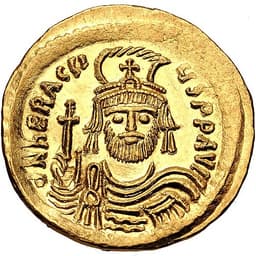
Heraclius
Emperor · Ancient
61.0Total

Martinianus
Emperor · Ancient
56.1Total
Basic Information
Born
-575
280
Died
—
324
Era
Ancient
Ancient
Nationality
Byzantine Empire
Roman Empire
Occupation
Emperor
Emperor
Civilization
Western
Western
Score Comparison
Military (10%)
78.5
19.6
Political (20%)
45.0
68.0
Influence (20%)
58.3
56.8
Legacy (20%)
52.0
57.2
Leadership (15%)
72.0
74.7
Strategy (15%)
80.6
42.1
TOTAL
61.0
56.1
Heraclius — Complete Timeline
610 AD
Overthrow of PhocasPolitical Action◆ Major
Heraclius led a revolt from Carthage against the usurper Emperor Phocas. He sailed to Constantinople, where supporters opened the gates. Phocas was captured and executed, and Heraclius was crowned emperor, ending a period of civil strife and military decline.
CoupPhocasByzantine Empire
Impact: nationalconstructive
622 AD
Byzantine-Sassanid War: Final CampaignWar
Heraclius personally led a multi-year campaign against the Sassanid Persian Empire, which had occupied much of Byzantine territory. He defeated Persian forces at the Battle of Nineveh in 627 and recovered the True Cross, restoring Byzantine prestige and ending the war.
Byzantine-Sassanid WarNinevehTrue Cross
Impact: globalconstructive
636 AD
Loss of the Levant to Muslim ConquestWar
Heraclius's forces were decisively defeated by the Rashidun Caliphate at the Battle of Yarmouk. This loss led to the permanent loss of Syria, Palestine, and Egypt to Muslim rule, drastically reducing Byzantine territory and marking the beginning of the Arab-Byzantine wars.
Muslim ConquestYarmoukTerritorial Loss
Impact: globaltragic
Martinianus — Complete Timeline
324 AD
Defeated at the Battle of the HellespontWar◆ Major
Martinianus commanded Licinius's fleet at the Battle of the Hellespont against Constantine's forces. Constantine's son Crispus defeated the fleet, forcing Martinianus to flee and contributing to Licinius's overall defeat.
Naval BattleCivil WarCrispus
Impact: regionaltragic
Appointed co-emperor by LiciniusPolitical Action◆ Major
During the final civil war against Constantine I, Licinius appointed Martinianus as his co-emperor (Augustus) to bolster his legitimacy and command. This was a last-minute move as Licinius's position deteriorated.
Imperial AppointmentCivil WarLicinius
Impact: regional
Executed by Constantine IPolitical Action◆ Major
After Licinius surrendered and was initially spared, Constantine ordered the execution of Martinianus. The execution eliminated a potential rival and secured Constantine's sole rule over the Roman Empire.
ExecutionCivil WarConstantine I
Impact: regionaltragic
Expert Analysis
Origins
Heraclius was born around 575 AD, likely in Cappadocia, to a family of Armenian or possibly Arsacid descent. His father, Heraclius the Elder, was a prominent general and later Exarch of Africa. The younger Heraclius grew up in a military environment, learning command and administration. His early life was marked by the chaotic reign of Emperor Phocas, who had usurped power in 602 AD, leading to widespread rebellion and Persian invasions.
Martinianus, by contrast, appears in history only in the twilight of the Tetrarchy. Little is known of his early life; he was a Roman official and a supporter of Licinius, the Eastern Augustus. His background was likely bureaucratic rather than military, as his later appointment as co-emperor was a desperate political move rather than a reward for military prowess.
Rise to Power
Heraclius rose to power by leading a revolt against the hated Emperor Phocas. In 608 AD, his father and he began a rebellion in Carthage, minting coins and gathering forces. In 610 AD, Heraclius sailed to Constantinople, where the populace and the Green faction opened the gates. Phocas was captured and executed, and Heraclius was crowned emperor on October 5, 610 AD. His rise was swift, but he inherited a crumbling empire: Persians had overrun the east, Slavs and Avars threatened the Balkans, and the treasury was empty.
Martinianus's rise was far more modest and abrupt. In 324 AD, during the final civil war between Licinius and Constantine I, Licinius faced a crisis after losing a major battle at Adrianople. To bolster his legitimacy and command, Licinius appointed Martinianus as his co-emperor (Augustus) in the West. This was a last-minute attempt to rally troops and present a united front. Martinianus had no independent power base; his elevation was purely a political expedient.
Leadership & Governance
Heraclius's leadership was defined by personal military command and religious reform. He reorganized the empire into themes (military districts) and promoted the Greek language, strengthening Byzantine identity. His most famous act was leading a multi-year campaign against the Persians (622-628 AD), personally commanding armies and using strategic withdrawals and counterattacks. He also promoted the doctrine of Monothelitism to unify the church but failed. His governance scores 72.0 in leadership and 80.6 in strategy, reflecting his hands-on approach.
Martinianus had no opportunity to govern. As co-emperor for only a few months, his role was purely titular. He may have assisted Licinius in administrative tasks, but no reforms or policies are attributed to him. His leadership score of 74.7 is based on his theoretical potential, but in practice, he exercised no real authority.
Triumph & Tragedy
Heraclius's greatest triumph was the defeat of the Sassanid Persian Empire. In a series of campaigns, he recaptured the True Cross, restored the relic to Jerusalem, and forced the Persian king to sue for peace. This victory restored Byzantine prestige and recovered lost territories. However, his tragedy was the rapid loss of these gains to the Muslim conquests. In 636 AD, the Battle of Yarmouk saw the Byzantine army crushed by the Rashidun Caliphate, leading to the permanent loss of Syria, Palestine, and Egypt. Heraclius's later years were spent watching his life's work unravel, and he died in 641 AD, possibly of illness or despair.
Martinianus's triumph, if any, was his brief elevation to the purple. But his tragedy was total defeat. At the Battle of the Hellespont (324 AD), he commanded Licinius's fleet against Constantine's forces under Crispus. The fleet was destroyed, and Martinianus fled. After Licinius surrendered, Constantine initially spared them, but later ordered Martinianus's execution. He died as a footnote in Constantine's rise.
Character & Destiny
Heraclius was a determined and energetic leader, known for his personal bravery and strategic acumen. He was also prone to melancholy and religious indecision, which may have contributed to his failure to counter the Muslim threat effectively. His character shaped his destiny: his military genius saved the empire, but his inability to consolidate lasting peace or anticipate new threats led to its greatest losses.
Martinianus was likely a loyal and competent administrator, but his destiny was to be a sacrificial pawn. His appointment as co-emperor was a desperate gamble that failed. He lacked the military skill to defeat Constantine's forces, and his execution was a political necessity for Constantine to secure his sole rule. There is no evidence of exceptional character; he simply ended up on the losing side.
Legacy
Heraclius's legacy is mixed. He saved the Byzantine Empire from collapse and reformed its military and administrative structures, laying the foundations for the medieval Byzantine state. He is remembered as a heroic emperor in Greek Orthodox tradition, and the True Cross's recovery became a celebrated event. However, his loss of the eastern provinces to Islam permanently changed the course of history. His military score of 78.5 and strategy of 80.6 reflect his battlefield successes, but his political score of 45.0 and influence of 58.3 indicate his failure to secure lasting stability.
Martinianus left no legacy. He is a minor figure in the civil wars of Constantine, known only to specialists. His scores—military 19.6, political 68.0, influence 56.8, legacy 57.2—reflect his obscurity. His only impact is as a cautionary tale of the dangers of being a short-lived usurper.
Conclusion
Heraclius clearly had greater impact than Martinianus. Heraclius scored 61.0 overall, while Martinianus scored 56.1, a gap of 4.9 points. More importantly, Heraclius shaped the course of the Byzantine Empire and early Islamic history, while Martinianus was a footnote. Heraclius's military and strategic achievements were monumental, even if his political failures were severe. Martinianus's brief co-emperorship had no lasting effect. Thus, Heraclius stands as a significant historical figure, while Martinianus is a triviality.
Rankings
🥇
HeracliusLeader
Mil: 78.5Pol: 45.0Inf: 58.3
61.0
🥈
Martinianus
Mil: 19.6Pol: 68.0Inf: 56.8
56.1
+4.9 behind
How This Comparison Works
Algorithm
Each figure is scored on 6 dimensions (0—100 scale) based on structured historical data: Military (10%), Political (20%), Influence (20%), Legacy (20%), Leadership (15%), Strategy (15%). The weighted total produces the final ranking.
Data Sources
Scores are computed from structured sub-indicators in the database. Scale factors adjust for era (Ancient ×0.85, Modern ×1.0) and civilization size (Eastern ×1.05, Other ×0.80) to account for differences in population and military scale.
Maximum 3 Figures
Comparisons are limited to 2—3 figures to ensure readability and statistical meaningfulness.
Error Margins
±5 points per dimension — Sub-scores are derived from historical records with inherent uncertainty. Two figures within 5 points on a dimension should be considered roughly equivalent in that area.
Total Score Accuracy
±3 points overall — The weighted combination of 6 dimensions produces a total score with approximately ±3 points of uncertainty. Differences of less than 3 points are not statistically significant— the figures are effectively tied.
Known Limitations
- Historical records are incomplete and uneven across civilizations
- Figures from oral-tradition societies may be underrepresented
- Occupation labels can misclassify multi-role figures
- Scores measure capability and impact, not moral character
- Quantitative scoring is a comparison tool, not absolute truth
Capability Radar
Military (10%) — Battles & Warfare
Battles
85
6
Win Rate
80
10
Expansion
70
9
Political (20%) — Governance & Reform
Reform
70
52
Diplomacy
65
51
Economy
60
57
Influence (20%) — Cultural & Global Reach
Cultural
65
68
Global
75
77
Legacy (20%) — Historical Impact
Historical
80
73
Longevity
70
70
Leadership (15%) — Power & Stability
Tenure
75
47
Stability
55
62
Strategy (15%) — Tactics & Innovation
Strategy
90
16
Tactics
85
19
Reform
75
22
Similar Comparisons
Comments & Discussion
No comments yet. Be the first to share your thoughts!