Loading...
Heraclius vs Napoleon Bonaparte
Napoleon Bonaparte leads by 9.9 pts · 2 figures compared
…
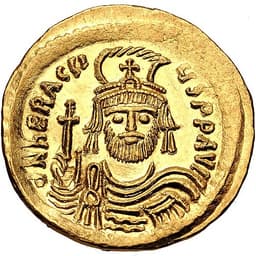
Heraclius
Emperor · Ancient
61.0Total

Napoleon Bonaparte
General · Modern
70.9Total
Basic Information
Born
-575
1769
Died
—
1821
Era
Ancient
Modern
Nationality
Byzantine Empire
France
Occupation
Emperor
General
Civilization
Western
Western
Score Comparison
Military (10%)
78.5
94.0
Political (20%)
45.0
72.0
Influence (20%)
58.3
40.0
Legacy (20%)
52.0
80.0
Leadership (15%)
72.0
78.0
Strategy (15%)
80.6
90.0
TOTAL
61.0
70.9
Heraclius — Complete Timeline
610 AD
Overthrow of PhocasPolitical Action◆ Major
Heraclius led a revolt from Carthage against the usurper Emperor Phocas. He sailed to Constantinople, where supporters opened the gates. Phocas was captured and executed, and Heraclius was crowned emperor, ending a period of civil strife and military decline.
CoupPhocasByzantine Empire
Impact: nationalconstructive
622 AD
Byzantine-Sassanid War: Final CampaignWar
Heraclius personally led a multi-year campaign against the Sassanid Persian Empire, which had occupied much of Byzantine territory. He defeated Persian forces at the Battle of Nineveh in 627 and recovered the True Cross, restoring Byzantine prestige and ending the war.
Byzantine-Sassanid WarNinevehTrue Cross
Impact: globalconstructive
636 AD
Loss of the Levant to Muslim ConquestWar
Heraclius's forces were decisively defeated by the Rashidun Caliphate at the Battle of Yarmouk. This loss led to the permanent loss of Syria, Palestine, and Egypt to Muslim rule, drastically reducing Byzantine territory and marking the beginning of the Arab-Byzantine wars.
Muslim ConquestYarmoukTerritorial Loss
Impact: globaltragic
Napoleon Bonaparte — Complete Timeline
1799 AD
Coup of 18 BrumaireOther◆ Major
Napoleon Bonaparte, with support from his brother Lucien and key political figures, overthrew the Directory in a bloodless coup. He established the Consulate with himself as First Consul, effectively becoming the ruler of France. This event ended the French Revolution's most unstable period.
French RevolutionCoupRise to Power
Impact: regional
1804 AD
Promulgation of the Napoleonic CodeOther◆ Major
Napoleon enacted the Civil Code of the French, known as the Napoleonic Code, a comprehensive set of laws that replaced the fragmented feudal legal systems. The code established legal equality, protected property rights, and secularized law. It became the basis for legal systems in many European and world countries.
Legal ReformNapoleonic CodeCivil Law
Impact: globalconstructive
1805 AD
Battle of AusterlitzWar◆ Major
Napoleon's Grande Arm
Napoleonic WarsBattleDecisive Victory
Impact: global
1812 AD
Invasion of RussiaWar◆ Major
Napoleon led the Grande Arm
Napoleonic WarsInvasionDisaster
Impact: globaldestructive
1815 AD
Battle of WaterlooWar◆ Major
Napoleon's French army was defeated by the combined forces of the Duke of Wellington's Anglo-Allied army and Gebhard Leberecht von Bl
Napoleonic WarsBattleFinal Defeat
Impact: globaldestructive
Expert Analysis
heraclius-vs-napoleon-bonaparte
# The Emperor and the Eagle: Napoleon and Heraclius
In the spring of 1815, Napoleon Bonaparte stood on the battlefield of Waterloo, commanding an army that had once terrified Europe. Across the centuries, another emperor—Heraclius—had watched his own empire crumble after a staggering defeat. Both men rose from chaos, reshaped their worlds, and fell in ways that still echo today. What drove two such different fates? The answer lies not in their victories alone, but in the forces that shaped them.
Origins
Napoleon was born in 1769 on the Mediterranean island of Corsica, a place of rugged independence and simmering resentment against French rule. His family was minor nobility, but their status was precarious—his father’s collaboration with the French after Corsica’s conquest left a bitter mark on young Napoleon. He grew up speaking Italian, not French, and felt like an outsider in the mainland’s elite military academies. This sense of displacement forged an ambition that was both personal and ideological: he would prove himself not just equal to the French aristocracy, but superior to them.
Heraclius, born around 575, entered a world far older and more fragile. The Byzantine Empire, heir to Rome, was a sprawling, multi-ethnic realm stretched from the Balkans to the Levant. His father, the exarch of Carthage, governed a distant province where Latin and Greek mixed with African influences. Heraclius was raised in the shadow of imperial decay—the Persians had ravaged the east, the Avars menaced the Balkans, and the emperor Phocas had seized power through murder. Where Napoleon’s drive came from personal rejection, Heraclius’s came from a duty to a civilization on the brink.
Rise to Power
Napoleon’s ascent was a masterpiece of opportunism. During the French Revolution, as the old order collapsed, he seized the chaos. At age 24, he crushed a royalist uprising in Paris with a “whiff of grapeshot,” earning the gratitude of the revolutionary government. Then came Italy: in 1796, he led a ragged army across the Alps and defeated the Austrians, transforming himself from a Corsican outsider into a national hero. Each victory fed the next—Egypt, the coup of 18 Brumaire in 1799, and finally the imperial crown in 1804. His rise was a whirlwind, a testament to how a single man could exploit the vacuum left by a broken system.
Heraclius’s path was more violent and direct. In 610, he sailed from Carthage to Constantinople, leading a fleet against Emperor Phocas—a tyrant who had executed Heraclius’s relatives. The city’s elite, desperate for salvation, opened the gates. Heraclius personally beheaded Phocas, then married his own niece to secure a fractured dynasty. Unlike Napoleon, who won power through dazzling campaigns and political maneuvering, Heraclius took it through a single, brutal act of revenge. He was not a revolutionary but a restorer—a man trying to save an empire, not remake one.
Leadership & Governance
As emperor, Napoleon was a force of nature. He reorganized France’s legal system with the Napoleonic Code, a rational, secular framework that abolished feudal privileges and spread across Europe. He centralized the state, created a merit-based bureaucracy, and built a network of roads and canals that tied his empire together. Yet his governance was also autocratic: he suppressed dissent, censored the press, and crowned himself emperor in a ceremony where he snatched the crown from the Pope’s hands. His military genius—scoring a 93 in strategy—was undeniable. At Austerlitz in 1805, he lured the Austrians and Russians into a trap, smashing their armies with a precision that still awes historians. But he could not stop. His political score of 75 reflects a fatal flaw: he saw allies as vassals, not partners, and his empire became a machine of war that consumed itself.
Heraclius governed a different beast. The Byzantine Empire was a theocracy where emperor and church were inseparable. He reformed the army by creating the *theme* system—military districts where soldiers were granted land, binding their loyalty to the state. He also championed Christianity, recovering the True Cross from the Persians in 630 and parading it through Jerusalem. His military score of 72.9 is lower than Napoleon’s, but his political score of 72 is comparable, because he understood survival. In 622, he launched a desperate campaign against the Sassanid Persians, who had occupied Egypt, Syria, and Anatolia. For six years, he fought in the mountains of Armenia and the plains of Mesopotamia, finally crushing the Persian king at Nineveh in 627. It was a triumph of endurance over brilliance—a strategy of attrition that saved the empire, but at immense cost.
Triumph & Tragedy
Napoleon’s greatest moment was arguably Austerlitz, where he destroyed a coalition of European powers in a single day. His tragedy was the invasion of Russia in 1812. With a Grand Army of 600,000 men, he marched into the vastness, only to find Moscow burned and winter closing in. The retreat killed hundreds of thousands, and his empire unraveled. He was exiled to Elba, returned for a Hundred Days, and met final defeat at Waterloo in 1815. The man who had conquered Europe died alone on a remote Atlantic island, his legacy a mix of glory and ruin.
Heraclius’s triumph was his Persian campaign—a David-versus-Goliath struggle that restored Byzantine pride. But his tragedy came immediately after. Exhausted by decades of war, his empire was unprepared for the Arab Muslim conquests that began in the 630s. At the Battle of Yarmouk in 636, his forces were routed, and the Levant—Syria, Palestine, Egypt—was lost forever. Heraclius reportedly cried out, “Peace be with you, Syria; what a beautiful land you will be for the enemy!” He died in 641, a broken man watching his life’s work evaporate. Both emperors saw their greatest victories undone by forces they could not control—Napoleon by nature, Heraclius by history.
Character & Destiny
Napoleon was a man of relentless will. He once said, “Impossible is a word to be found only in the dictionary of fools.” This drive made him unstoppable, but also blind. He could not share power or accept limits, and his personality—arrogant, impatient, grandiose—drove him to overreach. Heraclius, by contrast, was a pragmatist. He knew when to fight and when to retreat. Yet his caution after the Persian war—his decision to focus on religious unity rather than military preparedness—was a fatal miscalculation. He was a survivor, not a visionary, and survival could not stop the tide of the Caliphate.
Legacy
Napoleon’s legacy is immense. The Napoleonic Code shaped modern law across Europe and the Americas. His military tactics influenced every general from Clausewitz to Patton. He is remembered as both a liberator and a tyrant—a man who spread revolutionary ideals but also crushed them under his boot. Heraclius’s legacy is quieter but profound. He saved the Byzantine Empire for another 800 years, and his *theme* system became the foundation of medieval European feudalism. Yet he is often forgotten, overshadowed by the Muslim conquests he could not prevent.
Conclusion
Standing on opposite ends of history—one at the dawn of modernity, the other at the twilight of antiquity—Napoleon and Heraclius remind us that greatness is not a single path. Napoleon’s genius was in expansion; Heraclius’s was in endurance. One built an empire of glory; the other preserved an empire of memory. Both fell not because they were weak, but because they faced forces larger than themselves: for Napoleon, the limits of human ambition; for Heraclius, the relentless march of time. In the end, their stories are not about victory or defeat, but about what it means to lead when the world is breaking apart.
Rankings
🥇
Napoleon BonaparteLeader
Mil: 94.0Pol: 72.0Inf: 40.0
70.9
🥈
Heraclius
Mil: 78.5Pol: 45.0Inf: 58.3
61.0
+9.9 behind
How This Comparison Works
Algorithm
Each figure is scored on 6 dimensions (0—100 scale) based on structured historical data: Military (10%), Political (20%), Influence (20%), Legacy (20%), Leadership (15%), Strategy (15%). The weighted total produces the final ranking.
Data Sources
Scores are computed from structured sub-indicators in the database. Scale factors adjust for era (Ancient ×0.85, Modern ×1.0) and civilization size (Eastern ×1.05, Other ×0.80) to account for differences in population and military scale.
Maximum 3 Figures
Comparisons are limited to 2—3 figures to ensure readability and statistical meaningfulness.
Error Margins
±5 points per dimension — Sub-scores are derived from historical records with inherent uncertainty. Two figures within 5 points on a dimension should be considered roughly equivalent in that area.
Total Score Accuracy
±3 points overall — The weighted combination of 6 dimensions produces a total score with approximately ±3 points of uncertainty. Differences of less than 3 points are not statistically significant— the figures are effectively tied.
Known Limitations
- Historical records are incomplete and uneven across civilizations
- Figures from oral-tradition societies may be underrepresented
- Occupation labels can misclassify multi-role figures
- Scores measure capability and impact, not moral character
- Quantitative scoring is a comparison tool, not absolute truth
Capability Radar
Military (10%) — Battles & Warfare
Battles
85
95
Win Rate
80
90
Expansion
70
95
Political (20%) — Governance & Reform
Reform
70
95
Diplomacy
65
80
Economy
60
85
Influence (20%) — Cultural & Global Reach
Cultural
65
85
Global
75
90
Legacy (20%) — Historical Impact
Historical
80
95
Longevity
70
90
Leadership (15%) — Power & Stability
Tenure
75
85
Stability
55
70
Strategy (15%) — Tactics & Innovation
Strategy
90
95
Tactics
85
98
Reform
75
92
Similar Comparisons
Comments & Discussion
No comments yet. Be the first to share your thoughts!