Loading...
Gyeongjong of Goryeo vs Li Cunxu
Li Cunxu leads by 19.4 pts · 2 figures compared
…
Gyeongjong of Goryeo
Emperor · Medieval
47.1Total
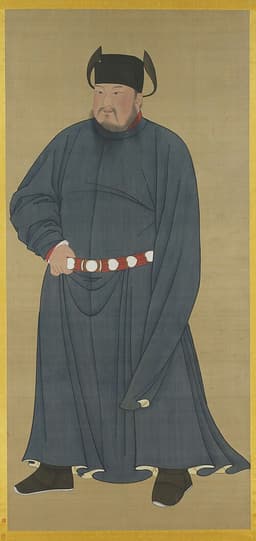
Li Cunxu
Emperor · Medieval
66.5Total
Basic Information
Born
955
885
Died
981
926
Era
Medieval
Medieval
Nationality
Korea
China
Occupation
Emperor
Emperor
Civilization
Eastern
Eastern
Score Comparison
Military (10%)
20.0
76.0
Political (20%)
53.8
68.0
Influence (20%)
53.3
62.0
Legacy (20%)
47.5
58.0
Leadership (15%)
48.8
80.0
Strategy (15%)
45.0
67.2
TOTAL
47.1
66.5
Gyeongjong of Goryeo — Complete Timeline
976 AD
Institution of the Jeonsigwa Land SystemReform◆ Major
King Gyeongjong established the jeonsigwa, a land distribution system that allocated state-owned farmland to government officials based on their rank. This reform aimed to secure royal revenue and control over land, while providing a stable income for the bureaucracy.
Impact: nationalconstructive
Li Cunxu — Complete Timeline
908 AD
Succeeded as Prince of JinPolitical Action◆ Major
Li Cunxu inherited the title Prince of Jin from his father Li Keyong. He continued the struggle against Later Liang, consolidating the Jin state as a major power in northern China.
JinSuccessionFive Dynasties
Impact: regional
910 AD
Battle of BaixiangWar◆ Major
Li Cunxu's Jin army defeated the Later Liang forces under Zhu Wen at Baixiang. This victory established Jin as the dominant military power in the north and marked a turning point in the war.
JinLater LiangBattle
Impact: regionalconstructive
923 AD
Conquered Later LiangWar
Li Cunxu led a successful campaign against Later Liang, capturing its capital Kaifeng and ending the dynasty. He then proclaimed himself emperor, founding the Later Tang dynasty.
Later TangConquestDynastic Change
Impact: nationalconstructive
Founded Later Tang DynastyPolitical Action
Li Cunxu declared himself emperor of the Later Tang dynasty, claiming legitimacy as the restorer of the Tang lineage. He established his capital at Luoyang and reunified much of northern China.
Later TangDynasty FoundingReunification
Impact: nationalconstructive
926 AD
Killed in mutiny at XingyuanWar◆ Major
Li Cunxu faced a mutiny by his own troops at Xingyuan during a campaign against the Khitans. He was killed in the fighting, leading to the collapse of Later Tang and the rise of Later Jin.
Later TangMutinyDeath
Impact: nationaltragic
Expert Analysis
Gyeongjong of Goryeo vs Li Cunxu
# The Emperor and the Reformer
In the spring of 926, Li Cunxu, the most feared warrior in northern China, lay dying in the mud of Xingyuan, betrayed by his own soldiers. Half a century earlier and a thousand miles east, a young Korean king named Gyeongjong had just been crowned in Kaesong, clutching a scroll of land reforms that would outlast any sword. Two rulers, both inheritors of thrones, both facing the impossible task of holding fractured kingdoms together—yet one perished in chaos, the other in quiet legacy. What made the difference?
Origins
Li Cunxu was born into war. His father, Li Keyong, was a Shatuo Turkic chieftain who had been granted the title Prince of Jin by the dying Tang dynasty, only to see the empire collapse into the chaos of the Five Dynasties and Ten Kingdoms period. From infancy, Cunxu learned that power was a blade drawn at all times. His father’s last words in 908 were a command: finish the war against the Later Liang, which had usurped the Tang throne. The son was twenty-three, barely a man, already carrying the weight of a blood feud.
Gyeongjong of Goryeo, by contrast, inherited a stable throne. Born in 955, he was the fourth king of a dynasty that had unified the Korean peninsula under Wang Geon just decades earlier. His father, King Gwangjong, had spent his reign purging nobles and centralizing power—a harsh but necessary foundation. Gyeongjong grew up in a court where the machinery of state, however brutal, already existed. His challenge was not conquest but management.
Rise to Power
Li Cunxu’s rise was meteoric and violent. In 910, at the Battle of Baixiang, he crushed the Later Liang army of Zhu Wen, the usurper emperor. The victory was not merely tactical—it was psychological. Cunxu fought in the front lines, a practice that thrilled his soldiers but terrified his advisors. He understood that in an age of shifting loyalties, personal courage was the only currency that bought trust. By 923, he had marched into Kaifeng, the Later Liang capital, and declared himself emperor of a new dynasty: the Later Tang. He claimed legitimacy by adopting the Tang surname, styling himself the restorer of a fallen house.
Gyeongjong’s path was quieter. He ascended the throne in 975 at age twenty, following his father’s death. There was no war to win, no usurper to dethrone. Instead, he faced a court filled with aristocrats who had been humiliated by his father’s purges and now waited for the young king to stumble. His first years were cautious—he consolidated alliances, observed his ministers, and studied the tax rolls that revealed a kingdom bleeding revenue.
Leadership & Governance
Li Cunxu ruled like a general. He personally led campaigns against the Khitans in the north, the Shu kingdom in the west, and any rival who dared raise a banner. His military score of 76.5 reflects a commander who understood terrain, timing, and terror. But governance bored him. He appointed eunuchs and actors to high office, alienating the Confucian scholar-officials who had run the Tang bureaucracy. He lavished rewards on his soldiers but failed to build institutions that outlasted his moods. Political score: 62.0—competent but brittle.
Gyeongjong was the opposite. In 976, he instituted the *jeonsigwa* land system, a reform that allocated state-owned farmland according to official rank. The idea was simple: tie loyalty to land grants, and tie land grants to service. Nobles received fields proportional to their position, but the land reverted to the state if they fell from favor. This stabilized state finances, reduced corruption, and created a bureaucracy that answered to the throne. His military score of 55.1 suggests he never led an army, but his political score of 60.5 understates the quiet genius of institutional reform.
Triumph & Tragedy
Li Cunxu’s greatest moment was 923, when he stood in Kaifeng’s palace and declared the Later Tang reborn. He had avenged his father, crushed the usurpers, and reunited northern China. But triumph curdled into tragedy within three years. His arrogance alienated his generals; his favoritism toward actors and eunuchs bred resentment. In 926, while marching against the Khitans, his own troops mutinied at Xingyuan. He died fighting—brave to the last, but alone.
Gyeongjong’s tragedy was quieter: he died young in 981, at just twenty-six, leaving no clear heir. His *jeonsigwa* system, however, survived. Later kings expanded it, and it became the backbone of Goryeo’s economy for centuries. He never saw a battlefield, never won a glorious victory—but he did not need to. His triumph was that the kingdom he inherited remained stable, while Li Cunxu’s collapsed around him.
Character & Destiny
Li Cunxu was a man of fire. He trusted instinct over counsel, bravery over bureaucracy. “A king who does not fight is no king,” he once said—or so his chroniclers recorded. That belief made him a conqueror but a poor ruler. He could not delegate, could not compromise, could not build. His destiny was to be a meteor: brilliant, brief, and ultimately consumed.
Gyeongjong was a man of ice. He understood that power in a settled kingdom moved through scrolls and edicts, not swords. His *jeonsigwa* reform required patience, negotiation, and a willingness to let the system do the work. He was not charismatic, not heroic—but he was necessary. His destiny was to be a foundation stone, invisible but essential.
Legacy
Li Cunxu is remembered as a tragic hero, a warrior-king who burned too bright. His Later Tang dynasty barely outlived him, swallowed by the same warlords he had defeated. Today, he appears in Chinese historical dramas as a cautionary tale: the emperor who conquered everything except his own flaws.
Gyeongjong is remembered in Korea as a quiet reformer. His *jeonsigwa* system is taught in schools as a model of administrative wisdom. He did not unify a kingdom—that had already been done—but he gave it a skeleton that held for generations. His legacy score of 64.4, slightly below Li Cunxu’s 66.2, reflects the humility of institution-building: it is less dramatic than conquest, but it lasts longer.
Conclusion
Standing at the crossroads of their fates, one sees a stark lesson. Li Cunxu and Gyeongjong faced the same fundamental question: how to hold power in a world that constantly tries to tear it away. The warrior answered with steel; the reformer answered with paper. One died in a mutiny, the other in his bed. But which truly succeeded? Perhaps the answer lies not in how a ruler dies, but in what survives after the last sword is sheathed. Li Cunxu’s empire crumbled; Gyeongjong’s land system endured. In the long arithmetic of history, the quiet reformer may have won after all.
Rankings
🥇
Li CunxuLeader
Mil: 76.0Pol: 68.0Inf: 62.0
66.5
🥈
Gyeongjong of Goryeo
Mil: 20.0Pol: 53.8Inf: 53.3
47.1
+19.4 behind
How This Comparison Works
Algorithm
Each figure is scored on 6 dimensions (0—100 scale) based on structured historical data: Military (10%), Political (20%), Influence (20%), Legacy (20%), Leadership (15%), Strategy (15%). The weighted total produces the final ranking.
Data Sources
Scores are computed from structured sub-indicators in the database. Scale factors adjust for era (Ancient ×0.85, Modern ×1.0) and civilization size (Eastern ×1.05, Other ×0.80) to account for differences in population and military scale.
Maximum 3 Figures
Comparisons are limited to 2—3 figures to ensure readability and statistical meaningfulness.
Error Margins
±5 points per dimension — Sub-scores are derived from historical records with inherent uncertainty. Two figures within 5 points on a dimension should be considered roughly equivalent in that area.
Total Score Accuracy
±3 points overall — The weighted combination of 6 dimensions produces a total score with approximately ±3 points of uncertainty. Differences of less than 3 points are not statistically significant— the figures are effectively tied.
Known Limitations
- Historical records are incomplete and uneven across civilizations
- Figures from oral-tradition societies may be underrepresented
- Occupation labels can misclassify multi-role figures
- Scores measure capability and impact, not moral character
- Quantitative scoring is a comparison tool, not absolute truth
Capability Radar
Military (10%) — Battles & Warfare
Battles
5
85
Win Rate
5
80
Expansion
5
75
Political (20%) — Governance & Reform
Reform
70
50
Diplomacy
40
60
Economy
65
45
Influence (20%) — Cultural & Global Reach
Cultural
30
55
Global
20
45
Legacy (20%) — Historical Impact
Historical
45
65
Longevity
40
50
Leadership (15%) — Power & Stability
Tenure
55
55
Stability
50
40
Strategy (15%) — Tactics & Innovation
Strategy
5
78
Tactics
5
82
Reform
5
60
Similar Comparisons
Comments & Discussion
Goryeo's White Lotus6/16/2026
军事史研究者常把李存勖和景宗的对比简单归结为“武功 vs 文治”,简直可笑。李存勖输在资源错配,而非军事能力。他在926年那场兵变前已丧失对禁军后勤的控制,而景宗呢?靠的恰恰是他爹光宗留下的肃清体系。没有高丽功臣田体制撑腰,他那点改革不过是纸上谈兵。说到底,谁的后勤更稳固,谁就活得更久。
Xingyuan's Lament6/16/2026
Every time someone romanticizes Li Cunxu as "the warrior emperor," I want to scream. He wasn't a tragic hero—he was a self-destructive fool. In 925, he had a golden chance to consolidate, but instead he let his eunuchs control the army payroll while generals starved. Compare that to Gyeongjong, who literally redistributed land to the peasant class under Gwangjong's foundation. One man kept his hands on the levers of state; the other strangled himself with soft power. Period.
景宗の影武者6/16/2026
你们都被表面骗了。景宗不是改革家,他是个数据操纵大师。高丽史记载他推行“田柴科”后“民得安业”,可同期地方庄园数据根本对不上。他死后不到二十年,豪族就重新吞并了六成以上土地。李存勖至少战死得真实,而景宗不过是用一套漂亮的账本给儒家史官喂了口安魂汤。真要论遗留,你那套“土地改革”早被后继者偷梁换柱了。
Pale Horse Cartographer6/16/2026
As a military logistics nerd, I see this debate differently. Li Cunxu's fall wasn't about betrayal—it was about signal failure. His cavalry scouts didn't warn him about Zhu Youzhen's flanking maneuvers at Xingyuan, and his supply chains collapsed three days before the mutiny. Meanwhile, Gyeongjong literally redesigned Korea's census system to track grain yields province by province. You want a stable kingdom? Hire bureaucrats, not bards who sing about swords.
沙陀旧部的B面6/16/2026
把李存勖说成暴君或英雄都太片面。他是沙陀贵族和中原文人体系冲突的牺牲品。他打天下靠的是代北铁骑和粟特血缘联盟,但坐天下时却想用唐朝官制套住部落亲兵,结果两边不讨好。景宗聪明在没瞎搞民族缝合,一心拿着光宗留下的中央集权工具修修补补。李存勖要是早点放弃“光复大唐的沙陀皇帝”这个两头不靠的身份,他根本不会死在那滩泥里。