Loading...
Grover Cleveland vs Yuan Shikai
Yuan Shikai leads by 6.3 pts · 2 figures compared
…
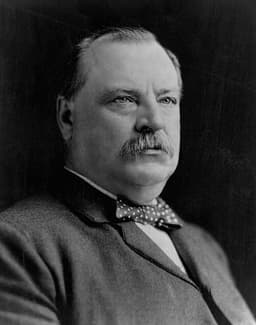
Grover Cleveland
Politician · Modern
53.7Total
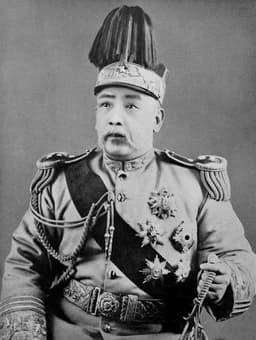
Yuan Shikai
Politician · Modern
60.0Total
Basic Information
Born
1837
1859
Died
1908
1916
Era
Modern
Modern
Nationality
United States
China
Occupation
Politician
Politician
Civilization
Western
Eastern
Score Comparison
Military (10%)
50.0
45.0
Political (20%)
45.0
72.0
Influence (20%)
54.9
57.2
Legacy (20%)
48.3
54.0
Leadership (15%)
79.8
72.0
Strategy (15%)
41.8
61.2
TOTAL
53.7
60.0
Grover Cleveland — Complete Timeline
1884 AD
Election as President of the United States (First Term)Political Action◆ Major
Cleveland, a Democrat, won the 1884 presidential election against Republican James G. Blaine. The campaign was marked by personal attacks, but Cleveland's reputation as a reformer helped him win a narrow victory.
Presidential ElectionDemocratic Party
Impact: national
1887 AD
Signing of the Interstate Commerce ActReform◆ Major
Cleveland signed the Interstate Commerce Act, which created the Interstate Commerce Commission (ICC) to regulate railroad rates and practices. This was the first federal agency to regulate private industry, marking a significant expansion of federal power over commerce.
Railroad RegulationFederal Regulation
Impact: nationalconstructive
1892 AD
Election as President of the United States (Second Term)Political Action◆ Major
Cleveland won the 1892 presidential election against incumbent Benjamin Harrison, becoming the only president to serve two non-consecutive terms. His victory was a repudiation of the McKinley Tariff and Republican economic policies.
Presidential ElectionNon-Consecutive Terms
Impact: national
1894 AD
Intervention in the Pullman StrikePolitical Action◆ Major
Cleveland ordered federal troops to break the Pullman Strike, a nationwide railroad strike led by Eugene V. Debs. The intervention was controversial, as it used federal power to suppress labor unrest, and led to Debs' imprisonment.
Labor StrikeFederal Intervention
Impact: nationaldestructive
Yuan Shikai — Complete Timeline
1901 AD
Command of the Beiyang ArmyReform◆ Major
Yuan Shikai took command of the Beiyang Army, the most modern military force in late Qing China. He expanded and trained the army, which became the basis for his political power and later dominated Chinese politics.
Military reformBeiyang Army
Impact: national
1912 AD
Appointed First President of the Republic of ChinaPolitical Action
Yuan Shikai became the first president of the Republic of China after negotiating the abdication of the Qing emperor. He used his control of the Beiyang Army to pressure the revolutionary government into accepting his leadership.
PresidencyRepublic of China
Impact: national
1915 AD
Declaration of the Empire of ChinaPolitical Action◆ Major
Yuan Shikai declared himself emperor of the Empire of China, attempting to restore the monarchy. This move sparked widespread opposition from provincial leaders and foreign powers, leading to the collapse of his regime.
Monarchy restorationPolitical crisis
Impact: nationaldestructive
Signing of the Twenty-One DemandsPolitical Action◆ Major
Yuan Shikai accepted most of Japan's Twenty-One Demands, which expanded Japanese influence in China. The agreement granted Japan economic rights in Manchuria and Shandong, and was seen as a national humiliation.
DiplomacyJapanese imperialism
Impact: globaltragic
1916 AD
Death and Collapse of the Beiyang GovernmentPolitical Action◆ Major
Yuan Shikai died of uremia, leaving no clear successor. His death led to the fragmentation of the Beiyang Army into warlord factions, plunging China into a period of civil war and political instability.
Warlord eraPolitical fragmentation
Impact: nationaltragic
Expert Analysis
Origins
Grover Cleveland (born 1837) grew up in a modest Presbyterian household in New Jersey, the son of a minister. He left school at 14 to support his family, later studying law and becoming a lawyer in Buffalo, New York. His early career focused on legal work and local politics, serving as sheriff of Erie County. Yuan Shikai (born 1859) came from a military family in Henan, China. He failed the imperial examinations twice and purchased a minor official post, but his talent for military organization propelled his rise. He gained experience in Korea as a Chinese diplomat and military commander.
Rise to Power
Cleveland rose quickly: he was elected mayor of Buffalo in 1881, then governor of New York in 1882, and president in 1884 at age 47. His reputation for honesty and reform, especially his veto of pork-barrel bills, appealed to voters. Yuan Shikai's rise was more gradual: he commanded the Beiyang Army, the most modern force in China, and used it as a power base. In 1911, after the Wuchang Uprising, he negotiated the abdication of the Qing emperor and became the first president of the Republic of China in 1912.
Leadership & Governance
Cleveland's leadership style was hands-on and conservative. He vetoed hundreds of private pension bills, believing they were wasteful. He signed the Interstate Commerce Act (1887) to regulate railroads, but also used federal troops to break the Pullman Strike (1894), showing a pro-business stance. Yuan Shikai governed through military control and patronage. He centralized power, suppressed opposition, and accepted Japan's Twenty-One Demands in 1915 to secure support, which humiliated China and sparked protests.
Triumph & Tragedy
Cleveland's triumphs include being the only president to serve two non-consecutive terms (1885-1889, 1893-1897) and his tariff reform efforts. His tragedy was the Panic of 1893, a severe depression that he failed to resolve, and the violent end to the Pullman Strike. Yuan Shikai's triumph was ending the Qing dynasty and establishing the Republic. His tragedy was his attempt to restore the monarchy in 1915, which led to a nationwide revolt and his forced abandonment of the empire. He died in 1916, leaving China in chaos.
Character & Destiny
Cleveland was known for his stubborn integrity, earning the nickname "Old Veto." His character made him a symbol of honest government but also inflexible. Yuan Shikai was ambitious and pragmatic, often prioritizing power over principle. His decision to declare himself emperor cost him popular support and doomed his regime. Historians see him as a transitional figure who failed to balance military strength with political legitimacy.
Legacy
Cleveland's legacy is mixed: he strengthened the presidency's veto power and pushed for civil service reform, but his economic conservatism limited his impact. He scores 48.3 in legacy. Yuan Shikai's legacy is more profound: his military-based rule set a precedent for warlordism, and his acceptance of the Twenty-One Demands weakened China's sovereignty. He scores 54.0 in legacy. His death directly led to the Warlord Era, which lasted until 1928.
Conclusion
Yuan Shikai had a greater impact on history, despite his lower total score (60.0 vs Cleveland's 53.7). His actions directly shaped China's transition from empire to republic and the subsequent fragmentation. Cleveland, while notable for his non-consecutive terms and reformist image, operated within a stable system that limited his influence. Yuan's decisions had consequences for millions and altered China's trajectory for decades.
Rankings
🥇
Yuan ShikaiLeader
Mil: 45.0Pol: 72.0Inf: 57.2
60.0
🥈
Grover Cleveland
Mil: 50.0Pol: 45.0Inf: 54.9
53.7
+6.3 behind
How This Comparison Works
Algorithm
Each figure is scored on 6 dimensions (0—100 scale) based on structured historical data: Military (10%), Political (20%), Influence (20%), Legacy (20%), Leadership (15%), Strategy (15%). The weighted total produces the final ranking.
Data Sources
Scores are computed from structured sub-indicators in the database. Scale factors adjust for era (Ancient ×0.85, Modern ×1.0) and civilization size (Eastern ×1.05, Other ×0.80) to account for differences in population and military scale.
Maximum 3 Figures
Comparisons are limited to 2—3 figures to ensure readability and statistical meaningfulness.
Error Margins
±5 points per dimension — Sub-scores are derived from historical records with inherent uncertainty. Two figures within 5 points on a dimension should be considered roughly equivalent in that area.
Total Score Accuracy
±3 points overall — The weighted combination of 6 dimensions produces a total score with approximately ±3 points of uncertainty. Differences of less than 3 points are not statistically significant— the figures are effectively tied.
Known Limitations
- Historical records are incomplete and uneven across civilizations
- Figures from oral-tradition societies may be underrepresented
- Occupation labels can misclassify multi-role figures
- Scores measure capability and impact, not moral character
- Quantitative scoring is a comparison tool, not absolute truth
Capability Radar
Military (10%) — Battles & Warfare
Battles
29
45
Win Rate
30
55
Expansion
33
50
Political (20%) — Governance & Reform
Reform
55
55
Diplomacy
65
70
Economy
60
50
Influence (20%) — Cultural & Global Reach
Cultural
30
40
Global
40
35
Legacy (20%) — Historical Impact
Historical
50
65
Longevity
40
40
Leadership (15%) — Power & Stability
Tenure
60
60
Stability
70
30
Strategy (15%) — Tactics & Innovation
Strategy
35
65
Tactics
40
60
Reform
46
80
Similar Comparisons
Comments & Discussion
No comments yet. Be the first to share your thoughts!