Loading...
This comparison has not been analyzed yet.
One-time AI generation (~1 minute). Scores and timeline are already available below.
Godfrey of Bouillon vs Tancred of Galilee
Godfrey of Bouillon leads by 9.5 pts · 2 figures compared
…
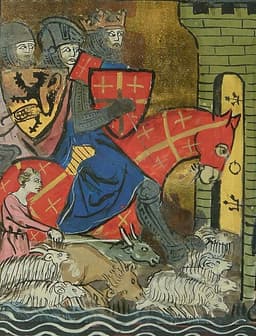
Godfrey of Bouillon
General · Medieval
52.2Total
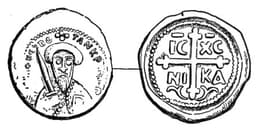
Tancred of Galilee
General · Medieval
42.7Total
Basic Information
Born
1060
1075
Died
1100
1112
Era
Medieval
Medieval
Nationality
Jerusalem
Principality of Antioch
Occupation
General
General
Civilization
Western
Western
Score Comparison
Military (10%)
60.0
52.5
Political (20%)
37.9
29.3
Influence (20%)
55.7
45.5
Legacy (20%)
47.5
37.5
Leadership (15%)
54.2
47.3
Strategy (15%)
66.3
52.5
TOTAL
52.2
42.7
Godfrey of Bouillon — Complete Timeline
1096 AD
Leadership of the First CrusadeWar◆ Major
Godfrey of Bouillon was a key leader of the First Crusade, commanding an army from Lorraine. He participated in the Siege of Nicaea, the Battle of Dorylaeum, and the Siege of Antioch, and was instrumental in the capture of Jerusalem in 1099.
CrusadeFirst CrusadeJerusalem
Impact: global
1099 AD
Capture of JerusalemWar
Godfrey led the successful assault on Jerusalem on July 15, 1099, ending Muslim rule. The capture was followed by a massacre of the city's Jewish and Muslim inhabitants. Godfrey was elected as the first ruler of the Kingdom of Jerusalem.
CrusadeJerusalemMassacre
Impact: globaldestructive
Battle of AscalonWar◆ Major
Godfrey led the Crusader army to victory against a Fatimid Egyptian force at Ascalon, securing the new kingdom's southern border. The victory prevented an immediate Muslim reconquest of Jerusalem.
BattleCrusader KingdomFatimids
Impact: regional
Election as Advocate of the Holy SepulchrePolitical Action◆ Major
After the capture of Jerusalem, Godfrey was elected as the ruler of the kingdom, but he refused the title of king, instead taking the title Advocatus Sancti Sepulchri (Advocate of the Holy Sepulchre). This established the Crusader state.
Crusader KingdomJerusalemTitle
Impact: regional
1100 AD
Death and SuccessionPolitical Action◆ Major
Godfrey died in 1100, possibly from illness or a wound. His brother Baldwin I succeeded him as the first king of Jerusalem. Godfrey's death left the kingdom in a precarious position, but Baldwin's leadership expanded it.
DeathSuccessionCrusader Kingdom
Impact: regionaltragic
Tancred of Galilee — Complete Timeline
1098 AD
Captured Antioch During First CrusadeWar◆ Major
Tancred of Galilee was a key commander during the Siege of Antioch, leading the capture of the city from the Seljuks. He then became Prince of Galilee, establishing a Crusader state in the region.
First CrusadeSiegeTerritorial Conquest
Impact: regional
1101 AD
Served as Regent of AntiochPolitical Action◆ Major
Tancred acted as regent of the Principality of Antioch while his uncle Bohemond was imprisoned by the Danishmends. He successfully defended the principality against Byzantine and Muslim attacks, expanding its territory.
RegencyDefenseCrusader States
Impact: regionalconstructive
1104 AD
Defeated at Battle of HarranWar◆ Major
Tancred participated in the Battle of Harran against the Seljuks, which ended in a decisive Crusader defeat. The loss weakened the Principality of Antioch and led to the capture of Bohemond, forcing Tancred to assume full control.
BattleDefeatSeljuks
Impact: regionaltragic
This comparison has not been analyzed yet.
One-time AI generation (~1 minute). Scores and timeline are already available below.
Rankings
🥇
Godfrey of BouillonLeader
Mil: 60.0Pol: 37.9Inf: 55.7
52.2
🥈
Tancred of Galilee
Mil: 52.5Pol: 29.3Inf: 45.5
42.7
+9.5 behind
How This Comparison Works
Algorithm
Each figure is scored on 6 dimensions (0—100 scale) based on structured historical data: Military (10%), Political (20%), Influence (20%), Legacy (20%), Leadership (15%), Strategy (15%). The weighted total produces the final ranking.
Data Sources
Scores are computed from structured sub-indicators in the database. Scale factors adjust for era (Ancient ×0.85, Modern ×1.0) and civilization size (Eastern ×1.05, Other ×0.80) to account for differences in population and military scale.
Maximum 3 Figures
Comparisons are limited to 2—3 figures to ensure readability and statistical meaningfulness.
Error Margins
±5 points per dimension — Sub-scores are derived from historical records with inherent uncertainty. Two figures within 5 points on a dimension should be considered roughly equivalent in that area.
Total Score Accuracy
±3 points overall — The weighted combination of 6 dimensions produces a total score with approximately ±3 points of uncertainty. Differences of less than 3 points are not statistically significant— the figures are effectively tied.
Known Limitations
- Historical records are incomplete and uneven across civilizations
- Figures from oral-tradition societies may be underrepresented
- Occupation labels can misclassify multi-role figures
- Scores measure capability and impact, not moral character
- Quantitative scoring is a comparison tool, not absolute truth
Capability Radar
Military (10%) — Battles & Warfare
Battles
65
45
Win Rate
60
50
Expansion
55
40
Political (20%) — Governance & Reform
Reform
25
20
Diplomacy
40
40
Economy
20
25
Influence (20%) — Cultural & Global Reach
Cultural
55
25
Global
50
15
Legacy (20%) — Historical Impact
Historical
60
35
Longevity
55
20
Leadership (15%) — Power & Stability
Tenure
30
35
Stability
25
30
Strategy (15%) — Tactics & Innovation
Strategy
60
50
Tactics
55
55
Reform
30
20
Similar Comparisons
Comments & Discussion
No comments yet. Be the first to share your thoughts!