Loading...
Godfrey of Bouillon vs Saladin
Saladin leads by 11.9 pts · 2 figures compared
…
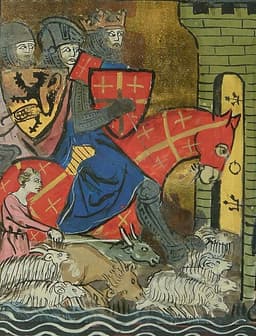
Godfrey of Bouillon
General · Medieval
52.2Total
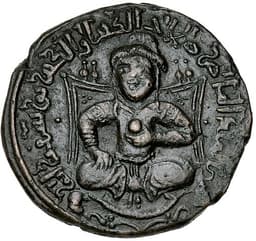
Saladin
General · Medieval
64.1Total
Basic Information
Born
1060
1137
Died
1100
1193
Era
Medieval
Medieval
Nationality
Jerusalem
Ayyubid Sultanate
Occupation
General
General
Civilization
Western
Middle Eastern
Score Comparison
Military (10%)
60.0
75.0
Political (20%)
37.9
69.6
Influence (20%)
55.7
65.2
Legacy (20%)
47.5
52.0
Leadership (15%)
54.2
62.0
Strategy (15%)
66.3
76.0
TOTAL
52.2
64.1
Godfrey of Bouillon — Complete Timeline
1096 AD
Leadership of the First CrusadeWar◆ Major
Godfrey of Bouillon was a key leader of the First Crusade, commanding an army from Lorraine. He participated in the Siege of Nicaea, the Battle of Dorylaeum, and the Siege of Antioch, and was instrumental in the capture of Jerusalem in 1099.
CrusadeFirst CrusadeJerusalem
Impact: global
1099 AD
Capture of JerusalemWar
Godfrey led the successful assault on Jerusalem on July 15, 1099, ending Muslim rule. The capture was followed by a massacre of the city's Jewish and Muslim inhabitants. Godfrey was elected as the first ruler of the Kingdom of Jerusalem.
CrusadeJerusalemMassacre
Impact: globaldestructive
Battle of AscalonWar◆ Major
Godfrey led the Crusader army to victory against a Fatimid Egyptian force at Ascalon, securing the new kingdom's southern border. The victory prevented an immediate Muslim reconquest of Jerusalem.
BattleCrusader KingdomFatimids
Impact: regional
Election as Advocate of the Holy SepulchrePolitical Action◆ Major
After the capture of Jerusalem, Godfrey was elected as the ruler of the kingdom, but he refused the title of king, instead taking the title Advocatus Sancti Sepulchri (Advocate of the Holy Sepulchre). This established the Crusader state.
Crusader KingdomJerusalemTitle
Impact: regional
1100 AD
Death and SuccessionPolitical Action◆ Major
Godfrey died in 1100, possibly from illness or a wound. His brother Baldwin I succeeded him as the first king of Jerusalem. Godfrey's death left the kingdom in a precarious position, but Baldwin's leadership expanded it.
DeathSuccessionCrusader Kingdom
Impact: regionaltragic
Saladin — Complete Timeline
1187 AD
Battle of HattinWar
Saladin's forces defeated the Crusader army at Hattin, near Tiberias. He captured King Guy of Jerusalem and the True Cross relic. The victory decimated the Crusader military and opened the way for the recapture of Jerusalem.
BattleCrusadesVictory
Impact: regional
Recapture of JerusalemWar
Saladin's army besieged and captured Jerusalem from the Crusaders after 88 years of Christian rule. He allowed the inhabitants to leave peacefully or be ransomed, contrasting with the Crusaders' massacre in 1099. This event triggered the Third Crusade.
ConquestJerusalemCrusades
Impact: global
1189 AD
Siege of AcreWar◆ Major
Saladin faced a prolonged siege of Acre by Crusader forces under Richard the Lionheart and Philip Augustus. After nearly two years, the city fell to the Crusaders. Saladin's inability to relieve the siege was a major setback.
SiegeCrusadesDefeat
Impact: regional
1191 AD
Battle of ArsufWar◆ Major
Saladin's forces attacked Richard the Lionheart's army marching south from Acre. Richard's disciplined infantry repelled the attacks, inflicting heavy losses on Saladin's troops. The battle ended in a tactical Crusader victory, but Saladin's army remained intact.
BattleCrusadesRichard the Lionheart
Impact: regional
1192 AD
Treaty of RamlaPolitical Action◆ Major
Saladin and Richard the Lionheart signed the Treaty of Ramla, ending the Third Crusade. The treaty granted Crusaders control of a coastal strip from Jaffa to Acre, while Muslims retained Jerusalem. Christian pilgrims were allowed access to holy sites.
TreatyCrusadesDiplomacy
Impact: regional
Expert Analysis
Saladin vs Godfrey of Bouillon
# The Conqueror and the Defender
On a July morning in 1099, the walls of Jerusalem ran red. Crusader soldiers, driven by faith and fury, poured through breaches in the city’s defenses, slaughtering Muslim and Jewish inhabitants with a ferocity that would echo through centuries. Godfrey of Bouillon, the man who led this assault, knelt at the Church of the Holy Sepulchre and refused the crown of a king, choosing instead the title "Advocate of the Holy Sepulchre." Eighty-eight years later, another general entered Jerusalem—but this time, the gates opened peacefully. Saladin, the Kurdish sultan who had shattered the Crusader army at Hattin that same year, allowed the city’s Christian inhabitants to leave with their lives and possessions, paying ransoms for those who could not afford them. Two men, two conquests, two utterly different visions of what it meant to be a conqueror. What made them so different?
Origins
Godfrey of Bouillon was born around 1060 into the high nobility of Lorraine, a border region between France and the Holy Roman Empire. His world was one of feudal loyalties, castle politics, and the restless energy of knights seeking glory. The First Crusade, proclaimed by Pope Urban II in 1095, offered exactly that—a holy war to reclaim Jerusalem, but also land, wealth, and redemption. Godfrey was a second son, meaning he had no inheritance. The Crusade was his path to power.
Saladin, born in 1137 in Tikrit (modern-day Iraq), came from a Kurdish family of soldiers and administrators. His uncle Shirkuh served the powerful Zengid dynasty, which had already begun pushing back against the Crusader states. Saladin grew up in Damascus and Aleppo, surrounded by the complexities of Islamic politics—rival emirs, competing sects, and the ever-present threat of the Frankish invaders. Where Godfrey saw a holy war of conquest, Saladin inherited a holy war of reconquest. The difference was fundamental: one man fought to take, the other to restore.
Rise to Power
Godfrey’s path was direct. He sold or mortgaged his lands to fund his army, then marched across Europe and Anatolia, surviving sieges, starvation, and betrayal. At the Siege of Antioch in 1098, he distinguished himself as a capable commander. But his true moment came at Jerusalem in 1099, when he led the final assault. The Crusader leaders elected him ruler not because he was the most powerful—that was Raymond of Toulouse—but because he was the least threatening to the other barons. He was a compromise candidate, and he knew it.
Saladin’s rise was more circuitous. He accompanied his uncle Shirkuh on campaigns into Fatimid Egypt, a crumbling Shia caliphate. When Shirkuh died in 1169, Saladin, then only 32, found himself as vizier of Egypt. Over the next decade, he methodically eliminated rivals, suppressed rebellions, and built a power base independent of his Zengid overlords. By 1183, he controlled Egypt, Syria, and much of Mesopotamia. His rise was not a single battle but a slow, patient game of chess, played across the entire Islamic world.
Leadership & Governance
Godfrey ruled Jerusalem for barely a year. His leadership was that of a military chieftain, not a statesman. He fought the Battle of Ascalon in 1099, defeating a Fatimid army and securing the kingdom’s southern border, but he died in 1100, possibly from typhus or a battle wound. His refusal to be crowned king was either genuine piety or shrewd politics—by calling himself "Advocate," he avoided the jealousy of the Church and other nobles. But he left no administrative reforms, no lasting institutions. His legacy was the conquest itself.
Saladin ruled for over two decades and governed a sprawling empire. He was a reformer: he unified the Islamic world under Sunni orthodoxy, built schools and mosques, and established a system of justice that respected both Muslim and Christian communities. After capturing Jerusalem, he allowed the Christian population to leave—a stark contrast to the 1099 massacre. He even returned the True Cross to the Crusaders as a gesture of goodwill. His chivalry toward Richard the Lionheart during the Third Crusade became legendary: when Richard’s horse was killed, Saladin sent him a fresh one; when Richard fell ill, Saladin sent him fruit and snow from Mount Hermon.
Triumph & Tragedy
Godfrey’s triumph was the capture of Jerusalem. His tragedy was that he could not hold it. The kingdom he founded was a narrow strip of coast, perpetually undermanned and surrounded by enemies. Within a generation, it would begin to crumble.
Saladin’s triumph was the Battle of Hattin in 1187, where he trapped the Crusader army on a dry hillside, cut off from water, and annihilated it. He captured King Guy of Jerusalem and the True Cross, a relic the Crusaders believed guaranteed victory. His tragedy was the Third Crusade itself. Despite his victory at Hattin, he could not retake the coastal cities. The Siege of Acre in 1189–1191 ended in Crusader victory, and the Battle of Arsuf in 1191 showed that Richard’s disciplined infantry could match Saladin’s cavalry. The Treaty of Ramla in 1192 left the Crusaders with a coastal strip—a compromise that neither side truly wanted.
Character & Destiny
Godfrey was a man of his age—pious, brutal, and ambitious. The massacre at Jerusalem was not an anomaly; it was standard practice in medieval warfare. He believed he was doing God’s work, and that belief gave him the strength to lead starving, desperate men across a continent.
Saladin was also a man of his age, but his age was different. Islamic jurisprudence had developed sophisticated rules of war: prisoners could be ransomed, civilians should be spared, and treaties could be honored. Saladin was not a saint—he executed the Knights Templar and Hospitaller after Hattin, and his campaigns were often brutal—but he understood that conquest without legitimacy was unsustainable. He needed to be seen as a just ruler, not just a victorious one.
Legacy
Godfrey of Bouillon became a legend in medieval Europe, immortalized in the epic poems and chronicles of the Crusades. He was the ideal Christian knight—brave, devout, and selfless. His refusal of the crown made him a symbol of humility. But his legacy is inseparable from the violence of the First Crusade, which poisoned Christian-Muslim relations for centuries.
Saladin is remembered across the Islamic world as a hero of unmatched chivalry. His tomb in Damascus remains a pilgrimage site, and his name adorns streets, schools, and hotels from Cairo to Jakarta. In the West, he has been romanticized as a noble adversary, the Saracen who was more honorable than his Christian foes. Dante placed him in Limbo, not Hell.
Conclusion
Standing on the walls of Jerusalem, one sees the same stones Godfrey and Saladin saw—the same golden dome of the Dome of the Rock, the same narrow alleys, the same ancient gates. But they saw different things. Godfrey saw a prize to be taken, a holy city to be cleansed of infidels. Saladin saw a city to be reclaimed, a sanctuary to be protected. One conquered with the sword, the other with a treaty. One left a kingdom, the other an idea. And ideas, as history shows, are far harder to kill.
Rankings
🥇
SaladinLeader
Mil: 75.0Pol: 69.6Inf: 65.2
64.1
🥈
Godfrey of Bouillon
Mil: 60.0Pol: 37.9Inf: 55.7
52.2
+11.9 behind
How This Comparison Works
Algorithm
Each figure is scored on 6 dimensions (0—100 scale) based on structured historical data: Military (10%), Political (20%), Influence (20%), Legacy (20%), Leadership (15%), Strategy (15%). The weighted total produces the final ranking.
Data Sources
Scores are computed from structured sub-indicators in the database. Scale factors adjust for era (Ancient ×0.85, Modern ×1.0) and civilization size (Eastern ×1.05, Other ×0.80) to account for differences in population and military scale.
Maximum 3 Figures
Comparisons are limited to 2—3 figures to ensure readability and statistical meaningfulness.
Error Margins
±5 points per dimension — Sub-scores are derived from historical records with inherent uncertainty. Two figures within 5 points on a dimension should be considered roughly equivalent in that area.
Total Score Accuracy
±3 points overall — The weighted combination of 6 dimensions produces a total score with approximately ±3 points of uncertainty. Differences of less than 3 points are not statistically significant— the figures are effectively tied.
Known Limitations
- Historical records are incomplete and uneven across civilizations
- Figures from oral-tradition societies may be underrepresented
- Occupation labels can misclassify multi-role figures
- Scores measure capability and impact, not moral character
- Quantitative scoring is a comparison tool, not absolute truth
Capability Radar
Military (10%) — Battles & Warfare
Battles
65
78
Win Rate
60
72
Expansion
55
82
Political (20%) — Governance & Reform
Reform
25
68
Diplomacy
40
88
Economy
20
65
Influence (20%) — Cultural & Global Reach
Cultural
55
85
Global
50
78
Legacy (20%) — Historical Impact
Historical
60
82
Longevity
55
80
Leadership (15%) — Power & Stability
Tenure
30
75
Stability
25
70
Strategy (15%) — Tactics & Innovation
Strategy
60
85
Tactics
55
80
Reform
30
70
Similar Comparisons
Comments & Discussion
THE SIEGE LORD6/16/2026
"Calling Godfrey and Saladin 'two conquerors' is like comparing a wolf to a shepherd. Godfrey was a brilliant siege commander—his engineers built the siege towers at Jerusalem in under a month with wood from a forest 50 miles away. But he also let his men butcher 30,000 people after breaching the walls. Saladin took Jerusalem with siege machinery too, but he wrote negotiation terms beforehand. One was a butcher with logistics; the other was a diplomat with artillery."
CRUSADE DEBUNKER6/16/2026
"Let's not romanticize Saladin's 'mercy.' He only offered generous terms at Jerusalem because his own army was exhausted and he feared a bloody street fight like 1099. And Godfrey's refusal of a crown? That wasn't piety—it was political genius. He ducked the power struggle between the Pope and the Byzantine Emperor. Both were hard-nosed realists, just playing different hands. Saladin had the Kipchak Turks as allies. Godfrey faced a fractured Muslim coalition. Context matters more than saintly le
沙漠之狐6/16/2026
"萨拉丁从来不是软心肠的和平主义者,他是个狡猾的战术家。1187年哈丁战役,他故意切断十字军的水源,在烈日下烤了三天才开打,这比直接攻城狡猾多了。但拿他跟戈弗雷比公平吗?戈弗雷攻下耶路撒冷时,对方城里有上万民兵和拜占庭来的雇佣兵,而萨拉丁面对的是孤立的守军和谈判窗口。一个是烈火,一个是寒刃——都是刽子手,只是手法不同。"
历史修正派6/16/2026
"总有人说萨拉丁仁慈、戈弗雷残暴,但这完全无视了时代背景。1099年的十字军是真信末世预言——他们以为耶稣马上回来,屠杀是驱魔仪式的一部分。而萨拉丁是十二世纪的职业军人,他的政治目标是把十字军赶走,不是搞宗教清洗。拿现代道德观套中世纪,就好像用米尺量海水的深度——根本没用对工具。"
CLASSICS SCHOLAR6/16/2026
"You're all missing the code of *chevalerie* that Godfrey actually imperfectly practiced. He refused the crown because he'd taken a vow to the Pope—breaking it meant eternal damnation. And Saladin's famous generosity to Balian of Ibelin? That was a calculated display of *futuwwa*, the Islamic chivalric code, meant to shame his enemies into surrender. Both were prisoners of their own honor systems. They weren't being 'good' or 'evil'—they were performing for their respective audiences: Godfrey fo