Loading...
Godfrey of Bouillon vs Shaka Zulu
Shaka Zulu leads by 18.0 pts · 2 figures compared
…
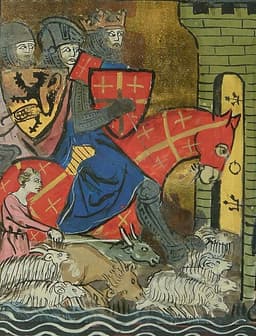
Godfrey of Bouillon
General · Medieval
52.2Total
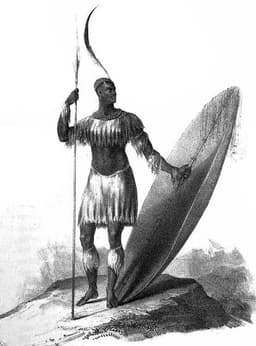
Shaka Zulu
General · Modern
70.2Total
Basic Information
Born
1060
1787
Died
1100
1828
Era
Medieval
Modern
Nationality
Jerusalem
Zulu Kingdom
Occupation
General
General
Civilization
Western
Other
Score Comparison
Military (10%)
60.0
80.0
Political (20%)
37.9
72.0
Influence (20%)
55.7
68.0
Legacy (20%)
47.5
68.0
Leadership (15%)
54.2
62.0
Strategy (15%)
66.3
80.8
TOTAL
52.2
70.2
Godfrey of Bouillon — Complete Timeline
1096 AD
Leadership of the First CrusadeWar◆ Major
Godfrey of Bouillon was a key leader of the First Crusade, commanding an army from Lorraine. He participated in the Siege of Nicaea, the Battle of Dorylaeum, and the Siege of Antioch, and was instrumental in the capture of Jerusalem in 1099.
CrusadeFirst CrusadeJerusalem
Impact: global
1099 AD
Capture of JerusalemWar
Godfrey led the successful assault on Jerusalem on July 15, 1099, ending Muslim rule. The capture was followed by a massacre of the city's Jewish and Muslim inhabitants. Godfrey was elected as the first ruler of the Kingdom of Jerusalem.
CrusadeJerusalemMassacre
Impact: globaldestructive
Battle of AscalonWar◆ Major
Godfrey led the Crusader army to victory against a Fatimid Egyptian force at Ascalon, securing the new kingdom's southern border. The victory prevented an immediate Muslim reconquest of Jerusalem.
BattleCrusader KingdomFatimids
Impact: regional
Election as Advocate of the Holy SepulchrePolitical Action◆ Major
After the capture of Jerusalem, Godfrey was elected as the ruler of the kingdom, but he refused the title of king, instead taking the title Advocatus Sancti Sepulchri (Advocate of the Holy Sepulchre). This established the Crusader state.
Crusader KingdomJerusalemTitle
Impact: regional
1100 AD
Death and SuccessionPolitical Action◆ Major
Godfrey died in 1100, possibly from illness or a wound. His brother Baldwin I succeeded him as the first king of Jerusalem. Godfrey's death left the kingdom in a precarious position, but Baldwin's leadership expanded it.
DeathSuccessionCrusader Kingdom
Impact: regionaltragic
Shaka Zulu — Complete Timeline
1816 AD
Introduction of the iklwa and horns of the buffalo formationReform
Shaka introduced the iklwa, a short stabbing spear, and the 'horns of the buffalo' tactical formation to the Zulu army. These innovations replaced the traditional throwing assegai and allowed for close-quarters combat, significantly increasing the Zulu's military effectiveness and enabling rapid conquest.
Military InnovationTacticsZulu Warfare
Impact: regional
1819 AD
Conquest of the Ndwandwe KingdomWar◆ Major
Shaka's Zulu army defeated the Ndwandwe kingdom at the Battle of Gqokli Hill, a decisive victory that eliminated a major rival. This conquest allowed Shaka to consolidate control over a large territory in present-day KwaZulu-Natal, marking the rise of the Zulu as a dominant regional power.
ConquestZulu ExpansionNdwandwe
Impact: regional
1828 AD
Assassination of ShakaPolitical Action◆ Major
Shaka was assassinated by his half-brothers Dingane and Mhlangana, with the support of his aunt Mkabayi. The coup ended his reign of terror and expansionist wars, leading to a period of instability and the eventual rise of Dingane as king.
AssassinationSuccession CrisisZulu Kingdom
Impact: regionaltragic
Expert Analysis
Shaka Zulu vs Godfrey of Bouillon
# The Spear and the Cross: Shaka Zulu and Godfrey of Bouillon
On a July morning in 1099, a Frankish knight in blood-stained armor stood atop the walls of Jerusalem, gazing at a city he had just helped conquer in the name of Christ. Seven centuries later and half a world away, a Zulu warrior-king watched his *impis* drive terrified enemies into a river, their short stabbing spears rising and falling with mechanical precision. Both men built empires from nothing. Both died violently, betrayed by those closest to them. Yet one founded a kingdom that would endure for generations, while the other left a fragile realm that crumbled within decades. What accounts for the difference? The answer lies not in their achievements, but in the worlds they inhabited—and the terrible choices each was forced to make.
Origins
Shaka kaSenzangakhona was born in 1787, the illegitimate son of a minor Zulu chief. His childhood was a study in humiliation: he and his mother Nandi were driven from village to village, mocked as outcasts. By the time he reached manhood, Shaka had learned that mercy was a luxury the powerless could not afford. He served as a warrior under the Mthethwa chief Dingiswayo, absorbing lessons in military organization that would later reshape southern Africa.
Godfrey of Bouillon, born around 1060, emerged from the opposite end of the social spectrum. He was a Duke of Lower Lorraine, a feudal lord whose bloodline stretched back to Charlemagne. His world was one of fixed hierarchies, oaths of fealty, and the eternal tension between secular ambition and spiritual obligation. Where Shaka’s Africa was fluid, turbulent, and open to radical innovation, Godfrey’s Europe was rigid, tradition-bound, and suspicious of change.
Rise to Power
Shaka’s path to power was forged in blood. In 1816, after Dingiswayo’s death, he seized control of the Zulu clan and immediately set about dismantling every convention of warfare his people knew. He discarded the long throwing spear—the *assegai*—for the *iklwa*, a short-bladed stabbing weapon that forced his warriors to close with the enemy. He replaced sandals with bare feet, demanding his men run across thorns and rocks until their soles became leather. He invented the “horns of the buffalo” formation: a powerful center to pin the enemy, flanking horns to encircle, and reserves in the “loins” to exploit breakthroughs. Within three years, he had annihilated the Ndwandwe kingdom at Gqokli Hill in 1819, and the Zulu became the terror of the region.
Godfrey’s rise was quieter, more political. When Pope Urban II called for the First Crusade in 1095, Godfrey saw an opportunity that transcended mere ambition. He mortgaged his lands, sold his castles, and raised an army of 40,000 men—not as a conqueror seeking earthly glory, but as a pilgrim seeking salvation. His journey to the Holy Land took three years, marked by starvation, betrayal, and the massacre of entire cities. At Antioch, his men were reduced to eating horses and leather; at Jerusalem, they wept at the sight of the Holy City they had come to liberate.
Leadership & Governance
Here the two men diverge most sharply. Shaka was a revolutionary. He abolished age-set regiments in favor of a standing army organized by military performance alone. He centralized power, destroyed rival chiefs, and absorbed their people into the Zulu nation. Every innovation—the *iklwa*, the formation, the brutal training—was designed for one purpose: total domination. His rule was a perpetual state of war, and he demanded absolute loyalty. When his mother died in 1827, he ordered a year of mourning during which no crops could be planted, no milk could be drunk, and thousands were executed for insufficient grief.
Godfrey, by contrast, governed through consensus and compromise. After capturing Jerusalem in July 1099, he was offered the title of king—and refused it, declaring he would not wear a crown of gold where Christ had worn a crown of thorns. Instead, he accepted the title “Advocate of the Holy Sepulchre,” a caretaker role that acknowledged his subordination to the Church. He spent his brief reign defending the kingdom’s borders, defeating a Fatimid Egyptian army at Ascalon later that same year, and negotiating with fractious barons who owed him only nominal allegiance. He was a general, not a tyrant; a leader of equals, not a master of subjects.
Triumph & Tragedy
Shaka’s greatest triumph was also his greatest tragedy. By 1824, he had unified dozens of tribes into a Zulu nation of 250,000 people, with an army capable of marching 50 miles in a day. But the *mfecane*—the “crushing”—that accompanied his conquests depopulated vast swaths of southern Africa. Refugees fled before his armies, carrying famine and chaos across the region. His paranoia grew with his power. By 1828, even his closest advisors feared his instability.
Godfrey’s triumph was Jerusalem itself. To have led a ragged army across thousands of miles, through sieges and starvation, and to have taken the most holy city in Christendom—this was a feat that seemed miraculous. But the tragedy was that he could not hold what he had won. The kingdom of Jerusalem was a narrow strip of coast, surrounded by enemies, dependent on constant reinforcement from Europe. When Godfrey died in 1100—possibly from typhoid, possibly from poison—the kingdom passed to his brother Baldwin, who accepted the crown Godfrey had refused. The dream of a Christian king who ruled as a servant was over.
Character & Destiny
Shaka’s personality was forged in rejection. He trusted no one, loved no one, and ruled through terror. His half-brothers Dingane and Mhlangana, aided by his aunt Mkabayi, stabbed him to death in 1828. As he fell, tradition says he whispered to his assassins: “You think you will rule the land? You will be devoured by the white men who are coming.” He was right. Within fifty years, the Zulu kingdom would be shattered by British rifles.
Godfrey’s character was shaped by piety and pragmatism. He was neither a saint nor a butcher; he ordered massacres at Jerusalem but wept at the sight of the city. His refusal of the crown was not humility but political wisdom—he knew the papacy would never accept a king of Jerusalem who claimed equal authority. He died as he had lived: a servant of a cause greater than himself, leaving a kingdom that survived only because it was propped up by European crusaders.
Legacy
Shaka’s legacy is the Zulu nation itself. Today, millions of South Africans identify as Zulu, speaking a language he helped standardize, remembering a warrior tradition he invented. His military innovations are studied at Sandhurst and West Point. He is remembered as both a unifier and a destroyer, a genius and a monster—a figure too large for simple judgment.
Godfrey’s legacy is more ambiguous. He became a legend of chivalry, the perfect Christian knight, celebrated in medieval romances and Dante’s *Paradiso*. But the kingdom he founded lasted only ninety years, and the crusading ideal he embodied would be used to justify centuries of violence. Today, he is remembered primarily as a symbol—of faith, of conquest, of the tragic collision between East and West.
Conclusion
What drives the difference between these two men? Shaka built a nation from the bottom up, using war as a forge. Godfrey built a kingdom from the top down, using faith as a foundation. Shaka’s revolution was total—he remade his people in his image. Godfrey’s was partial—he could only channel existing forces. One created a world; the other inherited one and tried to reshape it. Both died by the sword, as they had lived by it. But Shaka’s nation endures, while Godfrey’s kingdom is a memory. Perhaps the lesson is this: it is easier to build something new than to preserve something old. Or perhaps it is simpler: the spear that stabs close is more lasting than the cross that reaches for heaven.
Rankings
🥇
Shaka ZuluLeader
Mil: 80.0Pol: 72.0Inf: 68.0
70.2
🥈
Godfrey of Bouillon
Mil: 60.0Pol: 37.9Inf: 55.7
52.2
+18.0 behind
How This Comparison Works
Algorithm
Each figure is scored on 6 dimensions (0—100 scale) based on structured historical data: Military (10%), Political (20%), Influence (20%), Legacy (20%), Leadership (15%), Strategy (15%). The weighted total produces the final ranking.
Data Sources
Scores are computed from structured sub-indicators in the database. Scale factors adjust for era (Ancient ×0.85, Modern ×1.0) and civilization size (Eastern ×1.05, Other ×0.80) to account for differences in population and military scale.
Maximum 3 Figures
Comparisons are limited to 2—3 figures to ensure readability and statistical meaningfulness.
Error Margins
±5 points per dimension — Sub-scores are derived from historical records with inherent uncertainty. Two figures within 5 points on a dimension should be considered roughly equivalent in that area.
Total Score Accuracy
±3 points overall — The weighted combination of 6 dimensions produces a total score with approximately ±3 points of uncertainty. Differences of less than 3 points are not statistically significant— the figures are effectively tied.
Known Limitations
- Historical records are incomplete and uneven across civilizations
- Figures from oral-tradition societies may be underrepresented
- Occupation labels can misclassify multi-role figures
- Scores measure capability and impact, not moral character
- Quantitative scoring is a comparison tool, not absolute truth
Capability Radar
Military (10%) — Battles & Warfare
Battles
65
85
Win Rate
60
90
Expansion
55
88
Political (20%) — Governance & Reform
Reform
25
85
Diplomacy
40
60
Economy
20
65
Influence (20%) — Cultural & Global Reach
Cultural
55
80
Global
50
70
Legacy (20%) — Historical Impact
Historical
60
85
Longevity
55
75
Leadership (15%) — Power & Stability
Tenure
30
70
Stability
25
55
Strategy (15%) — Tactics & Innovation
Strategy
60
90
Tactics
55
95
Reform
30
98
Similar Comparisons
Comments & Discussion
SpearGriot6/16/2026
Shaka’s tactical revolution outshines Godfrey’s crusader piety any day. The *iklwa* and bull-horn formation didn’t just win battles—they reshaped an entire continent’s military paradigm. Godfrey inherited a system of armored knights and siege warfare that had existed for centuries; Shaka *invented* a new way of war from scratch. That’s the difference between a capable commander and a true military genius.
铁矛真言者6/16/2026
别被十字军的光环骗了。戈弗雷征服耶路撒冷时,他的骑士伤亡惨重,要不是热那亚工匠造出攻城塔,他连城墙都摸不着。反观沙卡,他仅凭牛角阵形和短刺矛就摧毁了数个王国,在短短十几年内统一了祖鲁民族。这才叫真正的军事革新——不靠技术进口,全靠战略头脑。
DataSkeptic6/16/2026
Let’s talk hard numbers. Shaka’s Zulu population grew from maybe 1,500 to 250,000 in twenty years—that’s a 166-fold increase. Godfrey’s Kingdom of Jerusalem never exceeded 300,000 total inhabitants, and most were Muslim peasants paying tithes to Latin lords. One built a functioning state; the other got a deluxe crusader camping trip that collapsed in 88 years. The data doesn’t lie.
铁锈十字架6/16/2026
沙卡被神话了。史实是:他的姆福洛齐河战役根本算不上征服,那只是对逃跑难民的屠杀。戈弗雷至少面对的是训练有素的法蒂玛军队,对方的骑兵和弓箭手比祖鲁投掷矛兵先进几个世纪。别把种族屠杀当作建国伟业——祖鲁扩张中的"迪法肯"大迁徙造成了上百万人死亡。沙卡不是英雄,是地区的灾难。
RatioRider6/16/2026
Comparing these two is a category error. Shaka faced scattered Bantu chiefdoms with populations in the thousands; Godfrey confronted a sophisticated Islamic empire spanning Egypt to Syria. Shaka’s "empire" was a block of land the size of Rhode Island; Godfrey’s crusader state controlled the entire Levantine coast. Different scales, different challenges. The real question is who would have adapted better to a peer competitor—and Shaka never faced one.