Loading...
Cao Cao vs Godfrey of Bouillon
Cao Cao leads by 25.3 pts · 2 figures compared
…
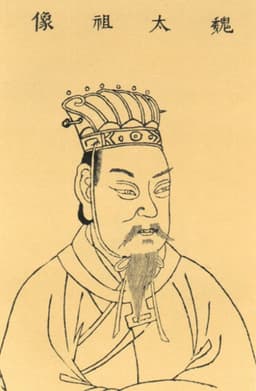
Cao Cao
General · Ancient
77.5Total
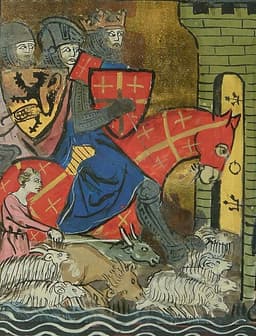
Godfrey of Bouillon
General · Medieval
52.2Total
Basic Information
Born
155
1060
Died
220
1100
Era
Ancient
Medieval
Nationality
China
Jerusalem
Occupation
General
General
Civilization
Eastern
Western
Score Comparison
Military (10%)
88.0
60.0
Political (20%)
59.0
37.9
Influence (20%)
82.0
55.7
Legacy (20%)
83.0
47.5
Leadership (15%)
64.4
54.2
Strategy (15%)
89.4
66.3
TOTAL
77.5
52.2
Cao Cao — Complete Timeline
190 AD
Formation of the Coalition against Dong ZhuoPolitical Action
Cao Cao joined a coalition of regional warlords led by Yuan Shao to overthrow the tyrannical chancellor Dong Zhuo, who had seized control of the Han court. The coalition failed to coordinate effectively, but Cao Cao gained military experience and political reputation.
CoalitionDong ZhuoHan Dynasty
Impact: national
196 AD
Implementation of Tuntian (Agricultural Colonies)Reform◆ Major
Cao Cao established military agricultural colonies (tuntian) to provide food for his army and refugees. Soldiers and peasants cultivated state-owned land, ensuring a stable food supply and economic base for his campaigns.
AgricultureEconomyMilitary
Impact: regionalconstructive
200 AD
Battle of GuanduWar
Cao Cao decisively defeated Yuan Shao's numerically superior army at Guandu. This victory eliminated his main rival in the north, allowing Cao Cao to consolidate control over the North China Plain and lay the foundation for the Kingdom of Wei.
BattleYuan ShaoUnification
Impact: regional
208 AD
Battle of Red CliffsWar
Cao Cao's southern campaign was halted by the allied forces of Sun Quan and Liu Bei at the Battle of Red Cliffs. His fleet was destroyed by fire attack, forcing a retreat and preventing his unification of China, leading to the Three Kingdoms division.
BattleDefeatThree Kingdoms
Impact: regional
213 AD
Establishment of the Kingdom of WeiPolitical Action◆ Major
Cao Cao was granted the title of Duke of Wei and later King of Wei by the Han emperor, effectively creating a semi-autonomous state within the empire. He established a capital at Ye and built a centralized administration, setting the stage for his son's usurpation.
WeiStatehoodHan Dynasty
Impact: national
Godfrey of Bouillon — Complete Timeline
1096 AD
Leadership of the First CrusadeWar◆ Major
Godfrey of Bouillon was a key leader of the First Crusade, commanding an army from Lorraine. He participated in the Siege of Nicaea, the Battle of Dorylaeum, and the Siege of Antioch, and was instrumental in the capture of Jerusalem in 1099.
CrusadeFirst CrusadeJerusalem
Impact: global
1099 AD
Capture of JerusalemWar
Godfrey led the successful assault on Jerusalem on July 15, 1099, ending Muslim rule. The capture was followed by a massacre of the city's Jewish and Muslim inhabitants. Godfrey was elected as the first ruler of the Kingdom of Jerusalem.
CrusadeJerusalemMassacre
Impact: globaldestructive
Battle of AscalonWar◆ Major
Godfrey led the Crusader army to victory against a Fatimid Egyptian force at Ascalon, securing the new kingdom's southern border. The victory prevented an immediate Muslim reconquest of Jerusalem.
BattleCrusader KingdomFatimids
Impact: regional
Election as Advocate of the Holy SepulchrePolitical Action◆ Major
After the capture of Jerusalem, Godfrey was elected as the ruler of the kingdom, but he refused the title of king, instead taking the title Advocatus Sancti Sepulchri (Advocate of the Holy Sepulchre). This established the Crusader state.
Crusader KingdomJerusalemTitle
Impact: regional
1100 AD
Death and SuccessionPolitical Action◆ Major
Godfrey died in 1100, possibly from illness or a wound. His brother Baldwin I succeeded him as the first king of Jerusalem. Godfrey's death left the kingdom in a precarious position, but Baldwin's leadership expanded it.
DeathSuccessionCrusader Kingdom
Impact: regionaltragic
Expert Analysis
Cao Cao vs Godfrey of Bouillon
# Two Swords, Two Worlds
On a summer day in 200, the plains of Guandu in northern China trembled under the hooves of charging cavalry. Cao Cao, outnumbered ten to one, watched his carefully laid trap spring shut on Yuan Shao’s army. Ninety years later and six thousand miles away, Godfrey of Bouillon stood atop the walls of Jerusalem, his sword dripping with blood as Crusader banners replaced Muslim crescents. Both men were generals who carved kingdoms from chaos. But one built an empire that would outlast him; the other founded a kingdom that crumbled within a generation. The difference was not in their courage but in their minds.
Origins
Cao Cao was born in 155 into a world dissolving. The Han dynasty, which had ruled China for four centuries, was rotting from within—eunuchs controlled the court, corruption sapped the treasury, and peasant rebellions ignited the countryside. His father was a foster son of a powerful eunuch, giving Cao Cao access to the elite while marking him with a stain of illegitimacy. He grew up shrewd, ruthless, and hungry—a boy who learned early that status meant nothing without power to back it.
Godfrey of Bouillon, born around 1060, came from the opposite world. He was a Frankish noble of impeccable lineage, descended from Charlemagne. His Europe was fractured but spiritually united: the Church provided the only universal authority, and the call of Pope Urban II to reclaim Jerusalem in 1095 gave ambitious knights a holy purpose. Godfrey was a product of his age—pious, brave, and bound by the codes of chivalry that demanded honor over cunning.
Rise to Power
Cao Cao’s path was a ladder of blood and calculation. In 190, he joined the coalition against Dong Zhuo, the tyrannical chancellor who had kidnapped the emperor. When the coalition dissolved into squabbling warlords, Cao Cao saw the truth: the old order was dead, and only the cleverest would survive. He spent the next decade absorbing smaller territories, building alliances, and perfecting his army. His turning point came in 196, when he seized the puppet Emperor Xian and established his capital at Xuchang. From that moment, Cao Cao ruled in the emperor’s name—a masterstroke of political legitimacy that his rivals never matched.
Godfrey’s rise was simpler. He sold or mortgaged his lands to fund his crusade, then marched east with 40,000 men. His leadership was tested at the grueling Siege of Antioch in 1098, where starvation and betrayal nearly destroyed the Crusader army. Godfrey held his men together through sheer presence and faith. When the crusaders finally breached Jerusalem on July 15, 1099, Godfrey was the first over the wall—a feat of personal bravery that made him the natural choice to rule the conquered city.
Leadership & Governance
Here the two men diverged completely. Cao Cao governed like an engineer building a machine. He implemented the *tuntian* system in 196, turning soldiers and refugees into farming colonies that fed his army without draining the countryside. He recruited talent without regard for birth—his generals included former enemies, bandits, and commoners. He wrote poetry, studied strategy, and personally directed every campaign. His military genius was systematic: he used spies, logistics, and psychological warfare as precisely as he used cavalry charges.
Godfrey ruled Jerusalem for barely a year, and his governance reflected the crusade’s contradictions. He refused the title of king, calling himself only “Advocate of the Holy Sepulchre”—a pious gesture that left his authority ambiguous. He faced constant threats from Fatimid Egypt and from rival crusader lords who saw him as first among equals, not a sovereign. His victory at Ascalon in 1099 secured the kingdom’s southern flank, but he had no time to build institutions, no *tuntian* to feed his people, no bureaucracy to outlast him.
Triumph & Tragedy
Cao Cao’s greatest triumph was Guandu in 200, where he burned Yuan Shao’s supply wagons and annihilated an army three times his size. His greatest tragedy came eight years later at Red Cliffs, where his ambition overreached. In 208, he launched a massive invasion of the south, only to see his fleet burned by the allied forces of Sun Quan and Liu Bei. The defeat was total—he retreated north, his dream of a unified China shattered. He spent his remaining years consolidating what he held, never again attempting the crossing.
Godfrey’s triumph and tragedy were the same day: the capture of Jerusalem. He achieved what centuries of Christendom had failed to do. But the massacre that followed—thousands of Muslims and Jews slaughtered in the streets—poisoned the kingdom from birth. Godfrey died in 1100, possibly from a wound or typhus, leaving a realm that survived on crusader reinforcements from Europe, never taking root in the soil it conquered.
Character & Destiny
Cao Cao was a pragmatist who quoted Confucius while burning villages. He once said, “Better to wrong the world than have the world wrong me”—a philosophy that allowed him to execute rivals, betray allies, and rule through fear when necessary. Yet he also wept for fallen friends and wrote tender poems about the moon. His complexity made him dangerous: he could be merciful one day, merciless the next, and no one could predict which.
Godfrey was simpler—a knight who believed his cause was just and his enemies were evil. He refused the crown of Jerusalem because, he said, “I will not wear a crown of gold where my Savior wore a crown of thorns.” That piety inspired his men but limited his politics. He could conquer but not govern, inspire but not scheme.
Legacy
Cao Cao’s Kingdom of Wei became the foundation of the Three Kingdoms, and his military writings influenced Chinese strategy for two millennia. In popular culture, he is remembered as a brilliant villain—the cunning fox of the Romance of the Three Kingdoms. But historians know him as the man who preserved Chinese civilization when the Han collapsed, who fed the hungry and promoted talent, who built an empire on the ashes of an age.
Godfrey’s Kingdom of Jerusalem lasted barely two centuries before falling to Saladin. He is remembered as a crusader hero, the ideal Christian knight, but his legacy is tangled in the violence of his conquest. For the West, he is a symbol of faith; for the Middle East, a symbol of invasion.
Conclusion
Standing at opposite ends of the medieval world, Cao Cao and Godfrey of Bouillon faced the same question: how do you build order from chaos? Godfrey answered with faith and courage, and his kingdom died with him. Cao Cao answered with cunning and institutions, and his empire shaped a civilization. The difference was not in their swords but in their minds—one looked to heaven for his mandate, the other to the earth beneath his feet. History, it seems, rewards those who build for this world, not the next.
Rankings
🥇
Cao CaoLeader
Mil: 88.0Pol: 59.0Inf: 82.0
77.5
🥈
Godfrey of Bouillon
Mil: 60.0Pol: 37.9Inf: 55.7
52.2
+25.3 behind
How This Comparison Works
Algorithm
Each figure is scored on 6 dimensions (0—100 scale) based on structured historical data: Military (10%), Political (20%), Influence (20%), Legacy (20%), Leadership (15%), Strategy (15%). The weighted total produces the final ranking.
Data Sources
Scores are computed from structured sub-indicators in the database. Scale factors adjust for era (Ancient ×0.85, Modern ×1.0) and civilization size (Eastern ×1.05, Other ×0.80) to account for differences in population and military scale.
Maximum 3 Figures
Comparisons are limited to 2—3 figures to ensure readability and statistical meaningfulness.
Error Margins
±5 points per dimension — Sub-scores are derived from historical records with inherent uncertainty. Two figures within 5 points on a dimension should be considered roughly equivalent in that area.
Total Score Accuracy
±3 points overall — The weighted combination of 6 dimensions produces a total score with approximately ±3 points of uncertainty. Differences of less than 3 points are not statistically significant— the figures are effectively tied.
Known Limitations
- Historical records are incomplete and uneven across civilizations
- Figures from oral-tradition societies may be underrepresented
- Occupation labels can misclassify multi-role figures
- Scores measure capability and impact, not moral character
- Quantitative scoring is a comparison tool, not absolute truth
Capability Radar
Military (10%) — Battles & Warfare
Battles
95
65
Win Rate
88
60
Expansion
92
55
Political (20%) — Governance & Reform
Reform
88
25
Diplomacy
82
40
Economy
86
20
Influence (20%) — Cultural & Global Reach
Cultural
85
55
Global
75
50
Legacy (20%) — Historical Impact
Historical
92
60
Longevity
90
55
Leadership (15%) — Power & Stability
Tenure
85
30
Stability
78
25
Strategy (15%) — Tactics & Innovation
Strategy
96
60
Tactics
97
55
Reform
90
30
Similar Comparisons
Comments & Discussion
DukeOfDecimation6/16/2026
Cao Cao would’ve eaten Godfrey alive in a tactical duel. Godfrey’s siege of Jerusalem was by the book—brutal, yes, but riding Crusader momentum and sheer numbers. Cao Cao turned a ruined grain supply at Guandu into a strategic masterstroke, burning Yuan Shao’s depots after losing his own. Godfrey never faced a logistical nightmare like that. One founded a kingdom on faith; the other on famine and foresight. Give me the man who outthinks starvation.
断头侯6/16/2026
戈弗雷就是个神棍工具人,靠教皇喊一嗓子拉起来的乌合之众打了一场血战。耶路撒冷陷落后不到一年他就死了,十字军王国全靠罗马输血才苟延残喘。曹操呢?赤壁输了照样稳住北方,二十年内曹魏南征北伐不断。戈弗雷连继承人都留不下,曹操的儿子曹丕直接篡汉称帝。一个活不到第二幕的配角,和一个撑起整部剧的主角,比什么比?
NumericNemesis6/16/2026
Let’s stop romanticizing. Cao Cao’s “outnumbered ten to one" is a myth inflated by Records of the Three Kingdoms to make Yuan Shao’s incompetence seem greater. Real casualty estimates at Guandu put Cao at roughly 10,000 vs Yuan’s 50,000—still a win, but not Thermopylae. Godfrey’s Jerusalem siege had 15,000 Crusaders against maybe 30,000 defenders, including Egyptians who arrived too late. Both won, but Godfrey’s victory broke the back of Fatimid power in the Levant for decades. Cao Cao’s win jus
哲史留名6/16/2026
从文明断裂看,戈弗雷是欧洲封建宗教秩序的缩影,他统治的耶路撒冷王国靠骑士领地和教会封地维持,三十年就丢了城市。曹操终结了东汉的神权-贵族联盟,推行屯田制和寒门法家路线,为曹魏打下制度建设根基。戈弗雷死后十字军内部还在争王位,曹操死时北方已经完成统一基业。一个是宗教狂热的泡沫,一个是官僚理性的钢筋。历史会忘记泡沫,但会记住钢筋。
TheRedWolf6/16/2026
Stop simping for the Crusader. Godfrey didn't even want the crown—he took "Advocate of the Holy Sepulcher" like a Holy Land hipster avoiding titles. Cao Cao craved power, admitted it, and acted on it without religious cover. Godfrey slaughtered thousands in Jerusalem, then prayed. Cao Cao ordered the massacre of Xu province, yes, but you know why? To send a message. Godfrey was a symbol; Cao Cao was a system-builder. I'll take the man who calls his ambition by