Loading...
Godfrey of Bouillon vs Julius Caesar
Julius Caesar leads by 30.6 pts · 2 figures compared
…
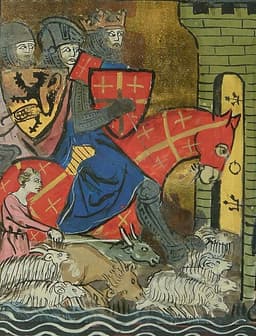
Godfrey of Bouillon
General · Medieval
52.2Total

Julius Caesar
General · Ancient
82.8Total
Basic Information
Born
1060
-100
Died
1100
-44
Era
Medieval
Ancient
Nationality
Jerusalem
Roman Republic
Occupation
General
General
Civilization
Western
Western
Score Comparison
Military (10%)
60.0
88.0
Political (20%)
37.9
78.0
Influence (20%)
55.7
85.0
Legacy (20%)
47.5
82.0
Leadership (15%)
54.2
80.0
Strategy (15%)
66.3
85.0
TOTAL
52.2
82.8
Godfrey of Bouillon — Complete Timeline
1096 AD
Leadership of the First CrusadeWar◆ Major
Godfrey of Bouillon was a key leader of the First Crusade, commanding an army from Lorraine. He participated in the Siege of Nicaea, the Battle of Dorylaeum, and the Siege of Antioch, and was instrumental in the capture of Jerusalem in 1099.
CrusadeFirst CrusadeJerusalem
Impact: global
1099 AD
Capture of JerusalemWar
Godfrey led the successful assault on Jerusalem on July 15, 1099, ending Muslim rule. The capture was followed by a massacre of the city's Jewish and Muslim inhabitants. Godfrey was elected as the first ruler of the Kingdom of Jerusalem.
CrusadeJerusalemMassacre
Impact: globaldestructive
Battle of AscalonWar◆ Major
Godfrey led the Crusader army to victory against a Fatimid Egyptian force at Ascalon, securing the new kingdom's southern border. The victory prevented an immediate Muslim reconquest of Jerusalem.
BattleCrusader KingdomFatimids
Impact: regional
Election as Advocate of the Holy SepulchrePolitical Action◆ Major
After the capture of Jerusalem, Godfrey was elected as the ruler of the kingdom, but he refused the title of king, instead taking the title Advocatus Sancti Sepulchri (Advocate of the Holy Sepulchre). This established the Crusader state.
Crusader KingdomJerusalemTitle
Impact: regional
1100 AD
Death and SuccessionPolitical Action◆ Major
Godfrey died in 1100, possibly from illness or a wound. His brother Baldwin I succeeded him as the first king of Jerusalem. Godfrey's death left the kingdom in a precarious position, but Baldwin's leadership expanded it.
DeathSuccessionCrusader Kingdom
Impact: regionaltragic
Julius Caesar — Complete Timeline
58 BC
Gallic WarsWar◆ Major
Caesar, as proconsul of Gaul, launched a series of campaigns that conquered all of Gaul (modern France, Belgium, and parts of Switzerland). He fought numerous battles, including against the Helvetii, the Belgae, and the Gallic chieftain Vercingetorix. The wars brought immense wealth and a loyal army to Caesar.
Gallic WarsConquestRoman Expansion
Impact: regional
49 BC
Crossing the RubiconPolitical Action◆ Major
Caesar led Legio XIII across the Rubicon River into Italy, defying the Roman Senate's order to disband his army. This act triggered a civil war against Pompey and the Optimates, ultimately leading to Caesar's dictatorship and the end of the Roman Republic.
Roman Civil WarEnd of RepublicPower Struggle
Impact: global
48 BC
Battle of PharsalusWar◆ Major
Caesar's outnumbered army defeated the larger forces of Pompey the Great at Pharsalus in Greece. Caesar's tactical use of a reserve line to counter Pompey's cavalry charge proved decisive. Pompey fled to Egypt, where he was assassinated, leaving Caesar as the undisputed master of the Roman world.
Roman Civil WarBattleDecisive Victory
Impact: regional
44 BC
Appointment as Dictator for LifePolitical Action◆ Major
The Roman Senate appointed Caesar dictator perpetuo (dictator for life), granting him unprecedented personal power. This move concentrated military, legislative, and judicial authority in one person, effectively ending the Roman Republic's traditional system of checks and balances and alarming many senators.
DictatorshipEnd of RepublicPower Consolidation
Impact: regionaldestructive
Assassination on the Ides of MarchPolitical Action◆ Major
A group of Roman senators, led by Marcus Junius Brutus and Gaius Cassius Longinus, stabbed Caesar to death at a meeting of the Senate in the Theatre of Pompey. The assassination was intended to restore the Republic, but instead triggered another civil war that led to the rise of the Roman Empire.
AssassinationRoman PoliticsEnd of Republic
Impact: globaldestructive
Expert Analysis
Julius Caesar vs Godfrey of Bouillon
# The Conqueror and the Crusader
On a January morning in 49 BCE, a Roman general stood at the banks of a small river in northern Italy. Ahead lay Rome, and behind him lay a decision that would echo through millennia. Julius Caesar paused, then spoke a phrase that has become legend: "The die is cast." He crossed the Rubicon, and the Republic never recovered. A thousand years later, another general climbed the walls of Jerusalem, his sword wet with blood, and when offered a golden crown, he refused it, saying he would not wear a crown of gold where his Savior had worn a crown of thorns. Two men, two crossings, two fates. Both shaped the West. But why did one become the father of an empire, and the other a footnote in a saga that would outlive him?
Origins
Caesar was born into the patrician Julian clan, a family that traced its lineage to the goddess Venus. But by 100 BCE, the Julii were politically marginal. Young Caesar grew up in a Rome torn by civil war, where Marius and Sulla butchered their enemies and the old republican virtues rotted from within. He learned early that in a world of wolves, you must be the sharpest fang. His education was ruthless: rhetoric, military command, and the art of debt—he borrowed fortunes to buy influence, understanding that power in Rome was a commodity to be purchased.
Godfrey of Bouillon, born in 1060, emerged from the feudal chaos of Lorraine, a region that straddled modern France and Germany. He was the second son of Count Eustace II, a minor noble who had fought at Hastings. The Church was the only ladder for such men, but Godfrey chose the sword over the cross—or rather, he bound them together. The First Crusade, called by Pope Urban II in 1095, offered a desperate nobility a way out: salvation, land, and glory. Godfrey pawned his castle to raise an army. He was a man of his age, where faith and violence were indistinguishable.
Rise to Power
Caesar’s path was a masterclass in patience and audacity. He served as a military tribune, then quaestor in Spain, where he wept before a statue of Alexander the Great, lamenting that he had conquered the world by his age while Caesar had done nothing. He climbed the *cursus honorum*—the ladder of Roman offices—each step greased by bribes and alliances. The First Triumvirate with Pompey and Crassus in 60 BCE was his masterstroke: an illegal pact that gave him command in Gaul. There, over eight years, he conquered a million men, enslaved another million, and wrote *Commentaries* that made him a legend.
Godfrey rose differently. The Crusade was a collective madness and a calculated gamble. He led the Army of Lorraine through Hungary and Anatolia, surviving starvation and ambush. At the Siege of Antioch in 1098, the crusaders were themselves besieged, reduced to eating leather. Godfrey fought with a fury that earned him the title "Defender of the Holy Sepulchre." But he was never the supreme commander—that role fell to Bohemond of Taranto and Raymond of Toulouse. Godfrey was a lieutenant, a man of faith and steel, but not of political genius.
Leadership & Governance
Caesar governed as he commanded: with speed, clemency, and calculation. As dictator, he reformed the calendar, extended citizenship to provincials, and launched public works that employed the poor. His military genius lay in logistics and speed—he built a bridge across the Rhine in ten days, invaded Britain twice, and at the Battle of Alesia in 52 BCE, he starved a Gallic army of 80,000 into submission while besieging their fortress. He pardoned his enemies, but only to weaken them. His rule was a velvet glove over an iron fist.
Godfrey’s governance was brief and saintly. After the capture of Jerusalem on July 15, 1099—a massacre so complete that blood reportedly reached the horses' bridles—he was elected ruler. But he refused the title "king," calling himself "Advocate of the Holy Sepulchre," a caretaker for Christ. He fought only one major battle, at Ascalon in August 1099, where he defeated a Fatimid army. He issued no laws, built no monuments, and died in 1100, possibly from typhoid or a wound. His kingdom was a fragile outpost, surrounded by enemies, held together by faith and fear.
Triumph & Tragedy
Caesar’s triumph was the conquest of Gaul and the defeat of Pompey at Pharsalus in 48 BCE. His tragedy was the Ides of March, 44 BCE, when sixty senators stabbed him to death. He had centralized power but failed to secure loyalty. His last words—"Et tu, Brute?"—are apocryphal, but the meaning is real: he trusted the men who killed him.
Godfrey’s triumph was the capture of Jerusalem, the climax of a thousand-year Christian dream. His tragedy was his death, just one year later. He never saw his kingdom grow. His brother Baldwin took the crown Godfrey had refused, and the Kingdom of Jerusalem lasted another 88 years, but Godfrey’s name became a symbol, not a reality.
Character & Destiny
Caesar was a gambler who calculated every risk. He divorced his wife because "Caesar’s wife must be above suspicion," yet he slept with Cleopatra and flaunted it. He was generous to a fault, but his generosity was a weapon. He believed in his own star, and history proved him right—his adopted son Octavian became Augustus, the first Roman emperor.
Godfrey was a knight of faith, not of reason. He prayed before battle, refused riches, and died without heirs. His destiny was not to build but to begin. He was the first, and that is enough.
Legacy
Caesar’s legacy is the Roman Empire, and through it, Western civilization. His name became a title: Kaiser, Tsar. His *Commentaries* are still read in military academies. He transformed the Republic into a monarchy, and his assassination only accelerated that change.
Godfrey’s legacy is the Crusader ideal. He appears in Dante’s *Paradiso*, in Tasso’s *Jerusalem Delivered*, and in every romantic vision of the Crusades. His score of 62.9 on the historical scale reflects a man who was more symbol than substance. But symbols matter.
Conclusion
Two men, separated by a millennium, crossed thresholds into the unknown. Caesar crossed a river and changed the world. Godfrey climbed a wall and changed the soul. One sought power; the other sought salvation. Both found what they sought, and both were consumed by it. The difference lies not in their achievements but in their ambitions: Caesar wanted to be remembered as a god, and Godfrey wanted to be forgotten as a man. History, in its irony, remembered them both—but for very different reasons.
Rankings
🥇
Julius CaesarLeader
Mil: 88.0Pol: 78.0Inf: 85.0
82.8
🥈
Godfrey of Bouillon
Mil: 60.0Pol: 37.9Inf: 55.7
52.2
+30.6 behind
How This Comparison Works
Algorithm
Each figure is scored on 6 dimensions (0—100 scale) based on structured historical data: Military (10%), Political (20%), Influence (20%), Legacy (20%), Leadership (15%), Strategy (15%). The weighted total produces the final ranking.
Data Sources
Scores are computed from structured sub-indicators in the database. Scale factors adjust for era (Ancient ×0.85, Modern ×1.0) and civilization size (Eastern ×1.05, Other ×0.80) to account for differences in population and military scale.
Maximum 3 Figures
Comparisons are limited to 2—3 figures to ensure readability and statistical meaningfulness.
Error Margins
±5 points per dimension — Sub-scores are derived from historical records with inherent uncertainty. Two figures within 5 points on a dimension should be considered roughly equivalent in that area.
Total Score Accuracy
±3 points overall — The weighted combination of 6 dimensions produces a total score with approximately ±3 points of uncertainty. Differences of less than 3 points are not statistically significant— the figures are effectively tied.
Known Limitations
- Historical records are incomplete and uneven across civilizations
- Figures from oral-tradition societies may be underrepresented
- Occupation labels can misclassify multi-role figures
- Scores measure capability and impact, not moral character
- Quantitative scoring is a comparison tool, not absolute truth
Capability Radar
Military (10%) — Battles & Warfare
Battles
65
95
Win Rate
60
92
Expansion
55
97
Political (20%) — Governance & Reform
Reform
25
90
Diplomacy
40
85
Economy
20
82
Influence (20%) — Cultural & Global Reach
Cultural
55
88
Global
50
94
Legacy (20%) — Historical Impact
Historical
60
95
Longevity
55
96
Leadership (15%) — Power & Stability
Tenure
30
75
Stability
25
60
Strategy (15%) — Tactics & Innovation
Strategy
60
94
Tactics
55
96
Reform
30
88
Similar Comparisons
Comments & Discussion
RubiconRider6/16/2026
Caesar understood that power flows from decisive action, not piety. Godfrey refused a crown in Jerusalem out of religious humility — a noble gesture, but one that doomed the Crusader states to weak, factional leadership. Caesar crossed the Rubicon knowing that hesitation equals death in politics. Godfrey hesitated at the moment of institutional creation, and the Kingdom of Jerusalem crumbled within generations. Piety doesn't build empires; ruthless pragmatism does.
数据侦探6/16/2026
说Godfrey是"历史上伟大的征服者"太牵强了。1099年攻陷耶路撒冷时,他的兵力最多1.5万人,对手法蒂玛王朝内部分裂且瘟疫横行。相比之下,Caesar在高卢战役中消灭了超过100万敌人,占领了800多座城市。历史爱好者总爱渲染十字军的神圣光环,但数据会说话:Godfrey的军事成就跟Caesar根本不在一个量级上。
CrownRefuser6/16/2026
The real contrast isn't military — it's in how each man used martyrdom. Caesar became a martyr for tyranny, assassinated by idealists, which ironically birthed the imperial system he wanted. Godfrey lived as a living martyr, rejecting earthly crowns to embody Christ's suffering servant. That choice gave the Crusader movement its most potent symbol: a leader who conquered not for glory but for God. Which legacy would you rather build your civilization on?
古典学人6/16/2026
有趣的是两人都面对"宪政危机"的不同抉择。Caesar跨过卢比孔河是对罗马共和体制的致命一击,而Godfrey拒绝在耶稣戴荆棘冠冕的地方戴金冠——这不仅是宗教虔诚,更是一种政治智慧:他明白在十字军各派系间称王会立刻引发内战。结果Godfrey选择"圣墓守护者"的头衔,反而获得了比Caesar更持久的政治合法性。有些权力,不握在手里反而更强大。
RevisionistAxe6/16/2026
Let's stop romanticizing both. Caesar was a bankrupt aristocrat who waged illegal wars of genocide against the Gauls to pay off his debts to Crassus. Godfrey was one of many petty lords who joined the Crusade after failing to hold his own lands against local rivals — the First Crusade was basically a mass emigration of bankrupt European gentry looking to loot the East. Call them "great men" all you want, but the reality is they were opportunistic debt-collectors with swords.