Loading...
Godfrey of Bouillon vs Napoleon Bonaparte
Napoleon Bonaparte leads by 18.7 pts · 2 figures compared
…
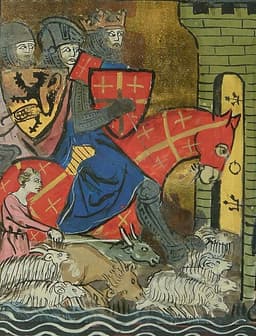
Godfrey of Bouillon
General · Medieval
52.2Total

Napoleon Bonaparte
General · Modern
70.9Total
Basic Information
Born
1060
1769
Died
1100
1821
Era
Medieval
Modern
Nationality
Jerusalem
France
Occupation
General
General
Civilization
Western
Western
Score Comparison
Military (10%)
60.0
94.0
Political (20%)
37.9
72.0
Influence (20%)
55.7
40.0
Legacy (20%)
47.5
80.0
Leadership (15%)
54.2
78.0
Strategy (15%)
66.3
90.0
TOTAL
52.2
70.9
Godfrey of Bouillon — Complete Timeline
1096 AD
Leadership of the First CrusadeWar◆ Major
Godfrey of Bouillon was a key leader of the First Crusade, commanding an army from Lorraine. He participated in the Siege of Nicaea, the Battle of Dorylaeum, and the Siege of Antioch, and was instrumental in the capture of Jerusalem in 1099.
CrusadeFirst CrusadeJerusalem
Impact: global
1099 AD
Capture of JerusalemWar
Godfrey led the successful assault on Jerusalem on July 15, 1099, ending Muslim rule. The capture was followed by a massacre of the city's Jewish and Muslim inhabitants. Godfrey was elected as the first ruler of the Kingdom of Jerusalem.
CrusadeJerusalemMassacre
Impact: globaldestructive
Battle of AscalonWar◆ Major
Godfrey led the Crusader army to victory against a Fatimid Egyptian force at Ascalon, securing the new kingdom's southern border. The victory prevented an immediate Muslim reconquest of Jerusalem.
BattleCrusader KingdomFatimids
Impact: regional
Election as Advocate of the Holy SepulchrePolitical Action◆ Major
After the capture of Jerusalem, Godfrey was elected as the ruler of the kingdom, but he refused the title of king, instead taking the title Advocatus Sancti Sepulchri (Advocate of the Holy Sepulchre). This established the Crusader state.
Crusader KingdomJerusalemTitle
Impact: regional
1100 AD
Death and SuccessionPolitical Action◆ Major
Godfrey died in 1100, possibly from illness or a wound. His brother Baldwin I succeeded him as the first king of Jerusalem. Godfrey's death left the kingdom in a precarious position, but Baldwin's leadership expanded it.
DeathSuccessionCrusader Kingdom
Impact: regionaltragic
Napoleon Bonaparte — Complete Timeline
1799 AD
Coup of 18 BrumaireOther◆ Major
Napoleon Bonaparte, with support from his brother Lucien and key political figures, overthrew the Directory in a bloodless coup. He established the Consulate with himself as First Consul, effectively becoming the ruler of France. This event ended the French Revolution's most unstable period.
French RevolutionCoupRise to Power
Impact: regional
1804 AD
Promulgation of the Napoleonic CodeOther◆ Major
Napoleon enacted the Civil Code of the French, known as the Napoleonic Code, a comprehensive set of laws that replaced the fragmented feudal legal systems. The code established legal equality, protected property rights, and secularized law. It became the basis for legal systems in many European and world countries.
Legal ReformNapoleonic CodeCivil Law
Impact: globalconstructive
1805 AD
Battle of AusterlitzWar◆ Major
Napoleon's Grande Arm
Napoleonic WarsBattleDecisive Victory
Impact: global
1812 AD
Invasion of RussiaWar◆ Major
Napoleon led the Grande Arm
Napoleonic WarsInvasionDisaster
Impact: globaldestructive
1815 AD
Battle of WaterlooWar◆ Major
Napoleon's French army was defeated by the combined forces of the Duke of Wellington's Anglo-Allied army and Gebhard Leberecht von Bl
Napoleonic WarsBattleFinal Defeat
Impact: globaldestructive
Expert Analysis
Napoleon Bonaparte vs Godfrey of Bouillon
# The Conqueror and the Crusader: Two Visions of Power
On a July morning in 1099, Godfrey of Bouillon stood atop the walls of Jerusalem, his sword dripping with blood, as his Crusader army poured into the city. The air was thick with dust and the cries of the dying. Godfrey had achieved the impossible: after three years of marching, starving, and fighting, he had reclaimed the holiest city in Christendom. Seven centuries later, on a June evening in 1815, Napoleon Bonaparte watched his Imperial Guard break and flee at Waterloo. The man who had conquered Europe from Madrid to Moscow was now a beaten fugitive, his dreams of empire dissolving into the Belgian mud. Both men sought to reshape the world through conquest. One built a kingdom that lasted barely a century; the other built a legend that reshaped the modern age. Why did their paths diverge so dramatically?
Origins
Godfrey of Bouillon was born around 1060 into the turbulent world of feudal Europe, a continent fractured into warring duchies and petty kingdoms. He was the second son of Count Eustace II of Boulogne, raised in the shadow of the Holy Roman Empire, a world where piety and violence were inseparable. His era was defined by faith—the Church’s call to reclaim Jerusalem from Muslim rule gave ambitious nobles a divine purpose. Godfrey’s upbringing taught him that power came from God and that a leader’s duty was to serve, not to dominate.
Napoleon Bonaparte, born in 1769 on the island of Corsica, entered a very different world. The French Revolution had shattered the old order of kings and nobles, replacing it with a volatile mix of republican ideals, military ambition, and raw opportunity. Napoleon’s Corsican family was minor nobility, but he was educated in mainland France, where he absorbed the Enlightenment’s faith in reason and merit. His era taught him that a man could rise by talent alone—and that the world was a chessboard to be mastered.
Rise to Power
Godfrey’s path to power was typical for a medieval noble: inheritance, marriage, and warfare. He fought for the Holy Roman Emperor Henry IV, earning a reputation for skill and loyalty. But his true moment came in 1096, when Pope Urban II’s call for a Crusade electrified Europe. Godfrey sold his lands to fund an army of 40,000 men from Lorraine, becoming one of the few Crusade leaders who was genuinely motivated by faith rather than greed. His rise was not self-made—it was a response to a collective religious frenzy.
Napoleon’s ascent was a study in calculated ambition. In 1793, at just 24, he distinguished himself at the Siege of Toulon, using innovative artillery tactics to drive out British forces. By 1796, he was commanding the French army in Italy, where his lightning campaigns stunned Europe. He was not born into power; he seized it. In 1799, he staged a coup and made himself First Consul, then Emperor in 1804. His rise was a product of revolution, chaos, and his own relentless will.
Leadership & Governance
Godfrey’s leadership was shaped by the constraints of his time. After capturing Jerusalem in 1099, he was elected ruler—but he refused the title of king, calling himself instead “Advocate of the Holy Sepulchre.” This was not mere humility; it reflected a medieval worldview where ultimate authority belonged to God and the Church. Godfrey governed as a military commander, focusing on defending the fragile Crusader kingdom. His victory at the Battle of Ascalon in 1099 secured Jerusalem’s southern border, but he lacked the political machinery to build a lasting state. He died in 1100, possibly from illness or a battle wound, after just one year of rule.
Napoleon governed on a vastly different scale. As Emperor of the French, he reformed law through the Napoleonic Code, centralized administration, and created a merit-based bureaucracy. His military genius was legendary: he won 60 of 70 battles, using speed, deception, and massed artillery. But his political wisdom was flawed. He placed his brothers on European thrones, alienated potential allies, and invaded Russia in 1812 with 600,000 men—a catastrophic miscalculation. His leadership was a paradox: brilliant in conception, hubristic in execution.
Triumph & Tragedy
Godfrey’s greatest triumph was the capture of Jerusalem itself. On July 15, 1099, after a grueling siege, his forces breached the walls and massacred the city’s Muslim and Jewish defenders. For medieval Christendom, it was a miracle; for posterity, it remains a bloody symbol of religious violence. His tragedy was that he did not live to consolidate his victory. His kingdom survived by the sword, constantly threatened by Muslim counterattacks, and fell a century later.
Napoleon’s triumphs were staggering: Austerlitz in 1805, where he destroyed an Austro-Russian army; Jena in 1806, where he crushed Prussia; and his empire that stretched from Spain to Poland. His tragedy was the invasion of Russia in 1812, where winter and scorched-earth tactics annihilated his Grand Army. Exiled to Elba, he returned for a final gamble at Waterloo in 1815, but the Duke of Wellington’s defense and Prussian reinforcements sealed his fate.
Character & Destiny
Godfrey was a man of his age: devout, dutiful, and bound by collective faith. He refused the crown of Jerusalem because he believed no man should wear a crown where Christ wore thorns. This humility limited his ambition—he built a kingdom for God, not for himself. His destiny was to be a symbol, not a shaper of history.
Napoleon was the opposite: a titan of ego and intellect who believed he could bend reality to his will. “Impossible is a word to be found only in the dictionary of fools,” he once said. His character drove him to conquer, reform, and ultimately overreach. His destiny was to remake Europe and then be destroyed by his own ambition.
Legacy
Godfrey of Bouillon is remembered as the idealized Crusader—a pious knight who reclaimed Jerusalem. His legacy is largely symbolic, a figure in medieval epics and nationalist myths. His military score of 66.3 and leadership score of 39.7 reflect a competent commander in a limited theater, not a world-historical genius.
Napoleon’s legacy is immense. His Napoleonic Code influenced legal systems worldwide; his wars redrew European borders; his ambition inspired both admiration and fear. With a military score of 94.0 and a political score of 75.0, he ranks among history’s greatest commanders and rulers. But his legacy is also a warning: the pursuit of glory without limits leads to ruin.
Conclusion
Godfrey and Napoleon were both conquerors, but they belonged to different worlds. Godfrey’s power was a vessel for faith; Napoleon’s was an expression of self. One built a kingdom that crumbled; the other built a legend that endures. Their stories remind us that history judges not just what we achieve, but what we are. In the end, the Crusader’s humility and the Emperor’s ambition both shaped their fates—and ours.
Rankings
🥇
Napoleon BonaparteLeader
Mil: 94.0Pol: 72.0Inf: 40.0
70.9
🥈
Godfrey of Bouillon
Mil: 60.0Pol: 37.9Inf: 55.7
52.2
+18.7 behind
How This Comparison Works
Algorithm
Each figure is scored on 6 dimensions (0—100 scale) based on structured historical data: Military (10%), Political (20%), Influence (20%), Legacy (20%), Leadership (15%), Strategy (15%). The weighted total produces the final ranking.
Data Sources
Scores are computed from structured sub-indicators in the database. Scale factors adjust for era (Ancient ×0.85, Modern ×1.0) and civilization size (Eastern ×1.05, Other ×0.80) to account for differences in population and military scale.
Maximum 3 Figures
Comparisons are limited to 2—3 figures to ensure readability and statistical meaningfulness.
Error Margins
±5 points per dimension — Sub-scores are derived from historical records with inherent uncertainty. Two figures within 5 points on a dimension should be considered roughly equivalent in that area.
Total Score Accuracy
±3 points overall — The weighted combination of 6 dimensions produces a total score with approximately ±3 points of uncertainty. Differences of less than 3 points are not statistically significant— the figures are effectively tied.
Known Limitations
- Historical records are incomplete and uneven across civilizations
- Figures from oral-tradition societies may be underrepresented
- Occupation labels can misclassify multi-role figures
- Scores measure capability and impact, not moral character
- Quantitative scoring is a comparison tool, not absolute truth
Capability Radar
Military (10%) — Battles & Warfare
Battles
65
95
Win Rate
60
90
Expansion
55
95
Political (20%) — Governance & Reform
Reform
25
95
Diplomacy
40
80
Economy
20
85
Influence (20%) — Cultural & Global Reach
Cultural
55
85
Global
50
90
Legacy (20%) — Historical Impact
Historical
60
95
Longevity
55
90
Leadership (15%) — Power & Stability
Tenure
30
85
Stability
25
70
Strategy (15%) — Tactics & Innovation
Strategy
60
95
Tactics
55
98
Reform
30
92
Similar Comparisons
Comments & Discussion
EMPEROR'S GHOST6/16/2026
Godfrey was a relic, a feudal lord who thought piety could hold Jerusalem. Napoleon's real genius? He saw war as total mobilization—the levee en masse, the Grande Armée's corps system, meritocracy over birthright. Godfrey's kingdom crumbled because he built a crusader castle on sand; Napoleon's legal codes and administrative reforms conquered Europe long after his exile. One won a city, the other reshaped modernity itself.|zh|戈弗雷是为信仰而战的封建领主,拿破仑才是现代战争的缔造者。看看奥斯特里茨战役的菱形方阵,再看看十字军那混乱的冲锋——拿破仑用军事学校培养了职
BoldEye806/16/2026
This comparison is absurd. Napoleon is Caesar's successor—a statesman-general who used law, propaganda, and institutional reform. Godfrey is from the world of Roland and the Chansons de Geste, where leadership was about personal charisma and divine favor. Napoleon died reading Tacitus and Caesar; Godfrey probably couldn't read Latin. They belong to different civilizations: one is Enlightenment reason, the other is medieval faith. Comparing them is like comparing a telescope to a stained-glass wi
SharpWatcher946/16/2026
Let's talk numbers: Napoleon commanded 600,000 men for the Russian campaign; Godfrey's entire army at Jerusalem was maybe 1,200 cavalry and 12,000 infantry. That's a junior corps commander vs. a national sovereign. But Napoleon's casualty rate per battle averaged 30% of his force—Godfrey fought smarter, with lower losses and higher strategic gains. The "genius" lost every major war after 1809. Godfrey lost zero battles and held his prize until death. Who's really the better tactician?|zh|别被浪漫传说骗