Loading...
Godfrey of Bouillon vs Sun Tzu
Sun Tzu leads by 8.6 pts · 2 figures compared
…
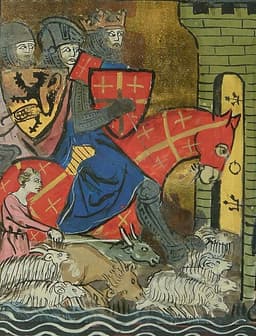
Godfrey of Bouillon
General · Medieval
52.2Total
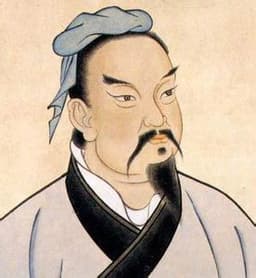
Sun Tzu
General · Ancient
60.8Total
Basic Information
Born
1060
-544
Died
1100
-496
Era
Medieval
Ancient
Nationality
Jerusalem
China
Occupation
General
General
Civilization
Western
Eastern
Score Comparison
Military (10%)
60.0
50.0
Political (20%)
37.9
35.0
Influence (20%)
55.7
85.0
Legacy (20%)
47.5
65.0
Leadership (15%)
54.2
30.0
Strategy (15%)
66.3
85.0
TOTAL
52.2
60.8
Godfrey of Bouillon — Complete Timeline
1096 AD
Leadership of the First CrusadeWar◆ Major
Godfrey of Bouillon was a key leader of the First Crusade, commanding an army from Lorraine. He participated in the Siege of Nicaea, the Battle of Dorylaeum, and the Siege of Antioch, and was instrumental in the capture of Jerusalem in 1099.
CrusadeFirst CrusadeJerusalem
Impact: global
1099 AD
Capture of JerusalemWar
Godfrey led the successful assault on Jerusalem on July 15, 1099, ending Muslim rule. The capture was followed by a massacre of the city's Jewish and Muslim inhabitants. Godfrey was elected as the first ruler of the Kingdom of Jerusalem.
CrusadeJerusalemMassacre
Impact: globaldestructive
Battle of AscalonWar◆ Major
Godfrey led the Crusader army to victory against a Fatimid Egyptian force at Ascalon, securing the new kingdom's southern border. The victory prevented an immediate Muslim reconquest of Jerusalem.
BattleCrusader KingdomFatimids
Impact: regional
Election as Advocate of the Holy SepulchrePolitical Action◆ Major
After the capture of Jerusalem, Godfrey was elected as the ruler of the kingdom, but he refused the title of king, instead taking the title Advocatus Sancti Sepulchri (Advocate of the Holy Sepulchre). This established the Crusader state.
Crusader KingdomJerusalemTitle
Impact: regional
1100 AD
Death and SuccessionPolitical Action◆ Major
Godfrey died in 1100, possibly from illness or a wound. His brother Baldwin I succeeded him as the first king of Jerusalem. Godfrey's death left the kingdom in a precarious position, but Baldwin's leadership expanded it.
DeathSuccessionCrusader Kingdom
Impact: regionaltragic
Sun Tzu — Complete Timeline
512 BC
Service as General for King Helü of WuWar◆ Major
Sun Tzu served as a general under King Hel
GeneralWuWar
Impact: regional
506 BC
Battle of BojuWar◆ Major
Sun Tzu is traditionally credited with contributing to the Wu victory at the Battle of Boju, where Wu forces defeated the larger Chu army. The battle demonstrated the application of strategic principles from The Art of War.
BattleWuChu
Impact: regional
500 BC
Composition of The Art of WarCultural
Sun Tzu authored The Art of War, a treatise on military strategy and tactics. The text covers planning, deception, terrain, and leadership, and has been studied for centuries in both military and civilian contexts worldwide.
Military StrategyClassicPhilosophy
Impact: globalconstructive
Expert Analysis
Sun Tzu vs Godfrey of Bouillon
# The Warrior and the Strategist: Sun Tzu and Godfrey of Bouillon
On a misty morning in 506 BCE, the marshes of central China echoed with the clash of bronze weapons as Wu forces outmaneuvered the mighty Chu army at Boju. Thirteen centuries later, on a scorching July day in 1099, crusaders scaled the walls of Jerusalem, their siege towers creaking under the weight of armored knights. Two victories, two worlds apart—yet both shaped by men whose names would outlive their empires. One wrote a book that would never be surpassed; the other seized a crown he refused to wear. What drove them, and why did their legacies diverge so sharply?
Origins
Sun Tzu was born into the waning years of China’s Spring and Autumn period (c. 544 BCE), an age of constant warfare between rival states. His precise origins remain shadowy—some accounts place him in the state of Qi, others in Wu—but the world he inhabited was one of feudal chaos, where a general’s survival depended on cunning as much as courage. The Warring States period loomed, and thinkers like Confucius were already reshaping Chinese philosophy. Sun Tzu absorbed this environment of intellectual ferment and military necessity, emerging as a man who saw war not as brute force but as a problem to be solved.
Godfrey of Bouillon (c. 1060–1100) was born into a very different chaos: the high medieval world of feudal Europe, where the Church wielded immense power and the dream of reclaiming Jerusalem burned in the hearts of knights. As the second son of Count Eustace II of Boulogne, Godfrey inherited little land but a fierce sense of religious duty. The First Crusade, called by Pope Urban II in 1095, offered him a path to glory and salvation. Where Sun Tzu’s China was a landscape of competing philosophies, Godfrey’s Europe was one of competing loyalties—to God, to kin, and to the sword.
Rise to Power
Sun Tzu’s rise is legendary, perhaps apocryphal. According to Sima Qian’s *Records of the Grand Historian*, King Helü of Wu tested Sun Tzu by asking him to train 180 court concubines as soldiers. When the women laughed at his commands, Sun Tzu executed the king’s two favorite concubines—despite Helü’s protests—to enforce discipline. The king, impressed by this ruthless pragmatism, appointed Sun Tzu as his general around 512 BCE. This story, whether true or not, captures the essence of Sun Tzu’s philosophy: victory depends on order, and order depends on absolute authority.
Godfrey’s path was more straightforward. In 1096, he sold or mortgaged most of his estates to fund a crusading army from Lorraine, joining thousands of knights and peasants marching toward Constantinople. Unlike Sun Tzu, who rose through intellectual demonstration, Godfrey rose through sheer presence and piety. He was not the most brilliant strategist of the Crusade—that title might belong to Bohemond of Taranto—but he was steadfast, devout, and trusted. By the time the Crusaders reached Antioch in 1098, Godfrey had emerged as a leader, his reputation built on endurance rather than brilliance.
Leadership & Governance
Sun Tzu’s leadership was cerebral. In *The Art of War*, composed around 500 BCE, he wrote: “All warfare is based on deception.” He advocated for knowing both yourself and your enemy, for avoiding protracted sieges, and for winning without fighting when possible. At the Battle of Boju (506 BCE), Wu forces under his command—or at least his influence—used feigned retreats and flanking maneuvers to crush the numerically superior Chu army. Yet Sun Tzu’s political score (26.6) suggests he was not a ruler; he was a tool of rulers. His genius lay in strategy (85.0), not governance.
Godfrey, by contrast, was forced to govern. After the capture of Jerusalem on July 15, 1099—a brutal assault followed by a massacre that stained the Crusader victory—he was elected ruler of the new kingdom. But he refused the title of king, accepting instead “Advocate of the Holy Sepulchre.” This humility was strategic: wearing a crown in a city where Christ wore thorns might seem blasphemous. His leadership score (39.7) and political score (45.7) are modest, but they reflect a man who understood that legitimacy in the Holy Land required divine sanction, not earthly ambition. His victory at Ascalon in 1099 secured the kingdom’s borders, but his reign lasted barely a year.
Triumph & Tragedy
Sun Tzu’s greatest triumph was not a battle but a book. *The Art of War* distilled centuries of Chinese military thought into thirteen concise chapters, influencing not only generals but also politicians, business leaders, and even sports coaches across millennia. His tragedy is that we know almost nothing about his personal life—no family, no final words, no tomb. He disappears from history after his service to King Helü, leaving only his text as a ghostly monument.
Godfrey’s triumph was Jerusalem itself. Leading the assault on the holy city was the pinnacle of the First Crusade, a moment of ecstatic faith and horrific violence. His tragedy came swiftly: he died in 1100, possibly from typhus or a battle wound, after just one year as ruler. His brother Baldwin succeeded him as the first crowned King of Jerusalem, but Godfrey’s refusal to take the crown became his defining contradiction—a man who conquered a kingdom but would not claim its throne.
Character & Destiny
Sun Tzu’s character was one of detachment. He wrote, “The supreme art of war is to subdue the enemy without fighting.” This clinical distance allowed him to analyze war as a system, but it also made him a shadowy figure—a thinker more than a man. His destiny was to become a symbol of strategic wisdom, not a ruler of nations.
Godfrey’s character was one of faith and fatalism. He believed he was an instrument of God’s will, which gave him courage in battle but also a certain passivity in politics. His destiny was to be a transitional figure—the first ruler of a Crusader state that would last less than two centuries, a brief flame in the desert.
Legacy
Sun Tzu’s legacy is immense and global. *The Art of War* is read from West Point to Beijing boardrooms, its principles applied to everything from military campaigns to corporate takeovers. His influence score (82.0) and legacy score (91.4) reflect a timelessness that few historical figures achieve. He is not remembered as a conqueror but as a teacher.
Godfrey’s legacy is more localized. He is celebrated in Catholic tradition as a model crusader, but his kingdom fell in 1291, and modern historians debate the morality of his actions. His legacy score (62.9) is solid but not transcendent. He is a symbol of a specific moment—the First Crusade—rather than a universal archetype.
Conclusion
Sun Tzu and Godfrey of Bouillon represent two poles of military leadership: the strategist who wins by thinking, and the warrior who wins by believing. One left a book that transcends time; the other left a kingdom that crumbled into dust. Yet both understood something essential about their eras: Sun Tzu knew that in an age of endless war, the mind was the ultimate weapon; Godfrey knew that in an age of faith, the soul was the ultimate prize. Their differences are not just personal but epochal—a reminder that greatness is never absolute, only contextual. In the end, we remember both, but for very different reasons: one for how he taught us to fight, the other for what he fought for.
Rankings
🥇
Sun TzuLeader
Mil: 50.0Pol: 35.0Inf: 85.0
60.8
🥈
Godfrey of Bouillon
Mil: 60.0Pol: 37.9Inf: 55.7
52.2
+8.6 behind
How This Comparison Works
Algorithm
Each figure is scored on 6 dimensions (0—100 scale) based on structured historical data: Military (10%), Political (20%), Influence (20%), Legacy (20%), Leadership (15%), Strategy (15%). The weighted total produces the final ranking.
Data Sources
Scores are computed from structured sub-indicators in the database. Scale factors adjust for era (Ancient ×0.85, Modern ×1.0) and civilization size (Eastern ×1.05, Other ×0.80) to account for differences in population and military scale.
Maximum 3 Figures
Comparisons are limited to 2—3 figures to ensure readability and statistical meaningfulness.
Error Margins
±5 points per dimension — Sub-scores are derived from historical records with inherent uncertainty. Two figures within 5 points on a dimension should be considered roughly equivalent in that area.
Total Score Accuracy
±3 points overall — The weighted combination of 6 dimensions produces a total score with approximately ±3 points of uncertainty. Differences of less than 3 points are not statistically significant— the figures are effectively tied.
Known Limitations
- Historical records are incomplete and uneven across civilizations
- Figures from oral-tradition societies may be underrepresented
- Occupation labels can misclassify multi-role figures
- Scores measure capability and impact, not moral character
- Quantitative scoring is a comparison tool, not absolute truth
Capability Radar
Military (10%) — Battles & Warfare
Battles
65
30
Win Rate
60
40
Expansion
55
20
Political (20%) — Governance & Reform
Reform
25
10
Diplomacy
40
30
Economy
20
10
Influence (20%) — Cultural & Global Reach
Cultural
55
95
Global
50
95
Legacy (20%) — Historical Impact
Historical
60
98
Longevity
55
99
Leadership (15%) — Power & Stability
Tenure
30
20
Stability
25
10
Strategy (15%) — Tactics & Innovation
Strategy
60
98
Tactics
55
95
Reform
30
85
Similar Comparisons
Comments & Discussion
TheCalmContrarian6/16/2026
Sun Tzu would have told Godfrey that siege towers are for suckers. "The supreme art of war is to subdue the enemy without fighting" — but the Crusaders threw away hundreds of lives scaling walls, when a simple blockade and starvation would have done the job. The Boju victory relied on exploiting river currents and timing. Jerusalem was a brute-force slugfest. Godfrey wasn't a strategist, just a pious thug with good PR.
剑雨居士6/16/2026
拿孙武和布永的戈弗雷比,简直是在羞辱《孙子兵法》。戈弗雷拿下耶路撒冷靠的是威尼斯人提供的木材和狂热士兵的命;孙武在柏举之战用三万军队击溃二十万楚军,靠的是“以逸待劳”和“出奇制胜”。一个中世纪的莽夫也配和兵圣相提并论?戈弗雷的“成功”更像是宗教狂热的牺牲品,而不是军事天才的作品。
TheDataSkeptic6/16/2026
Love how the Crusader narrative frames the 1099 conquest like some genius maneuver, when the city fell because the Fatimids literally forgot to restock their cisterns. Godfrey didn't "seize" a crown — he starved out a city that was already on its last drop of water. Meanwhile Sun Tzu outsmarted an actual professional army at Boju using terrain and river tactics. One's a military classicist's darling; the other just got lucky with dehydrated defenders.
铁血考据党6/16/2026
戈弗雷最被吹嘘的“拒戴金冠”操作,说白了就是政治作秀——他根本不敢在耶路撒冷称王,怕被拜占庭和阿拉伯联军群殴。孙武却敢在吴王面前斩杀两名宠姬以正军法,这才是真将军的魄力。一个靠虚假谦卑维持脆弱统治,一个用铁血法则铸造威慑力。谁更值得铭记?答案不言自明。