Loading...
Shaka Zulu vs Yang Su
Shaka Zulu leads by 13.0 pts · 2 figures compared
…
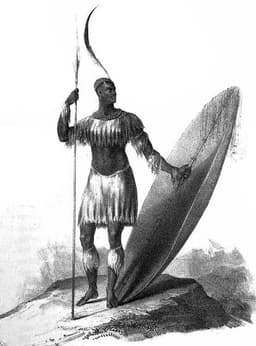
Shaka Zulu
General · Modern
70.2Total

Yang Su
General · Medieval
57.2Total
Basic Information
Born
1787
544
Died
1828
606
Era
Modern
Medieval
Nationality
Zulu Kingdom
China
Occupation
General
General
Civilization
Other
Eastern
Score Comparison
Military (10%)
80.0
80.0
Political (20%)
72.0
45.0
Influence (20%)
68.0
51.8
Legacy (20%)
68.0
45.0
Leadership (15%)
62.0
68.0
Strategy (15%)
80.8
80.5
TOTAL
70.2
57.2
Shaka Zulu — Complete Timeline
1816 AD
Introduction of the iklwa and horns of the buffalo formationReform
Shaka introduced the iklwa, a short stabbing spear, and the 'horns of the buffalo' tactical formation to the Zulu army. These innovations replaced the traditional throwing assegai and allowed for close-quarters combat, significantly increasing the Zulu's military effectiveness and enabling rapid conquest.
Military InnovationTacticsZulu Warfare
Impact: regional
1819 AD
Conquest of the Ndwandwe KingdomWar◆ Major
Shaka's Zulu army defeated the Ndwandwe kingdom at the Battle of Gqokli Hill, a decisive victory that eliminated a major rival. This conquest allowed Shaka to consolidate control over a large territory in present-day KwaZulu-Natal, marking the rise of the Zulu as a dominant regional power.
ConquestZulu ExpansionNdwandwe
Impact: regional
1828 AD
Assassination of ShakaPolitical Action◆ Major
Shaka was assassinated by his half-brothers Dingane and Mhlangana, with the support of his aunt Mkabayi. The coup ended his reign of terror and expansionist wars, leading to a period of instability and the eventual rise of Dingane as king.
AssassinationSuccession CrisisZulu Kingdom
Impact: regionaltragic
Yang Su — Complete Timeline
599 AD
Led Campaigns against the Tujue (Göktürks)War◆ Major
Yang Su commanded Sui forces in campaigns against the Eastern Tujue (G
Tujue CampaignsMilitary InnovationNorthern Frontier
Impact: regional
604 AD
Suppressed the Rebellion of Yang LiangWar◆ Major
After Emperor Yang of Sui ascended the throne, his brother Yang Liang rebelled in Bingzhou. Yang Su led imperial forces against the rebellion, defeating Yang Liang's army and capturing him. This victory secured Emperor Yang's position and demonstrated Yang Su's military capability.
Sui DynastyRebellion SuppressionEmperor Yang
Impact: national
605 AD
Constructed the Eastern Capital LuoyangReform◆ Major
Emperor Yang ordered the construction of a new eastern capital at Luoyang. Yang Su was appointed as one of the supervisors of the massive project. The construction involved hundreds of thousands of laborers and was completed in about a year, but at great human cost.
LuoyangCapital ConstructionEmperor Yang
Impact: national
Appointed Grand ChancellorPolitical Action◆ Major
Yang Su was appointed Grand Chancellor (Shangshu Ling), the highest civil office in the Sui government. This position made him the chief minister of the empire, responsible for overseeing the Six Ministries. He held this office until his death in 606.
Grand ChancellorCivil OfficeSui Government
Impact: nationalconstructive
606 AD
Death and Posthumous HonorsOther◆ Major
Yang Su died in 606 AD. Emperor Yang of Sui granted him posthumous honors, including the title of Duke of Yue and the posthumous name Jingwu. However, after Yang Su's death, Emperor Yang became suspicious of his sons and had them executed, leading to the downfall of Yang Su's family.
DeathPosthumous HonorsFamily Downfall
Impact: nationaltragic
Expert Analysis
Shaka Zulu vs Yang Su
# The Spear and the Scroll: Two Paths to Power
On a hill in southern Africa in 1819, a warrior king watched his young nation bleed against a larger enemy. On a plain in northern China in 599, an aging general faced a mounted horde that had terrorized empires for centuries. Both men would win their battles through innovation, but their fates would diverge like rivers flowing to different seas. Shaka Zulu and Yang Su built empires with steel and strategy, yet one died by his brothers’ hands and the other in his bed, honored by an emperor. What accounts for the difference? The answer lies not in their genius—both were brilliant—but in the worlds they sought to shape.
Origins
Shaka kaSenzangakhona was born in 1787 into a world of small chieftaincies and constant cattle raids. His father, the Zulu chief Senzangakhona, rejected him as illegitimate; his mother, Nandi, raised him in exile among the Langeni clan. He grew up mocked by other boys, learning to fight with a fury that would later define his reign. The Zulu were then a minor clan, one among dozens in the patchwork of Bantu-speaking peoples who occupied what is now KwaZulu-Natal. Shaka’s world was one of local power, where a man’s worth was measured in cattle and the reach of his spear.
Yang Su was born in 544 into a China fractured by centuries of division. His family belonged to the aristocratic elite of the Northern Zhou dynasty, a regime of Sinicized Xianbei warriors. Unlike Shaka, Yang Su inherited status and education. He studied the classics, mastered the arts of war and governance, and moved in circles where power was a game of court intrigue and dynastic maneuvering. His world was ancient, literate, and bureaucratic—an empire waiting to be reunited.
Rise to Power
Shaka’s rise began in 1816, when he returned to the Zulu after his father’s death. With the support of the powerful Dingiswayo of the Mthethwa, he seized the chieftaincy. He immediately set about remaking his army. He introduced the *iklwa*, a short stabbing spear that forced warriors to close with the enemy, and the “horns of the buffalo” formation—a crescent-shaped encirclement that could trap and annihilate opponents. He drilled his men relentlessly, outlawed sandals to toughen their feet, and created an *age-grade* regimental system that bound young men to his service. Within three years, he had transformed a raiding band into a killing machine.
Yang Su’s path was more conventional. He served the Northern Zhou and then the Sui, which unified China in 589 under Emperor Wen. His genius lay in adapting traditional Chinese military methods to new challenges. In 599, when the Eastern Tujue (Göktürk) Khaganate threatened the Sui border, Yang Su abandoned the standard defensive wagon-fort tactic. Instead, he ordered his infantry to advance in open formation, supported by cavalry, and struck the nomads in a mobile battle. The Tujue were routed—a victory that shocked the steppe and secured the Sui frontier.
Leadership & Governance
Shaka ruled through fear and spectacle. He centralized power, destroyed rival chieftains, and absorbed their followers into the Zulu nation. His army was his state; every young man was a soldier, every woman a producer of food and children. He built military homesteads (*amakhanda*) across his domain, where commanders enforced his will. His reforms were brutal but effective: by 1828, the Zulu controlled a territory spanning much of modern South Africa. Yet Shaka governed without a bureaucracy, without written law, without any institution beyond his own person. His word was absolute, and his paranoia grew as his power did.
Yang Su governed through the apparatus of the Sui state. He served both Emperor Wen and his successor, Emperor Yang, as a general and Grand Chancellor—the highest civil office. He oversaw the construction of the eastern capital at Luoyang in 605, a massive project that showcased Sui ambition. His military campaigns were precise: he suppressed the rebellion of Yang Liang in 604 with a combination of siegecraft and negotiation, offering amnesty to defectors. Unlike Shaka, Yang Su worked within a system of laws, taxes, and officials. He was a servant of the throne, not the throne itself.
Triumph & Tragedy
Shaka’s greatest moment came at the Battle of Gqokli Hill in 1819. Outnumbered by the Ndwandwe, he used the terrain and his “horns” formation to encircle and destroy the enemy. The victory eliminated his last major rival and opened the way for Zulu expansion. But the triumph carried a seed of tragedy. The *mfecane*—the violent upheaval caused by Zulu conquest—depopulated vast regions, creating refugees and chaos. Shaka’s mother’s death in 1827 triggered a period of madness: he ordered mass executions, forbade the planting of crops, and killed anyone who did not show sufficient grief. His people grew terrified of him.
Yang Su’s tragedy was subtler. He died in 606, apparently of illness, at the height of his power. Emperor Yang granted him posthumous honors—the title of Duke of Yue—and a grand funeral. But Yang Su’s legacy would be tarnished by his association with Emperor Yang, whose megalomania and failed campaigns against Goguryeo led to the Sui dynasty’s collapse. Yang Su had been the architect of Sui strength; he did not live to see its ruin.
Character & Destiny
Shaka was a man of raw will. His illegitimacy and childhood rejection forged a personality that demanded total loyalty and punished any hint of disloyalty. He trusted no one, not even his half-brothers. In 1828, they struck: Dingane and Mhlangana, aided by their aunt Mkabayi, assassinated him. Shaka’s final words were reportedly a prophecy of Zulu doom. His character—brilliant, paranoid, and isolated—ensured that his empire would not survive him.
Yang Su was a man of calculation. He navigated the treacherous politics of the Sui court with skill, knowing when to strike and when to serve. He remained loyal to Emperor Wen and, after initial hesitation, to Emperor Yang. His ambition was real but bounded by the realities of Chinese governance. He died with his reputation intact, his family honored. The difference is not one of virtue but of context: Shaka built a state on personal power, Yang Su on institutional power.
Legacy
Shaka is remembered as a military genius who created a nation. The Zulu identity he forged survives to this day, and his tactics are studied in war colleges. But his legacy is also one of destruction—the *mfecane* and the suffering it caused. In South Africa, he is both a hero and a cautionary tale.
Yang Su is less known outside China. His innovations—mobile infantry tactics against nomads, effective siegecraft—were absorbed into the Chinese military tradition. But his association with a failed dynasty meant that later historians, especially Confucian moralists, judged him harshly. He was a brilliant servant of a flawed master, and his legacy faded into the footnotes of the Sui story.
Conclusion
Two men, two worlds. Shaka’s Africa was a place of oral tradition, cattle, and kinship—a world where a single man could reshape society through sheer force of will. Yang Su’s China was a place of writing, bureaucracy, and empire—a world where even the greatest general served a system larger than himself. Shaka’s tragedy was that he could build only as long as he lived; Yang Su’s tragedy was that he built for a dynasty that would not endure. In the end, both achieved greatness, but only one understood that power must outlive the man who wields it.
Rankings
🥇
Shaka ZuluLeader
Mil: 80.0Pol: 72.0Inf: 68.0
70.2
🥈
Yang Su
Mil: 80.0Pol: 45.0Inf: 51.8
57.2
+13.0 behind
How This Comparison Works
Algorithm
Each figure is scored on 6 dimensions (0—100 scale) based on structured historical data: Military (10%), Political (20%), Influence (20%), Legacy (20%), Leadership (15%), Strategy (15%). The weighted total produces the final ranking.
Data Sources
Scores are computed from structured sub-indicators in the database. Scale factors adjust for era (Ancient ×0.85, Modern ×1.0) and civilization size (Eastern ×1.05, Other ×0.80) to account for differences in population and military scale.
Maximum 3 Figures
Comparisons are limited to 2—3 figures to ensure readability and statistical meaningfulness.
Error Margins
±5 points per dimension — Sub-scores are derived from historical records with inherent uncertainty. Two figures within 5 points on a dimension should be considered roughly equivalent in that area.
Total Score Accuracy
±3 points overall — The weighted combination of 6 dimensions produces a total score with approximately ±3 points of uncertainty. Differences of less than 3 points are not statistically significant— the figures are effectively tied.
Known Limitations
- Historical records are incomplete and uneven across civilizations
- Figures from oral-tradition societies may be underrepresented
- Occupation labels can misclassify multi-role figures
- Scores measure capability and impact, not moral character
- Quantitative scoring is a comparison tool, not absolute truth
Capability Radar
Military (10%) — Battles & Warfare
Battles
85
85
Win Rate
90
90
Expansion
88
80
Political (20%) — Governance & Reform
Reform
85
65
Diplomacy
60
60
Economy
65
55
Influence (20%) — Cultural & Global Reach
Cultural
80
45
Global
70
35
Legacy (20%) — Historical Impact
Historical
85
60
Longevity
75
40
Leadership (15%) — Power & Stability
Tenure
70
70
Stability
55
50
Strategy (15%) — Tactics & Innovation
Strategy
90
85
Tactics
95
88
Reform
98
75
Similar Comparisons
Comments & Discussion
SlingBlade Historian6/16/2026
Shaka wasn't just a military innovator; he was a logistics revolutionary. The iklwa stabbing spear gets all the attention, but his real genius was the "bull horn" formation and the _forced march_ that let his impi cover 50 miles in a day. Yang Su had horse archers and drilled infantry. Shaka built an empire where teenage boys out-marched any army on earth. That's not just tactics—that's physiology as policy.
铁筝刺客6/16/2026
杨素打仗像弹古琴,讲究音律般的节奏。他在突厥战役中搞了“阵中列骑”的奇招——把精锐骑兵隐藏在步兵方阵中间,等敌人冲锋到一半才突然释放。这一步棋直接把突厥可汗打懵了。相比之下,沙卡那套“公牛角”阵型虽然狠,但更多是蛮力碾压。杨素靠的是对战场节奏的算计,沙卡靠的是对肉体的压榨。这两人一个是棋手,一个是铁匠。
StatWatch6/16/2026
The analysis romanticizes both men, but let's look at the numbers. Yang Su supposedly never lost a battle—but historical records from the Sui dynasty were written by court officials who had every incentive to flatter. Shaka's "10,000 dead at Isandlwana" is a modern projection; contemporary sources can't even agree on his army's size. We're comparing two legends built on shaky documentation, not two generals. This whole exercise rests on historiography, not history.
青简散人6/16/2026
杨素最被人忽视的不是打仗,而是政治嗅觉。沙卡最后被亲兄弟刺杀,是因为他把自己变成了孤家寡人。杨素呢?他一边给隋文帝当刀,一边结交杨广,还提前把儿子塞进东宫。他知道什么时候该收刀入鞘。沙卡不懂政治是游戏,杨素明白政治是战场。所以一个死得窝囊,一个死得风光。天才不是只靠打仗活下来的。
Sunrise Spear6/16/2026
People forget Shaka didn't just conquer—he _reinvented_ society. The _age-grade regiments_ he created were a complete social and economic overhaul. Every young man became a soldier, but also a cattle-herder and a builder. Yang Su inherited a bureaucratic state; Shaka built one from scratch with a population probably under 200,000. That's the difference: one played chess with existing pieces, the other carved his board from raw wood.