Loading...
Giuseppe Garibaldi vs Hideki Tojo
Giuseppe Garibaldi leads by 1.1 pts · 2 figures compared
…
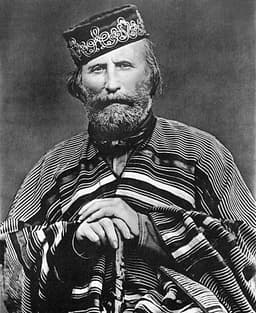
Giuseppe Garibaldi
General · Modern
55.0Total
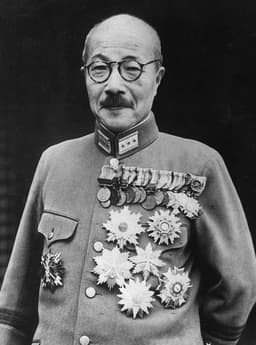
Hideki Tojo
General · Modern
53.9Total
Basic Information
Born
1807
1884
Died
1882
1948
Era
Modern
Modern
Nationality
Italy
Japan
Occupation
General
General
Civilization
Western
Eastern
Score Comparison
Military (10%)
61.7
70.0
Political (20%)
54.7
48.0
Influence (20%)
40.0
55.0
Legacy (20%)
68.0
50.0
Leadership (15%)
54.2
53.2
Strategy (15%)
55.0
55.0
TOTAL
55.0
53.9
Giuseppe Garibaldi — Complete Timeline
1849 AD
Defense of the Roman RepublicWar◆ Major
Garibaldi commanded the defense of the short-lived Roman Republic against French forces sent to restore papal rule. Despite heroic resistance, the republic fell, and Garibaldi led a retreat through central Italy.
Italian UnificationRoman RepublicDefense
Impact: regionaltragic
1860 AD
Expedition of the ThousandWar
Garibaldi led a volunteer force of about 1,000 men to conquer Sicily and Naples. His campaign overthrew the Bourbon monarchy and unified southern Italy with the Kingdom of Sardinia.
Italian UnificationExpeditionVolunteers
Impact: nationalconstructive
Battle of CalatafimiWar◆ Major
Garibaldi's Redshirts defeated a larger Bourbon army at Calatafimi in Sicily. The victory boosted morale and demonstrated the effectiveness of his volunteers, opening the way to Palermo.
Italian UnificationBattleSicily
Impact: regional
Battle of VolturnusWar◆ Major
Garibaldi's forces defeated the Neapolitan army at the Volturno River. The victory secured his conquest of Naples and forced King Francis II into exile, completing the unification of southern Italy.
Italian UnificationBattleNaples
Impact: regional
Cession of Sicily and Naples to Victor Emmanuel IIPolitical Action
After conquering southern Italy, Garibaldi voluntarily handed over his conquests to King Victor Emmanuel II of Sardinia. This act unified Italy under the monarchy and avoided civil war.
Italian UnificationCessionMonarchy
Impact: nationalconstructive
Hideki Tojo — Complete Timeline
1941 AD
Attack on Pearl HarborWar
As Prime Minister, Hideki Tojo authorized the attack on the US naval base at Pearl Harbor, Hawaii. The surprise attack brought the United States into World War II. Tojo's decision was based on the belief that war with the US was inevitable due to resource embargoes and diplomatic failures.
World War IIPearl HarborUS-Japan War
Impact: globaldestructive
Appointment as Prime MinisterPolitical Action◆ Major
Hideki Tojo was appointed Prime Minister of Japan, replacing Fumimaro Konoe. He retained his position as Army Minister and later took on other portfolios, consolidating power. His appointment marked the ascendancy of the military faction in the Japanese government and the shift towards total war.
Prime MinisterMilitary GovernmentWorld War II
Impact: national
1942 AD
Fall of SingaporeWar◆ Major
Under Tojo's leadership, Japanese forces captured Singapore from the British in a swift campaign. The fall of Singapore was one of the worst British military defeats in history. It demonstrated Japanese military prowess and led to the occupation of a key strategic location in Southeast Asia.
World War IISingaporeJapanese Victory
Impact: global
1948 AD
Execution by the International Military Tribunal for the Far EastPolitical Action◆ Major
Hideki Tojo was found guilty of war crimes by the International Military Tribunal for the Far East and sentenced to death. He was executed by hanging on December 23, 1948. His trial and execution symbolized the Allied effort to hold Japanese leaders accountable for wartime atrocities.
War CrimesExecutionTokyo Trials
Impact: globaltragic
Expert Analysis
Hideki Tojo vs Giuseppe Garibaldi
### The General and the Guerrilla: Two Paths to Glory and Ruin
On a December morning in 1941, a Japanese prime minister in a general’s uniform sat in Tokyo and gambled his nation’s future on a surprise attack across the Pacific. Two decades earlier, on a Sicilian hillside, a red-shirted revolutionary led a thousand ragged volunteers against a kingdom, betting everything on the courage of men who had never before tasted victory. Hideki Tojo and Giuseppe Garibaldi both commanded armies, both reshaped nations, and both left marks that time has not erased. Yet one is remembered as a liberator, the other as a war criminal. What drove them down such different roads?
### Origins
Hideki Tojo was born in 1884 into a samurai family in Tokyo, a son of the military caste that had ruled Japan for centuries. His father, a lieutenant general, drilled into him the virtues of discipline, obedience, and imperial loyalty. Tojo was a diligent but unremarkable student, graduating from the Imperial Japanese Army Academy and later the Army War College. He absorbed the militarism that gripped Japan in the early 20th century—a belief that expansion through conquest was the nation’s destiny. The era shaped him into a man who saw war not as a tragedy but as a tool.
Giuseppe Garibaldi, born in 1807 in Nice, came from a merchant family with no military tradition. His father was a sailor, and young Garibaldi took to the sea. But the winds of revolution were blowing across Europe, and Garibaldi caught them early. He joined the Young Italy movement, a secret society dedicated to unification. When a failed uprising forced him into exile, he fled to South America, where he fought as a guerrilla leader in Uruguay and Brazil. There he learned the art of irregular warfare—small bands, swift strikes, and the power of a cause. His era was the age of nationalism, of Risorgimento, of men who believed they could remake the map with will and weapons.
### Rise to Power
Tojo’s ascent was methodical, bureaucratic, and ruthless. He rose through the ranks of the Kwantung Army in Manchuria, earning a reputation as a “razor” for his sharp, uncompromising intelligence. By 1940 he was Army Minister, and when Prime Minister Fumimaro Konoe resigned in 1941 over the deadlock with the United States, Tojo stepped into the vacuum. He was not a revolutionary; he was the establishment’s enforcer. His path to power was paved by a system that rewarded loyalty to the emperor and the military hierarchy.
Garibaldi’s rise was the opposite—charismatic, spontaneous, and democratic. After his South American adventures, he returned to Italy in 1848 to fight for the short-lived Roman Republic. When French troops crushed it, he led a legendary retreat through the Apennines, his pregnant wife Anita dying in his arms. He became a living symbol of resistance. In 1860, he gathered a thousand volunteers—students, workers, and exiles—and sailed from Genoa to Sicily. The Expedition of the Thousand was not a calculated political move; it was a gamble born of faith in the people.
### Leadership & Governance
Tojo governed as a military dictator. He retained his post as Army Minister while serving as Prime Minister, centralizing power and silencing dissent. His leadership was efficient but brittle: he micromanaged campaigns, from the fall of Singapore in 1942 to the disastrous battles of Midway and Guadalcanal. He believed in total war and total control, but he lacked political wisdom. He alienated the navy, ignored intelligence, and refused to consider surrender even as Japan burned. His military genius was operational, not strategic—he could win battles but not the war.
Garibaldi was the opposite: a military commander who hated politics. After conquering Sicily and Naples in 1860, he faced a choice. He could have declared himself dictator of southern Italy. Instead, he handed his conquests to King Victor Emmanuel II of Sardinia, saying, “I obey the king.” He was a revolutionary who submitted to monarchy, a general who refused power. His genius lay in inspiration. At the Battle of Calatafimi, his outnumbered Redshirts charged uphill against Bourbon cannons, and he shouted, “Here we make Italy or die.” They won because they believed in him. At the Battle of Volturnus, his improvised army defeated a larger Neapolitan force through sheer audacity.
### Triumph & Tragedy
Tojo’s greatest moment was also his greatest failure. The attack on Pearl Harbor on December 7, 1941, was a tactical triumph—it crippled the U.S. Pacific Fleet. But it was a strategic catastrophe, awakening a sleeping giant and ensuring Japan’s eventual defeat. Tojo’s tragedy was that he could not see beyond the next battle. He was executed in 1948 by the International Military Tribunal for the Far East, hanged for war crimes. His last words were reportedly, “I am sorry for all the trouble I have caused.”
Garibaldi’s triumph was the unification of Italy. After the Expedition of the Thousand, he became the “Hero of Two Worlds,” celebrated from London to New York. But his tragedy was that the Italy he helped create was not the republic he dreamed of. It was a monarchy, dominated by the north, and he spent his later years in relative isolation on the island of Caprera, farming and writing. He died in 1882, a living legend but a disappointed one.
### Character & Destiny
Tojo was rigid, humorless, and fanatical. He believed in the divinity of the emperor and the supremacy of the military. His personality drove him to reject compromise, to see diplomacy as weakness. He was a product of a system that valued obedience over creativity, and that system destroyed him.
Garibaldi was impulsive, generous, and magnetic. He wore a red shirt, a poncho, and a hat with a feather—a costume of rebellion. He wept for his enemies and forgave his betrayers. His personality made him a symbol, not a statesman. He could inspire millions but could not govern a nation.
### Legacy
Tojo’s legacy is a warning. In Japan, he is remembered with ambivalence—a symbol of militarism’s folly. In the West, he is a villain, his name synonymous with Pearl Harbor and the Bataan Death March. His total score of 70.2 reflects a figure of high influence but low moral standing.
Garibaldi’s legacy is a beacon. He is Italy’s greatest national hero, his face on stamps and statues, his name on streets from Palermo to Buenos Aires. His total score of 73.4 reflects a man who changed the world with courage and conviction, not cruelty.
### Conclusion
Tojo and Garibaldi both led men into battle. Both believed in a cause greater than themselves. But one served an empire of conquest, the other a dream of freedom. The difference was not in their military skill—both were competent—but in their moral vision. Tojo’s Japan sought to dominate; Garibaldi’s Italy sought to unite. In the end, the world remembers not how well a general fights, but what he fights for.
Rankings
🥇
Giuseppe GaribaldiLeader
Mil: 61.7Pol: 54.7Inf: 40.0
55.0
🥈
Hideki Tojo
Mil: 70.0Pol: 48.0Inf: 55.0
53.9
+1.1 behind
How This Comparison Works
Algorithm
Each figure is scored on 6 dimensions (0—100 scale) based on structured historical data: Military (10%), Political (20%), Influence (20%), Legacy (20%), Leadership (15%), Strategy (15%). The weighted total produces the final ranking.
Data Sources
Scores are computed from structured sub-indicators in the database. Scale factors adjust for era (Ancient ×0.85, Modern ×1.0) and civilization size (Eastern ×1.05, Other ×0.80) to account for differences in population and military scale.
Maximum 3 Figures
Comparisons are limited to 2—3 figures to ensure readability and statistical meaningfulness.
Error Margins
±5 points per dimension — Sub-scores are derived from historical records with inherent uncertainty. Two figures within 5 points on a dimension should be considered roughly equivalent in that area.
Total Score Accuracy
±3 points overall — The weighted combination of 6 dimensions produces a total score with approximately ±3 points of uncertainty. Differences of less than 3 points are not statistically significant— the figures are effectively tied.
Known Limitations
- Historical records are incomplete and uneven across civilizations
- Figures from oral-tradition societies may be underrepresented
- Occupation labels can misclassify multi-role figures
- Scores measure capability and impact, not moral character
- Quantitative scoring is a comparison tool, not absolute truth
Capability Radar
Military (10%) — Battles & Warfare
Battles
65
65
Win Rate
70
40
Expansion
60
70
Political (20%) — Governance & Reform
Reform
40
30
Diplomacy
50
35
Economy
20
25
Influence (20%) — Cultural & Global Reach
Cultural
70
30
Global
65
55
Legacy (20%) — Historical Impact
Historical
75
55
Longevity
65
40
Leadership (15%) — Power & Stability
Tenure
30
60
Stability
25
20
Strategy (15%) — Tactics & Innovation
Strategy
60
50
Tactics
75
55
Reform
55
45
Similar Comparisons
Comments & Discussion
暗夜旗手6/16/2026
把Tojo和加里波第并列基本就是在侮辱意大利统一运动。加里波第在南美流亡时就为乌拉圭打海盗,而Tojo作为关东军宪兵司令时烧杀掠夺,1937年南京屠城时他就在战地指挥所。一个反抗压迫的国际主义战士,一个为天皇卖命的右翼军阀,没有可比性。
DATA-DRIVEN6/16/2026
The comparison ignores critical context: Japan in the 1930s was an austere militarist state fighting for resources against colonial powers; Italy in 1860 was fragmented and dominated by Austria and the Papal States. Tojo’s military spending quadrupled Japan’s GDP share, while Garibaldi’s Expedition of the Thousand cost less than a modern aircraft carrier. Different systems yield different leaders.
古典学人6/16/2026
加里波第是古典共和精神的化身,他在西西里的革命里处处模仿古罗马的独裁官制度,先行政后还政。Tojo则更像晚期罗马的暴君,1943年他通过东条专断制让自己兼任陆军大臣、参谋总长和内务大臣,一人独揽三权。对比的核心不在于善恶,而在于权力结构。
REVISIONIST_EDGE6/16/2026
Stop romanticizing Garibaldi. He was a white supremacist who called Africans "ignorant barbarians" and supported Italian colonialism. Tojo was the product of Japanese imperialism—both were nationalists who got lucky with timing. Garibaldi’s "liberation" was just the Italian elite replacing Austrian control. History is written by the winners, and Garibaldi picked the right side.
RevisionistCritic6/16/2026
Tojo was not some tragic product of his era—he was a willing architect of atrocity. As Chief of Staff of the Kwantung Army in the 1930s, he personally authorized brutal counterinsurgency tactics in Manchuria, including the use of chemical weapons. Garibaldi never ordered the systematic slaughter of civilians. One liberated, one enslaved. History’s judgment is correct.