Loading...
Galba vs Sahure
Sahure leads by 11.0 pts · 2 figures compared
…
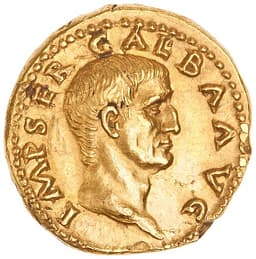
Galba
Emperor · Ancient
33.8Total

Sahure
Emperor · Ancient
44.8Total
Basic Information
Born
-3
-2450
Died
69
-2440
Era
Ancient
Ancient
Nationality
Roman Empire
Old Kingdom Egypt
Occupation
Emperor
Emperor
Civilization
Western
Middle Eastern
Score Comparison
Military (10%)
22.6
50.0
Political (20%)
27.9
37.9
Influence (20%)
42.4
48.6
Legacy (20%)
35.0
40.0
Leadership (15%)
36.9
55.3
Strategy (15%)
25.0
36.8
TOTAL
33.8
44.8
Galba — Complete Timeline
68 AD
Proclamation as EmperorPolitical Action◆ Major
Galba was proclaimed emperor by the Roman Senate after the suicide of Nero. He was governor of Hispania Tarraconensis and had rebelled against Nero. His accession ended the Julio-Claudian dynasty and began the Year of the Four Emperors.
Year of the Four EmperorsNeroProclamation
Impact: national
69 AD
Assassination of GalbaPolitical Action◆ Major
Galba was murdered by Praetorian Guards in the Roman Forum after adopting Lucius Calpurnius Piso as his successor. His unpopularity and failure to pay the Praetorians led to his overthrow by Otho. This event triggered a series of civil wars.
AssassinationPraetorian GuardOtho
Impact: nationaltragic
Sahure — Complete Timeline
2450 BC
Military campaigns in the Sinai and LibyaWar
Sahure conducted military expeditions into the Sinai Peninsula to secure turquoise and copper mines, and into Libya to subdue nomadic tribes. These campaigns are recorded in reliefs from his pyramid complex, showing the king smiting enemies.
MilitarySinaiLibya
Impact: regional
Maritime expedition to PuntPolitical Action◆ Major
Sahure dispatched a fleet to the land of Punt, likely located in the Horn of Africa. The expedition returned with myrrh, electrum, and exotic goods, demonstrating Egypt's naval capabilities and establishing trade routes that would be used for centuries.
TradeMaritimeOld Kingdom
Impact: regionalconstructive
Construction of the Pyramid of Sahure at AbusirCultural◆ Major
Sahure built his pyramid complex at Abusir, the first royal pyramid built in that necropolis. The complex included a valley temple, causeway, and mortuary temple decorated with reliefs depicting the Punt expedition and other achievements.
ArchitecturePyramidAbusir
Impact: nationalconstructive
Expert Analysis
Origins
Galba was born into a wealthy patrician family in 3 BC near Terracina, Italy. His full name was Servius Sulpicius Galba. He was adopted by his stepmother and inherited a vast fortune. Galba served as praetor, consul, and governor of provinces including Aquitania, Africa, and Hispania Tarraconensis. His early career was marked by administrative competence but also by a reputation for severity.
Sahure was the second pharaoh of the Fifth Dynasty of Egypt, reigning approximately 2487–2475 BC. He was likely the son of Userkaf, the dynasty's founder, and Queen Neferhetepes. Little is known of his early life, but he grew up in the royal court at Memphis. His reign is noted for peaceful development and external trade rather than military conquest.
Rise to Power
Galba rose to power amid the chaos following Nero's suicide in June 68 AD. As governor of Hispania Tarraconensis, Galba initially hesitated but eventually declared himself a legate of the Senate and Roman people. The Praetorian Guard and the Senate recognized him as emperor after Nero's death. He marched to Rome and was proclaimed emperor in October 68 AD at the age of 71.
Sahure ascended the throne after his father Userkaf died. The transition was peaceful, indicating a stable succession. Sahure's rise was typical for a pharaoh of the Fifth Dynasty, a period of strong central administration and religious devotion to the sun god Ra.
Leadership & Governance
Galba's leadership style was rigid and austere. He refused to pay the Praetorian Guard their promised donative, famously saying "I levy my soldiers, I do not buy them." He also reversed many of Nero's populist policies, which alienated the populace. His political score of 27.9 reflects his inability to build consensus and manage the Roman elite.
Sahure governed with a focus on economic development and religious building. He commissioned the Pyramid of Sahure at Abusir, the first royal pyramid in that necropolis. His expedition to Punt brought back myrrh, electrum, and exotic goods, boosting trade. He also developed the Egyptian navy. His leadership score of 55.3 indicates effective administration, though his political score of 37.9 suggests limited political maneuvering.
Triumph & Tragedy
Galba's greatest success was his initial rebellion against Nero, which ended the Julio-Claudian dynasty. However, his greatest failure was his brief reign: he failed to secure loyalty, and his adoption of Lucius Calpurnius Piso angered his supporter Marcus Otho. Galba scored only 22.6 in military because he never led troops in battle. His assassination on January 15, 69 AD, after just seven months, marked a tragic end.
Sahure's triumph was the maritime expedition to Punt, which demonstrated Egypt's naval capabilities and secured valuable resources. He also conducted military campaigns in the Sinai and Libya, securing mines and subduing tribes, giving him a military score of 50.0. However, his pyramid complex was later plundered, and his dynasty declined after his reign, limiting his long-term impact.
Character & Destiny
Galba was known for his frugality and severity. He was influenced by his advisors, especially Titus Vinius and Cornelius Laco. His inability to adapt to the political realities of Rome sealed his fate. The historian Tacitus described him as "capable of ruling if he had never ruled," suggesting his qualities were not suited for the turbulent times.
Sahure is depicted as a capable and prosperous ruler. His reign was a period of peace and artistic achievement. His character likely reflected the ideals of the Fifth Dynasty: piety, administrative order, and commercial enterprise. His destiny was to be remembered as a builder and explorer.
Legacy
Galba's legacy is minimal; he is remembered as a failed emperor who triggered the Year of the Four Emperors. His rule demonstrated the Praetorian Guard's power to make and break emperors. He scores 35.0 in legacy, reflecting his brief impact.
Sahure's legacy is more substantial. His pyramid complex at Abusir became a model for later pyramids. The Punt expedition expanded Egyptian trade and knowledge. His military campaigns secured resources for decades. He scores 40.0 in legacy, higher than Galba.
Conclusion
Sahure clearly had greater impact than Galba. With a total score of 44.8 against Galba's 33.8, Sahure outperformed in every category: military (50.0 vs. 22.6), political (37.9 vs. 27.9), influence (48.6 vs. 42.4), legacy (40.0 vs. 35.0), leadership (55.3 vs. 36.9), and strategy (36.8 vs. 25.0). Sahure's 14-year reign brought stability, trade, and architectural achievements, while Galba's 7-month rule ended in chaos. While both ruled ancient empires, Sahure's contributions to Egyptian civilization were lasting, whereas Galba's failure highlighted the fragility of Roman imperial politics.
Rankings
🥇
SahureLeader
Mil: 50.0Pol: 37.9Inf: 48.6
44.8
🥈
Galba
Mil: 22.6Pol: 27.9Inf: 42.4
33.8
+11.0 behind
How This Comparison Works
Algorithm
Each figure is scored on 6 dimensions (0—100 scale) based on structured historical data: Military (10%), Political (20%), Influence (20%), Legacy (20%), Leadership (15%), Strategy (15%). The weighted total produces the final ranking.
Data Sources
Scores are computed from structured sub-indicators in the database. Scale factors adjust for era (Ancient ×0.85, Modern ×1.0) and civilization size (Eastern ×1.05, Other ×0.80) to account for differences in population and military scale.
Maximum 3 Figures
Comparisons are limited to 2—3 figures to ensure readability and statistical meaningfulness.
Error Margins
±5 points per dimension — Sub-scores are derived from historical records with inherent uncertainty. Two figures within 5 points on a dimension should be considered roughly equivalent in that area.
Total Score Accuracy
±3 points overall — The weighted combination of 6 dimensions produces a total score with approximately ±3 points of uncertainty. Differences of less than 3 points are not statistically significant— the figures are effectively tied.
Known Limitations
- Historical records are incomplete and uneven across civilizations
- Figures from oral-tradition societies may be underrepresented
- Occupation labels can misclassify multi-role figures
- Scores measure capability and impact, not moral character
- Quantitative scoring is a comparison tool, not absolute truth
Capability Radar
Military (10%) — Battles & Warfare
Battles
10
10
Win Rate
10
10
Expansion
5
20
Political (20%) — Governance & Reform
Reform
5
20
Diplomacy
10
40
Economy
5
40
Influence (20%) — Cultural & Global Reach
Cultural
5
30
Global
5
20
Legacy (20%) — Historical Impact
Historical
15
30
Longevity
5
20
Leadership (15%) — Power & Stability
Tenure
5
30
Stability
5
40
Strategy (15%) — Tactics & Innovation
Strategy
15
10
Tactics
15
10
Reform
5
10
Similar Comparisons
Comments & Discussion
No comments yet. Be the first to share your thoughts!