Loading...
Galba vs Napoleon Bonaparte
Napoleon Bonaparte leads by 37.1 pts · 2 figures compared
…
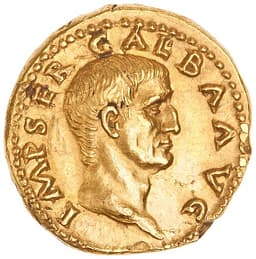
Galba
Emperor · Ancient
33.8Total

Napoleon Bonaparte
General · Modern
70.9Total
Basic Information
Born
-3
1769
Died
69
1821
Era
Ancient
Modern
Nationality
Roman Empire
France
Occupation
Emperor
General
Civilization
Western
Western
Score Comparison
Military (10%)
22.6
94.0
Political (20%)
27.9
72.0
Influence (20%)
42.4
40.0
Legacy (20%)
35.0
80.0
Leadership (15%)
36.9
78.0
Strategy (15%)
25.0
90.0
TOTAL
33.8
70.9
Galba — Complete Timeline
68 AD
Proclamation as EmperorPolitical Action◆ Major
Galba was proclaimed emperor by the Roman Senate after the suicide of Nero. He was governor of Hispania Tarraconensis and had rebelled against Nero. His accession ended the Julio-Claudian dynasty and began the Year of the Four Emperors.
Year of the Four EmperorsNeroProclamation
Impact: national
69 AD
Assassination of GalbaPolitical Action◆ Major
Galba was murdered by Praetorian Guards in the Roman Forum after adopting Lucius Calpurnius Piso as his successor. His unpopularity and failure to pay the Praetorians led to his overthrow by Otho. This event triggered a series of civil wars.
AssassinationPraetorian GuardOtho
Impact: nationaltragic
Napoleon Bonaparte — Complete Timeline
1799 AD
Coup of 18 BrumaireOther◆ Major
Napoleon Bonaparte, with support from his brother Lucien and key political figures, overthrew the Directory in a bloodless coup. He established the Consulate with himself as First Consul, effectively becoming the ruler of France. This event ended the French Revolution's most unstable period.
French RevolutionCoupRise to Power
Impact: regional
1804 AD
Promulgation of the Napoleonic CodeOther◆ Major
Napoleon enacted the Civil Code of the French, known as the Napoleonic Code, a comprehensive set of laws that replaced the fragmented feudal legal systems. The code established legal equality, protected property rights, and secularized law. It became the basis for legal systems in many European and world countries.
Legal ReformNapoleonic CodeCivil Law
Impact: globalconstructive
1805 AD
Battle of AusterlitzWar◆ Major
Napoleon's Grande Arm
Napoleonic WarsBattleDecisive Victory
Impact: global
1812 AD
Invasion of RussiaWar◆ Major
Napoleon led the Grande Arm
Napoleonic WarsInvasionDisaster
Impact: globaldestructive
1815 AD
Battle of WaterlooWar◆ Major
Napoleon's French army was defeated by the combined forces of the Duke of Wellington's Anglo-Allied army and Gebhard Leberecht von Bl
Napoleonic WarsBattleFinal Defeat
Impact: globaldestructive
Expert Analysis
galba-vs-napoleon-bonaparte
# The Emperor's Shadow and the Emperor's Echo
In the early months of AD 69, a frail old man in a purple toga stood before the Praetorian Guard in Rome, offering them nothing but stern words and empty promises. Seven months later, his severed head was paraded on a spear through the Forum. Across eighteen centuries and a continent away, a young Corsican artillery officer stood before his starving troops in Italy and promised them glory, riches, and immortality. They followed him to Moscow, to Waterloo, and to the edge of the world. Why did one emperor fall in a matter of months while another reshaped an entire civilization? The answer lies not merely in talent, but in the profound chasm between the worlds that shaped them.
Origins
Servius Sulpicius Galba entered history in 3 BC, born into one of Rome's oldest patrician families. He was a creature of the old Republic's dying twilight, raised on stories of Cato and Scipio, trained in the austere virtues of a senatorial class that believed power came from lineage, not from the people. His world was one of rigid hierarchies, where a nobleman's word was law and the mob was something to be managed, not inspired.
Napoleon Bonaparte was born in 1769 on Corsica, an island that had belonged to the Republic of Genoa until the year before his birth. His family was minor nobility, but in the chaos of revolutionary France, birth meant little. What mattered was talent, ambition, and the willingness to seize opportunity. Napoleon's France was a world turned upside down, where a brilliant commoner could become emperor. Galba inherited his world; Napoleon had to conquer his.
Rise to Power
Galba's path to the purple was the traditional one: military command, provincial governorship, and careful cultivation of the right connections. He served with distinction in Germany and Africa, governed Hispania Tarraconensis with a reputation for harsh justice, and when Nero's madness finally destroyed the Julio-Claudian dynasty, Galba was the Senate's safe choice. In June of AD 68, after Nero's suicide, the Senate proclaimed him emperor. He was seventy-one years old, and he believed that his name alone would command obedience.
Napoleon's rise was anything but traditional. In 1793, at the age of twenty-four, he drove the British out of Toulon with a brilliant use of artillery. In 1796, he took command of a starving, unpaid army in Italy and turned it into a conquering force through sheer force of will, promising his men "honor, glory, and riches." By 1799, he had seized power in a coup. He was thirty years old. Where Galba waited for the Senate to hand him power, Napoleon took it.
Leadership & Governance
As emperor, Galba governed as a stern patrician of the old school. He cut Nero's extravagant spending, refused to bribe the Praetorian Guard with the donative they expected, and punished corruption with relentless severity. His political wisdom score of 64.8 reflects a man who understood the rules of the old Republic but utterly failed to grasp the new realities of imperial Rome. The legions in Germany proclaimed their own emperor, Vitellius, and Galba's response was to adopt a young nobleman, Piso, as his successor—a move that alienated his most powerful ally, Otho, who promptly had him murdered.
Napoleon governed with a genius that matched his military brilliance. His political score of 75.0 understates his achievements: the Napoleonic Code, the Bank of France, the lycée system, the Concordat with the Church. He centralized the state, streamlined the bureaucracy, and created a legal framework that still shapes European law today. His military score of 94.0 and strategy score of 93.0 are legendary: Austerlitz, Jena, Wagram. He understood that war was not merely a matter of tactics but of logistics, morale, and the psychological destruction of the enemy.
Triumph & Tragedy
Galba's triumph was brief: he ended the tyranny of Nero and restored senatorial authority. His tragedy was that he believed this was enough. In January of AD 69, when the Praetorian Guard dragged him from his litter in the Roman Forum and butchered him, his last words were reportedly, "Do your duty, soldiers, and you are mine." They did not care.
Napoleon's triumphs were staggering: he conquered most of Europe, crowned himself emperor in Notre Dame, and remade the map of the continent. His tragedy was the same as all great conquerors: he could not stop. The invasion of Russia in 1812 destroyed his Grand Army—600,000 men reduced to fewer than 30,000. He abdicated in 1814, returned in 1815 for the Hundred Days, and met his final defeat at Waterloo on June 18, 1815. He died in exile on Saint Helena in 1821, a prisoner of the British.
Character & Destiny
Galba was a man of principle in an age that rewarded pragmatism. His austerity was seen as greed, his justice as cruelty, his caution as weakness. He trusted in the old forms when the old forms were dead. He was, in essence, a senator trying to be a princeps in an era that demanded an autocrat.
Napoleon was a man of boundless ambition and ruthless pragmatism. He could charm a diplomat, inspire a grenadier, and destroy an enemy army with cold calculation. Yet his fatal flaw was hubris: he believed his own legend. He once said, "There is no such thing as a bad soldier, only bad officers." He did not see that he himself had become the bad officer, leading his men into a Russian winter because he could not imagine defeat.
Legacy
Galba's legacy is almost entirely negative: he is remembered as the first emperor in the disastrous Year of the Four Emperors, a warning that imperial Rome could not survive without a stable succession. His total score of 54.8 reflects a man who was competent in a minor key but disastrous in the major. He is studied by historians, but he inspires no one.
Napoleon's legacy is immense and contradictory. He is remembered as a military genius who reshaped Europe, a reformer who spread the ideals of the French Revolution, and a tyrant who caused the deaths of millions. His total score of 82.4 places him among history's great figures. His name is on the Arc de Triomphe, his code is in French law, his campaigns are studied at every military academy. He said, "A leader is a dealer in hope." Galba dealt only in discipline.
Conclusion
Standing on the opposite slopes of history, Galba and Napoleon reveal something essential about power. Galba believed power was a birthright, a thing to be inherited and guarded. Napoleon believed power was a tool, a thing to be seized and wielded. One died in a gutter in Rome, forgotten by the soldiers he refused to pay. The other died on a remote island, but his shadow still falls across the world. The difference was not in their ambition—both wanted to rule—but in their understanding of what rule requires. Galba thought the office made the man. Napoleon knew the man must make the office. In that difference lies the entire story of how some emperors vanish in a season while others echo through eternity.
Rankings
🥇
Napoleon BonaparteLeader
Mil: 94.0Pol: 72.0Inf: 40.0
70.9
🥈
Galba
Mil: 22.6Pol: 27.9Inf: 42.4
33.8
+37.1 behind
How This Comparison Works
Algorithm
Each figure is scored on 6 dimensions (0—100 scale) based on structured historical data: Military (10%), Political (20%), Influence (20%), Legacy (20%), Leadership (15%), Strategy (15%). The weighted total produces the final ranking.
Data Sources
Scores are computed from structured sub-indicators in the database. Scale factors adjust for era (Ancient ×0.85, Modern ×1.0) and civilization size (Eastern ×1.05, Other ×0.80) to account for differences in population and military scale.
Maximum 3 Figures
Comparisons are limited to 2—3 figures to ensure readability and statistical meaningfulness.
Error Margins
±5 points per dimension — Sub-scores are derived from historical records with inherent uncertainty. Two figures within 5 points on a dimension should be considered roughly equivalent in that area.
Total Score Accuracy
±3 points overall — The weighted combination of 6 dimensions produces a total score with approximately ±3 points of uncertainty. Differences of less than 3 points are not statistically significant— the figures are effectively tied.
Known Limitations
- Historical records are incomplete and uneven across civilizations
- Figures from oral-tradition societies may be underrepresented
- Occupation labels can misclassify multi-role figures
- Scores measure capability and impact, not moral character
- Quantitative scoring is a comparison tool, not absolute truth
Capability Radar
Military (10%) — Battles & Warfare
Battles
10
95
Win Rate
10
90
Expansion
5
95
Political (20%) — Governance & Reform
Reform
5
95
Diplomacy
10
80
Economy
5
85
Influence (20%) — Cultural & Global Reach
Cultural
5
85
Global
5
90
Legacy (20%) — Historical Impact
Historical
15
95
Longevity
5
90
Leadership (15%) — Power & Stability
Tenure
5
85
Stability
5
70
Strategy (15%) — Tactics & Innovation
Strategy
15
95
Tactics
15
98
Reform
5
92
Similar Comparisons
Comments & Discussion
No comments yet. Be the first to share your thoughts!