Loading...
Galba vs Julius Caesar
Julius Caesar leads by 49.0 pts · 2 figures compared
…
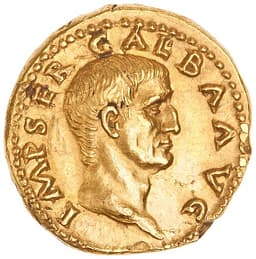
Galba
Emperor · Ancient
33.8Total

Julius Caesar
General · Ancient
82.8Total
Basic Information
Born
-3
-100
Died
69
-44
Era
Ancient
Ancient
Nationality
Roman Empire
Roman Republic
Occupation
Emperor
General
Civilization
Western
Western
Score Comparison
Military (10%)
22.6
88.0
Political (20%)
27.9
78.0
Influence (20%)
42.4
85.0
Legacy (20%)
35.0
82.0
Leadership (15%)
36.9
80.0
Strategy (15%)
25.0
85.0
TOTAL
33.8
82.8
Galba — Complete Timeline
68 AD
Proclamation as EmperorPolitical Action◆ Major
Galba was proclaimed emperor by the Roman Senate after the suicide of Nero. He was governor of Hispania Tarraconensis and had rebelled against Nero. His accession ended the Julio-Claudian dynasty and began the Year of the Four Emperors.
Year of the Four EmperorsNeroProclamation
Impact: national
69 AD
Assassination of GalbaPolitical Action◆ Major
Galba was murdered by Praetorian Guards in the Roman Forum after adopting Lucius Calpurnius Piso as his successor. His unpopularity and failure to pay the Praetorians led to his overthrow by Otho. This event triggered a series of civil wars.
AssassinationPraetorian GuardOtho
Impact: nationaltragic
Julius Caesar — Complete Timeline
58 BC
Gallic WarsWar◆ Major
Caesar, as proconsul of Gaul, launched a series of campaigns that conquered all of Gaul (modern France, Belgium, and parts of Switzerland). He fought numerous battles, including against the Helvetii, the Belgae, and the Gallic chieftain Vercingetorix. The wars brought immense wealth and a loyal army to Caesar.
Gallic WarsConquestRoman Expansion
Impact: regional
49 BC
Crossing the RubiconPolitical Action◆ Major
Caesar led Legio XIII across the Rubicon River into Italy, defying the Roman Senate's order to disband his army. This act triggered a civil war against Pompey and the Optimates, ultimately leading to Caesar's dictatorship and the end of the Roman Republic.
Roman Civil WarEnd of RepublicPower Struggle
Impact: global
48 BC
Battle of PharsalusWar◆ Major
Caesar's outnumbered army defeated the larger forces of Pompey the Great at Pharsalus in Greece. Caesar's tactical use of a reserve line to counter Pompey's cavalry charge proved decisive. Pompey fled to Egypt, where he was assassinated, leaving Caesar as the undisputed master of the Roman world.
Roman Civil WarBattleDecisive Victory
Impact: regional
44 BC
Appointment as Dictator for LifePolitical Action◆ Major
The Roman Senate appointed Caesar dictator perpetuo (dictator for life), granting him unprecedented personal power. This move concentrated military, legislative, and judicial authority in one person, effectively ending the Roman Republic's traditional system of checks and balances and alarming many senators.
DictatorshipEnd of RepublicPower Consolidation
Impact: regionaldestructive
Assassination on the Ides of MarchPolitical Action◆ Major
A group of Roman senators, led by Marcus Junius Brutus and Gaius Cassius Longinus, stabbed Caesar to death at a meeting of the Senate in the Theatre of Pompey. The assassination was intended to restore the Republic, but instead triggered another civil war that led to the rise of the Roman Empire.
AssassinationRoman PoliticsEnd of Republic
Impact: globaldestructive
Expert Analysis
galba-vs-julius-caesar
# The General and the Caretaker
On a January morning in 69 AD, an old man in his seventies was dragged from his litter in the Roman Forum and hacked to death by Praetorian Guards. His severed head was paraded on a pole, his body left to rot. Just over a century earlier, on the Ides of March in 44 BC, another Roman leader fell to assassins’ knives in the same city—but the difference between these two deaths tells us nearly everything about the men themselves. Why did one murder plunge Rome into civil war and ultimately birth an empire, while the other was merely the first act in a chaotic year that ended with a new dynasty? The answer lies not in the daggers, but in the hands that held them—and the visions those hands once served.
Origins
Gaius Julius Caesar was born into the patrician Julian clan, an ancient but impoverished family that claimed descent from the goddess Venus. His childhood unfolded against the backdrop of the late Republic’s death throes—civil wars, slave revolts, and the collapse of traditional norms. Caesar’s father died when he was sixteen, forcing him to navigate a world of ruthless ambition where alliances shifted like desert sands. He was a product of a system that rewarded brilliance and ruthlessness in equal measure.
Servius Sulpicius Galba, by contrast, was born three years before the birth of Christ into a wealthy senatorial family at the height of Augustan stability. He grew up in a world that had already learned to bow to one man. His grandfather had been a historian, his father a consul—Galba was respectable, competent, and utterly conventional. Where Caesar was forged in crisis, Galba was molded by bureaucracy.
Rise to Power
Caesar’s ascent was a masterclass in calculated risk. He fled Rome to avoid Sulla’s proscriptions, then returned to climb the cursus honorum with breathtaking speed. He borrowed fortunes to stage games that won the people’s love, formed the First Triumvirate with Pompey and Crassus, and then spent eight years conquering Gaul—a campaign that gave him an unbeatable army, immense wealth, and a reputation that terrified the Senate. When ordered to disband his legions, he crossed the Rubicon in 49 BC with the words “the die is cast,” sparking a civil war that ended with him as dictator.
Galba’s rise was quieter, more bureaucratic. He served as governor of Aquitania, then Africa, then Hispania Tarraconensis—competently, without flair. When Nero’s excesses finally broke the Senate’s patience in 68 AD, Galba was proclaimed emperor almost by default. He was seventy-one years old, had no legions of his own, and had been chosen not because anyone loved him, but because everyone hated Nero more. His proclamation was less a revolution than a vacancy.
Leadership & Governance
Caesar governed with the instincts of a military genius and the vision of a reformer. He redistributed land to veterans, reformed the calendar, granted citizenship to Gauls, and centralized power in ways that made the old Republic obsolete. His military score of 88 reflects campaigns that are still studied in war colleges: the siege of Alesia, the lightning war in Gaul, the victory at Pharsalus against Pompey’s larger army. He ruled with a blend of clemency and iron—pardoning former enemies while crushing those who resisted.
Galba’s governance was defined by austerity and rigidity. He refused to pay the Praetorian Guard the donative they expected, dismissed loyal soldiers, and punished corruption with such severity that he alienated everyone. His political score of 64.8 is generous—he lacked the wisdom to know that a new emperor must buy loyalty before he can demand it. His military score of 39.5 reflects the simple truth that he never commanded an army in battle. Where Caesar inspired devotion, Galba inspired only resentment.
Triumph & Tragedy
Caesar’s greatest moment was his triumph over Gaul—parading Vercingetorix in chains through Rome, celebrating victories that expanded the Republic’s borders to the Rhine. His tragedy was the Ides of March, when the senators he had pardoned stabbed him twenty-three times. Yet even in death, Caesar won: his adopted heir Octavian avenged him and founded the Empire.
Galba’s triumph was his proclamation—the moment he became emperor without a battle. His tragedy was everything that followed. He adopted Piso as his successor, a decision that infuriated Otho, a powerful rival who had expected the honor. Within days, the Praetorians murdered Galba and proclaimed Otho emperor. Galba’s reign lasted seven months; his death was not a tragedy but an inevitability.
Character & Destiny
Caesar was reckless yet calculating, arrogant yet generous. He burned bridges deliberately, understanding that only total victory or total defeat awaited him. His character drove him to cross the Rubicon, to refuse the crown three times while clearly wanting it, to trust his assassins until the final moment. He shaped his own destiny with the force of a man who believed the gods were on his side.
Galba was cautious to the point of paralysis, frugal to the point of cruelty. He believed that competence alone would secure his throne, ignoring the brutal reality that in imperial Rome, perception mattered more than reality. His character—stubborn, aloof, inflexible—made his fall certain. He was a man out of time, trying to govern an empire as if it were still a republic.
Legacy
Caesar’s legacy is immeasurable. His name became synonymous with power—Kaiser, Tsar. His reforms shaped Western governance for two millennia. His assassination, rather than ending his influence, made him a martyr and paved the way for the imperial system he had envisioned. His legacy score of 82 understates the truth: he is one of the most consequential figures in human history.
Galba’s legacy is a footnote. He is remembered only as the first emperor to die in the Year of the Four Emperors—a cautionary tale about what happens when a caretaker inherits a throne. His legacy score of 48.6 is generous; most people have never heard of him.
Reflection
The difference between Caesar and Galba is not merely talent or ambition—it is the difference between a man who reshaped history and a man who was reshaped by it. Caesar understood that power must be seized, consolidated, and wielded with both vision and ruthlessness. Galba believed that power was a title bestowed by the Senate, something to be managed rather than commanded. One built an empire; the other was swept away by the currents he could not control. In the end, the Ides of March and the Forum execution tell the same story from opposite sides: history belongs to those who dare to write it, not to those who merely inherit the pen.
Rankings
🥇
Julius CaesarLeader
Mil: 88.0Pol: 78.0Inf: 85.0
82.8
🥈
Galba
Mil: 22.6Pol: 27.9Inf: 42.4
33.8
+49.0 behind
How This Comparison Works
Algorithm
Each figure is scored on 6 dimensions (0—100 scale) based on structured historical data: Military (10%), Political (20%), Influence (20%), Legacy (20%), Leadership (15%), Strategy (15%). The weighted total produces the final ranking.
Data Sources
Scores are computed from structured sub-indicators in the database. Scale factors adjust for era (Ancient ×0.85, Modern ×1.0) and civilization size (Eastern ×1.05, Other ×0.80) to account for differences in population and military scale.
Maximum 3 Figures
Comparisons are limited to 2—3 figures to ensure readability and statistical meaningfulness.
Error Margins
±5 points per dimension — Sub-scores are derived from historical records with inherent uncertainty. Two figures within 5 points on a dimension should be considered roughly equivalent in that area.
Total Score Accuracy
±3 points overall — The weighted combination of 6 dimensions produces a total score with approximately ±3 points of uncertainty. Differences of less than 3 points are not statistically significant— the figures are effectively tied.
Known Limitations
- Historical records are incomplete and uneven across civilizations
- Figures from oral-tradition societies may be underrepresented
- Occupation labels can misclassify multi-role figures
- Scores measure capability and impact, not moral character
- Quantitative scoring is a comparison tool, not absolute truth
Capability Radar
Military (10%) — Battles & Warfare
Battles
10
95
Win Rate
10
92
Expansion
5
97
Political (20%) — Governance & Reform
Reform
5
90
Diplomacy
10
85
Economy
5
82
Influence (20%) — Cultural & Global Reach
Cultural
5
88
Global
5
94
Legacy (20%) — Historical Impact
Historical
15
95
Longevity
5
96
Leadership (15%) — Power & Stability
Tenure
5
75
Stability
5
60
Strategy (15%) — Tactics & Innovation
Strategy
15
94
Tactics
15
96
Reform
5
88
Similar Comparisons
Comments & Discussion
No comments yet. Be the first to share your thoughts!